Licious: Building a Premium Brand in India's Unorganized Meat Market
Executive Summary
Licious is India's first direct-to-consumer (D2C) unicorn in the fresh meat and seafood category, founded in 2015 by Abhay Hanjura and Vivek Gupta in Bengaluru. Operating in a market historically defined by unorganized wet markets, absent cold-chain infrastructure, and entrenched consumer distrust of packaged meat, Licious constructed a brand strategy that was fundamentally inseparable from its operational model. By owning the entire value chain — from farm sourcing to last-mile delivery — the company transformed trust into a brand asset and freshness into a category claim. This case examines how Licious translated a supply chain advantage into a premium consumer brand, navigated the post-pandemic growth correction, and is now pursuing an omnichannel model in preparation for a public market listing.
Industry & Competitive Context
India's meat and seafood market is one of the largest food categories by volume, yet one of the most structurally fragmented. At the time of Licious's founding, the market was estimated at approximately USD 31 billion, growing at a compound annual growth rate of around 20 percent, with projections reaching USD 65 billion by 2022, according to company-cited industry figures shared in public statements. Despite this scale, the overwhelming majority of transactions occurred through unorganized local butcher shops and wet markets, where cold-chain standards were absent, traceability was negligible, and brand differentiation was nonexistent. The structural problem was not one of demand — India has a large and growing non-vegetarian consuming population — but of supply integrity. No credible organized player had attempted to build a branded, quality-assured, hygienically processed meat delivery system at scale. As co-founder Abhay Hanjura noted in a documented interview, "Nobody wanted to make it their business and, hence, there was absolutely nothing that existed." This vacuum defined the market entry opportunity. Competitors that emerged in the subsequent years — FreshToHome, Zappfresh, TenderCuts, and regional players — addressed similar pain points, but none matched Licious in the scope of vertical integration or the depth of brand investment. Indirect competitive pressure came from the grocery and quick commerce segment through platforms like BigBasket and, more recently, Zepto, which launched an in-house meat brand called Relish in 2023. In the category of online meat delivery, Licious has maintained its position as the market-leading branded player.
Brand Situation Prior to Strategy Formation
When Licious launched in October 2015 from a modest 3,000 square foot facility in Bengaluru, beginning with approximately 100 daily orders, the founders identified three structural consumer pain points: quality inconsistency, hygiene uncertainty, and delivery unreliability. These were not cosmetic problems — they were fundamental barriers to consumer trust that had prevented category formalization for decades. The founders undertook research that included visits to poultry farms, consultations with food industry experts, and study tours to meat-processing markets in China, Japan, and Korea to understand cold-chain operations. From this research, they concluded — as Vivek Gupta has stated publicly — that "the main solution to the problem was improving the quality of the meat, not just delivery systems." This insight was foundational: it positioned Licious not as a logistics company that delivered meat, but as a meat quality company that used logistics as a delivery mechanism. At launch, the brand operated in a cultural environment that carried significant social stigma around the meat trade itself. Packaging decisions — such as replacing the standard black polythene bag with clean, leak-proof branded pouches — were deliberate acts of destigmatization. The brand name, derived from the word "delicious," was chosen to evoke emotional resonance and aspirational appeal rather than category utility alone. These early signals indicated that Licious was building a lifestyle brand, not merely a commodity delivery service.
Strategic Objective
The central strategic objective of Licious was to make a category claim on trust in the Indian meat market. In category theory terms, Licious was engaged in category creation rather than category entry — the goal was to define what "branded, premium, safe meat" meant in the Indian context, and to occupy that mental space before any credible competitor could establish it. The strategic intent had three integrated layers. First, operational: to build a vertically integrated, cold-chain-protected, ISO-certified supply chain that made quality delivery structurally possible. Second, brand: to convert this operational superiority into a consumer-facing trust narrative that could command premium pricing and foster loyalty. Third, commercial: to use the D2C model to build a direct consumer relationship — bypassing intermediaries — that would generate data, reduce channel costs, and create the foundation for a recurring-revenue loyalty ecosystem. The tagline "#Forthe Love of Meat" was not an advertising slogan — it was a strategic positioning statement that sought to normalize and celebrate non-vegetarian consumption, detach the category from cultural stigma, and frame Licious as the natural companion to the modern Indian meat lover's lifestyle.
Positioning & Consumer Insight
Licious's brand positioning can be understood through two consumer insights that the founders identified and documented publicly. The first insight was functional: Indian urban consumers who ate meat regularly had no access to a reliable, hygienic, and consistent product. The alternative — local butchers — required compromise on hygiene, price transparency, cut precision, and product freshness. As Vivek Gupta recounted, even a friend returning from the United States had contemplated vegetarianism when confronted with India's unorganized meat market. The insight was that quality deprivation was not preference — it was infrastructure failure. The second insight was cultural and behavioral: India's urban middle class was increasingly quality-conscious and willing to pay a premium for assurance of safety. This cohort — young professionals and urban families, classified by the company as SEC A and A+ consumers — valued convenience and hygiene over price optimization. By targeting this segment explicitly, Licious was able to sustain pricing that reportedly averaged three times higher than unbranded local alternatives, as documented in third-party analyses, without volume erosion in its core base. The brand USP articulated as "Pay What You'll Really Eat, and Love" was a subtle but pointed competitive statement: Licious weighed meat after cutting and cleaning, unlike traditional vendors who weighed first and then trimmed. This single, verifiable operational difference was turned into a brand promise — a textbook example of converting an operational choice into a consumer value narrative. The STP logic was tightly executed. Geographically, the brand launched in Bengaluru and expanded into metro cities where the target demographic was concentrated. Demographically, it targeted affluent urban households. Psychographically, it appealed to aspirational, health-conscious meat consumers who saw food quality as an extension of their lifestyle values. Behaviorally, it focused on building frequency and repeat purchase rather than broad penetration.
Campaign Architecture & Execution
Licious's communication strategy was anchored in digital media, celebrity-led brand films, and below-the-line activations. Rather than mass broadcast advertising, the brand invested in targeted campaigns appropriate for its premium, urban demographic. The #FasterChef campaign (2021), developed with agency TILT Brand Solutions, is the most documented of these efforts. The campaign starred actor Kunaal Roy Kapur and was designed to promote Licious's Ready-to-Cook (RTC) product range. The creative insight, as described by TILT's Chief Creative Officer Shriram Iyer in public statements, was that "meat lovers are not just happy with master chef quality food, they now want it to be served on-demand." The campaign depicted a familiar urban social scenario — friends arriving unannounced — and positioned Licious RTC products as the enabler of a premium home-cooked meal within eight minutes. The campaign was distributed through digital media and brand assets, targeting a national urban audience. Celebrity engagement extended to Bollywood and Tollywood collaborations, including documented campaigns featuring Anil Kapoor that emphasized the freshness and non-compromising quality position of the brand. These executions were consistent with the broader brand narrative: Licious was not selling a commodity but a quality food experience. Below-the-line, the company conducted tasting sessions near residential complexes — an activation strategy that reportedly accounted for a significant share of early customer acquisition. The Priority Desk initiative, a documented loyalty feature for frequent purchasers providing access to a dedicated relationship manager from order placement to delivery, extended the premium service experience beyond the product itself. The brand also introduced a formal loyalty program called Infiniti (also referred to as Infinity), which, as confirmed in company statements to Business Standard in October 2024, grew to 200,000 weekly active subscribers and contributed 58 percent of the company's monthly business revenue by FY24. By November 2025, this subscriber base had grown to 3.2 lakh subscribers, per documented media reports. This is a notable brand metric — the loyalty program's revenue contribution indicates that the brand's premium positioning is supported by a recurring, high-engagement consumer base rather than transactional acquisition.
Supply Chain as Brand Strategy
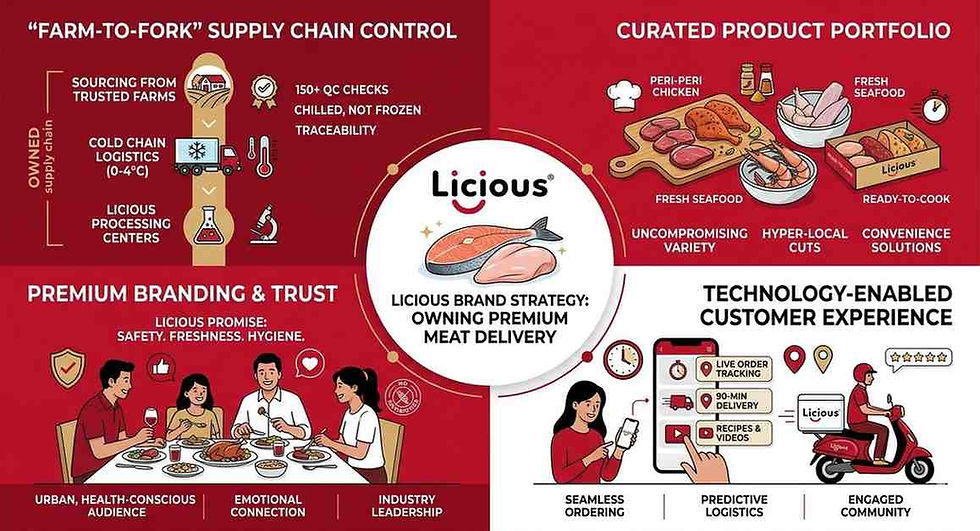
In the Licious model, the supply chain is not merely a backend operation — it is the brand's primary competitive moat and a central element of its consumer communication. This strategic choice deserves separate treatment because it represents a departure from conventional FMCG brand-building, where supply chain and marketing are treated as separate functions. Licious publicly claims that every product undergoes more than 150 quality and safety checks across sourcing and processing stages, as stated by co-founder Abhay Hanjura in documented interviews. The company maintains a cold chain that keeps meat at temperatures between 0°C and 4°C throughout the supply journey. It operates 90+ delivery centers across its operating cities and has confirmed that it does not outsource any core operations — sourcing, processing, delivery fleet, or customer service — to third parties. The company's processing facilities carry ISO certification, and its food safety compliance has been recognized through FSSC certification as documented in public brand communications. These credentials were surfaced in consumer-facing messaging, converting an operational investment into brand trust infrastructure. The decision to never freeze products — confirmed consistently in company statements as a founding principle — directly addressed the consumer concern about quality degradation in packaged meat. The "never frozen, always fresh" commitment was positioned as a structural guarantee rather than a marketing claim, and it was made credible by the vertically integrated cold chain that made it operationally possible. During the COVID-19 pandemic, when consumer hygiene sensitivity was elevated, this pre-existing infrastructure allowed Licious to amplify its trust positioning without substantive operational changes. As the founders stated in a documented company communication: "During the pandemic fuelled surge in online consumption, we focused on scaling supply and cold chains to unprecedented levels in India, which we have accomplished." The brand's 500 percent growth during the pandemic year was attributed in company statements to this trust advantage.
Media & Channel Strategy
Licious operates as a digital-native D2C brand. As of FY24, the company's own app accounted for 85 percent of its total business, serving approximately 1.2 million customers monthly, as confirmed in official company disclosures. This level of app-dependency is a deliberate channel strategy — not merely a distribution outcome — because it preserves direct consumer relationships, enables data collection, and supports the Infiniti loyalty program infrastructure. Digital advertising, influencer partnerships, and social media have been the primary media vehicles. The brand has tailor-made marketing approaches by city — recognizing that consumer profiles, cultural contexts, and competitive dynamics vary across Indian metros — as documented in third-party analyses of the company's marketing operations. The company also used quick commerce as a distribution channel, with quick commerce deliveries growing 35 percent year-on-year in FY24 according to company disclosures. However, when third-party distribution channels like Dunzo and Swiggy Meatstore shut down, the revenue impact was material — contributing to an 8 percent year-on-year revenue decline from Rs 746 crore in FY23 to Rs 685 crore in FY24. This episode demonstrated the risk of distribution dependency on third-party platforms and reinforced the company's subsequent strategic pivot toward owned-channel dominance. The company is now piloting its Flash 30-minute delivery service, which per documented media reports from November 2025 accounts for approximately half of monthly sales. This represents a direct response to the quick commerce threat from Zepto, Blinkit, and Swiggy Instamart, executed through an owned-channel model rather than platform dependency.
Business & Brand Outcomes
The following outcomes are drawn exclusively from officially confirmed company disclosures and credible media coverage:
Funding and valuation: Licious raised $52 million in its Series G round in October 2021, achieving a valuation exceeding $1 billion — making it India's first D2C unicorn in the fresh meat and seafood category. Total funding raised as of available records stands at approximately $490 million across 12 rounds, with investors including Temasek Holdings, Multiples PE, Vertex Ventures, 3one4 Capital, Mayfield India, and Bertelsmann India Investments.
Revenue trajectory: The company reported revenue of Rs 682.5 crore in FY22, Rs 746 crore in FY23, and Rs 685 crore in FY24. The FY24 decline of approximately 8 percent was attributed by the company to the closure of Dunzo and Swiggy Meatstore distribution channels and the deliberate deprioritization of modern trade and local stores. Platform-driven sales grew 5 percent year-on-year in FY24, and quick commerce deliveries grew 35 percent YoY.
Loss reduction: Net losses declined from Rs 524 crore in FY23 to Rs 293.77 crore in FY24 — a 44 percent reduction — as reported by the company's parent entity, Delightful Gourmet, in official filings. The company projected EBITDA breakeven by FY25. As of the first half of FY26, revenue grew 42 percent year-on-year to Rs 530 crore, with the company surpassing Rs 100 crore in monthly net revenue for the first time in November 2025, per documented media reports.
Loyalty program: The Infiniti program reached 200,000 weekly active subscribers as of FY24, contributing 58 percent of monthly revenues. By November 2025, this had grown to 3.2 lakh subscribers, with the program serving as the brand's primary retention engine.
Omnichannel expansion: Following the acquisition of Bengaluru-based offline retailer My Chicken and More (adding 23 stores), Licious expanded its physical retail footprint to 26 stores in late 2024. By late 2025, the company operated over 55 physical stores, with offline channels contributing approximately Rs 16 crore of the Rs 103 crore November 2025 monthly revenue. The company has announced a strategic target of 500 physical stores across approximately 20 cities over five years.
IPO plans: The company has publicly communicated IPO ambitions, with founders indicating at the ET Soonicorns Summit 2025 that listing has been deferred to 2027–28, prioritizing business fundamentals and profitability over premature market access.
Strategic Implications
Supply chain as competitive moat, not just efficiency driver. The Licious case demonstrates that in categories where trust is the primary purchase barrier, operational integrity is not a precondition for marketing — it is the marketing. The brand's most powerful communications were factual: 150+ quality checks, 0°–4°C cold chain, ISO-certified processing, never-frozen policy. The lesson for strategists is that in trust-deficient categories, brand equity is built bottom-up from operational credibility rather than top-down from advertising investment.
The D2C loyalty paradox. Licious's dependence on its own app (85% of business) and the Infiniti program (58% of revenue) is a strength when viewed as a retention architecture, but also a concentration risk. The FY24 revenue decline caused by the shutdown of third-party distribution channels revealed the fragility of any channel-dependent strategy, even when the primary channel is owned. The pivot to omnichannel is as much a risk management exercise as a growth strategy.
Category creation requires category investment. Licious did not simply launch a product — it launched a consumer behavior change program. Shifting urban Indians from local butchers to app-based premium meat delivery required changing habits, overcoming stigma, and demonstrating reliability over hundreds of purchase cycles. This is expensive and slow. The company's cumulative losses (~Rs 1,500 crore across FY22–FY24) reflect the cost of category creation, not operational mismanagement alone.
Premium positioning under quick commerce pressure. The emergence of Zepto Relish, which reportedly achieved an annual recurring revenue of Rs 150 crore within six months of launch in 2023, signaled that quick commerce platforms were willing to use the meat category as a convenience-led acquisition play. Licious's response — investing in its own Flash 30-minute delivery service rather than competing on convenience via third-party platforms — reflects a deliberate choice to defend premium positioning through owned experience rather than surrendering the category to convenience commoditization.
The omnichannel transition as brand equity amplification. Licious's offline store expansion is strategically coherent beyond unit economics. Physical stores in India's top metros serve as brand visibility assets in a category where consumer trial and sensory engagement remain important purchase drivers. The acquisition of My Chicken and More was not merely a store count exercise — it was an acceleration of physical brand presence in the company's home market, signaling to consumers and investors alike that Licious is building category infrastructure, not just a delivery app.
Discussion Questions
Vertical integration as brand strategy: Licious chose to own its entire supply chain rather than partner with third-party processors and logistics providers. Evaluate this choice through the lens of competitive advantage theory. Under what conditions does full vertical integration create durable brand differentiation versus becoming a capital and operational burden that limits scalability?
Category creation versus category entry: Licious effectively created a new category — branded, premium, app-delivered fresh meat — rather than entering an existing one. What are the marketing implications of this distinction? How should a brand allocate its communication budget when the primary challenge is consumer education and habit change rather than competitive differentiation?
The profitability-growth tension in D2C brands: Licious reported cumulative significant losses over FY22–FY24 while simultaneously achieving unicorn status. How should investors and brand strategists interpret losses in the context of category creation? At what point does loss-funded growth transition from a rational investment in market development to an unsustainable business model?
Loyalty programs as revenue architecture: The Infiniti program's contribution of 58 percent of monthly business revenue signals a fundamental shift in how Licious generates revenue — from transactional to subscription-led. What are the brand and operational implications of this revenue concentration? How should Licious manage the risk of over-dependence on a subscriber segment while continuing to attract new consumers?
Omnichannel in a perishable category: Licious's plan to build 500 physical stores represents a significant strategic and capital commitment for a brand that achieved scale as a digital-native D2C player. Evaluate the risks and opportunities of this omnichannel transition. How does physical retail change the brand's competitive dynamics with unorganized local butchers on one end and quick commerce platforms on the other?


Comments