LVMH's Portfolio Brand Strategy Across Luxury Categories: Building the World's Largest Luxury Conglomerate
Executive Summary
LVMH Moët Hennessy Louis Vuitton SE, commonly known as LVMH, represents the world's largest luxury goods conglomerate, operating a portfolio of over 75 prestigious brands across multiple categories including fashion and leather goods, wines and spirits, perfumes and cosmetics, watches and jewelry, and selective retailing. This case study examines LVMH's multi-brand portfolio strategy, the organizational architecture supporting diverse luxury brands, acquisition and integration approaches, and the strategic logic underlying the company's category diversification. The analysis relies exclusively on verified public information from company disclosures, regulatory filings, and credible media sources.
Company Background and Portfolio Structure
LVMH was formed in 1987 through the merger of fashion house Louis Vuitton with Moët Hennessy, a company formed earlier through the combination of champagne producer Moët & Chandon and cognac manufacturer Hennessy. According to the company's official corporate history published on its website, this merger created a new model for luxury conglomeration, bringing together brands from different product categories under unified ownership while maintaining individual brand identities.
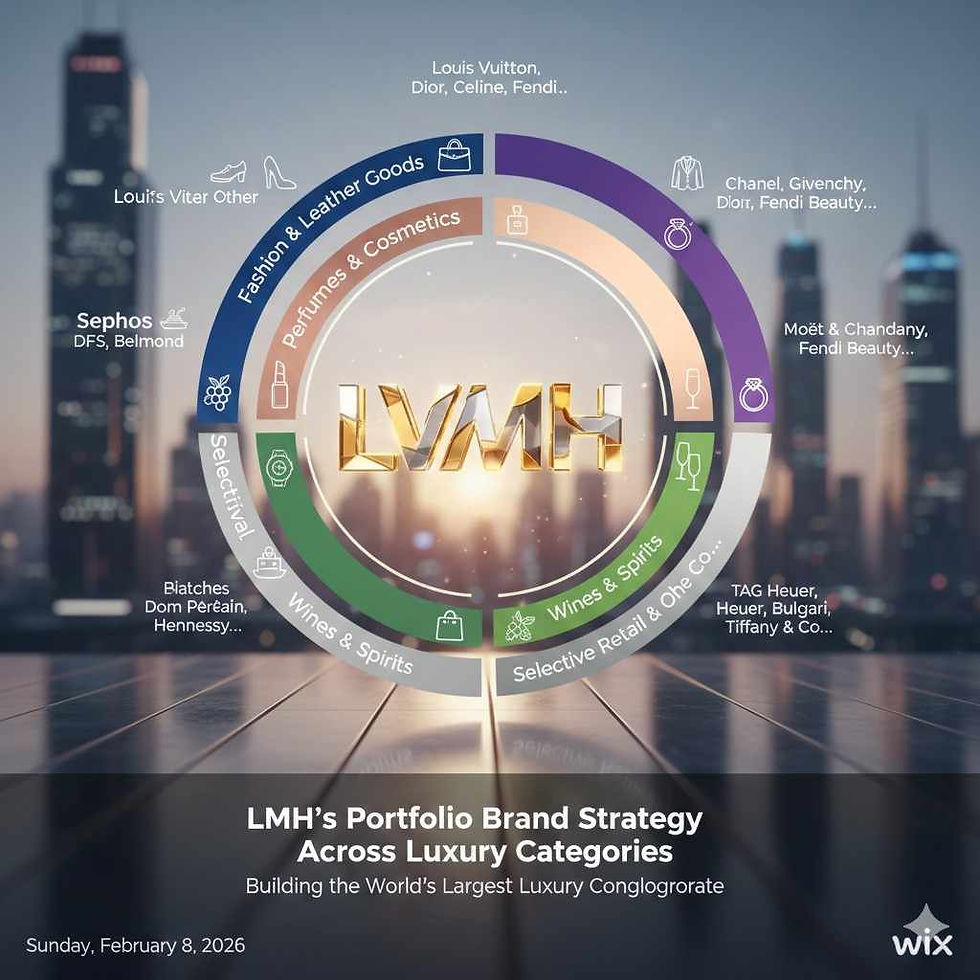
As of 2024, according to LVMH's official corporate information, the company operates over 75 brands organized into five principal business groups. The Wines & Spirits division includes brands such as Moët & Chandon, Dom Pérignon, Veuve Clicquot, Krug, Hennessy, and Château d'Yquem, among others. The Fashion & Leather Goods division encompasses Louis Vuitton, Christian Dior, Fendi, Celine, Givenchy, Loewe, Kenzo, Marc Jacobs, and others. The Perfumes & Cosmetics division includes brands such as Parfums Christian Dior, Guerlain, Givenchy Parfums, and Benefit Cosmetics. The Watches & Jewelry division comprises TAG Heuer, Bulgari, Hublot, Zenith, Tiffany & Co., and others. The Selective Retailing division includes Sephora, DFS (duty-free shops), and Le Bon Marché.
According to LVMH's 2023 annual report, the company operates approximately 5,600 stores worldwide and employs over 200,000 people across its various brands and operations. The geographic distribution spans Europe, the United States, Asia, and other international markets, with no single market representing overwhelming concentration.
Strategic Rationale for Portfolio Diversification
LVMH's multi-brand, multi-category portfolio strategy serves several strategic objectives documented in company communications and executive statements. According to interviews with Bernard Arnault, Chairman and CEO of LVMH, published in The Financial Times in September 2019, the portfolio approach provides resilience against category-specific downturns, geographic market fluctuations, and consumer trend shifts. Diversification across categories with different consumption drivers and purchase cycles creates stability not achievable through single-category focus.
The portfolio strategy enables resource sharing and capability leverage across brands while maintaining distinct brand identities. According to LVMH's annual reports from various years, the company provides shared services including retail real estate expertise, manufacturing capabilities, supply chain infrastructure, digital technology platforms, and talent development programs that benefit multiple brands. This infrastructure sharing creates scale economies unavailable to independent luxury brands.
Category diversification also addresses different consumer occasions, price points, and purchase frequencies. According to luxury industry analysis published in The Wall Street Journal in May 2021, LVMH's portfolio spans from frequently purchased products like cosmetics and wines to infrequent high-value purchases like jewelry and couture fashion. This span enables the company to engage consumers across multiple touchpoints and life stages, building relationships that extend beyond single-category interactions.
The portfolio structure facilitates strategic experimentation and learning transfer across brands. According to reporting in Bloomberg from March 2020, innovations in retail formats, digital commerce, customer experience, or sustainability practices developed at one LVMH brand can be adapted and applied across the portfolio. This knowledge sharing accelerates innovation adoption while reducing individual brand experimentation costs.
Acquisition Strategy and Brand Selection Criteria
LVMH has grown its portfolio substantially through acquisitions, adding established luxury brands rather than primarily building new ones organically. According to analysis in Reuters tracking LVMH's acquisition history from 1987-2023, major additions have included Christian Dior (1984, with full consolidation in 2017), Bulgari (2011), and Tiffany & Co. (2021), among dozens of smaller acquisitions across categories.
The Tiffany & Co. acquisition, completed in January 2021 for approximately $15.8 billion according to regulatory filings and media reporting, represented LVMH's largest transaction. According to coverage in The New York Times from November 2019 when the acquisition was announced, the deal provided LVMH with strengthened presence in jewelry, a category identified as strategic growth opportunity, and expanded reach in the United States market where Tiffany held strong brand recognition.
The Bulgari acquisition in 2011, reported extensively in The Financial Times and Bloomberg at the time, added Italian jewelry and watch expertise to LVMH's portfolio. According to company statements reported in these publications, Bulgari's heritage, craftsmanship reputation, and product design capabilities aligned with LVMH's luxury positioning while providing complementary geographic strength in Europe.
LVMH's acquisition criteria, as described in executive interviews published in various business publications including Harvard Business Review in 2001 and updated in subsequent media coverage, emphasize several factors. Target brands must possess authentic heritage and craftsmanship foundations, demonstrating quality and expertise that cannot be easily replicated. Brands should occupy distinctive positioning within their categories rather than being commoditized or lacking differentiation. Management teams should demonstrate commitment to brand values and long-term development rather than short-term profit maximization. Products should command premium pricing supported by genuine value creation rather than artificially inflated margins.
According to reporting in Bloomberg from June 2022, LVMH typically seeks brands with growth potential that can be realized through LVMH's resources, infrastructure, and expertise rather than acquiring mature brands operating at full potential. This acquisition philosophy targets brands where LVMH's capabilities can create substantial value beyond standalone performance.
Organizational Architecture and Brand Autonomy
LVMH employs a decentralized organizational structure granting substantial autonomy to individual brand management teams. According to the company's governance descriptions in annual reports and executive commentary published in The Financial Times from various years, brand presidents and creative directors maintain control over product design, brand communication, pricing strategies, and retail concepts. This decentralization contrasts with centralized conglomerate models where corporate headquarters dictates brand strategies.
The rationale for brand autonomy, as explained by Bernard Arnault in interviews published in multiple business publications including Fortune in 2014, recognizes that luxury brand success depends on creative vision, design excellence, and authentic brand expression that cannot be achieved through committee decision-making or corporate mandate. Individual brands must maintain distinct identities, aesthetic points of view, and cultural relevance that would be diluted under homogenized corporate direction.
Despite operational autonomy, LVMH provides centralized support functions that individual brands leverage. According to company descriptions in annual reports, corporate functions include talent recruitment and development, real estate acquisition and store construction, manufacturing facility operations for certain product categories, supply chain and logistics infrastructure, legal and regulatory compliance, and technology platform development. This shared services model allows brands to benefit from scale while maintaining creative independence.
The organizational structure also facilitates talent development and mobility across the portfolio. According to reporting in Women's Wear Daily from various years tracking executive appointments, LVMH frequently moves talented executives between brands, allowing individuals to gain experience across categories, learn different brand cultures, and develop broader luxury industry expertise. This internal talent marketplace strengthens organizational capability while maintaining brand-specific knowledge.
Creative Leadership and Talent Management
LVMH places significant emphasis on attracting and retaining exceptional creative talent across its brand portfolio. According to extensive media coverage in publications including Vogue Business, The New York Times, and The Financial Times tracking creative director appointments from 2010-2024, LVMH brands have employed many of the industry's most celebrated designers and creative leaders.
The appointment of prominent creative directors represents a key element of LVMH's brand revitalization strategy. According to reporting in The Business of Fashion from February 2021, bringing renowned creative talent to heritage brands can reinvigorate brand relevance, attract younger consumers, generate media attention, and drive product innovation. These appointments signal brand evolution while respecting heritage foundations.
LVMH's approach to creative leadership emphasizes long-term relationships rather than frequent turnover. According to analysis in The Financial Times from July 2020, several LVMH brands have maintained creative director relationships spanning decades, providing stability that enables cohesive brand development. This continuity contrasts with industry patterns of frequent creative director changes that can create brand identity confusion.
The company also invests in emerging creative talent through initiatives including the LVMH Prize for Young Fashion Designers, established in 2013 according to official program information. This competition identifies and supports emerging designers globally, creating talent pipelines for LVMH brands while contributing to broader fashion industry development. According to coverage in Vogue from various years, prize winners receive financial support and mentorship from LVMH executives.
Manufacturing and Craftsmanship Infrastructure
LVMH maintains substantial manufacturing capabilities across product categories, emphasizing in-house production for core luxury goods. According to the company's sustainability reports and annual filings, LVMH operates leather goods workshops in France, Spain, and the United States; watch manufacturing facilities in Switzerland; jewelry ateliers in Italy and France; and wine production estates in France and other regions. This vertical integration provides quality control, protects artisanal techniques, and maintains supply security.
The company's commitment to craftsmanship preservation extends to training programs for artisans. According to LVMH's corporate social responsibility reports, the company operates schools and apprenticeship programs teaching traditional techniques in leather working, watchmaking, jewelry making, and other crafts. These educational initiatives address skills shortages while ensuring traditional expertise continues to future generations. According to reporting in The Financial Times from November 2019, LVMH established Institut des Métiers d'Excellence (IME) to provide training across its craft specializations.
Manufacturing location represents a strategic consideration for LVMH brands, with production often concentrated in regions associated with specific craft expertise. According to company disclosures and media reporting, fashion and leather goods production occurs primarily in France, Italy, and Spain; watches are manufactured in Switzerland; jewelry production concentrates in Italy and France; while cosmetics manufacturing operates across multiple countries including France and the United States. This geographic distribution leverages regional craft traditions and "made in" origin associations valued by luxury consumers.
Retail Strategy and Distribution Control
LVMH emphasizes direct-to-consumer retail distribution through company-operated stores rather than wholesale channels. According to analysis in The Wall Street Journal from January 2022, this retail strategy provides control over brand presentation, customer experience, pricing, and data collection while capturing retail margins that would otherwise accrue to third-party retailers. The shift toward direct distribution has accelerated across luxury brands industry-wide, with LVMH pioneering this approach across its portfolio.
The company invests heavily in flagship store locations in major cities globally. According to retail real estate coverage in various publications including The New York Times and Bloomberg tracking store openings from 2015-2024, LVMH brands operate prominent flagships on avenues including the Champs-Élysées in Paris, Fifth Avenue in New York, Bond Street in London, and comparable locations in Shanghai, Tokyo, and other luxury retail centers. These flagship locations serve brand-building functions beyond sales generation, creating destination experiences and reinforcing luxury positioning.
Store design and customer experience receive significant investment and attention. According to retail design coverage in publications including Architectural Digest and Dezeen featuring LVMH brand stores, the company engages renowned architects and designers to create distinctive retail environments. These spaces often incorporate brand heritage elements, artistic collaborations, and innovative materials or technologies that differentiate luxury retail from conventional shopping experiences.
The Sephora retail concept, acquired by LVMH in 1997 according to company history, represents a different distribution model focused on multi-brand beauty retail. According to retail industry analysis published in Business of Fashion from September 2020, Sephora's open-sell format, extensive product assortment, and prestige-mass positioning differ from single-brand luxury boutiques, demonstrating LVMH's portfolio diversity in retail formats. Sephora operates over 2,600 stores globally according to company information, providing significant retail infrastructure for LVMH's cosmetics brands alongside competitor products.
Digital Transformation and E-Commerce Development
LVMH has invested substantially in digital capabilities across its brand portfolio, addressing the luxury industry's initially cautious approach to online commerce. According to the company's annual reports and digital strategy discussions in media coverage from The Financial Times and Bloomberg between 2015-2023, LVMH developed e-commerce platforms for individual brands, created shared technology infrastructure, and acquired digital-native brands to strengthen digital expertise.
The company's digital strategy emphasizes brand-specific online experiences rather than multi-brand e-commerce platforms for most categories. According to reporting in Vogue Business from May 2021, LVMH fashion and leather goods brands typically operate individual e-commerce sites reflecting distinct brand identities and aesthetic approaches. This brand-specific approach contrasts with multi-brand luxury e-tailers, allowing LVMH to control customer experience and data while maintaining brand differentiation.
LVMH acquired a majority stake in 24 Sèvres, a multi-brand luxury e-commerce platform, in 2017 according to reporting in Women's Wear Daily, though this operation remained separate from individual brand e-commerce efforts. According to subsequent reporting in The Business of Fashion from November 2020, the platform was discontinued, with LVMH focusing digital investment on brand-specific sites and marketplace partnerships rather than operating its own multi-brand platform.
The company has also invested in digital marketing capabilities, social media presence, and influencer collaborations. According to analysis in Business of Fashion from July 2022, LVMH brands maintain substantial social media followings and engage digital content creators to reach younger consumers. These digital marketing efforts complement traditional advertising in fashion publications, outdoor campaigns, and event sponsorships that historically dominated luxury brand communication.
Sustainability and Social Responsibility Initiatives
LVMH has developed environmental and social responsibility programs addressing sustainability concerns increasingly important to luxury consumers and stakeholders. According to the company's environmental reports published annually, LVMH established targets for carbon emissions reduction, sustainable material sourcing, circular economy initiatives, and biodiversity protection across its operations.
The LIFE 360 program, launched in 2021 according to LVMH's sustainability communications, sets objectives across four pillars: climate, biodiversity, circular economy, and transparency. According to the published program details, specific targets include reducing greenhouse gas emissions, sourcing materials from sustainable and traceable supply chains, incorporating recycled or bio-based materials into products, and providing environmental impact information to consumers. No verified public information is available on the achievement rate of specific targets or detailed implementation metrics.
LVMH's sustainability initiatives also address social dimensions including working conditions in supply chains, artisan skill preservation, and community engagement. According to the company's corporate social responsibility reports, programs include supplier auditing for labor standards compliance, partnerships with NGOs on environmental conservation, and support for local communities near production facilities. The Institut des Métiers d'Excellence mentioned earlier serves both skills development and social inclusion objectives according to program descriptions.
The luxury industry faces particular sustainability challenges given its emphasis on high-quality materials, complex supply chains, and product desirability that potentially conflicts with consumption reduction messages. According to analysis in The Business of Fashion from April 2021 examining luxury sustainability, LVMH and competitors navigate tensions between growth objectives and environmental impact reduction, product longevity claims versus fashion turnover, and luxury exclusivity versus transparency demands.
Geographic Expansion and Market Development
LVMH operates globally with significant presence across major luxury markets. According to the company's annual reports, key geographic regions include Europe, the United States, Asia (particularly China, Japan, and Southeast Asia), and other international markets. The company's geographic diversification provides resilience against regional economic fluctuations while enabling growth through emerging market development.
China represents a particularly strategic market for LVMH. According to extensive media coverage in The Wall Street Journal, Bloomberg, and The Financial Times tracking luxury market trends from 2010-2024, Chinese consumer demand has driven substantial growth for luxury brands including LVMH's portfolio. The company has invested in retail expansion across Chinese cities, brand communication tailored to Chinese consumers, and digital platforms including partnerships with local e-commerce and social media platforms. According to reporting in South China Morning Post from August 2020, LVMH brands have embraced Chinese social media platforms and digital payment systems to engage local consumers.
The COVID-19 pandemic significantly impacted LVMH's geographic dynamics, according to extensive reporting in business media from 2020-2022. International travel restrictions and retail closures affected sales particularly in tourism-dependent locations, while domestic consumption patterns shifted as cross-border shopping declined. According to analysis in The Financial Times from July 2021, luxury brands including LVMH's portfolio adapted through increased focus on local markets, enhanced digital capabilities, and adjusted inventory distribution.
Brand Portfolio Pruning and Divestment
While LVMH's portfolio has grown primarily through acquisitions, the company has also divested brands that no longer align with strategic priorities. According to media reporting tracking LVMH's corporate actions, the company has sold or discontinued various brands over its history, though such transactions receive less public attention than acquisitions.
The divestment of certain fashion brands including DKNY, Donna Karan, and other contemporary labels occurred in the 2010s according to reporting in Women's Wear Daily and other fashion trade publications. According to analysis accompanying these reports, LVMH focused its fashion portfolio on higher-positioned luxury brands rather than maintaining presence across all price segments. This portfolio concentration reflected strategic emphasis on brands with stronger luxury credentials and growth potential.
No verified public information is available on specific criteria LVMH employs for divestment decisions, internal performance thresholds triggering portfolio review, or the frequency of strategic portfolio evaluation processes. Company executives have not published detailed commentary on portfolio pruning methodologies in accessible sources.
Competitive Positioning and Industry Structure
LVMH competes with other luxury conglomerates including Kering (which owns Gucci, Saint Laurent, Bottega Veneta, and others) and Richemont (which owns Cartier, Van Cleef & Arpels, and various watch brands), as well as independent luxury brands. According to luxury industry analysis published by consultancy Bain & Company in annual luxury market studies, LVMH holds the largest market position among luxury conglomerates measured by presence across categories and brand portfolio breadth.
The competitive dynamics among luxury conglomerates involve talent acquisition, brand acquisition opportunities, retail real estate, and consumer attention. According to reporting in The Business of Fashion from various years covering competitive developments, luxury groups compete for renowned creative directors, strategic acquisition targets when heritage brands become available, premium retail locations in luxury shopping districts, and consumer mindshare particularly among younger demographics entering luxury consumption.
LVMH's scale provides competitive advantages in several dimensions. According to analysis in The Economist from September 2021, the company's size enables investment in digital infrastructure, manufacturing facilities, retail networks, and talent development at levels individual brands or smaller groups cannot match. This scale advantage may widen over time as digital transformation, sustainability requirements, and global expansion demands increase capital intensity.
Independent luxury brands face strategic decisions about whether to remain standalone or join conglomerate portfolios. According to reporting in The Financial Times from June 2023 analyzing luxury industry consolidation trends, independent brands benefit from full profit retention and strategic autonomy but may lack resources for geographic expansion, digital development, and sustainability investment that conglomerates provide. This dynamic has driven continued consolidation within the luxury sector.
Strategic Challenges and Evolving Dynamics
LVMH faces several strategic challenges as the luxury market evolves. Maintaining brand distinctiveness across an expanding portfolio requires vigilance to prevent homogenization or dilution of individual brand identities. According to analysis in The Business of Fashion from January 2023, luxury conglomerates must balance resource sharing and best practice transfer with preservation of authentic brand differences that drive consumer preference.
Generational shifts in luxury consumption present both opportunities and risks. According to luxury consumer research published by Bain & Company in 2022, younger consumers including Millennials and Generation Z represent growing luxury market share with different values, purchase behaviors, and brand relationships than previous generations. These consumers emphasize sustainability, digital engagement, and value alignment alongside traditional luxury attributes of quality and exclusivity. LVMH's ability to adapt brands to evolving consumer expectations while maintaining heritage positioning represents an ongoing strategic challenge.
The tension between luxury exclusivity and growth objectives creates inherent strategic paradox. According to academic analysis of luxury brand management published in business journals, luxury brands derive value partly from scarcity, selectivity, and limited accessibility. However, growth objectives require expanding customer bases and increasing sales volumes, potentially undermining exclusivity perceptions. Managing this balance across a diverse brand portfolio with different positioning levels and growth trajectories requires careful strategic calibration.
Digital transformation continues to evolve luxury brand models. According to technology and retail analysis in publications including Vogue Business and The Financial Times from 2023-2024, emerging technologies including artificial intelligence, virtual reality, and blockchain create new opportunities for customer engagement, product authentication, and business models. LVMH's approach to evaluating and adopting such technologies while maintaining luxury positioning represents an ongoing strategic consideration.
Conclusion
LVMH's multi-brand, multi-category portfolio strategy has established the company as the world's largest and most diversified luxury conglomerate. The strategic logic underlying this approach combines risk diversification across categories and geographies, resource sharing and capability leverage across brands, talent development through portfolio breadth, and acquisition-driven growth augmented by organic brand development.
The company's organizational architecture balances brand autonomy with corporate support, enabling individual brands to maintain distinct identities and creative visions while benefiting from shared infrastructure, expertise, and resources. This balance between decentralization and integration represents a defining characteristic of LVMH's management approach.
LVMH's success demonstrates how conglomerate models can create value in luxury sectors where brand heritage, creative excellence, and artisanal quality remain central to consumer appeal. The portfolio approach enables investment levels, geographic reach, and capability development that independent brands struggle to match, while decentralized operations preserve brand authenticity and creative vitality.
The company faces ongoing challenges including maintaining brand differentiation, adapting to generational consumer shifts, balancing exclusivity with growth, and navigating digital transformation. LVMH's continued evolution will reflect how luxury conglomerates address these challenges while sustaining the fundamental brand building and craft excellence that create luxury value.
Discussion Questions for MBA-Level Analysis
1. Portfolio Architecture and Strategic Coherence: Evaluate LVMH's decision to maintain brand diversification across five distinct business groups (wines & spirits, fashion & leather goods, perfumes & cosmetics, watches & jewelry, selective retailing) rather than concentrating in fewer categories. What are the strategic benefits and costs of this broad diversification compared to focused luxury conglomerate strategies like Kering's concentration in fashion? How do corporate capabilities and resources transfer across dissimilar luxury categories? Under what conditions does category diversification create value versus complexity and management distraction? What frameworks should guide portfolio scope decisions for luxury conglomerates?
2. Organizational Design Trade-offs: Analyze LVMH's decentralized organizational structure granting substantial autonomy to brand presidents and creative directors versus centralized functions providing shared services. What are the advantages and disadvantages of this hybrid approach? How can organizations maintain authentic brand identities and creative excellence while capturing scale economies and sharing best practices? What governance mechanisms should balance brand independence with portfolio-level coordination? How might optimal organizational structures differ across luxury categories with varying requirements for creative vision versus operational standardization?
3. Acquisition Integration and Value Creation: Examine LVMH's acquisition strategy, particularly major transactions including Bulgari and Tiffany & Co. How should luxury conglomerates evaluate acquisition targets to ensure strategic fit and value creation potential? What integration approaches preserve acquired brand heritage and autonomy while enabling parent company resources to strengthen performance? What metrics should measure post-acquisition success in luxury contexts where brand equity, creative reputation, and long-term positioning may matter more than short-term performance? How can acquirers avoid over-integration that destroys the brand qualities that justified acquisition?
4. Exclusivity-Growth Paradox Management: Analyze the inherent tension between luxury brands' dependence on exclusivity, scarcity, and selectivity versus LVMH's growth objectives requiring expanded customer bases and increased volumes. How should luxury brand managers navigate this paradox across brands positioned at different luxury tiers? What strategies can enable growth while preserving exclusivity perceptions? How might approaches differ between ultra-luxury brands like Louis Vuitton versus more accessible luxury categories like cosmetics? What role should brand architecture, product tiering, limited editions, and distribution control play in managing this balance?
5. Digital Transformation in Luxury Contexts: Evaluate LVMH's approach to digital commerce and marketing, including brand-specific e-commerce sites, social media engagement, and emerging technology experimentation. How should luxury brands adapt to digital channels while maintaining premium positioning and experiential retail value? What are the risks and opportunities of marketplace partnerships versus brand-controlled digital channels? How can luxury brands leverage social media and influencer marketing without diluting exclusivity or cheapening brand associations? What principles should guide luxury brands' evaluation of emerging technologies including virtual reality, NFTs, or artificial intelligence applications?


Comments