Meesho: Building a Brand on the Backs of Resellers
Industry & Competitive Context
When Meesho was founded in December 2015, India's e-commerce sector was structurally divided between two capital-intensive horizontal marketplaces — Flipkart and Amazon India — both optimising for a narrow demographic: urban, English-proficient, credit-card-holding consumers concentrated in India's top eight metropolitan centres. Their acquisition logic was conventional, their categories dominated by electronics and branded fashion, and their fulfilment infrastructure anchored in large metros. The competitive playbook was defined by discounting, marketing spend, and warehousing density. What this duopoly systematically missed was a structural fact: over 70 percent of India's population lived outside its eight largest cities, according to publicly available census data. This mass of first-time internet users — concentrated in smaller towns across Uttar Pradesh, Rajasthan, Madhya Pradesh, and West Bengal — was entering digital life not through personal computers but through low-cost smartphones, often via sub-₹200 prepaid data plans activated by the Jio network rollout from 2016 onwards. These consumers had appetite for commerce but faced three compounding barriers: unfamiliarity with digital payments, distrust of buying from unknown sellers, and limited English-language digital interfaces. The social commerce category that Meesho would come to define was at this point nascent, with no dominant player and no proven playbook for the Indian market. The competitive landscape included hyperlocal and B2B platforms experimenting with similar concepts — Glow Road, Shop101, Deal Share — but none had yet achieved scale or category definition. This white space was the strategic entry point that Meesho's brand architecture was specifically engineered to occupy.
Brand Situation Prior to Pivot
Meesho did not begin as the company it became. Its founding entity, Fashnear Technologies Private Limited, launched in December 2015 as a hyperlocal fashion discovery application — described by its founders as a "Swiggy for fashion." The model attempted to connect nearby boutique shops with local buyers through an on-demand delivery interface. Founders Vidit Aatrey and Sanjeev Barnwal, both IIT Delhi engineering graduates, built the initial product themselves, cataloguing local shop inventories and handling deliveries personally in the early weeks. The hyperlocal model failed to scale for a structurally sound reason: fashion buyers were not geographically constrained, and boutique owners wanted city-wide or national reach, not proximity-limited audiences. The unit economics were unsustainable, and customer acquisition costs for the approach were prohibitively high. The company lacked a defensible brand position and faced a product-market fit problem that minor iteration could not resolve. The pivot was triggered by a behavioural observation, not a desk-based strategic exercise. While interviewing boutique owners and small sellers during the Fashnear phase, the founding team noticed that a significant portion of their most active users were women — homemakers in Tier 2 and Tier 3 cities — who were already selling products within their social circles via WhatsApp and Facebook, without any formal platform infrastructure. They were informal resellers, running commerce through personal relationships and trust networks. This observation prompted the founders to reframe their core proposition: instead of digitising a boutique for local discovery, why not build a platform specifically for these existing social resellers, giving them catalogue access, logistics, and payment infrastructure? The company was renamed Meesho — derived from "Meri Shop" (My Shop) — and relaunched as a social commerce platform enabling resellers to sell products from supplier catalogues through WhatsApp, Facebook, and Instagram, with Meesho handling fulfilment and payment. In July 2016, the company was selected by Y Combinator for its summer programme — one of only three Indian companies accepted that year — lending the revised model its first significant external validation.
Strategic Objective
Meesho's articulated strategic objective — consistently repeated across investor communications and press statements — was to democratise internet commerce for India's underserved majority. According to the company's Y Combinator profile, the stated mission was to "enable 100 million small businesses, including individual entrepreneurs, to succeed online." The commercial logic embedded in this mission was specific: Meesho was not targeting the same consumer as Flipkart or Amazon. It was targeting the first-time internet user in a smaller city who had never made an e-commerce transaction, using a person they trusted — a neighbour, friend, or family member — as the mechanism of introduction. The reseller was not incidental to this strategy. The reseller was the strategy. Meesho's brand proposition to the end consumer was not "buy products online." It was "buy products from someone you know, who happens to use Meesho." This meant Meesho's brand awareness — at least in the early phase — was built not through traditional media but through the personal credibility of millions of individual resellers operating within their social networks. The platform's brand equity was, in a structural sense, the sum of the trust equity that each reseller held within their own community. "We are focused on expanding our vision — from helping aspiring women entrepreneurs to creating Meesho as a single ecosystem that will enable all small businesses in India to succeed online."
Campaign Architecture & Execution
Meesho's brand architecture differed from conventional e-commerce in that it operated through two distinct, simultaneous brand relationships: one with resellers (B2R — business to reseller) and one with the end consumers reached through those resellers (B2C via reseller). The marketing infrastructure was built first on the reseller side, because reseller acquisition was the mechanism by which consumer reach scaled without proportional media spend.
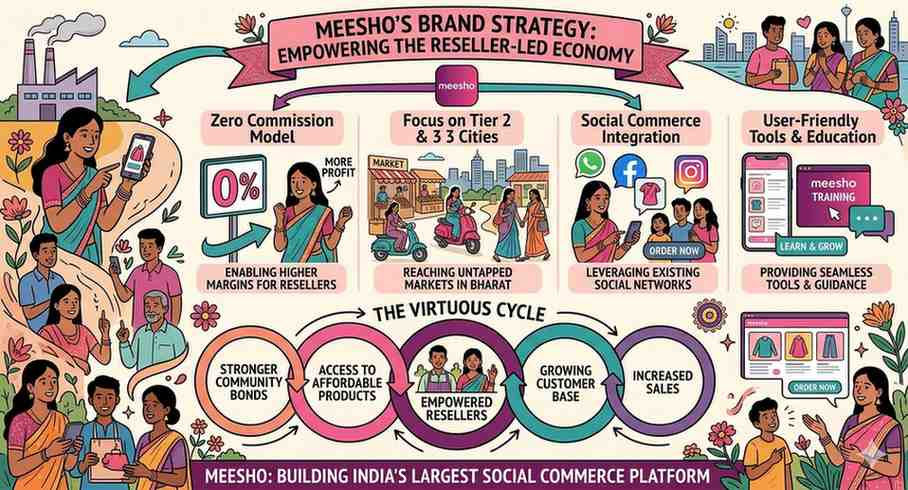
Reseller onboarding as brand-building: Meesho invested heavily in training resellers — primarily women with limited prior digital or business experience — through educational content about product presentation, margin-setting, and handling customer queries. This was a form of brand investment that simultaneously served an operational purpose. A well-trained reseller sold more effectively and reflected positively on Meesho's platform reputation. According to Y Combinator's published company profile, Meesho onboarded approximately 16 million entrepreneurs on the platform, of which over 10 million were women.
Zero-commission model as a brand signal: One of the most consequential brand strategy decisions was Meesho's elimination of seller commissions across all product categories — making it the first Indian e-commerce platform to do so. This was reported by credible tech and business outlets in 2021. The zero-commission policy was not merely a commercial price strategy; it functioned as a brand statement about whose side Meesho was on. For small sellers and micro-entrepreneurs competing against large brands on Amazon and Flipkart, Meesho's model removed the single most cited barrier to entry: the platform tax. By monetising primarily through advertising and logistics services rather than transaction commissions, Meesho structurally aligned its revenue model with seller growth rather than seller extraction.
Product and interface design as brand execution: Meesho's application was built for users who may have been accessing the internet on a 2G or 3G connection, on a low-memory Android device, in a language other than English. Vernacular language support and a simplified interface were not accessibility features added later — they were foundational brand decisions about who the intended user was. The platform's product positioning on "everyday low prices" across unbranded and regional-brand merchandise reinforced the same message: Meesho was built for a user whose average order value was a fraction of what Flipkart or Amazon optimised for.
Creator marketplace as brand evolution: According to IPO-related reporting, Meesho subsequently launched a Creator Marketplace connecting sellers with influencers and content creators, reaching 14.5 million users and engaging approximately 21,000 influencers, with a reported 3x platform-order growth in associated categories. This represented a brand evolution from pure reseller-led commerce toward content-driven commerce — an adjacent model that retained the platform's commitment to trust-mediated purchase behaviour while scaling the reach of individual resellers through video-based discovery formats.
Positioning & Consumer Insight
Meesho's positioning was built on a consumer insight that larger e-commerce incumbents had not operationalised: in trust-deficit markets where first-time digital buyers are unfamiliar with remote sellers, and where fraud anxiety is high, the most powerful conversion mechanism is a known intermediary. The reseller was simultaneously the product evangelist, the guarantor of quality, the post-sale customer service agent, and the financial facilitator. Amazon and Flipkart built algorithmic trust through ratings, return policies, and brand recognition. Meesho built social trust through human networks. The secondary consumer insight was economic. Target users in Tier 2 and Tier 3 cities were price-sensitive in ways that differed from metro consumers choosing between two comparable branded products. For a significant portion of Meesho's user base, the relevant comparison was not online versus offline at a similar price — it was online at a meaningfully lower price than the local market, enabled by access to supply chains they had previously been unable to reach. The platform's focus on unbranded and regionally manufactured goods — particularly from textile hubs like Surat and Tirupur — meant that Meesho was not simply creating a digital front-end for existing commerce. It was extending the geographic reach of manufacturers who had previously been unable to access national consumer markets. More than 80 percent of Meesho's resellers were reportedly women, and a significant portion had no offline shop or prior business experience. This demographic insight shaped every element of the brand's tone, product design, and support infrastructure. Meesho's positioning was not gender-neutral by accident: the brand specifically targeted financial empowerment for homemakers and women in semi-urban and rural contexts as both a commercial strategy and a reputational asset — and this positioning attracted international attention, contributing to Facebook's decision to invest in the company in August 2019, marking the first equity investment made by Facebook in an Indian startup, as reported by Business Standard and other credible outlets.
Media & Channel Strategy
Meesho's primary distribution channel for brand building in its formative phase was the reseller network itself — making it one of the few e-commerce platforms in India whose initial brand awareness grew substantially outside of paid media. Resellers shared product catalogues on WhatsApp broadcast lists, Facebook groups, and Instagram stories, using Meesho's app to generate shareable product images and payment links. This created a form of ambient brand exposure that was contextualised within personal relationships rather than advertising inventory. WhatsApp was structurally central to this approach. Because Meesho integrated directly with WhatsApp's sharing functionality, each reseller's personal WhatsApp network became a broadcast channel for the Meesho catalogue. This approach required no advertising spend per impression: it was powered by reseller motivation to earn commissions on sales, making it one of the most cost-efficient customer acquisition models in Indian e-commerce at the time. As Meesho matured and the platform transitioned toward direct consumer sales (with direct consumer purchases reportedly accounting for approximately 80 percent of business by the time of its Y Combinator profile update), the company expanded into performance marketing and digital advertising to support this B2C growth. However, verified details of specific advertising campaigns, media planning, or above-the-line spends during the primary reseller phase are not comprehensively documented in public sources.
Business & Brand Outcomes
The outcomes attributable to Meesho's reseller-led brand strategy are documented across multiple credible sources, including the company's IPO prospectus (Red Herring Prospectus filed in 2025), investor press releases, and recognised industry reports referenced within official IPO documentation. The funding trajectory documents investor conviction in the reseller-led brand premise at successive stages. Facebook's August 2019 equity investment at a $700 million valuation was notable not only for its size but for the institutional signal it carried: the world's largest social network was validating a model explicitly built on social-network-mediated commerce. By April 2021, SoftBank Vision Fund 2 led a $300 million Series E round that valued Meesho at $2.1 billion — its unicorn milestone. A subsequent $570 million Series F round in September 2021 pushed the valuation to $4.9 billion, according to reporting in Entrackr and Medianama, publications that cover Indian startup funding in detail. Total funding raised exceeded $1.36 billion across multiple rounds, including early backing from Elevation Capital, Y Combinator, and Sequoia. Brand recognition milestones further corroborate the strategy's trajectory. In 2020, Meesho was ranked 14th on Fast Company's list of 50 Most Innovative Companies worldwide — a significant acknowledgement for an Indian social commerce platform at that stage of development. In 2023, TIME magazine named Meesho one of the most influential companies of the year. In the same year, Meesho became the fastest shopping app in history to cross 500 million downloads, according to media reports citing company announcements. At the time of its December 2025 IPO, Meesho had achieved category leadership by order volume: according to a Redseer Report cited in the IPO filing, it had emerged as India's largest e-commerce platform by number of placed orders and annual transacting users in the twelve months ended June 30, 2025. The IPO attracted approximately 81.76x total subscription, with Qualified Institutional Buyers subscribing at approximately 123.34x and retail investors at approximately 19.89x — reflecting strong cross-segment market confidence. In terms of category market share, the IPO filing references a Redseer Report attributing to Meesho a 21–23% GMV share in Fashion, 23–25% in Home, Kitchen and Furnishing, and 8–10% in Beauty and Personal Care — categories that align directly with the product types most commonly sold through the reseller network. The platform's cost-to-enable-sales for sellers is reported as 35–61% lower than the industry average, according to the same Redseer Report cited in the IPO filing. It is important to note that Meesho remained loss-making at the time of IPO. FY25 total income grew approximately 26% year-on-year, and the company generated positive operating cash flow of ₹539.4 crore — a significant operational milestone. However, FY25 reported losses were materially affected by one-time ESOP-related exceptional items and tax effects from the corporate reorganisation process, as disclosed in the IPO prospectus. The company's path to net profitability was not achieved within the period covered by this case study.
Strategic Implications
Meesho's reseller-led brand strategy offers several analytically distinct insights for students of marketing and competitive strategy. The first concerns the relationship between distribution architecture and brand equity. Conventional brand theory locates equity in the company's direct relationship with its end consumer — shaped by advertising, product experience, and reputation management. Meesho demonstrated a third-party equity model in which brand trust was mediated through resellers and accumulated indirectly. This is structurally closer to franchise brand models than to traditional e-commerce brand models, and it created both advantages and risks: the speed of trust-building through personal networks was faster than mass advertising could achieve in the same demographic, but brand quality control was dependent on the behaviour of millions of independent resellers whom Meesho could incentivise but not directly manage. The second implication concerns platform business model design. Meesho's zero-commission policy, which eliminated the most common monetisation mechanism in marketplace businesses, was a brand strategy as much as a commercial one. By treating commission-free access as a foundational commitment rather than a promotional tactic, Meesho established a durable positioning differentiator against Amazon and Flipkart that was structurally difficult to replicate without disrupting their existing revenue models. This is an illustration of how pricing decisions in platform businesses can function as strategic brand commitments that reshape competitive dynamics. The third implication is geographic. Meesho's deliberate focus on Tier 2 and Tier 3 cities was not a market of last resort — it was a strategic beachhead in a consumer segment that India's largest e-commerce players had systematically underserved. The Redseer Report cited in the IPO filing noted that Tier 2+ consumers are projected to account for 51–52% of India's e-commerce market by FY30. By the time competitors recognised this demographic's commercial significance, Meesho had already established deep penetration through reseller networks, vernacular interfaces, and a low-average-order-value product mix that larger platforms could not profitably serve at equivalent scale. Finally, the case raises an enduring strategic tension: Meesho's brand was built on the reseller. Its growth beyond a certain threshold required moving toward direct consumer sales — a structural shift that the company publicly acknowledged when noting that direct consumer purchases represented approximately 80 percent of its business by the time of its Y Combinator profile update. This evolution required repositioning the brand from a reseller-empowerment platform to a mass-market consumer marketplace — a category in which it competes far more directly with Flipkart and Amazon. Whether Meesho can preserve the trust-driven, inclusion-oriented brand identity that differentiated its reseller phase while competing on scale and assortment against established horizontal marketplaces represents the central unresolved strategic question of its next chapter.
Discussion Questions
1
Meesho's brand equity in its early phase was derived primarily from the trust capital of individual resellers, not from company-controlled marketing. What are the structural risks and advantages of a brand architecture that is mediated through a third-party human network rather than built through direct consumer communication? Under what conditions does this model scale sustainably versus become a liability?
2
Meesho's zero-commission policy for sellers functions simultaneously as a pricing decision, a competitive weapon, and a brand signal. Evaluate the strategic coherence of using a price-based mechanism to communicate brand values. What are the long-term risks of anchoring brand differentiation on an economic concession rather than a product or experience advantage?
3
Meesho successfully positioned the "reseller" as a hero — a micro-entrepreneur deserving of a platform — at a time when conventional e-commerce positioned the "shopper" as the primary stakeholder. How does this stakeholder inversion affect product design, marketing strategy, and long-term brand loyalty? What are the implications of this positioning as the company transitions toward a predominantly direct-to-consumer model?
4
Meesho's geographic focus on Tier 2 and Tier 3 cities was a deliberate strategic choice at a time when competitors prioritised metropolitan density. Analyse this as a market segmentation decision: what criteria — demographic, psychographic, behavioural — defined Meesho's target segment, and how did this segmentation drive brand architecture decisions that would have been incompatible with a metro-first strategy?
5
Meesho went public in December 2025 while still recording net losses, with FY25 losses materially affected by one-time ESOP and reorganisation charges. As a publicly listed company competing in a market where Flipkart and Amazon can absorb losses indefinitely, how should Meesho's brand strategy evolve to support its path to profitability without abandoning the affordability and inclusion positioning that drove its growth? Is there an inherent contradiction between value-market brand positioning and the financial expectations of public shareholders?


Comments