Nykaa’s Inventory-Led vs Marketplace Hybrid Model
Industry & Competitive Context
India’s beauty and personal care (BPC) market has experienced sustained growth, supported by rising disposable incomes, increasing digital adoption, and evolving consumer preferences toward branded and premium products. The online BPC segment, in particular, has expanded rapidly, with e-commerce platforms playing a critical role in product discovery, education, and distribution.
The broader Indian e-commerce ecosystem has historically been dominated by marketplace-led models, where platforms connect third-party sellers with consumers without owning inventory. This approach enables scale and assortment but often introduces challenges related to product authenticity, quality control, and pricing inconsistencies.
In contrast, inventory-led models involve direct procurement and sale of products by the platform, allowing tighter control over sourcing, storage, and pricing. However, this model requires higher working capital investment and operational complexity.
Within this landscape, Nykaa emerged as a differentiated player by adopting a hybrid model that combines inventory-led operations with a selective marketplace component. This approach has been publicly documented in the company’s filings and investor communications, particularly around its initial public offering.
Brand Situation Prior to Campaign
Nykaa was founded in 2012 as a digital-first beauty retailer with a focus on authenticity, curation, and premium brand experience. Unlike many early e-commerce platforms in India that prioritized scale and discounting, Nykaa positioned itself as a destination for genuine products and curated assortments.
Publicly available information confirms that Nykaa initially adopted an inventory-led model, sourcing products directly from brands and authorized distributors. This enabled the company to address a critical market gap: concerns around counterfeit or expired beauty products in online channels.
At the time of its early growth, consumer trust in online beauty purchases was still developing. Reports and media coverage highlighted that authenticity and product quality were key barriers to adoption in the category.
Nykaa’s initial brand positioning was therefore closely tied to trust, authenticity, and a premium shopping experience rather than price-led competition.
Strategic Objective
Nykaa’s transition toward a hybrid model—combining inventory-led and marketplace elements—was driven by the need to balance control with scale.
The company’s strategic objectives, as reflected in its public disclosures, included:
Maintaining control over product authenticity and customer experience through inventory-led operations
Expanding assortment and category breadth through marketplace partnerships
Scaling efficiently without proportionally increasing working capital requirements
Strengthening relationships with both established brands and emerging sellers
This dual approach allowed Nykaa to retain its core brand promise while adapting to the demands of a growing and increasingly competitive market.
Campaign Architecture & Execution
Nykaa’s hybrid model was implemented as a structural business strategy rather than a standalone marketing campaign. Its execution is documented through company filings, investor presentations, and credible media coverage.
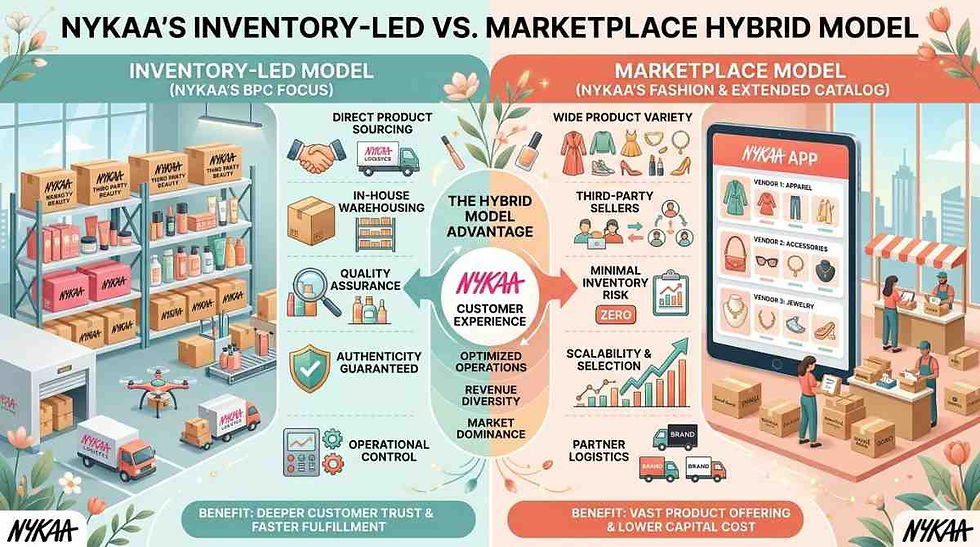
Under the inventory-led component, Nykaa procures products directly from brands and manages warehousing, inventory, and fulfillment. This enables the company to ensure product authenticity, control storage conditions, and maintain pricing discipline.
The marketplace component allows third-party sellers to list products on the platform, expanding assortment and enabling the inclusion of niche, emerging, and long-tail brands. Public disclosures indicate that Nykaa exercises selective control over marketplace participation to maintain quality standards.
Additionally, Nykaa has invested in private-label brands and exclusive partnerships, which are typically supported through its inventory-led operations.
The integration of both models is reflected in the platform’s user interface, where consumers experience a unified shopping journey regardless of the underlying supply model.
No verified public information is available on detailed internal processes governing the allocation between inventory-led and marketplace operations at a granular level.
Positioning & Consumer Insight
Nykaa’s hybrid model is anchored in a clear consumer insight: trust and authenticity are critical decision drivers in beauty and personal care purchases, particularly in online environments.
Industry analyses and company disclosures consistently highlight that consumers in this category seek assurance regarding product origin, quality, and safety. This is especially important for skincare and cosmetics, where product misuse or counterfeits can have direct personal consequences.
The inventory-led component directly addresses this need by enabling Nykaa to guarantee authenticity. At the same time, the marketplace component caters to the growing demand for variety, discovery, and access to niche brands.
Nykaa’s positioning therefore integrates two complementary value propositions:
Trust and authenticity through controlled sourcing
Variety and discovery through expanded assortment
This dual positioning allows the company to serve both first-time online buyers seeking reassurance and experienced consumers looking for choice.
Media & Channel Strategy
Nykaa operates as a digital-first platform, with its mobile app and website serving as primary transaction and engagement channels. Publicly available information confirms that the company leverages:
Digital marketing across online platforms
Content-driven engagement, including tutorials and product education
App-based notifications and personalized recommendations
Nykaa is also known for integrating commerce with content, offering editorial and video-based content to support product discovery. This approach has been widely reported in credible media coverage.
In addition to digital channels, Nykaa has expanded into offline retail through physical stores, creating an omnichannel presence. This development has been documented in company filings and public disclosures.
No verified public information is available on specific media budgets, channel allocation percentages, or campaign-level performance metrics.
Business & Brand Outcomes
Nykaa’s hybrid model has been associated with several publicly documented outcomes:
The company launched a successful initial public offering (IPO) in 2021, with significant investor interest, as widely reported by credible financial media.
Nykaa has been consistently described in public disclosures as a leading player in India’s online beauty and personal care segment.
The company has expanded its portfolio to include private-label brands and offline retail stores, indicating diversification and scale.
Investor communications highlight the contribution of both inventory-led and marketplace models to overall operations.
Nykaa’s financial filings provide detailed revenue and operational data; however, specific performance comparisons between inventory-led and marketplace segments are not fully disaggregated in publicly available summaries.
No verified public information is available on marketing-specific metrics such as customer acquisition cost, lifetime value, or conversion rates.
Strategic Implications
Nykaa’s hybrid model offers several strategic insights for platform-based businesses:
1. Balancing Control and ScalabilityThe combination of inventory-led and marketplace models allows Nykaa to maintain control over critical aspects such as authenticity while scaling assortment through third-party participation.
2. Category-Specific Strategy DesignNykaa’s approach reflects the unique characteristics of the beauty category, where trust and product integrity are paramount. This suggests that platform models must be tailored to category-specific consumer concerns.
3. Trust as a Differentiator in Digital CommerceBy prioritizing authenticity through its inventory-led operations, Nykaa established a strong foundation of trust, which supports long-term brand equity.
4. Hybrid Models as a Strategic EvolutionNykaa’s transition illustrates how companies can evolve beyond binary choices (inventory vs marketplace) to adopt blended models that capture the advantages of both.
5. Integration of Commerce and ContentThe company’s emphasis on content-driven engagement complements its hybrid model by enhancing product discovery and consumer confidence.
Conclusion
Nykaa’s inventory-led versus marketplace hybrid model represents a strategic response to the dual imperatives of trust and scale in India’s online beauty market. By combining controlled sourcing with expanded assortment, the company has positioned itself as both a reliable and comprehensive destination for beauty products.
Publicly available information confirms that this approach has supported Nykaa’s growth, market positioning, and investor confidence. While detailed segment-level metrics remain limited, the company’s trajectory underscores the effectiveness of aligning business model design with category-specific consumer insights.
MBA Discussion Questions
How does Nykaa’s hybrid model address the trade-offs between control and scalability in e-commerce?
In what ways does category context influence the choice between inventory-led and marketplace models?
Can Nykaa’s approach be replicated in other categories, or is it uniquely suited to beauty and personal care?
How does trust function as a competitive advantage in digital commerce, and how can it be operationalized?
What risks might arise from managing both inventory-led and marketplace operations simultaneously?


Comments