The Modern Consumer Decision Journey in the Digital Era
Industry & Competitive Context
The global digital advertising market crossed $600 billion in 2023, according to GroupM's annual report, reflecting the scale at which brands compete for consumer attention across fragmented digital environments. In India, the Internet and Mobile Association of India (IAMAI) reported over 900 million internet users as of 2023, with a significant share accessing digital content primarily through mobile devices. This mass digitalisation has fundamentally altered competitive dynamics: brands no longer compete solely on product attributes or distribution reach — they compete on relevance, visibility, and trust across multiple simultaneous touchpoints.
McKinsey & Company, in its foundational research on the Consumer Decision Journey (CDJ), first published in the Harvard Business Review in 2009 and subsequently updated, identified a decisive shift: consumers were no longer moving through a predictable funnel but through a dynamic, circular journey in which the post-purchase experience looped back into the consideration phase for future buyers. This insight, now over a decade old, has only deepened in significance as search behaviour, social media influence, and content consumption have restructured how decisions are made.
Google's own research introduced the concept of the Zero Moment of Truth (ZMOT) in 2011, documenting that consumers conduct extensive research before ever engaging with a brand's owned channels. A subsequent Google study found that the average consumer consults multiple sources in the days before a purchase decision. The ZMOT framework illustrated that the battle for consumer preference was being won or lost before a salesperson, an ad, or a store shelf ever entered the picture.
By the early 2020s, the environment had grown significantly more complex. The rise of short-form video (Instagram Reels, YouTube Shorts, TikTok), the explosion of creator-led content, the proliferation of review ecosystems (Google Reviews, Amazon ratings, Zomato, MakeMyTrip), and the maturation of D2C commerce had created what McKinsey described in 2022 as a "consumer decision loop" — a non-linear, multi-entry-point ecosystem where influence, intent, and purchase could occur in any sequence.

The Traditional Model and Its Limitations
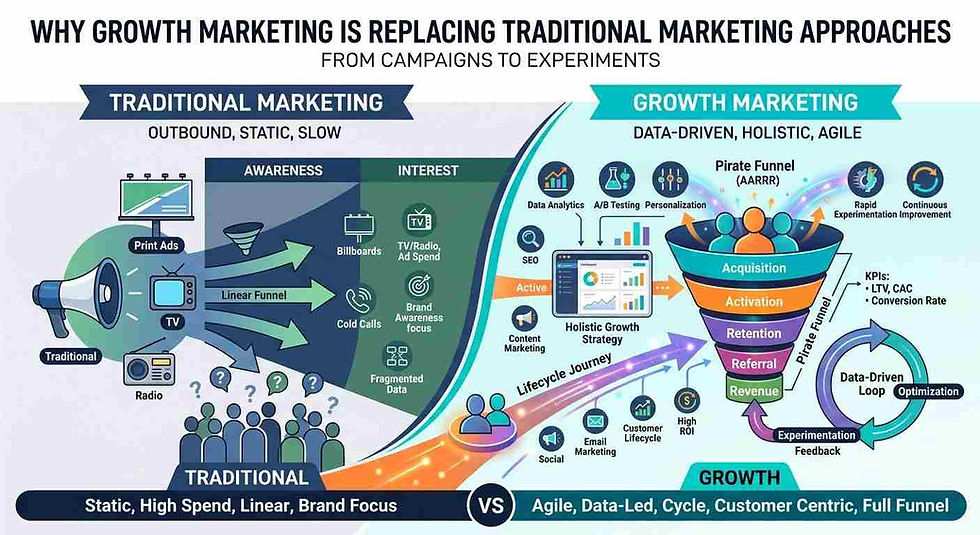
The classical purchase funnel — awareness, interest, desire, action (AIDA) — was designed for a media environment dominated by broadcast channels. Television, print, and radio allowed brands to control narrative and push consumers through a structured sequence. The model assumed a largely passive consumer who received brand messages and responded predictably.
This model broke down under three structural pressures. First, consumers gained access to peer-generated information at scale — through forums, review sites, and eventually social media — which meant brand narratives were no longer the dominant input at the consideration stage. Second, the cost of switching attention dropped to near-zero in a mobile-first environment, meaning the window in which a brand had a consumer's undivided attention collapsed from minutes to seconds. Third, the proliferation of touchpoints meant that a consumer's path to purchase could begin on a YouTube video, continue on a comparison website, be interrupted by a competitor's sponsored post, and eventually complete on a marketplace or brand website — with no single channel owning the journey.
The Boston Consulting Group, in its research on digital marketing maturity, has consistently noted that organisations still structured around funnel-stage metrics — reach, frequency, click-through — are misaligned with the actual decision behaviour of modern consumers. The strategic implication is clear: marketing investment and organisational design must account for a journey that is networked, not linear.
Strategic Framework: The Messy Middle
In 2020, Google published a landmark research report titled "Decoding Decisions: Making Sense of the Messy Middle." Based on a large-scale behavioural study conducted in partnership with The Behavioural Architects, the research introduced the concept of the "Messy Middle" to describe the exploration and evaluation loop that sits between a consumer's initial trigger and their final purchase decision.
The research documented two primary cognitive modes operating in this space: exploration, which is expansive and open-ended, and evaluation, which is reductive and focused on narrowing options. Consumers were found to cycle repeatedly between these two modes, influenced by six documented cognitive biases — category heuristics, the power of now, social proof, scarcity bias, authority bias, and the power of free. Critically, Google's research found that a simulated brand — one with no prior awareness — could capture significant purchase share simply by optimising its presence and signals across the Messy Middle, even against established market leaders.
This finding has profound strategic implications. It suggests that brand equity, while still important as an entry point into the consideration set, is not sufficient to secure a purchase if a competitor is better optimised for the information environment in which evaluation occurs. Brands that invest only in upper-funnel awareness without managing their presence in the exploratory and evaluative stages of the journey are structurally vulnerable to losing decisions they have already won at the awareness stage.
The Role of Digital Touchpoints and Platform Architecture
The modern consumer decision journey is now substantially shaped by platform architecture — the algorithmic, design, and commercial logic of the platforms through which consumers navigate information. This represents a structurally new variable in marketing strategy: the platform itself functions as a channel architect, determining which content surfaces, in what sequence, and to which audience.
Meta's advertising ecosystem, for instance, operates on an interest and behaviour-based targeting model that allows brands to re-enter a consumer's feed at multiple points in their journey — from initial awareness through retargeting sequences designed to address consideration-stage objections. Google's search and shopping infrastructure captures declared intent — the moment a consumer actively seeks information — making it uniquely valuable for brands competing in the evaluation stage. YouTube's content recommendation algorithm exposes consumers to long-form brand and creator content that can operate simultaneously as entertainment and commercial influence.
The Indian digital ecosystem adds further complexity. RedSeer Consulting has documented that Indian consumers exhibit a notably high degree of platform switching during their purchase journey — moving between WhatsApp (for peer recommendations), YouTube (for product reviews and unboxing content), Google (for price comparison and specifications), and marketplace platforms such as Amazon, Flipkart, and Meesho (for final evaluation and purchase). This multi-platform behaviour, documented across categories including consumer electronics, fashion, and financial services, makes the Indian consumer journey particularly resistant to single-channel marketing strategies.
Additionally, the emergence of social commerce — where discovery and purchase occur within the same platform — has further compressed stages of the journey. Instagram's native shopping features, WhatsApp Business integrations, and live-commerce formats on platforms like Meesho Live are documented examples of infrastructure changes that alter the journey's architecture.
Consumer Insight: Psychological Drivers of the Modern Journey
Beyond platform mechanics, the modern consumer decision journey is shaped by well-documented psychological and behavioural dynamics. Byron Sharp's research at the Ehrenberg-Bass Institute, published in "How Brands Grow," established that mental availability — the ease with which a brand comes to mind in a buying situation — is a primary driver of market share. Sharp's empirical data across multiple categories showed that brands with high mental availability, built through consistent, reach-maximising communication, systematically outperform brands that focus exclusively on targeting loyal or high-value segments.
This framework aligns with and partially explains the findings from Google's Messy Middle research: the brands that survive the evaluation loop are often those that have invested in broad-reach mental availability, making them accessible as "safe choices" when consumers are under cognitive load during evaluation. The practical implication is that the upper funnel and the Messy Middle are not independent — mental availability built through awareness investment creates a baseline advantage that influences evaluative outcomes even when the consumer is encountering competitor information.
The Jobs to Be Done (JTBD) framework, developed by Clayton Christensen and documented extensively in business literature, provides a complementary lens. JTBD argues that consumers do not buy products — they hire solutions to make progress in specific contexts. In the digital decision journey, this means consumers are often searching not for a category or brand, but for a functional or emotional outcome. Brands that align their digital content, search presence, and platform signals with the specific "jobs" their consumers are trying to accomplish — rather than broadcasting category-generic messaging — are better positioned to intercept intent at its point of origin.
Research by Forrester has documented the growing importance of trust signals in digital decision-making. In categories where product complexity or financial risk is high — insurance, real estate, financial services, health — consumers exhibit a documented preference for third-party validation over brand-owned content. This is reflected in the strategic importance of review management, earned media, and influencer credibility (distinct from influencer reach) in modern marketing investment decisions.
The Post-Purchase Loop and Its Commercial Implications
One of the most commercially significant structural features of the modern consumer decision journey is the formalisation of the post-purchase phase as a commercial asset. McKinsey's CDJ research identified a "loyalty loop" through which consumers who develop post-purchase satisfaction bypass the full exploratory and evaluative stages in subsequent purchase cycles, moving directly from trigger to repurchase. This loop represents a substantial competitive advantage: brands that own the loyalty loop reduce the effective cost of customer retention and create a compounding share-of-wallet effect over time.
In the digital era, the loyalty loop is built and maintained through a combination of CRM infrastructure, content marketing, community development, and product experience design. Documented examples from publicly available brand communications include Nykaa's loyalty programme architecture, which the company has referenced in its investor communications as a driver of repeat purchase behaviour; Zomato's subscription-based Gold and Pro programmes, referenced in its annual reports as instruments of frequency and stickiness; and Amazon Prime, whose membership economics have been extensively documented in the company's annual shareholder letters as evidence of the post-purchase loop's commercial value.
The strategic implication for brand teams is that post-purchase investment is not a service function — it is a growth function. Brands that treat customer onboarding, community engagement, and retention communication as secondary to acquisition marketing are structurally forfeiting the most capital-efficient segment of their addressable growth.
Strategic Implications for Marketing Organisations
Several clear strategic implications emerge from the documented evolution of the consumer decision journey.
Organisational Alignment Around the Full Journey. The siloed marketing organisation — where brand teams manage awareness, performance teams manage conversion, and CRM teams manage retention — is misaligned with a journey in which all three phases are deeply interconnected. McKinsey's research on marketing maturity consistently identifies cross-functional journey alignment as a differentiator of marketing effectiveness. Brands that create organisational accountability for the full journey, rather than discrete funnel stages, are better positioned to capture compound value across the decision loop.
Content as Infrastructure, Not Campaign. In a journey driven by search, algorithm, and peer recommendation, content is no longer a campaign deliverable — it is a persistent infrastructure asset. A product review video published three years ago continues to influence consideration decisions today. An SEO-optimised article continues to intercept intent months after publication. Brands that conceptualise content investment as infrastructure — with compounding, long-horizon returns — make fundamentally different allocation decisions than brands that treat content as a campaign cost.
Trust as a Competitive Moat. In a high-information, high-comparison environment, consumer trust — built through consistency, transparency, peer validation, and authentic brand behaviour — functions as a structural competitive advantage. Google's Messy Middle research documented that trust signals (reviews, endorsements, authoritative content) were among the most powerful variables influencing evaluation outcomes. Brands that invest in trust-building as a strategic priority, not a communications afterthought, are building a moat that is difficult and slow for competitors to replicate.
Platform Fluency as a Core Competency. The architecture of digital platforms directly shapes consumer journey behaviour. Marketing organisations that develop deep, specific fluency with the platforms through which their consumers navigate decisions — including how algorithms surface content, how purchase intent signals are captured, and how platform-native formats influence engagement — have a systematic advantage over organisations that treat platforms as interchangeable media channels.
Data as a Journey Mapping Tool. The modern consumer decision journey is, in principle, more observable than any prior version of it — search queries, content consumption patterns, comparison behaviour, and purchase signals are all documented in digital exhaust. Organisations that develop the capability to read these signals and map their consumers' actual journeys — rather than the idealised journeys depicted in marketing plans — can make significantly more precise investment and messaging decisions.
Conclusion
The consumer decision journey in the digital era is characterised by non-linearity, platform dependency, cognitive complexity, and a post-purchase loop that feeds forward into future acquisition. The evidence base for this transformation — from McKinsey's CDJ framework to Google's ZMOT and Messy Middle research, to Byron Sharp's mental availability model, to the documented behaviour of Indian digital consumers mapped by RedSeer — is robust, cross-validated, and strategically actionable.
For brands and marketing organisations, the central strategic challenge is not to understand that the journey has changed — this is now well-documented — but to restructure their investment logic, organisational design, and capability development to match the journey as it actually operates. Brands that continue to treat the purchase funnel as linear, content as campaign-bound, and post-purchase as service will systematically underperform against competitors who have internalised the complexity, continuity, and compounding nature of the modern consumer decision journey.
MBA Discussion Questions
1. McKinsey's Consumer Decision Journey model and Google's Messy Middle framework both challenge the linear funnel, but from different analytical perspectives. How would you reconcile these two frameworks into a single, actionable decision-journey model for a mid-sized Indian D2C brand operating in a high-consideration category such as personal finance or health supplements?
2. Byron Sharp's mental availability theory argues for broad-reach, low-targeting brand communication, while performance marketing logic argues for precise audience targeting at the evaluation stage. How should a brand CMO allocate budget across these philosophies in a digital-first environment, and what variables should govern that allocation decision?
3. The Messy Middle research suggests that a brand with no prior equity can outperform an established brand purely through Messy Middle optimisation. What are the strategic risks this creates for incumbent brands, and what defensive marketing investments would you recommend to reduce vulnerability to Messy Middle disruption?
4. In the Indian digital context, where consumers exhibit documented multi-platform switching behaviour across WhatsApp, YouTube, Google, and marketplace platforms, how would you design a cross-platform consumer journey strategy for a fashion brand launching its first D2C channel, without relying on internal performance metrics?
5. As social commerce compresses the distance between discovery and purchase, what are the implications for brand building? Does reducing the evaluative journey — eliminating the Messy Middle — strengthen or weaken a brand's long-term equity position, and why?
Comments