Xiaomi India’s Insight into Value-Conscious Smartphone Buyers
- Jun 8
- 5 min read
Industry & Competitive Context
India emerged as one of the world’s largest smartphone markets during the 2010s, characterized by rapid smartphone adoption, intense price competition, and a large population of first-time internet users. The market became highly competitive as global and Chinese smartphone manufacturers sought growth through affordable devices with increasingly advanced specifications.
Within this environment, consumer purchasing behavior was strongly influenced by price-to-performance considerations. Industry analysts consistently identified affordability and perceived value as major purchase drivers, particularly in the mass-market smartphone segment.
Xiaomi entered India in 2014 and expanded rapidly through an online-first distribution strategy. By the fourth quarter of 2017, Xiaomi became the leading smartphone brand in India by shipments according to Counterpoint Research and Canalys. Industry analysts attributed this growth to aggressively priced smartphones with high specifications and an effective market expansion strategy.
The company’s rise occurred during a period when competitors including Samsung, Vivo, Oppo, Lenovo, and others were competing intensely across multiple price tiers. The sub-₹15,000 segment was especially important because of its large volume potential and the concentration of value-conscious consumers.
Brand Situation Prior to Campaign
Prior to becoming the market leader, Xiaomi faced the challenge of building awareness and trust in a market where Samsung had long held a dominant position.
Rather than competing primarily through premium brand heritage or extensive traditional retail networks, Xiaomi focused on delivering smartphones that emphasized specifications and functionality at competitive price points. The company frequently highlighted its commitment to providing advanced features at accessible prices.
Publicly available information indicates that Xiaomi initially relied heavily on e-commerce platforms and flash-sale models. This approach allowed the company to scale rapidly while reaching digitally engaged consumers seeking strong value propositions.
As the smartphone market matured, consumers increasingly compared devices based on perceived value rather than brand legacy alone. Xiaomi’s growth suggested that a significant segment of Indian consumers was willing to switch brands if offered compelling performance and features at a competitive price.
Strategic Objective
Based on Xiaomi’s publicly stated positioning and market actions, the company’s strategic objective in India was to establish leadership within the mass smartphone market by aligning product offerings with the needs of value-conscious consumers.
Rather than competing solely on low prices, Xiaomi sought to position itself as a brand capable of delivering premium-like specifications and user experiences at lower price points than many established competitors.
No verified public information is available on specific internal campaign objectives, target sales figures, or proprietary performance metrics.
Campaign Architecture & Execution
Xiaomi’s execution strategy in India combined product strategy, pricing strategy, distribution strategy, and brand communication around a consistent value proposition.
A central element of execution was the launch of smartphones that emphasized features typically associated with higher-priced devices. Industry coverage frequently highlighted Xiaomi’s ability to offer competitive processors, larger displays, advanced camera systems, and high-capacity batteries at relatively affordable prices.
The company also adopted an online-first approach during its early growth phase. E-commerce partnerships enabled Xiaomi to reach consumers efficiently while maintaining competitive pricing structures.
As the brand expanded, Xiaomi increased its offline presence through retail partnerships and branded stores, allowing it to reach consumers beyond major metropolitan areas.
The consistency of Xiaomi’s messaging was notable. Across product launches and public communications, the company repeatedly emphasized delivering value and technology accessibility to a broad consumer base.
No verified public information is available regarding detailed campaign budgets, media spending levels, or internal decision-making processes.
Positioning & Consumer Insight
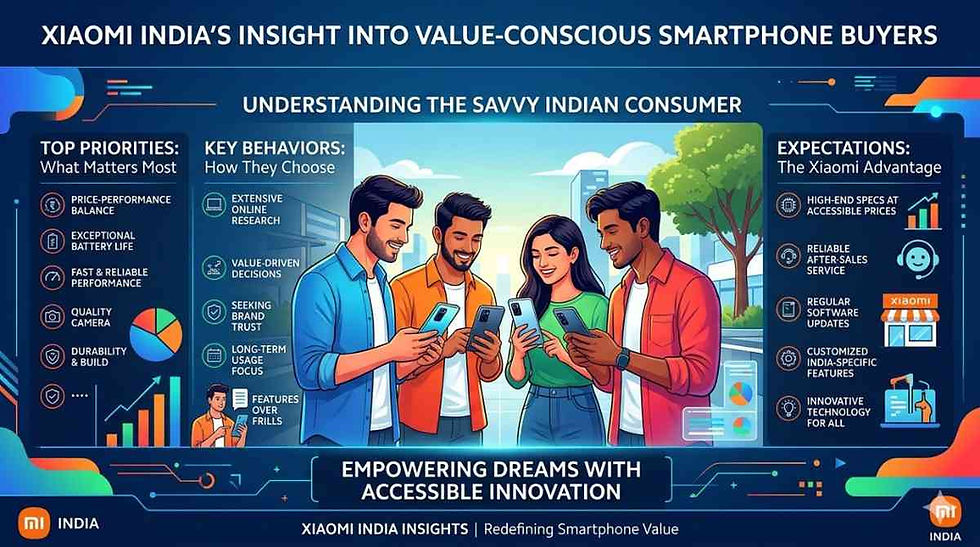
The most significant strategic insight underlying Xiaomi’s growth in India appears to have been its understanding that a large segment of smartphone buyers evaluated purchases through a value-conscious lens.
Rather than viewing affordability and quality as mutually exclusive, many consumers sought devices that maximized utility per rupee spent. Xiaomi’s market positioning addressed this preference directly.
Industry analysts credited Xiaomi’s success to a combination of aggressive pricing and high-specification devices. Reports covering Xiaomi’s rise to market leadership repeatedly cited its ability to attract cost-conscious buyers who wanted advanced smartphone capabilities without paying premium-brand prices.
From a marketing perspective, Xiaomi’s positioning moved beyond simple low-cost competition. The company framed value as obtaining more features, performance, and functionality for a given expenditure.
This distinction was strategically important because it allowed Xiaomi to compete not only against lower-priced brands but also against established manufacturers whose products often carried higher price premiums.
The resulting positioning can be interpreted as a value leadership strategy rather than a pure cost leadership strategy. The emphasis was on superior perceived value rather than merely the lowest price.
Media & Channel Strategy
Verified public information indicates that Xiaomi’s early India growth relied heavily on digital and e-commerce channels.
Industry reports and business media coverage identified partnerships with major online marketplaces as a key component of Xiaomi’s market expansion. Online distribution provided access to technology-focused consumers who actively researched product specifications and compared alternatives.
This channel strategy aligned closely with the company’s value proposition. Consumers shopping online could easily compare features and prices across brands, making Xiaomi’s specification-to-price advantage highly visible.
Over time, Xiaomi expanded its offline footprint as smartphone adoption broadened across demographic and geographic segments. This expansion reflected the importance of reaching consumers who preferred physical retail experiences before making purchase decisions.
No verified public information is available on the exact media mix, channel-level spending allocations, or campaign-specific advertising effectiveness metrics.
Business & Brand Outcomes
The most visible outcome of Xiaomi’s strategy was rapid market-share growth.
According to industry research cited by major business publications, Xiaomi became the leading smartphone brand in India by shipments during the fourth quarter of 2017, surpassing Samsung. Analysts attributed this achievement in part to Xiaomi’s aggressively priced portfolio and strong appeal among value-conscious consumers.
The company subsequently maintained a significant presence in the Indian smartphone market for several years and was widely recognized as one of the country’s leading smartphone brands.
Public reporting also indicates that Xiaomi’s leadership position was built primarily through success in mass-market price segments rather than premium smartphone categories.
Later industry reports suggested that changing consumer preferences, intensifying competition, and growth in premium smartphone demand created new strategic challenges for Xiaomi. Business coverage in subsequent years noted the company’s efforts to strengthen its presence in higher-priced segments as the market evolved.
No verified public information is available on campaign-level return on investment, customer acquisition cost, lifetime value, retention rates, or conversion metrics.
Strategic Implications
Xiaomi India’s experience offers several important marketing lessons regarding consumer insight and market positioning.
First, the case demonstrates the power of aligning strategy with a clearly identifiable consumer need. Xiaomi recognized that a large segment of Indian smartphone buyers prioritized value optimization rather than brand prestige alone.
Second, the case illustrates how perceived value can become a sustainable competitive advantage when consistently reinforced through product design, pricing, and distribution decisions. Xiaomi’s success was not driven by a single marketing initiative but by the alignment of multiple strategic elements around the same consumer insight.
Third, the company’s rise highlights the role of digital channels in enabling value-oriented positioning. Online platforms allowed consumers to compare products directly, making specification-to-price advantages more transparent.
Finally, the case underscores the long-term challenge of evolving a brand that becomes strongly associated with affordability. As markets mature and consumer expectations shift toward premium experiences, brands built on value leadership may need to reposition carefully without undermining the equity that fueled their original growth.
The Xiaomi India case therefore represents an example of how deep understanding of value-conscious consumer behavior can create market leadership, while also illustrating the strategic complexities that emerge when consumer preferences evolve over time.
MBA Discussion Questions
How did Xiaomi transform consumer perceptions of value in the Indian smartphone market, and why was this positioning effective?
To what extent was Xiaomi’s success driven by consumer insight versus operational and distribution advantages?
What risks emerge when a brand becomes strongly associated with affordability and value?
How can companies maintain value-based positioning while simultaneously moving into higher-priced segments?
What lessons from Xiaomi India’s growth strategy can be applied to other emerging-market consumer technology categories?


Comments