247 Litres of Milk and a Farmer's Revolt Built India's Most Loved Brand — The Extraordinary Story of Amul
- 4 days ago
- 8 min read
In the early 1940s, the farmers of Kaira district in Gujarat were trapped in a system designed to exploit them. Polson — a private dairy company — held a near-total monopoly over milk collection in the region, and through its network of traders and agents, set arbitrary, unfair prices for the milk that farmers worked every single day to produce. The farmers had no leverage. They had no alternative buyer. They simply had to accept whatever price they were given.
In 1946, Sardar Vallabhbhai Patel — already one of India's most respected nationalist leaders — encouraged the agitated farmers of Kaira to organise a non-cooperation movement against this exploitation. Among those who answered that call was a young man named Tribhuvandas Kishibhai Patel, born in 1903, who had studied law but found his true calling in the cooperative movement that was beginning to stir across rural Gujarat.
Under Tribhuvandas Patel's leadership, and with the backing of Sardar Patel and Morarji Desai, the farmers made a radical decision: they would cut out the middlemen entirely. On 14 December 1946, the Kaira District Co-operative Milk Producers' Union Limited (KDCMPUL) was formally registered.
It began modestly — just two village dairy cooperative societies, collecting a combined 247 litres of milk. It was, in every visible sense, a tiny operation. But it carried within it an idea that would eventually reshape the entire Indian dairy industry: that farmers, organised collectively, could control their own production, processing, and pricing — without depending on any trader, agent, or monopoly to determine their fate.
The Engineer Who Almost Left
In May 1949, a young man arrived in Anand to fulfil an obligation, not pursue a dream. Verghese Kurien, born in Calicut, had just completed his master's degree in mechanical engineering with a focus in metallurgy from Michigan State University in the United States, sponsored by a government scholarship. The terms of that scholarship required him to serve a bond period working for the Indian government — and he had been posted to a government creamery in Anand, a town he found, by his own admission, deeply unremarkable. He found the work boring and was, in his own words, ready to leave the moment his bond period ended.
What changed his mind was Tribhuvandas Patel.
In the evenings, Kurien began helping Patel repair and maintain the dairy equipment used to process milk procured from local farmers. He grew genuinely impressed by what Patel was attempting to build — a cooperative structure that gave ordinary farmers real economic power. Patel persuaded Kurien to stay on and help develop the cooperative further, rather than leaving Anand once his obligatory service ended.
Kurien accepted. It was a decision that would alter the course of Indian agricultural history.
Working alongside H. M. Dalaya — a fellow dairy engineer who had studied with Kurien in the United States — Kurien set about solving a technical problem that international experts had declared essentially impossible: producing skim milk powder and condensed milk from buffalo milk rather than the cow's milk used in Western dairy processing. Buffalo milk had a different composition and had never been successfully processed at scale using existing Western dairy technology.
Dalaya and Kurien cracked it. Amul's plant became the first in India — and the first in the world — to successfully convert buffalo milk into milk powder. This was not a minor technical footnote. Multinational dairy company Nestlé, which was at the time importing milk powder and other materials into India to manufacture condensed milk locally, had refused Kurien's request that it instead try manufacturing condensed milk using locally procured buffalo milk — telling him plainly that Indians would not be able to handle the technology involved. Kurien proved them definitively wrong. Within two years, the Indian government banned the import of condensed milk altogether, as Amul's indigenous buffalo-milk processing had made it unnecessary.
The Anand Pattern: A Cooperative Model Built to Spread
The structure that Patel and Kurien built at Kaira became known as the Anand Pattern — a three-tier cooperative model that has since defined Indian dairy development. At the village level, farmers formed local dairy cooperative societies, collecting milk twice daily and paying farmers based on the fat content of what they brought in, with safeguards such as standardised fat measurement and surprise inspections built in to prevent malpractice. These village societies federated upward into district-level unions, like the Kaira Union itself, which in turn federated into state-level marketing bodies.
The brand name Amul — derived from the Sanskrit word "Amulya," meaning priceless or invaluable — was adopted by the Kaira Union in 1955, giving the cooperative's products a single, memorable consumer-facing identity for the first time.
By 1960, the cooperative had grown to 219 farmer societies with 46,400 members, processing milk that grossed over $6 million annually — a remarkable trajectory for an organisation that had begun with 247 litres just over a decade earlier.
Operation Flood and the World's Largest Dairy Development Programme
What made Amul's story extraordinary was not just its own growth, but the decision by India's national leadership to replicate it everywhere.
On 31 October 1964, Prime Minister Lal Bahadur Shastri visited Anand and spoke directly with the farmers about their cooperative. He was struck by what he saw. On returning to Delhi, he set in motion the creation of the National Dairy Development Board (NDDB) in 1965, with the explicit goal of replicating the Kaira cooperative model across the rest of India. Verghese Kurien was appointed its founding chairman.
In 1970, this ambition crystallised into Operation Flood — the world's largest dairy development programme, modelled entirely on the Anand Pattern that Amul had pioneered. Operation Flood unfolded in three phases: the first linked 18 milk-producing regions to four major metropolitan cities; the second expanded this network to 136 milk sheds feeding 290 urban markets; and the third focused on strengthening cooperative infrastructure and extending veterinary care, animal feed support, and artificial insemination services to cooperative members across the country.
The results were transformative at a national scale. Operation Flood turned India from a milk-deficient nation into the world's largest milk producer, surpassing the United States in 1998, and effectively doubled the country's per capita milk availability within thirty years. Today, Amul's cooperative network encompasses approximately 3.6 million milk producers across more than 18,700 village cooperative societies, processing over 30 million litres of milk daily.
In 1973, recognising the value of marketing the products of all these district unions under one unified national and international identity, the Gujarat Co-operative Milk Marketing Federation Ltd. (GCMMF) was established as the apex marketing body. The Kaira Union transferred the Amul brand name to GCMMF — combining the marketing strength of dozens of district cooperatives under a single brand, while saving on advertising costs and avoiding the wasteful prospect of cooperatives competing against one another.
The Girl in the Polka-Dot Dress
In 1966, GCMMF hired Sylvester daCunha, managing director of an advertising agency, to design a campaign for Amul Butter. What daCunha and his team created would go on to become one of the most celebrated advertising achievements in the world.
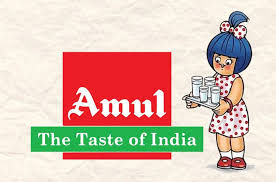
The campaign centred on a small, mischievous cartoon character — the Amul Girl, in her now-iconic blue polka-dot dress — appearing on hoardings across India with topical, witty commentary on the events of the day. Rather than running a fixed, static advertisement, daCunha's team produced new, current hoardings reacting to real news, politics, sport, and culture — week after week, year after year. Cartoon artist Kumar Morey and scriptwriter Bharat Dabholkar, who joined the effort in the 1980s, became central to the campaign's distinctive voice. Dabholkar made a deliberate choice to reject the prevailing trend of using celebrities in advertising, crediting Amul's chairman Verghese Kurien with creating the kind of creative freedom that allowed the campaign to take risks most corporate advertisers would never permit.
That freedom led the campaign into genuinely controversial territory at times — hoardings commenting on the Naxalite uprising in West Bengal, on an Indian Airlines employees' strike, and other politically sensitive subjects of the moment. daCunha's agency made it a firm policy never to back down from political pressure when it arose.
The campaign's longevity is its most extraordinary achievement: it has continued, uninterrupted, since 1966, earning a Guinness World Record for being the longest-running advertising campaign in the world.
The Marketing Strategy That Was Decades Ahead of Its Time
Amul's marketing approach has rested on a small number of deeply consistent, deliberately unconventional principles.
Returning the largest share of the consumer's rupee to the farmer. Kurien is widely credited with ensuring that Amul's commercial and marketing success was structured specifically to maximise the share of revenue flowing back to the primary milk producer — not just to intermediaries, processors, or marketers. This farmer-first economic philosophy was not just an operational principle; it became the moral foundation that every subsequent marketing decision was built upon.
Topical, real-time cultural commentary as brand voice. Long before "real-time marketing" became an industry term, the Amul Girl hoardings were responding to breaking news on a near-weekly basis, giving the brand a constantly renewing relevance that static, seasonal advertising campaigns could never achieve. This consistent topicality has kept Amul culturally present in Indian life for nearly six decades.
Deliberate avoidance of celebrity endorsement. At a time when Indian advertising was increasingly leaning on film stars and cricketers to sell products, Bharat Dabholkar and the Amul creative team made the opposite choice — building the entire campaign's appeal around a fictional cartoon character and sharp, self-aware wit rather than borrowed celebrity glamour. This gave Amul's advertising a timeless, character-driven identity that has not aged the way celebrity-led campaigns of the same era often have.
Cooperative federation to eliminate wasteful competition. The 1973 formation of GCMMF was itself a marketing strategy as much as a corporate structure — uniting multiple district cooperatives under one national brand specifically to combine advertising resources and avoid the inefficiency of these cooperatives competing against each other in the same market.
Courage in the face of political pressure. The willingness to publish controversial, politically charged hoardings — even when facing pressure to withdraw them — built a reputation for Amul as a brand unafraid to speak directly and honestly, reinforcing public trust in a way that more cautious, risk-averse advertising never could.
A Brand Owned by Farmers, Trusted by a Nation
In 1999, Amul was awarded the "Best of All" Rajiv Gandhi National Quality Award, recognition of the technical and operational excellence the cooperative had built since 1946. In 2025, Amul was ranked the third most valued brand in India in the YouGov India Value Rankings — a remarkable standing for a brand that has never operated as a conventional corporation, but as a cooperative owned collectively by millions of farmers.
Tribhuvandas Patel led the cooperative as its founding chairman until his retirement in the 1970s. Verghese Kurien, who joined as a reluctant young engineer in 1949, went on to be recognised globally as the "Father of the White Revolution," receiving India's highest civilian honours before his death on 9 September 2012. The institutions the two men built together — Amul, GCMMF, NDDB, and the Institute of Rural Management Anand — continue to shape Indian agriculture and rural development decades after their founding.
From 247 Litres to the World's Largest Milk Producer
The story of Amul did not begin with a marketing plan, a brand strategy document, or a corporate vision statement. It began with farmers in Kaira district who were being cheated, and who decided, with the encouragement of Sardar Patel, that they would rather build something themselves than continue accepting exploitation.
What they built — under Tribhuvandas Patel's organisational leadership and Verghese Kurien's technical and strategic vision — became the foundation of India's transformation from a milk-deficient nation into the largest milk producer on Earth. And the brand that emerged from that transformation, fronted for nearly sixty years by a small cartoon girl in a polka-dot dress with something witty to say about whatever was happening in the news that week, became something genuinely rare in the history of advertising: a campaign as enduring and as trusted as the cooperative movement it represents.
Amul means priceless. For the farmers who built it, and for the country it helped feed, that name has never felt like an exaggeration.
Founded 14 December 1946. Began with 247 litres of milk. 3.6 million farmer members today. World's longest-running ad campaign since 1966. Still utterly, unmistakably "The Taste of India."


Comments