Bira 91’s Insight into Urban Youth Drinking Culture
- Apr 20
- 5 min read
Industry & Competitive Context
India’s alcoholic beverages market has historically been dominated by legacy players such as United Breweries and Carlsberg Group, with beer consumption traditionally centered around strong lagers. Industry analyses from organizations like Boston Consulting Group and McKinsey & Company have highlighted the gradual premiumization of consumer preferences in urban India, particularly among younger demographics.
The emergence of craft and premium beer segments in India reflects a broader global trend toward differentiated, flavor-driven products. Reports in credible business media have noted that urban consumers, particularly millennials, have shown increasing openness to experimenting with new formats, flavors, and brand identities in alcoholic beverages.
This shift has intensified competition, not only among multinational brewers but also among new-age domestic brands seeking to capture evolving consumer tastes. Within this context, Bira 91 entered the market as a challenger brand with a distinct positioning.
Brand Situation Prior to Campaign
Bira 91, launched by B9 Beverages in 2015, entered a market where beer was largely perceived as a homogeneous category dominated by strong lagers. Publicly available information from credible media indicates that the brand initially introduced products such as wheat beers and low-bitterness lagers, which were relatively uncommon in the Indian mass market at the time.
Prior to its rise, the category lacked strong lifestyle-oriented branding targeted specifically at urban youth. Beer consumption was often associated with functional or occasion-based usage rather than identity-driven or cultural expression.
Bira 91’s early distribution strategy focused on urban centers, including bars, restaurants, and premium retail outlets. This selective presence aligned with its target demographic of young, urban consumers.
No verified public information is available on a single, defined “campaign” that marked a turning point; rather, the brand’s growth has been attributed to a combination of product innovation, branding, and cultural positioning.
Strategic Objective
Based on publicly available statements and credible media coverage, Bira 91’s strategic objective has been to establish itself as a contemporary, youth-centric beer brand that reflects evolving urban lifestyles in India.
A key component of this objective has been to differentiate from traditional beer brands by emphasizing flavor, design, and brand personality. The company has also aimed to build a global brand with Indian origins, as reflected in its international expansion into markets such as the United States.
Another documented objective has been to create a strong brand identity that resonates with urban consumers through cultural relevance, rather than relying solely on product attributes.
No verified public information is available on formally disclosed strategic KPIs or internal targets related to these objectives.
Campaign Architecture & Execution
No verified public information is available on a single integrated campaign explicitly titled around “urban youth drinking culture.” However, Bira 91’s execution strategy, as reflected in public reports and company communications, demonstrates a consistent focus on brand-building through multiple touchpoints.
The brand has invested in distinctive packaging, including its recognizable monkey logo and bright color palette, which has been widely covered in business media as a key differentiator. Product innovation has also been central, with the introduction of variants such as Bira 91 White and Bira 91 Blonde.
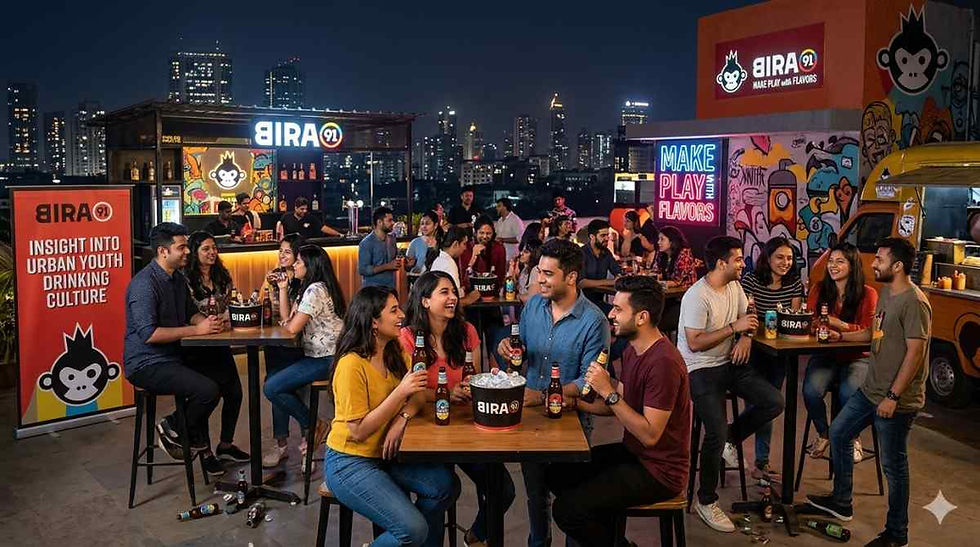
Bira 91 has participated in and sponsored cultural events, music festivals, and lifestyle experiences, positioning itself within urban youth culture. Its presence at events and collaborations with cultural platforms have been reported in credible media as part of its brand-building efforts.
The company has also expanded its product portfolio to include non-alcoholic beverages, reflecting an attempt to broaden its engagement with consumers beyond traditional beer consumption occasions.
No verified public information is available on specific creative campaign frameworks, messaging hierarchies, or execution timelines.
Positioning & Consumer Insight
Bira 91’s positioning is closely tied to its understanding of changing urban consumer behavior. Publicly available information indicates that the brand identified a gap in the market for beers that are lighter, more flavorful, and aligned with global consumption trends.
A key consumer insight reflected in its strategy is the desire among urban youth for products that signal individuality and modernity. This is consistent with broader industry observations from organizations like BCG, which have noted the increasing importance of brand identity and experience in consumer decision-making.
The brand’s visual identity and communication style have been designed to appeal to a younger demographic, emphasizing creativity, humor, and cultural relevance. Its association with social settings such as bars, restaurants, and events reinforces its positioning as a lifestyle brand rather than just a beverage.
Another relevant insight is the shift toward experiential consumption. Bira 91’s involvement in events and cultural platforms suggests an understanding that consumption is often embedded in social and experiential contexts.
No verified public information is available on proprietary consumer research conducted by the company.
Media & Channel Strategy
Publicly available information indicates that Bira 91 has adopted a multi-channel approach to brand building, with a strong emphasis on on-premise visibility in bars and restaurants, as well as presence in modern retail outlets.
The brand has also leveraged digital platforms, including social media, to engage with its target audience. Its communication style has been noted in credible media as being informal and youth-oriented.
Event sponsorships and experiential marketing have been significant components of its channel strategy, enabling direct interaction with consumers in social settings.
However, due to regulatory restrictions on alcohol advertising in India, direct promotion of alcoholic beverages is limited. As a result, brands often rely on surrogate advertising and brand extensions.
No verified public information is available on detailed media spend allocation, campaign budgets, or platform-specific performance metrics.
Business & Brand Outcomes
According to publicly reported information, Bira 91 has achieved rapid growth since its launch, expanding its presence across multiple cities in India and entering international markets. Credible media reports have highlighted the brand’s increasing market visibility and its role in popularizing craft-style beers in India.
The company has raised funding from investors such as Sequoia Capital and Sofina, reflecting investor confidence in its business model and growth potential.
Bira 91 has also established manufacturing facilities in India to support its expansion, as reported in business media.
No verified public information is available on specific market share figures, brand awareness metrics, or direct attribution of growth to particular marketing initiatives.
Strategic Implications
Bira 91’s trajectory illustrates how consumer insight into emerging cultural trends can inform brand positioning in a traditionally commoditized category. By aligning itself with urban youth culture, the brand has differentiated beyond functional attributes.
One key implication is the role of branding in category creation. Bira 91 has contributed to expanding the perception of beer in India from a largely undifferentiated product to a more diverse and experience-driven category.
Another implication is the importance of navigating regulatory constraints. In a market where direct advertising is restricted, brands must rely on indirect methods such as design, events, and digital engagement to build identity.
The case also highlights the interplay between product innovation and brand storytelling. Bira 91’s introduction of new variants supports its positioning as a modern and experimental brand.
Finally, the brand’s expansion into international markets suggests an ambition to position itself as a global player, leveraging its identity as an Indian-origin brand with contemporary appeal.
No verified public information is available on long-term profitability outcomes directly linked to its marketing strategy.
Discussion Questions
How did Bira 91 leverage insights into urban youth culture to differentiate itself in a traditionally homogeneous beer market?
What role does brand identity play in driving premiumization within the alcoholic beverages industry?
How can companies build strong brand presence in categories with strict advertising regulations?
What are the risks associated with positioning a brand too narrowly around a specific demographic segment?
How can Bira 91 sustain its cultural relevance as consumer preferences continue to evolve?


Comments