boAt's Flash Sale Strategy in Consumer Electronics
- 2 days ago
- 8 min read
Industry & Competitive Context
India's branded audio and wearables market grew rapidly through the 2010s on the back of smartphone penetration, falling data costs, and the rise of e-commerce marketplaces as the primary retail channel for electronics. Amazon India and Flipkart institutionalized the "flash sale" as a retail format — time-boxed, deep-discount events (Big Billion Days, Great Indian Festival, GOAT Sale, Big Saving Days) built around scarcity and urgency mechanics. Industry data from e-commerce analytics firm DataWeave shows that Flipkart's 2023 Big Billion Days drew a reported 1.4 billion customer visits during the early-access phase and across the seven days of the event, while Amazon's competing Great Indian Festival sale recorded 95 million customer visits within the first 48 hours. Within electronics specifically, DataWeave's analysis found that smartwatches, earbuds, and drones carried the steepest markdowns of any electronics subcategory, with Flipkart leading on discount depth, and industry body CEAMA anticipated rising festive-season demand for premium electronics purchased via EMI and credit cards. Against this backdrop, boAt entered a crowded, low-differentiation accessories market. As co-founder Aman Gupta has stated in a published interview with YourStory, roughly 200 brands — both domestic and international — were already selling audio devices in India when boAt started out. The category was split between premium international brands (JBL, Sony) and low-cost, low-trust unbranded imports, with no scaled domestic brand occupying the affordable-but-credible middle.
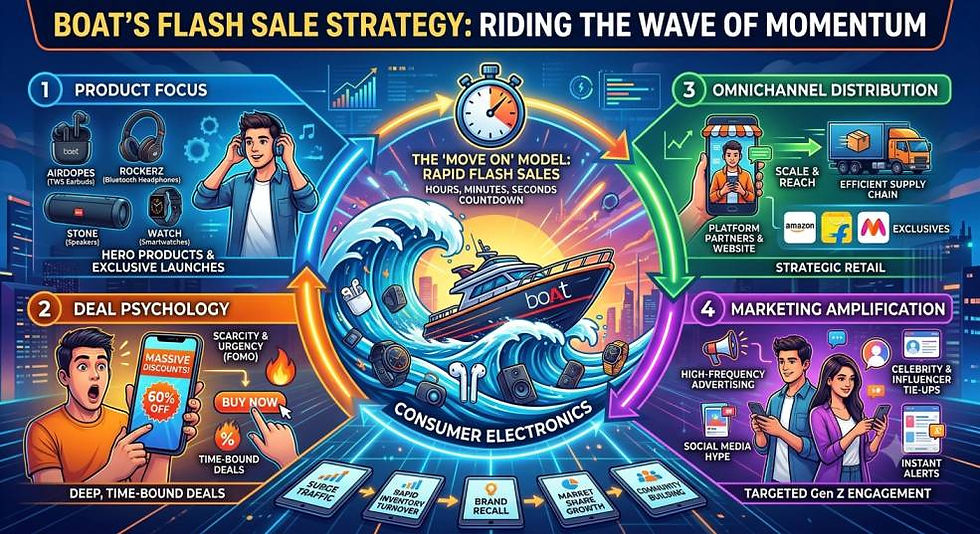
Brand Situation Prior to Campaign
Imagine Marketing Ltd., the entity behind boAt, was incorporated in November 2013, with the boAt brand built out shortly after. The company began as a marketplace-first, digital-native seller rather than a traditional retail brand — building distribution through Amazon, Flipkart, Myntra, and (in the early years) Jabong, without owned retail infrastructure. According to boAt's own regulatory disclosures reported by YourStory, the brand's early trajectory was modest but fast-compounding: revenue nearly tripled to ₹700.44 crore in FY20 from ₹239.4 crore in FY19, while profit rose from ₹9 crore in FY19 to ₹48.5 crore in FY20. By late 2020, boAt had achieved global scale recognition, ranking as the 5th largest wearable brand globally according to IDC's Worldwide Quarterly Device Tracker report for Q4 2020. Crucially, this growth was not built on a large offline retail footprint. As Gupta explained in the same interview, the company's channel philosophy was deliberate: "We have been focusing more on product and marketing, and not particularly on distribution and logistics. We found this experience much better on the marketplaces. So we kept our focus in building our product and the brand." This meant boAt's entire go-to-market engine — discovery, trust-building, and volume generation — ran through third-party marketplace mechanics, of which flash sales were the dominant format.
Strategic Objective
Publicly available statements attribute two linked objectives to boAt's marketplace strategy: first, to generate rapid, visible proof of product-market fit for new SKUs without owning inventory risk or offline distribution costs; and second, to use scarcity and urgency as a substitute for the trust signals — retail presence, established brand history, service networks — that an incumbent international brand could offer but a new entrant could not. Gupta's account frames this explicitly as a category-expansion mechanism: strong sell-through on a limited-stock marketplace launch was treated as a validated signal to expand beyond the brand's original audio category into new segments. As he put it regarding boAt's wearables expansion, "the kind of response we received from 'boAtheads' gave us the promise that the brand was of good quality at a logical feasible Indian price point... that is when we launched our new brand Misfit, which is into personal grooming devices."
Campaign Architecture & Execution
Publicly documented evidence points to two distinct, coexisting flash-sale mechanisms in boAt's playbook, and it is important not to conflate them.
(a) Scarcity-based product launches. boAt used limited initial stock drops on Flipkart to create visible, time-compressed demand signals for new products. Per Gupta's account, in 2019 boAt was selling over 6,000 units a day, at a rate of four units every minute, and subsequently 10,000 units of one of its wearable products sold out within one minute of launch on Flipkart. This single data point — repeated in the same interview as the trigger for boAt's expansion into wearables and personal grooming — is the most specific, attributable evidence available on boAt's "flash sale" mechanic as a launch tool rather than a discounting tool.
(b) Participation in platform-wide flash-sale calendars. Separately, boAt has been a consistent participant in Amazon's and Flipkart's recurring mega-sale events (Great Indian Festival, Big Billion Days, GOAT Sale, Republic Day Sale, and category-specific "Electronics Sale" events), where its audio and wearables SKUs are routinely featured with time-limited discounting. boAt also runs owned-channel flash-sale sections directly on its D2C website (labelled "boAt Flash Sale Offer," "Daily Deals," and "Super Savers"), indicating that the flash-sale format has been institutionalized as a standing promotional mechanic rather than a one-off campaign tied to a single date. A notable strategic nuance, documented in DataWeave's comparative pricing analysis of the 2023 Big Billion Days versus Amazon's Great Indian Festival, is that boAt and Zebronics offered comparatively lower discounts on Flipkart than the electronics category average, even as competitors such as Mi and JBL offered deeper cuts. This is a meaningful, source-backed data point: it suggests that in at least one documented sale cycle, boAt did not compete primarily on discount depth during platform-wide events, relying instead on assortment breadth, search visibility, and its accumulated brand equity — while reserving the scarcity mechanic (limited-quantity, sell-out-fast drops) more for new-product launches than for blanket clearance discounting.
Positioning & Consumer Insight
boAt's own communications, as reported across multiple business-media profiles of the brand and its co-founders, position the product not primarily on technical specification but on affordability paired with lifestyle relevance for a young, digitally native Indian consumer. This positioning is corroborated by the brand's own IPO disclosures: the company describes itself in its Draft Red Herring Prospectus as offering "mass premium lifestyle-oriented and technology-focused products at accessible price points" targeted at India's "young, digitally native" customer cohort. Flash sales are a natural extension of this positioning logic: a low-priced, design-forward product that "sells out" within minutes functions as social proof of desirability among a price- and trend-conscious audience, reinforcing the brand's community identity around its self-styled customer base of "boAtheads." The DataWeave study also offers an independent, platform-side view of consumer behaviour during these events, noting that flash sales tap into consumer psychology by leveraging scarcity and fear of missing out, with the limited-time nature of these events triggering impulse-buying behaviour — a mechanic consistent with, though not unique to, boAt's own launch tactics.
Media & Channel Strategy
boAt's channel strategy, as disclosed in its updated Draft Red Herring Prospectus filed with SEBI (reported October–December 2025), shows a business that remains digitally weighted even after a decade of growth: for FY2025, 70.55% of sales (₹2,166.07 crore) came through online channels, with the remaining 29.45% (₹904.32 crore) through offline channels. This channel mix is directly relevant to the flash-sale strategy, since online-channel dominance is what makes marketplace-timed sale events (rather than retail footfall) the primary lever for volume generation. Historically, as of 2021, Gupta indicated offline contributed a smaller share still — around 10–15% of the business, translating to more than ₹300 crore in offline revenue at that time — underscoring how central marketplace-driven online sales, including flash-sale events, have been to boAt's volume base over its growth history.
Business & Brand Outcomes
Documented, filing-based outcomes for Imagine Marketing Ltd. (boAt) include the following, drawn from its SEBI DRHP filings as reported by financial media:
Revenue from operations grew from ₹600 crore in fiscal 2020 to ₹3,100 crore in fiscal 2025, a compound annual growth rate of approximately 38%, while the company held the top spot in India's branded personal audio market for five consecutive years.
For FY2025 specifically, boAt reported revenue from operations of ₹3,070.38 crore and a profit of ₹61.08 crore — a turnaround from losses in the prior year — with EBITDA of ₹142.52 crore, representing an EBITDA margin of 4.64%. The company sold over 34 million units in India in FY2025.
By product line, FY25 revenue was led by audio at 84.23% of product revenues (₹2,586.04 crore), followed by wearables at 10.76% (₹330.41 crore) and other products at 5.01% (₹153.93 crore).
Per market-share data cited from a Redseer report in boAt's DRHP, the company held a 26% value share and 34% volume share in India's branded personal audio market for FY2025, ranking third among India's digital-first brands by revenue and fourth globally in branded personal audio by volume.
Growth continued into FY2026, with EBITDA margins rising to 6.6% in the June 2025 quarter.
Separately, as of Q2 2024, boAt was reported to hold a 26.7% share of India's wearables market, according to disclosures cited around its confidential DRHP filing, though the same reporting noted that growth in the audio business slowed in the latter half of FY24.
Strategic Implications
Three inferences can be drawn strictly from the documented record, without extending into unverified territory.
First, boAt's use of flash sales appears to have served two structurally different purposes that are often conflated in popular commentary: a scarcity-driven launch mechanic (limited-stock drops generating rapid sell-outs, as documented for its 2019 wearables launch) used to validate and expand into new product categories, and a recurring participation in platform-wide discount calendars (Big Billion Days, Great Indian Festival, and similar) used to sustain volume and visibility within an already-crowded promotional environment. The distinction matters strategically: the former is a demand-signalling and category-expansion tool used sparingly around launches, while the latter is a volume-sustaining tactic used routinely as part of the sale calendar.
Second, the DataWeave finding that boAt discounted less aggressively than category peers during at least one major sale cycle suggests that, by the point the brand had achieved market leadership, it was not purely a discount-driven participant in these events — brand equity and assortment breadth appear to have substituted, at least partially, for headline discount depth as a driver of sale-period performance.
Third, boAt's channel economics — a business still generating roughly seven-tenths of its revenue online as of FY2025 — mean that marketplace event calendars (rather than owned retail) continue to function as the primary demand-aggregation mechanism for the brand, even after its transition toward profitability and its move into offline retail partnerships. This dependency is also flagged as a formal risk factor in the company's own IPO disclosures, which note the brand's reliance on a small number of product categories and distribution arrangements.
Discussion Questions
Based on the documented distinction between scarcity-based product launches and participation in platform-wide discount calendars, how should a digital-first consumer brand decide when to use limited-stock scarcity tactics versus broad-based discounting, and what risks does over-reliance on either create for long-term brand equity?
boAt's DRHP discloses that online channels still contributed roughly 70% of FY2025 revenue. What are the strategic trade-offs of remaining this dependent on marketplace-timed sale events for volume, especially as the company diversifies into offline retail and pursues public-market investor scrutiny?
The DataWeave data shows boAt discounting less aggressively than some competitors during a major sale event, yet the company still achieved category leadership. What does this suggest about the relationship between discount depth and market share in a price-sensitive but brand-conscious consumer segment?
Aman Gupta has described a single sell-out event (10,000 units in one minute) as the trigger for boAt's expansion into a new product category (wearables, and subsequently personal grooming under Misfit). What are the risks of using a single marketplace demand signal as the basis for a major category-expansion decision, and what additional evidence would an MBA-trained strategist want before committing capital to such expansion?
Given that boAt's own IPO filings flag dependency on the audio and wearables category, and slowing audio growth in parts of FY24, as risk factors, how sustainable is a flash-sale-led, marketplace-dependent growth model as a company matures from a founder-led startup into a publicly listed, profit-accountable enterprise?


Comments