Bournvita's Education-Focused Campaign Messaging
- May 29
- 12 min read
Industry & Competitive Context
The Indian Health Food Drink (HFD) market is segmented into two structurally distinct sub-categories: white malt powders and brown malt powders. The white segment has historically been dominated by Horlicks (launched in India in the 1930s, later under GlaxoSmithKline Consumer Healthcare), while the brown segment — smaller in volume but significant in value — has been contested primarily between Cadbury Bournvita and, from the 1970s onward, Boost (Smith Kline Beecham / GlaxoSmithKline) and Complan (Heinz, later Zydus Wellness). At the time Bournvita launched in India in 1948, the malt food drink category was particularly developed in milk-deficient states of South India, where adding a fortified supplement to milk served a practical nutritional function. As documented in industry and brand history sources, the overall HFD category was populated by brands that directed their communication almost exclusively at mothers as the principal purchasing authority — positioning their products as scientifically validated contributions to a child's growth, intelligence, and immunity. By the early 2010s — a period for which verified Nielsen data exists — Horlicks commanded over 50% value share of the total HFD market, rendering it the category's undisputed leader by a wide margin, while Bournvita held a verified value share of approximately 16.2% (for the quarter ended March 2013, per Business Standard citing Nielsen data), making it the second-largest HFD brand overall and the leader within the brown powder sub-segment. Complan, at that point, held approximately 13.9% value share according to the same Nielsen data cited by Business Standard. The competitive dynamic within this category is structurally constrained. Because all brands compete for the same purchasing authority (mothers of children aged 2–16), the differentiation axis has historically been not product formulation (which is nutritionally similar across brands) but brand meaning — the emotional and aspirational values the mother associates with the product she chooses for her child. It is within this context that Bournvita's education-and-achievement positioning became strategically significant.
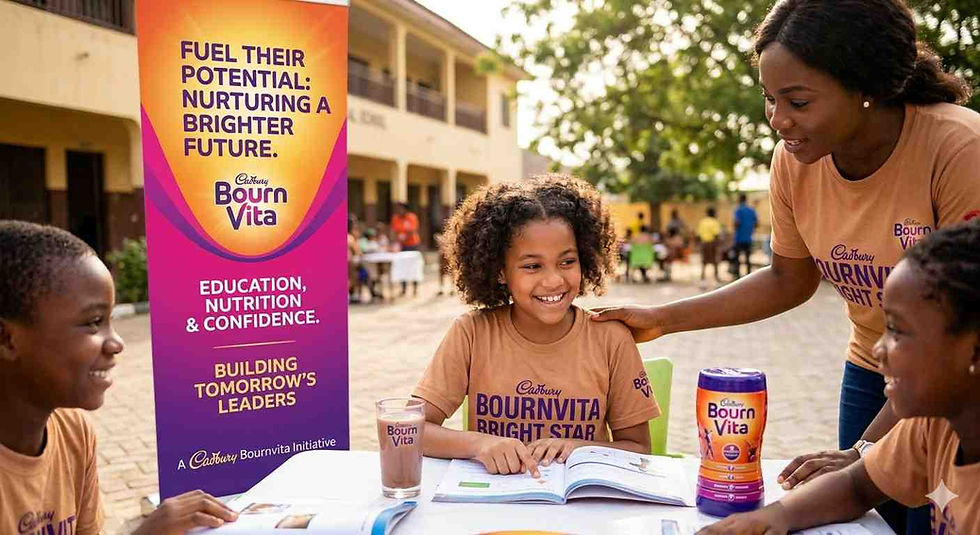
Brand Situation Prior to the Campaign
Bournvita was launched in India in 1948, the year Cadbury India was established, as a cocoa and malt-based powder to be mixed with milk. The brand had already established itself in the United Kingdom from the 1920s. In its early Indian decades, Bournvita's communication strategy followed the category convention: targeting mothers with messages about the product's nutritional contribution to a child's healthy upbringing. Its early positioning, documented in brand history sources, was summarised by the tagline "Goodness That Grows With You" — a nutritionally generic proposition that differentiated Bournvita minimally from its competitors. By the early 1970s, the HFD category had become more competitive. New entrants including Boost and the expanding presence of Complan and Horlicks intensified pressure on Bournvita's market position. As documented in Social Samosa's published brand history (citing advertising industry records), competitive pressure eventually gave birth to the Bournvita Quiz Contest in 1972 — a strategic decision to create a branded content property that could associate Bournvita with a specific, ownable domain of achievement, namely scholastic and general knowledge excellence. This was the foundational moment in Bournvita's education-focused positioning strategy. Rather than competing on nutrition claims, which were broadly similar across the category, Bournvita staked a claim on intellectual aspiration — the idea that choosing Bournvita was a choice made by and for children who would excel in tests of knowledge and achievement. The BQC was the institutional vehicle for that claim, and it preceded by nearly two decades the arrival of any comparable branded educational content property in Indian television.
Strategic Objective
Bournvita's education-focused campaign strategy served a multi-layered objective across different eras, but a consistent underlying logic connects them: to move the brand's competitive differentiation from the functional plane (nutritional composition) to the aspirational plane (what the child can become). In a category where all brands could make broadly similar vitamin and mineral fortification claims, the brand that succeeded in anchoring itself to a culturally resonant aspiration would enjoy a form of emotional monopoly that was difficult for competitors to dislodge without also running a sustained content or campaign property of comparable scale and duration. The BQC served a secondary strategic objective as well: it created a continuous and recurring brand-building touchpoint that was not dependent on any single advertisement's recall. A quiz contest that aired for decades, visited schools across 100 cities, and reached documented audiences of over a million students from 4,800 schools (per Bournvita's own documented contest figures) is a category of brand investment categorically different from media advertising — it becomes part of the lived experience of its audience. Branding expert Harish Bijoor, CEO of Harish Bijoor Consults, was quoted in Business Standard (2013) stating that BQC's constancy "established the natural associations between intelligence, knowledge and smartness with the brand." The later evolution into "Tayyari Jeet Ki" (Preparing to Win), from 2011 onward, extended this objective from the purely intellectual domain into the domain of holistic preparation — encompassing athletic effort, habit formation, parental modelling, and mental resilience. The shift reflected both an evolved consumer insight and a need to broaden the brand's aspiration appeal beyond quiz-oriented academic achievement to the wider domain of competitive success that was more resonant in a rapidly urbanising, sports-conscious India.
Campaign Architecture & Execution
The BQC's execution was notable for its structural discipline. The contest operated in two documented stages: a ground-level inter-school quiz across 100 cities, followed by zone-wise semi-finals (North, South, East, West) and a national final. Eligibility was restricted to students in classes 7 and 8, ensuring age-appropriate competition. The format remained broadly consistent across its television and digital eras, with Derek O'Brien as the singular hosting personality across the Zee TV, Sony, and Colors phases — providing a continuity of brand association that few contest properties achieve. O'Brien was conferred the Indian Television Academy's Anchor of the Year award for three consecutive years, lending external validation to the show's production standards. The "Tayyari Jeet Ki" campaign platform, launched formally in 2011, extended the education-adjacent aspiration narrative into a broader achievement philosophy. Rather than restricting the brand to academic contest success (the BQC's domain), "Tayyari Jeet Ki" positioned Bournvita as the companion of any child's journey toward excellence — in sports, academics, or character. Critically, as documented in multiple AFAQS analyses, the campaign consistently foregrounded the mother as the active agent of preparation rather than as a passive nutritional decision-maker, a positioning evolution that reflected documented shifts in how Indian mothers of the 2010s perceived their parenting role. The 2022 iteration of "Tayyari Jeet Ki" marked a further evolution: the campaign's explicit theme was failure, treating setback as a necessary component of preparation rather than something to be overcome by nutritional support. As Akshay Seth, ECD and copywriter at Ogilvy India, stated in AFAQS (2022): "Failure is an important part of success and it's about time we spoke about it." The campaign's lead film featured two siblings who lose a badminton match — the girl resumes practice while the boy withdraws in frustration. The narrative deliberately avoided showing the product in the advertisement, as documented by AFAQS, reinforcing the idea that the campaign was selling a philosophy of preparation rather than a nutritional supplement.
Positioning & Consumer Insight
Bournvita's education-focused positioning rested on a consumer insight that was both culturally specific and structurally durable: in India, the aspiration for children's educational and competitive success is not merely a personal ambition — it is a social and familial expectation that carries significant emotional weight for mothers. A brand that positioned itself as a partner in that aspiration, rather than merely a nutritional supplement, could claim a fundamentally different and higher-value place in the mother's decision-making framework.
The BQC operationalised this insight by creating a property in which Bournvita was the institutional sponsor of demonstrated intellectual excellence. Schools participated under the Bournvita name; children who excelled on the BQC stage did so as Bournvita champions. The brand was not claiming that its product made children smarter — it was associating itself with the culture and practice of striving for intellectual achievement. This is a subtle but strategically important distinction: the brand's relationship with education was aspirational and associative rather than functional and causal, which made it less vulnerable to the kind of nutritional claim scrutiny that would later destabilise the brand in 2023.
The insight underlying "Tayyari Jeet Ki" was a natural extension: if the mother's deepest aspiration is for her child to succeed, and if success requires preparation (not just talent), then the brand that associates itself with the discipline and habit of preparation — and presents the mother as the architect of that preparation — has a more emotionally resonant and motivationally powerful brand story than one that simply promises nutritional outcomes. Mondelez India's Vice President of Marketing, Anil Viswanathan, articulated this directly in the exchange4media statement published on the 2022 campaign launch: "It becomes imperative for parents to help children realize their true potential and help them embrace failures gracefully while encouraging them to learn from it." The transition from "Brought Up Right, Bournvita Bright" (1980s, intellectual upbringing) to "Tan Ki Shakti, Man Ki Shakti" (1990s, physical and mental strength) to "Tayyari Jeet Ki" (2011–present, holistic preparation and resilience) represents a coherent strategic arc: each positioning builds on the previous while expanding the brand's territory. Importantly, across all three phases, the core audience (mothers of school-age children) and the core aspiration (a child's excellence) remained constant — only the cultural frame in which that aspiration was articulated evolved.
Media & Channel Strategy
No verified, granular media spend data for any phase of Bournvita's campaigns has been publicly disclosed by Cadbury India or Mondelez International in accessible official filings. The following observations are limited to what is documentable from credible industry and press sources. The BQC's media journey itself constitutes a documented multi-channel strategy spanning five decades. It began as a live event property (schools across cities, 1972), then became a radio property on All India Radio (1973–1991), then a television property on Zee TV (June 1992–2000), then Sony Entertainment Television, then Pogo (a documented failure, taken off-air after one season), then Colors (from 2013), then a YouTube-only season (2015), and finally a dedicated mobile application (BQC app). This progression is analytically significant: it represents a brand-led content property that adapted its distribution channel to match the dominant media consumption behaviour of its target audience at each era, rather than remaining tied to a single medium. The "Tayyari Jeet Ki" campaign's documented media mix includes television as the primary vehicle, supplemented by Out-of-Home (OOH) advertising (verified in the exchange4media report on the 2022 campaign), digital content, athlete social media integration (Anahat Singh, Hima Das, and Ashish Kumar Chaudhary using their social media handles to amplify the campaign, per exchange4media), and a dedicated parenting microsite — tayyarijeetki.in — which hosted related content on preparation and child development. This multi-touchpoint structure, documented in the brand's own campaign communications, reflects an evolution from broadcast-led to ecosystem-led media strategy. The 2022 campaign's documented approach of partnering with near-miss athletes (those who came close to winning rather than gold medallists) was a deliberate channel and message alignment: the campaign's theme of failure-as-preparation was amplified by the authentic stories of sportspeople who had experienced visible public disappointment, making the OOH and social amplification components more credible than celebrity endorsement alone would have been.
Business & Brand Outcomes
The following outcomes are drawn exclusively from verified, publicly attributable sources. No internal metrics, inferred data, or unverified estimates are included. Since its launch in 1948, Bournvita has documented its status as the consistently leading brown malt food drink brand in India. Per Business Standard (2013) citing Nielsen data, for the quarter ended March 2013, Bournvita held a value share of 16.2% in the overall HFD market, against Complan's 13.9% — confirming its position as the second-largest HFD brand overall and the leader in the brown segment. Horlicks held over 50% of the market at the same period.
The BQC's documented reach at its 2015 peak — over one million students from 4,800 schools across 100 cities — represents a measurable footprint for a branded content property and a documented scale of brand engagement with its core target audience. The contest's five-decade span made it one of India's longest-running branded content properties, a distinction noted across advertising industry publications including AFAQS and Business Standard. Mondelez International's SEC filing (Form 8-K, FY2022) identifies Bournvita as one of the company's revenue-generating brands exceeding $100 million annually within the AMEA region, classifying it as a "local jewel" within the Mondelez portfolio alongside global power brands like Oreo and Cadbury Dairy Milk. This classification provides a verified upper-bound reference for Bournvita's revenue scale without disclosing brand-specific financials. The 2023 regulatory and reputational crisis constitutes a documented adverse brand outcome. In April 2023, a social media video by influencer Revant Himatsingka, alleging high sugar content in Bournvita, reached over 12 million views on Instagram before being taken down following a legal notice from Mondelez India. The National Commission for Protection of Child Rights (NCPCR) issued a formal legal notice to Cadbury India in June 2023, demanding withdrawal of what it characterised as misleading advertisements and packaging, and requesting explanation for the product's sugar content. By December 2023, Mondelez India had reduced Bournvita's added sugar content by approximately 15%, per Business Today reporting. The Ministry of Commerce and Industry subsequently issued an advisory directing e-commerce platforms to reclassify Bournvita and similar products from "health drinks" to "food drink / beverage / powder" categories — a documented regulatory outcome with potential long-term category-level implications.
Strategic Implications
On the strategic value of branded content properties over media advertising: The BQC's five-decade run illustrates a form of brand investment qualitatively different from conventional advertising. A quiz contest that became a Sunday morning institution for a generation of Indian families created brand memory that no 30-second commercial — however creatively superior — could have replicated. As branding expert Jagdeep Kapoor (CMD, Samsika Marketing Consultants) noted in Business Standard (2013), the BQC's "intellectual appeal for the young audience and emotional connect for the parents" created a dual engagement that simultaneously spoke to both the child as aspiring achiever and the parent as rational evaluator. This dual resonance is the structural advantage of educational content sponsorship over pure advertising.
On the architecture of sustained positioning platforms: Bournvita's sequential campaign progression — from "Goodness That Grows With You" to "Brought Up Right, Bournvita Bright" to "Tan Ki Shakti, Man Ki Shakti" to "Tayyari Jeet Ki" — demonstrates what might be called evolutionary positioning: each campaign phase expands and deepens a central brand belief (children's aspiration and achievement) rather than abandoning it. This architecture allowed Bournvita to stay culturally current across seven decades without the strategic disruption of repositioning. The "Tayyari Jeet Ki" platform, notably, was resilient enough to accommodate radically different thematic executions — from celebrating success to interrogating failure — without requiring the brand to change its fundamental positioning.
On the mother as strategic pivot: One of the analytically consistent elements across Bournvita's education-focused campaigns is the portrayal of the mother — not as a passive nutritional gatekeeper but as an active partner in her child's development journey. The "Aadatein" film (2014), in which the mother trains alongside her son, and the 2022 campaign's explicit call to parents to allow children to learn from failure, both position Bournvita as a brand that respects and elevates the mother's agency. This is strategically significant in a category where competitive messaging frequently defaults to maternal guilt (the "are you giving your child enough nutrition?" frame) — Bournvita's positive-reinforcement approach distinguishes it and creates a more loyal brand relationship.
On the inherent tension between aspirational health branding and product composition: The 2023 sugar crisis exposes a structural contradiction that education-focused health brand positioning cannot resolve on its own. For seven decades, Bournvita successfully anchored its brand to themes of intellectual and physical achievement — positioning that depends implicitly on the product being what it claims to be: a health drink. When the product's nutritional profile was publicly contested, the very credibility of the aspiration narrative was at risk, because the connection between "preparation for success" and a product containing nearly 50% sugar (in pre-2023 formulations, per NCPCR documentation) becomes paradoxical. This crisis illustrates that brand narratives built on implied health efficacy are exposed to a fundamental product-story alignment risk that is intensifying globally as nutritional transparency regulations tighten.
On the limits of content ownership: The BQC's trajectory also offers a cautionary note on content-led branding. The show's documented failures — the Pogo experiment that was pulled after one season, the multiple channel changes, the hiatus periods — demonstrate that branded content properties are vulnerable to distribution channel fragmentation and changing audience behaviour. Bournvita's eventual migration to YouTube and a dedicated app was strategically necessary but also represented a significant reduction in reach from the mass-audience Zee TV era. Brands that build equity through content must plan for content distribution disruption with the same rigour they apply to product distribution.
Discussion Questions
01The Bournvita Quiz Contest ran for over five decades as a branded content property, anchoring the brand to intellectual achievement without making any explicit product efficacy claim. Under what conditions is this kind of associative brand-building more strategically effective than direct functional advertising? What are the risks of this approach, and how does the BQC's own trajectory illustrate both the advantages and the vulnerabilities?
02Bournvita's "Tayyari Jeet Ki" platform sustained coherent brand identity across radically different thematic executions — from celebrating champion athletes, to modelling parental sacrifice, to normalising failure — over more than a decade. What principles distinguish a robust brand platform (one that can accommodate diverse executions) from a tagline? How should brand managers evaluate when a platform has exhausted its creative range?
03In the 2023 controversy, Bournvita's 75-year brand equity — built substantially on education, achievement, and child development associations — was challenged by a viral video questioning its sugar content. How should a brand with deep aspirational positioning manage a crisis that attacks the product-claim alignment rather than the brand values themselves? Evaluate Mondelez's documented response (legal notice, sugar reformulation) against alternative strategic options.
04Bournvita and Boost both operated in the HFD brown powder segment with distinct positioning: Bournvita owned intellectual and holistic achievement, Boost owned sporting energy through cricket celebrity. Both strategies proved durable across decades. What structural features of the Indian HFD market made dual long-run positioning viable? Under what circumstances would one positioning strategy be expected to dominate the other?
05The Ministry of Commerce and Industry's 2024 advisory directing e-commerce platforms to reclassify Bournvita from "health drink" to "food drink / beverage / powder" represents a regulatory attack on the brand's foundational category identity. If the "health drink" designation is no longer available to Bournvita in official classification, what strategic options does Mondelez India have to preserve the brand's aspirational equity without relying on implicit health efficacy claims?



Comments