Country Delight’s Insight into Trust Deficit in Milk Delivery
- 2 hours ago
- 5 min read
Industry & Competitive Context
India is the world’s largest milk-producing nation, yet the dairy sector has historically faced recurring concerns around adulteration, quality inconsistency, and supply-chain transparency. The market comprises large cooperative brands, private dairy companies, and a substantial unorganized segment consisting of local milk vendors.
Publicly documented discussions around milk quality have been influenced by findings from the Food Safety and Standards Authority of India (FSSAI), which highlighted non-conformance issues in portions of the milk supply chain. These concerns contributed to a broader consumer anxiety around purity, freshness, and reliability, particularly in urban markets where consumers are increasingly separated from the source of production.
Against this backdrop, dairy brands traditionally competed on availability, pricing, and distribution reach. However, the emergence of digitally enabled direct-to-consumer (D2C) models created an opportunity to compete on transparency and trust rather than solely on scale.
Country Delight entered this environment in 2015 with a proposition centered on fresh milk delivery through a direct-to-consumer model. Rather than positioning itself as another dairy brand, the company sought to address a structural consumer concern: whether the milk reaching households was genuinely fresh, pure, and traceable.
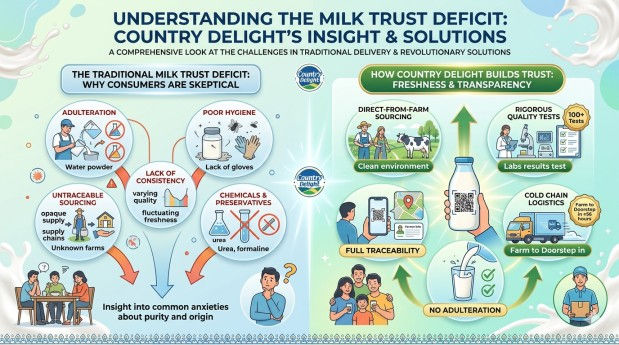
Brand Situation Prior to Campaign
No verified public information is available on a specific marketing campaign focused exclusively on “trust deficit in milk delivery.”
However, publicly available company communications and media coverage consistently indicate that Country Delight was founded around the belief that consumers had lost confidence in the traditional milk supply chain.
The company’s official descriptions have repeatedly referenced concerns such as milk adulteration, recombined milk, extended transportation distances, and delays between milking and consumption. According to company statements published through corporate channels and industry media, the founders believed that the essential qualities consumers associated with milk—freshness, purity, and authenticity—had diminished within conventional supply systems.
As a new entrant competing against established dairy brands with decades of consumer familiarity, Country Delight faced the challenge of building trust without the benefit of historical brand equity.
Strategic Objective
Based on verified public information, Country Delight’s strategic objective was to create consumer confidence in milk quality by reducing perceived uncertainty surrounding sourcing, freshness, and purity.
Rather than competing primarily on price, the company positioned trust as a core value proposition.
Its objective was not merely to deliver milk to households but to convince consumers that the product reaching them was fresher, more transparent, and more reliable than alternatives available through conventional channels.
This strategic focus reflected a broader understanding that milk is not an occasional purchase but a daily household staple. Consequently, trust becomes a critical determinant of brand choice because consumers often purchase milk for children, elderly family members, and regular household consumption.
Campaign Architecture & Execution
Although no verified public information identifies a standalone “Trust Deficit Campaign,” Country Delight’s broader market approach demonstrates a consistent trust-building architecture.
The company emphasized direct sourcing and farm-to-home delivery in its public communications. Media reports and company descriptions repeatedly highlighted efforts to reduce the distance and time between production and consumption.
Country Delight also built its proposition around freshness and quality verification. Publicly available reports indicate that the company communicated quality-testing procedures and purity-focused messaging as key components of its customer proposition.
A notable aspect of execution was the integration of technology into the delivery experience. Consumers interacted with the brand primarily through a mobile application, allowing subscriptions, order management, and recurring deliveries. This digital interface enabled the company to maintain direct relationships with customers rather than relying on traditional retail intermediaries.
The company’s communication consistently focused on demonstrating product credibility rather than promoting lifestyle aspirations. Freshness timelines, sourcing narratives, and quality assurances became recurring themes across its public-facing messaging.
Additionally, industry coverage documented instances where Country Delight promoted milk-testing initiatives intended to reinforce confidence in product purity. Such activities aligned with the brand’s broader effort to make trust tangible rather than purely promotional.
Positioning & Consumer Insight
The central consumer insight underlying Country Delight’s strategy was that many consumers viewed milk as a high-risk category when product quality could not be independently verified.
Unlike discretionary purchases, milk is consumed daily and is closely associated with family health. Consequently, concerns regarding adulteration, dilution, contamination, or excessive processing carry greater emotional significance than in many other food categories.
Country Delight’s positioning directly addressed this concern.
Rather than emphasizing affordability or variety, the brand consistently highlighted:
Freshness
Purity
Direct sourcing
Transparency
Home delivery convenience
This positioning represented a shift from treating milk as a commodity to treating it as a trust-dependent product.
The strategic insight was that consumers may be willing to reconsider established purchasing habits if a brand can reduce uncertainty surrounding product quality. Country Delight’s communications therefore focused on eliminating doubt rather than creating aspiration.
In marketing terms, the company sought to occupy a space between traditional packaged milk brands and informal local milk suppliers by combining the perceived reliability of organized distribution with the perceived freshness associated with local sourcing.
Media & Channel Strategy
Verified public information indicates that Country Delight relied heavily on digital channels as its primary customer interface.
The company’s mobile application functioned as the central platform for subscriptions, ordering, customer management, and product delivery.
Its direct-to-consumer model reduced dependence on conventional retail distribution and enabled direct communication with consumers. This approach allowed the brand to reinforce its trust-oriented positioning through owned channels rather than relying exclusively on third-party retailers.
Public reports also document the company’s use of digital marketing and app-led engagement to acquire and retain customers.
No verified public information is available detailing the complete media budget, channel allocation, or campaign-specific media investments associated with a trust-focused marketing initiative.
Business & Brand Outcomes
Publicly available information confirms that Country Delight expanded beyond milk into a broader portfolio of daily essentials while maintaining freshness and quality as core brand themes.
The company attracted investment from major institutional investors and achieved significant business scale during its growth journey.
According to publicly reported corporate filings cited by Economic Times, Country Delight reported revenue of approximately ₹1,380 crore in FY24.
The company’s continued expansion into multiple product categories suggests that consumers were willing to extend trust from milk into adjacent household essentials. This reflects a broader strategic outcome in which trust became a transferable brand asset rather than a category-specific claim.
However, no verified public information is available quantifying the direct impact of trust-focused positioning on customer acquisition, retention, lifetime value, or other internal marketing performance metrics.
Strategic Implications
Country Delight’s approach demonstrates how consumer trust can become the primary basis for differentiation within a mature and highly competitive category.
The case illustrates that disruption does not always require technological invention or radical product innovation. Instead, growth opportunities may emerge when a company identifies persistent consumer anxieties that incumbent competitors have not fully resolved.
Country Delight recognized that urban consumers were not simply purchasing milk; they were purchasing confidence in what they were consuming. By framing freshness, purity, and transparency as solutions to a documented trust deficit, the company repositioned a routine household product as a credibility-driven purchase.
The broader strategic lesson is that categories characterized by information asymmetry—where consumers cannot easily verify quality themselves—often create opportunities for brands that can reduce uncertainty through transparency, traceability, and direct engagement.
For marketers, the case highlights the importance of identifying underlying consumer concerns that extend beyond functional product attributes. In Country Delight’s case, trust was not a supporting message; it became the central organizing principle of the brand’s value proposition.
MBA Discussion Questions
How did Country Delight transform a category-wide trust concern into a source of competitive differentiation?
What makes trust a particularly powerful positioning platform in food and dairy categories compared with other consumer goods sectors?
How does a direct-to-consumer model strengthen or weaken a brand strategy built around transparency and trust?
Can trust-based positioning remain sustainable as competitors adopt similar claims regarding freshness, purity, and sourcing transparency?
What strategic risks arise when a brand’s primary value proposition is built around consumer trust rather than product features or pricing advantages?


Comments