Daikin India's Premium Positioning Strategy in Air Conditioning
- Jul 1
- 9 min read
Industry & Competitive Context
India's air conditioner market has moved from a niche discretionary purchase to a structurally significant consumer durables category. According to the International Energy Agency, as cited by Bloomberg/Business Standard reporting, India is set to surpass the United States to become the world's second-largest air conditioner market behind China, a milestone Nikkei Asia reported India had already reached in 2024, overtaking Japan for the first time. Despite this growth, household penetration remains low: Daikin's own India CEO, Kanwal Jeet Jawa, stated in September 2024 that approximately 93% of Indian households still did not own an air conditioner, describing this gap as the company's core future market opportunity. Separate industry estimates place national AC penetration at roughly 8%, compared with significantly higher penetration in China, the United States, and other developed and emerging markets. The competitive landscape is led by Tata Group's Voltas, which industry tracking cited in 2025 placed at approximately 19.5% share of the room air conditioner (RAC) segment — a decline from a historical share in the 25–26% range as the market has fragmented across more than 65 competitors. Daikin, LG, Samsung, Blue Star, and Havells' Lloyd brand compete behind Voltas, each holding shares estimated in the high single digits to low double digits depending on the source and segment measured. Daikin's own disclosures and industry reporting indicate the company holds a leading position in commercial and variable refrigerant volume (VRV) air conditioning — TechSci Research reporting cites a roughly 60% Daikin share in the Indian VRV segment — while contributing an estimated 18–19% to the residential AC market, positioning it among the top players nationally in that segment as well, according to credit rating agency ICRA's published assessment of Daikin Airconditioning India Pvt. Ltd. (DAIPL). This competitive structure is notable for a clear bifurcation in strategic positioning: Voltas and Havells/Lloyd compete substantially on affordability, EMI financing, and Tier 2/3 distribution reach, while Daikin and, to a lesser extent, LG and Samsung compete on technology credentials, energy efficiency, and premium brand positioning, with industry commentary explicitly noting that Daikin's "premium pricing limits deep penetration into value-conscious buyers, especially in smaller towns" relative to mass-market rivals.
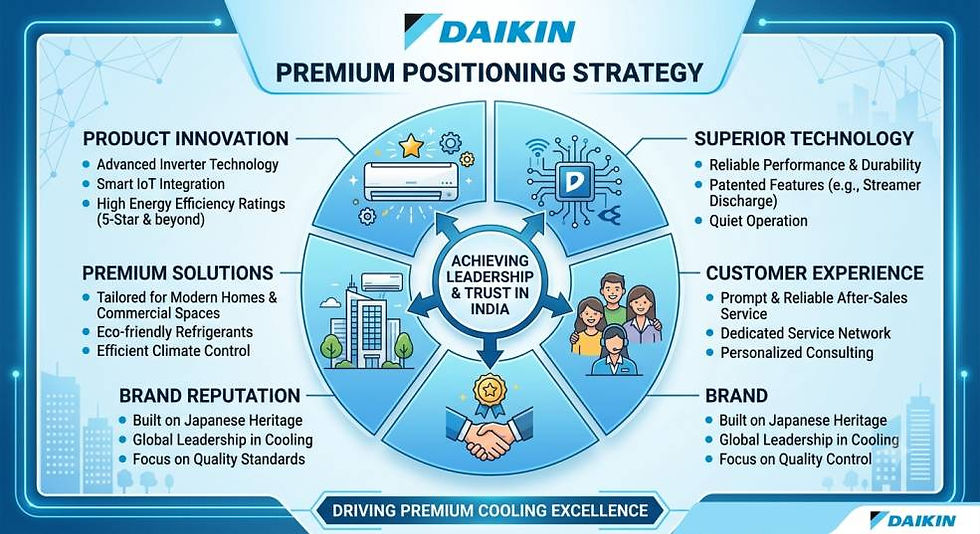
Brand Situation Prior to the Premium Positioning Strategy
Daikin's presence in India began with imports from the parent company's Japan, Thailand, and Malaysia facilities, according to ICRA's rating rationale for DAIPL, before the company commenced domestic chiller production in 2009 from its own manufacturing unit. Earlier in its India history, the company also operated as a joint venture under the name Daikin-Shriram Airconditioning, established in New Delhi as an air conditioning systems sales company, per Daikin's own corporate timeline. This origin as an import-dependent, joint-venture entrant placed Daikin in a position common to many global HVAC and electronics brands entering India in the 2000s: technologically credible but commercially unproven at scale, competing against established domestic and multinational incumbents with deeper distribution networks. The subsequent localization of manufacturing — beginning with chillers in 2009 and expanding over the following fifteen years to room air conditioners, compressors, and printed circuit boards (PCBs) across plants in Neemrana (Rajasthan) and Sri City (Andhra Pradesh), the latter inaugurated as Daikin's third Indian manufacturing unit according to Indian Retailer's reporting — was the structural precondition that allowed the company to scale volume domestically rather than remain a premium, import-led niche player.
Strategic Objective
Based on public statements by Daikin India's leadership and the company's documented operational choices, the strategic objective underpinning its positioning can be characterized as building and defending technological and brand premium leadership — particularly in VRV/commercial air conditioning, where ICRA's rating report explicitly states DAIPL "remains the market leader" — while simultaneously scaling residential volume aggressively enough to capture share of India's still-nascent mass household AC penetration, without abandoning premium pricing as the core differentiator against lower-priced domestic and Korean competitors. CEO Kanwal Jeet Jawa's public comments reinforce this framing directly: in September 2024 reporting, he stated that Indian consumers "don't look at cheap products anymore and want value for money," a positioning statement that explicitly rejects price-led competition in favor of a value/quality narrative, even as the company pursues mass-market volume growth. Separately, in 2023 reporting following Daikin India crossing the $1 billion turnover milestone, Jawa stated the company held "top shares in every segment which we operate — VRV, chillers and room air conditioners," indicating that segment leadership across the full commercial-to-residential portfolio, rather than volume share alone, was the explicit internal benchmark of success.
Campaign Architecture & Execution (Strategic and Operational Architecture)
Daikin's premium positioning has been executed primarily through four documented, interlinked operational levers rather than a single advertising campaign, consistent with the nature of B2B-adjacent durable goods marketing in this category.
Manufacturing localization paired with premium technology retention. Daikin progressively localized production of compressors and PCBs in India — per industry analysis (SOIC), the company has been "localizing aggressively" across these components — while continuing to position its inverter technology, eco-friendly refrigerants, and smart/connected systems as differentiators against lower-cost rivals. This combination allowed the company to reduce import costs and improve price competitiveness within its premium tier, without fully abandoning the premium tier itself. ICRA's report further notes that DAIPL has begun manufacturing critical components in-house specifically to ease margin pressure from input cost volatility, indicating localization was also a documented response to profitability constraints, not solely a growth-volume play.
Capacity expansion signaling long-term commitment. Daikin announced in September 2024 a memorandum of understanding to acquire an additional 33 acres (13.4 hectares) adjacent to its existing southern India facility, alongside its three existing manufacturing plants. Jawa's public commentary tied this expansion explicitly to a long-term residential AC market forecast of approximately threefold growth to around 30 million units by 2030, and to a broader company target of exporting Indian-made air conditioners to 100 countries across Africa, the Middle East, and South America by March 2026 — positioning India not just as a sales market but as a global manufacturing and export base for the Daikin group, a status that reinforces the brand's technological credibility domestically.
Multi-channel premium distribution. ICRA's rating rationale documents that DAIPL's distribution network comprises over 14,700 touch points, with the company deriving maximum revenue from its dealer and distributor channel, followed by regional and national retail chains, company-branded "Daikin Solutions Plaza" exclusive showrooms, e-commerce platforms, and general AC and consumer durable dealers. The dedicated Solutions Plaza retail format — branded showrooms operated by authorized dealers exclusively for Daikin products — functions as a premium brand-environment channel distinct from multi-brand retail, consistent with positioning strategies used by other premium durable goods brands to control the in-store brand experience.
Segment-led credibility transfer from commercial to residential. Because Daikin's documented market leadership is strongest in the VRV/commercial segment (an estimated 60% share per TechSci Research), the company's residential AC marketing benefits from an implicit credibility transfer: a brand proven in large-scale commercial and institutional cooling projects carries technical authority into the household segment, a positioning advantage not equally available to RAC-focused competitors like Voltas or Lloyd, whose commercial-segment presence is comparatively limited.
Positioning & Consumer Insight
The consumer insight underlying Daikin's strategy, as reflected in CEO Jawa's public statements, is that rising Indian disposable income and improved access to financing (EMI-based purchasing and online retail) have shifted purchase criteria away from pure price minimization toward a "value for money" framework in which brand reliability, energy efficiency (and therefore lower lifetime electricity cost), and technological credibility justify a price premium. This is consistent with broader documented industry dynamics: market research cited in trade press attributes overall Indian AC market growth in part to "increasing awareness of energy-efficient appliances" and "adoption of inverter technology," suggesting the energy-efficiency value proposition central to Daikin's brand narrative aligns with a documented broader market shift, not merely a company-specific claim. Daikin's positioning explicitly does not target the most price-sensitive segment of the market, where competitors like Havells' Lloyd brand compete aggressively on affordability and Tier 2/3 distribution reach. Instead, available reporting indicates Daikin's strategy accepts a trade-off — premium pricing constraining penetration among value-conscious buyers in smaller towns, as explicitly noted in industry analysis — in exchange for higher per-unit realization and stronger margins in segments willing to pay for the brand's technology and service credentials.
Media & Channel Strategy
No verified public information is available on Daikin India's specific advertising agency relationships, media spend by channel, celebrity endorsement contracts, or digital marketing campaign metrics. Publicly documented channel strategy is limited to the distribution architecture described above (dealer/distributor network, retail chains, branded Solutions Plaza showrooms, and e-commerce), as disclosed in ICRA's published credit rating rationale for DAIPL. The company's broader Japanese parent, Daikin Industries Ltd., has disclosed in its FY2024 investor presentation that in markets such as Japan it pursues "user-direct offline retail sales with online activities such as live broadcasting using showrooms, web advertising, and SNS [social media]" for residential air conditioning; however, this disclosure pertains to Daikin's Japan operations specifically, and no equivalent India-specific breakdown of media or digital marketing tactics is available in the sources reviewed for this case.
Business & Brand Outcomes
Daikin India's financial trajectory is well documented through company statements, credit rating disclosures, and press coverage. The company surpassed $1 billion in turnover in fiscal year 2023 (year ended March 31, 2023), reporting revenue of ₹8,860 crore, according to PTI reporting carried by Swarajya. At the time, Jawa stated an expectation for India turnover to roughly double to $2 billion within three years, targeting approximately ₹16,350 crore. Daikin became only the second company in India's cooling industry, after Voltas (which reported ₹9,667 crore total income for the same fiscal year), to cross the $1 billion milestone. In the quarter through June 2024, Daikin sold approximately 700,000 air conditioner units in India, with sales up approximately 40% year-on-year in local-currency terms, according to Bloomberg reporting carried by Business Standard and The Japan Times. Industry analysis (SOIC) separately reports Daikin scaling toward 2 million residential AC units sold in India in FY25, with a longer-term company ambition cited at 5 million units by 2030, alongside continued localization of compressors and PCB components. ICRA's published rating rationale confirms DAIPL received a ₹600 crore equity infusion from parent Daikin Industries Ltd. in June 2024 to fund ongoing capital expenditure, and states that the company "remains the market leader in the VRV segment and maintains a healthy and increasing market share in inverter RACs" — though ICRA does not disclose an exact numerical share figure in the publicly available excerpt of its report. ICRA also documents that DAIPL's operating profit margin (OPM) moderated in FY2022 and FY2023 due to input cost volatility, partially offset by the company's own price increases across product categories and in-house component manufacturing. Beyond air conditioning, Jawa has also publicly stated an ambition for Daikin's India commercial refrigeration business — serving customers including Blinkit (referred to as "Blink Commerce" in Business Standard's reporting) — to grow to approximately ₹1,000 crore (around $119.1 million) in annual revenue by 2030, indicating category expansion alongside the core premium AC business.
Strategic Implications
Daikin's India strategy illustrates a distinct path to premium-brand market leadership in a price-sensitive, high-growth emerging market: rather than compromising on pricing to chase volume share against domestic value players, the company has used backward-integrated local manufacturing to defend margin and reduce cost exposure within its premium tier, while relying on demonstrated commercial-segment dominance (VRV) to lend technical credibility to its residential consumer proposition. This sequencing — establish category authority in the higher-value, lower-volume commercial segment, then extend that authority into mass residential demand — is a structurally different playbook from competitors who built residential scale first (Voltas) or who lead with broad multi-category distribution reach (Havells/Lloyd). The strategy's central trade-off is explicitly acknowledged in industry commentary: premium pricing constrains penetration among India's large and price-sensitive Tier 2/3 population, even as that very segment represents the bulk of the country's largely untapped AC demand (the 93% of households without an AC cited by Jawa). Daikin's stated long-term volume targets (2 million units in FY25, scaling toward 5 million by 2030) suggest the company is attempting to grow into this mass-market opportunity without fully relinquishing its premium positioning — a strategy that depends on continued cost reduction through localization to narrow the price gap with mass-market competitors while preserving the brand's quality and technology narrative. Finally, Daikin India's growing role as an export manufacturing base — targeting 100 export countries by March 2026, per Jawa's public statement — signals a strategic evolution from "premium import brand localizing for cost reasons" to "premium global manufacturing hub," a positioning that, if sustained, could further reinforce the brand's technological credibility domestically by demonstrating that Indian-made Daikin products meet global Daikin quality standards rather than representing a downgraded, India-specific product tier.
Discussion Questions
Daikin's premium positioning in India is built substantially on its dominance in the commercial VRV segment rather than residential advertising. How transferable is B2B/commercial category authority to consumer purchase decisions in a durable goods category, and what risks does this credibility-transfer strategy carry if a competitor closes the technology gap in commercial cooling?
Industry commentary explicitly notes that Daikin's premium pricing "limits deep penetration into value-conscious buyers, especially in smaller towns." Given that the bulk of India's unmet AC demand sits in this price-sensitive segment, how should Daikin balance continued premium positioning against the risk of ceding long-term volume leadership to mass-market competitors like Voltas or Lloyd?
Daikin has pursued aggressive localization of compressors and PCBs, partly in response to documented operating margin pressure from input cost volatility (per ICRA). How does manufacturing localization function simultaneously as a cost strategy and a brand strategy in this case, and could over-localization eventually dilute the "imported Japanese technology" premium cue that underpins the brand's positioning?
With Daikin India positioned to become a global export manufacturing hub for the Daikin group (targeting 100 export markets by March 2026), what are the strategic implications of shifting India's role from "premium import market" to "premium production base" for how Indian consumers perceive the brand's authenticity and quality?
Daikin's strategy combines premium pricing with rapid volume scaling targets (2 million units in FY25, 5 million by 2030). From a brand architecture perspective, what risks does rapid volume growth pose to a brand whose differentiation has historically rested on exclusivity-adjacent premium positioning, and how might Daikin manage this tension as it scales?


Comments