From a Village in Gujarat to America's Biggest Indian Grocery Empire: The Unstoppable Story of Patel Brothers
- Apr 30
- 5 min read
There is a particular kind of hunger that no restaurant can fix. It is not hunger for food exactly — it is hunger for home. For the smell of turmeric hitting hot oil, for the weight of a bag of basmati in your hands, for the quiet comfort of eating something that tastes exactly like your mother made it. That hunger is what built one of America's most beloved retail empires — and it all started with one young man from a small village in Gujarat who simply couldn't find good Indian food in Chicago.
Mafat Patel grew up in Bhandu village in the Mehsana district of Gujarat, India. He was ambitious, sharp, and restless. He moved from Ohio to Chicago to work as an engineer at Jefferson Electrical Co. after finishing his business degree. By every external measure, life was going well. He had a job, a city, a future. But something was missing every single evening when it was time to eat.
Mafat started missing the Indian food and ingredients that he grew up with — khichdi, turmeric, rice flour, and so much more. He would look at the shelves of American grocery stores and find nothing that spoke his language. Mafat found that Indian groceries were very expensive and scarce in Chicago. But the more he paid attention, the more he realised this wasn't just his problem. Groceries were all but impossible to find. If families had the ingredients they needed, they probably brought them from back home, packed tightly into check-in suitcases or mailed in bulk by family members on the subcontinent.
The missing piece for an entire community was a hot Indian meal at the end of the day. That realisation — that his longing was a shared, collective ache — changed everything.
An opportunity arose in 1971 when Ramesh Trivedi approached Mafat with a storefront for sale on Devon Avenue. Mafat immediately recognised it as a business opportunity and a platform to sell Indian grocery items across the USA. But he knew he couldn't do it alone. Running a grocery store was a different beast altogether from engineering. So Mafat did what families do — he called his brother.
After talking his brother Tulsi Patel and sister-in-law Aruna into joining him in Chicago, he turned his tiny storefront into the nation's first Patel Brothers. Though Tulsi and his wife Aruna made the pilgrimage to Chicago in 1971 just to aid Mafat in this undertaking, it took three years for them to sort out the logistics and open the first Patel Brothers store in September of 1974.
It began as a modest operation — a sparse, dingy 900-square-foot store with little in the way of anatomical logic. Shelves were disorganised and cluttered, while the then-three family members, the store's sole staffers, traded shifts between 9AM and 9PM; on their off-hours, the men would go to their second jobs.
There were days, as Aruna Patel would later recall, when the cash register never opened. Days when the footfall was thin and the future was uncertain. But the Patels didn't leave. They stocked shelves, greeted every customer, and kept showing up. Word travels fast inside an immigrant community. One family tells another. An auntie recommends it to her neighbour. A newcomer from Ahmedabad, fresh off the plane and disoriented in a new country, walks into Devon Avenue and hears Gujarati for the first time in weeks. Devon Avenue exploded in tandem with Patel Brothers.
What made the store different wasn't just the products — it was the breadth of the vision. "Gujaratis shopped at Gujarati stores, people from the South shopped at separate stores," said Happie Dutt, a historian who had frequented Devon Avenue since 1976. "[Mafat] brought a broad base of items that would meet the needs of all South Asians." In the same aisles that carried ingredients for chole masala and aloo gobi, there were South Indian rasams, sambars, and uttapam. Patel Brothers wasn't just a Gujarati store. It was a South Asian store — and that distinction mattered enormously.
As the immigrant population grew, so did the business. Many relatives would stay and work at the Patel Brothers store on Devon Avenue for a few weeks or months. After that, Mafat and Tulsi would help them set up their own stores or branches of Patel Brothers in other cities with burgeoning NRI populations, like Atlanta, Connecticut, New York and Houston.
Then came the next chapter. In the early 1990s, Swetal and his brother Rakesh, both decided to put their degrees in Finance and Marketing to use. Rakesh recognised that there was a new generation of Indian-Americans experiencing a clamoring much like that of their predecessors — they were working long hours, and they missed their parents' food.
In 1991, they introduced a variety of authentic foods under the umbrella of Raja Foods LLC, which supplies 60% of Patel Brothers products. Raja Foods LLC operates under seven brands, three of which are Patel Brothers original brands. SWAD — meaning "taste" in Hindi — is the main brand and the largest selling Indian food brand in the USA.
The family hadn't just built a store. They had built an ecosystem.
A typical day at the store sees children running through the aisles, insisting their parents buy them malai kulfi. Aunties dressed in their saris and sneakers wait for their fresh roti at the bakery, while uncles surround a screen playing the cricket match from the morning. These are not scenes from a movie. This is Devon Avenue on any given weekend — a living, breathing piece of India planted firmly in the American Midwest. The original store was rebuilt in a $3.5 million revamp in 2021 as an ode to the founders and the starting point of the chain.
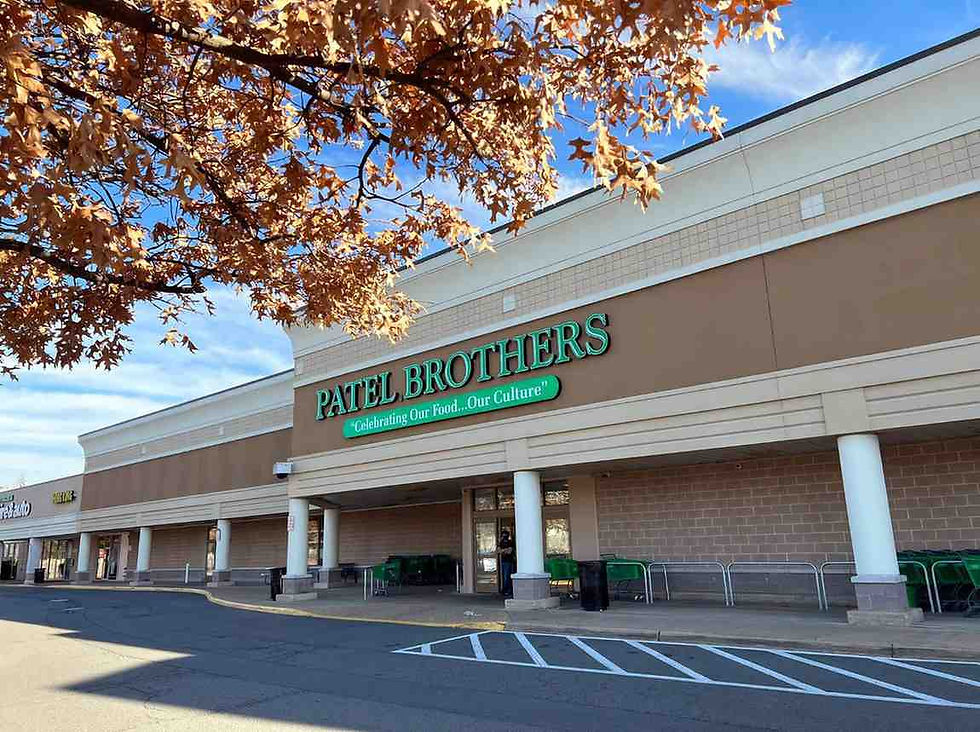
The giving didn't stop at the store counter either. Back in India, Mafat helped build a hospital as well as multiple water bodies in his native village, Bhandu. In Ahmedabad, the Patel brothers established the Samvedana Foundation, which built 160 houses, a school and a medical centre in Kutch — the colony is called Chicago Township — after the Gujarat earthquake. Today, Patel Brothers is the world's largest supermarket chain serving the Indian diaspora, with 52 locations in 20 US states, and is operated by three generations of the family since its inception.
"There was a growing Indian community, but nothing for us to eat," Tulsi Patel said, his eyes glistening with tears. "There was only a sari store when I started, and it was very hard."
From a 900-square-foot store with a cash register that sometimes sat silent all day, to an empire that feeds millions of South Asians across America — Patel Brothers is proof that the most powerful businesses are not built from business plans. They are built from hunger, from brotherhood, and from the unshakeable belief that a community deserves to feel at home, wherever in the world it happens to land.


Comments