Hit Spray's Instant Action Campaign Messaging
- 1 hour ago
- 10 min read
Industry & Competitive Context
Godrej Consumer Products Ltd (GCPL) is a major player in the Indian FMCG market with leadership in the hair color and fabric care categories, and is also one of the largest marketers of toilet soaps in the country. The HIT brand sits within GCPL's household insecticides portfolio. A joint venture between Godrej Group, India, and Sara Lee Corporation, USA, was formed in 1991 with a 49:51 shareholding respectively, which became the market leader in the Indian household insecticides category and acquired Trans Elektra Domestic Products Ltd — the makers of Good Knight and Hit — in 1994. HIT is the market leader in the mosquito aerosol category, which is pegged at INR 570 crore. Aerosols form part of the broader INR 7,400 crore household insecticides category, which also includes liquid vaporisers and burning formats such as incense sticks and coils. GCPL ranks among the largest Household Insecticides, Air Care, and Hair Care players in emerging markets of India, Indonesia, and Africa. In Household Insecticides, the company is the leader in India, the second largest player in Indonesia, and is expanding its footprint in Africa. Within this category, multiple formats compete on different efficacy and price propositions. In an industry case analysis covering the broader vaporizer segment, major Indian players were identified as Good Knight (Godrej), All Out (SC Johnson), Mortein (Reckitt Benckiser), and Maxo (Jyothi Labs), among others including Odomos, Baygon, and Tortoise. The aerosol/spray format, which HIT occupies, is positioned distinctly from these slower-acting formats due to its instant-kill mechanism of action.
Brand Situation Prior to Campaign
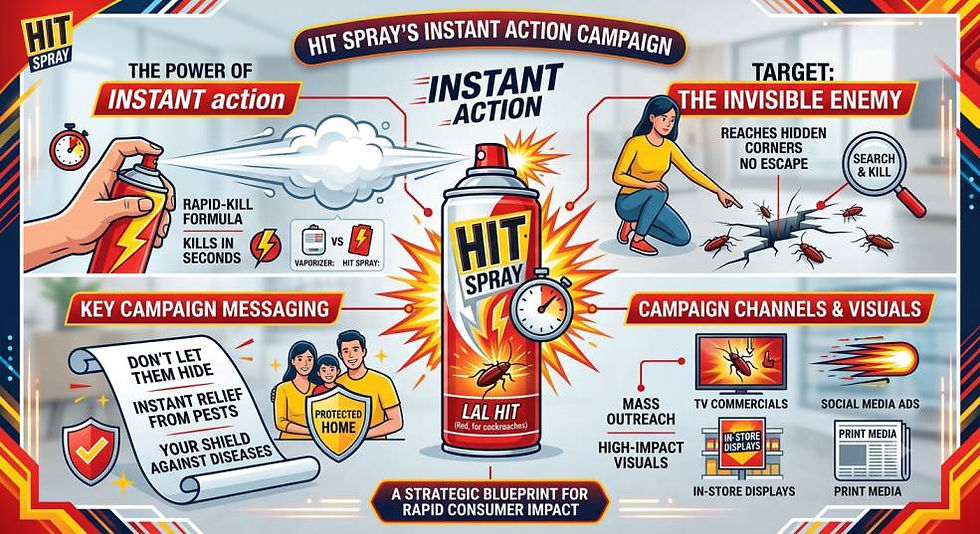
HIT's brand philosophy has long been anchored in an educational, disease-prevention framing rather than purely a comfort or convenience proposition. True to the brand philosophy of "Kill Pests Kill Diseases," HIT has taken its role as an educator seriously, for years communicating about how malaria is a threat that needs to be taken seriously, and over recent years extending its communication to include dengue as well. This educational positioning was also extended into structured public health outreach. An insecticide company undertook a nationwide campaign called "HIT Kill Malaria," carried out in partnership with the Mysore City Corporation, which saw participation from over ten schools and housing societies and reached approximately ten lakh families across the country, distributing informative handouts in schools about malaria symptoms and preventive measures, and organising quiz contests and street plays (the latter through an NGO called Credit-i). Kapil Dev Pillai, then category head for household insecticides at Godrej Consumer Products, stated that the company's experience indicated people held strong misconceptions about malaria — for instance, the common notion that it is prevalent only in high mosquito-infested areas or during the monsoon season — and that the "Hit Kill Malaria" campaign was focused on mitigating such misconceptions and creating a strong need for preventive measures. By 2015, the brand had identified a specific gap in consumer understanding that would inform later "instant action" messaging: the idea that mosquitoes are not always visible or airborne but often hide in specific locations within the home. Godrej Kala Hit and Lowe Lintas Mumbai unveiled a campaign built on the finding that mosquitoes hide in dark corners inside homes, safe from various mosquito repellents. The campaign communicated the message "ghar ke har kone mein hai danger" (there is danger in every corner of the house), revealing common hiding places such as under beds and sofas, and behind curtains or cupboards. Being an aerosol, Kala Hit was positioned as having the ability to reach mosquitoes in these hide-outs and eliminate them.
Strategic Objective
The documented strategic objective across HIT's spray campaigns has been to reinforce the brand's core differentiator — immediacy and certainty of kill — against competing formats (vaporizers, coils, mats) that work passively over time, while simultaneously expanding the product line to address price-sensitive and format-sensitive consumer segments. This dual objective is evident in the 2022 Kala HIT Lime campaign messaging. Somasree Bose Awasthi, then Chief Marketing Officer of Godrej Consumer Products Limited (India), stated that "by consistently driving the message that even a single mosquito can spread deadly diseases like dengue and malaria, Godrej Kala HIT has built consumer relevance," and that "since it is now monsoon, mosquitoes pose an even greater risk of infection and disease. The new TVC emphasizes the importance of killing them immediately. The only mosquito killer that is guaranteed to kill mosquitoes instantly is Kala HIT". She added that "the HIT brand has been trusted by its consumers because it has delivered on its promise". The 2023 Kala HIT Mini launch reflects a parallel strategic objective: extending the instant-action proposition into a more affordable format to widen category penetration. Shekhar Saurabh, Category Head – Household Insecticide at GCPL, stated that "as lower income households have smaller rooms, expensive LPG based aerosol spray (designed for big rooms) is not the most suitable solution for them. To make the format affordable, HIT took the inspiration from no-gas deodorants and developed Kala HIT Mini no-gas spray. This product makes safe & smoke-free mosquito protection accessible for everyone, especially lower income households".
Campaign Architecture & Execution
HIT's spray campaigns have consistently used a narrative architecture built around a protective parent (typically a mother) responding instantly and decisively to a visualised mosquito threat to a child, with the spray product functioning as the resolution mechanism within seconds of the threat being identified. The 2022 Kala HIT Lime campaign followed this structure explicitly. The film opens with a child playing with his toys when a mosquito's shadow is seen covering him as it approaches to bite. The sight of a dangerous mosquito near her child awakens the mother's protective side, and she instantly swings into action, picking up a can of Kala HIT. When she sprays it on the mosquito, its aerosol particles, shaped like tiny missiles, promptly eliminate the mosquito for good. The TVC was described as highlighting how the product is an "instant killer of mosquitoes," with the new TVC emphasizing "that dark yet firm and protective side of mothers". The 2023 Kala HIT Mini campaign used a similar protective-parent narrative but layered in an affordability message tied to the product's positioning. Conceptualised by Bates CHI and Partners Indonesia, the film opens with a mother and child happily engrossed in filling up a piggy bank with money when a mosquito's silhouette buzzes past the child. The mother turns around to see multiple shadows of deadly mosquitoes looming across the room, and this awakens her protective side. A single Rs 50 rupee note flies across the room into her hand and transforms into the new Kala HIT Mini no-gas spray. Like a superhero, the mother sprays Kala HIT Mini, which leads to an instant knock-down effect on mosquitoes. The TVC was conceptualized to emphasise how Kala HIT Mini offers instant protection during high-mosquito infestation at an economical price point, and to spread awareness of this format while highlighting how the innovation empowers people to be protected from mosquitoes. More recently, the "instant action" proposition has been extended into a technology-enabled product format. Godrej Consumer Products Limited officially launched the HIT Spray Matic, described as an automatic mosquito spray device and the first of its kind registered by the government in India. The product aims to enhance mosquito control in households, delivering instant protection against mosquito-borne diseases, and is exclusively available on Amazon India. The HIT Spray Matic operates on an automatic daily cycle that releases a spray every two hours for up to six hours, providing 12 hours of continuous protection. Godrej HIT Spray Matic is described as India's only government-registered automatic mosquito spray device, designed to eliminate the threat of mosquitoes instantly, setting a new benchmark in mosquito control and elimination. By launching this product, Godrej HIT has attempted to merge both aerosol and technology into one device to deliver instant protection from mosquitoes.
Positioning & Consumer Insight
The consumer insight underlying HIT's instant-action messaging is built on the premise that visible, immediate threat resolution carries greater emotional and functional reassurance than passive, ambient protection — a distinction relevant in a category where competing formats (liquid vaporizers, coils, mats) operate through slow, continuous diffusion rather than direct, observable action against a specific threat. This is most explicit in the "missile" visual metaphor used in the 2022 campaign, where aerosol particles are depicted as "shaped like tiny missiles" that "promptly eliminate mosquitoes for good" — a depiction designed to visualise the speed and certainty of the kill mechanism in a way that ambient or vaporizer-based products cannot replicate. The location-based insight from the 2015 campaign — that mosquitoes hide in dark corners inside homes, safe from various mosquito repellents, with common hiding places including under beds and sofas, and behind curtains or cupboards — provides a complementary positioning rationale for the aerosol/spray format specifically: unlike a stationary vaporizer that treats ambient air in a room, a spray can be directed at specific hiding locations, reinforcing an "instant, targeted action" proposition versus "passive, ambient" alternatives. The Kala HIT Mini campaign's insight addresses a structural barrier to category penetration among price-sensitive households. The insight was that lower-income households, having smaller rooms, found expensive LPG-based aerosol sprays (designed for larger rooms) unsuitable, creating a need for an affordable no-gas format inspired by deodorant technology, which the brand positioned as making "safe & smoke-free mosquito protection accessible for everyone, especially lower-income households". The HIT Gel Stick launch reflects a related insight regarding the cockroach sub-category, focused on entry-point interception rather than instant visible kill, though within the same broader "Kill Pests Kill Diseases" philosophy. GCPL noted that while 80% of average Indian households grapple with cockroach problems, only 8% resort to branded solutions to combat them, citing a lack of awareness about food poisoning spread by cockroaches as a barrier preventing housewives from choosing specialist solutions. The HIT Gel Stick campaign, with the tagline "HIT Gel Stick, Cockroaches Ko Ghustey Hi Maare" (kills cockroaches right as they enter), was designed to highlight the product's key offering of killing cockroaches right at the entry point and preserving household hygiene.
Media & Channel Strategy
The documented campaigns relied primarily on television commercials (TVCs) as the lead format, supplemented by nationwide grassroots outreach for educational campaigns. The 2015 "ghar ke har kone mein hai danger" campaign was created by Godrej Kala Hit in partnership with advertising agency Lowe Lintas Mumbai. The 2023 Kala HIT Mini campaign was conceptualised by Bates CHI & Partners Indonesia and disseminated via TVC. For the educational/public health initiative, the channel strategy combined institutional partnerships with on-ground community activation. The "HIT Kill Malaria" campaign was carried out in partnership with the Mysore City Corporation, involving participation from over ten schools and housing societies, with informative handouts distributed in schools, quiz contests for students in higher classes, and street plays organised at the housing society level through NGO partner Credit-i. For the HIT Spray Matic launch, the channel strategy was notable for its exclusivity to a single e-commerce platform. The HIT Spray Matic was made available exclusively on Amazon India, a channel decision that aligns with the product's positioning as a premium, technology-driven device rather than a mass-market aerosol sold through general trade.
Business & Brand Outcomes
On category leadership, HIT is documented as the market leader in the mosquito aerosol category, valued at INR 570 crore, within the broader INR 7,400 crore household insecticides category. On the rationale for product line extension, GCPL's own framing in the HIT Spray Matic launch references third-party market research to justify the strategic direction. According to Redseer's report "Unlocking Convenience: The Indian Smart Home Revolution," smart home device penetration in India rose to 8-10% in 2023, up from less than 4% pre-COVID, with adoption expected to reach 12-15% by 2025 and 25-28% by 2028, driven by increasing internet access, with 55% of the population now online. A separate citation of the same Redseer findings notes the 12-15% penetration expectation by 2025. On qualitative early-market reception for the Spray Matic, Shilpa Suresh, Head of Marketing – Home Care at GCPL, stated: "The early response from our exclusive launch on Amazon has been exceptionally positive, reinforcing our belief that HIT Spray Matic" would redefine mosquito protection in Indian homes — though this statement does not constitute a quantified sales or market-share outcome. At a corporate level, GCPL's stock had risen 29% over the preceding year and 6% over the preceding month as of the relevant reporting period, with gross margin recovery and continued marketing investments expected to translate to strong double-digit EBITDA growth, though this figure reflects overall company performance rather than HIT-specific outcomes.
Strategic Implications
The HIT spray campaigns illustrate a category-differentiation strategy built on format-specific mechanism-of-action storytelling: rather than competing on general claims of "protection" common across mosquito repellent formats, HIT's communication consistently visualises the speed and finality of the aerosol's kill action (the "missile" particle imagery, the "instant knock-down effect," and the "swings into action" narrative beat), creating a distinct emotional register — urgency and decisive resolution — that is harder for slower-acting formats (vaporizers, coils) to credibly replicate in their own communication. The brand's parallel investment in educational, disease-linked messaging ("Kill Pests Kill Diseases," the malaria and dengue awareness campaigns, and the "mosquitoes hide in corners" insight) provides a rational, health-based justification that complements the emotionally-driven "instant action" creative executions — suggesting a dual-track communication strategy where rational disease-risk arguments build category necessity, while emotionally charged instant-action creative drives brand and format preference within that necessity. The Kala HIT Mini and HIT Spray Matic launches represent two divergent extensions of the same "instant action" core proposition along the price-format spectrum: Kala HIT Mini extends the instant-spray proposition downward into price-sensitive, smaller-room households via a no-gas format inspired by an adjacent category (deodorants), while HIT Spray Matic extends it upward into a premium, technology-enabled, subscription-like automatic device sold through a single premium e-commerce channel. This bidirectional extension suggests a strategy of defending and growing the aerosol/spray segment's overall category share by capturing both the value end and the premium end of the market, rather than ceding either segment to format-specific competitors (no-gas deodorant-style products at the low end, or smart-home device entrants at the high end). Finally, the use of different creative and media agencies across campaigns (Lowe Lintas Mumbai for the 2015 campaign, Bates CHI & Partners Indonesia for the 2023 Kala HIT Mini campaign) while maintaining message consistency around "instant action" and disease-prevention themes suggests that the brand's positioning architecture is governed centrally (likely through GCPL's category marketing leadership, as referenced by category heads and CMOs quoted across these releases) even as creative execution is distributed across multiple agency partners — a structure that supports message consistency across a geographically and demographically diverse market while allowing creative diversity in execution.
Discussion Questions
HIT's campaigns consistently use a "protective parent responds instantly to visualised threat" narrative structure across multiple product variants (Kala HIT Lime, Kala HIT Mini). What are the risks of over-reliance on a single emotional narrative template across a product portfolio, and how might a brand balance creative consistency with the need for differentiated messaging across price-tier variants?
The Kala HIT Mini campaign explicitly targets lower-income households with a no-gas, affordable format, while HIT Spray Matic targets a premium, technology-savvy segment via Amazon exclusivity. Discuss the brand architecture implications of a single master brand (HIT) spanning such a wide price and technology spectrum, and the risks of brand dilution versus the benefits of category coverage.
HIT's "instant action" positioning is built on a mechanism-of-action claim (immediate, visible kill) that is structurally difficult for vaporizer or coil-based competitors to replicate. How sustainable is a positioning strategy anchored to a product format's inherent physical properties, and what would a competitor need to do to neutralize this advantage?
The "HIT Kill Malaria" campaign combined corporate brand messaging with public health partnerships (Mysore City Corporation, NGO Credit-i, schools). Evaluate the strategic value of embedding a commercial brand within public health education initiatives, including potential reputational risks if disease outcomes do not improve despite the campaign's reach.
GCPL justified the HIT Spray Matic launch by referencing third-party (Redseer) smart home adoption forecasts rather than HIT-specific consumer research. What are the risks of using category-level (smart home) adoption trends to justify a brand-specific product launch in a different category (pest control), and how should marketers validate such cross-category demand assumptions?


Comments