Licious’ Insight into Hygiene Concerns in Meat Consumption
- 8 hours ago
- 6 min read
Industry & Competitive Context
When Licious entered the Indian meat and seafood market, it operated within a category that was overwhelmingly unorganized. Multiple industry reports and public analyses consistently noted that most meat purchases in India were conducted through neighborhood butcher shops, wet markets, and fragmented local supply chains.
The category faced structural trust challenges. Consumers often had limited visibility into sourcing, storage conditions, slaughtering practices, cold-chain management, and hygiene standards. Unlike packaged food categories that had undergone significant brand-led formalization, fresh meat remained largely dependent on local vendors and informal quality assessment mechanisms.
This environment created a unique marketing challenge. Unlike categories where brands competed primarily on taste, pricing, or convenience, fresh meat consumption involved perceived food-safety risks. Consumer evaluation often depended on visual inspection, smell, freshness cues, and trust in local sellers.
Industry commentary published across business and supply-chain publications repeatedly highlighted concerns regarding hygiene, cross-contamination, inconsistent storage conditions, and the absence of organized cold-chain infrastructure within large portions of the market.
Within this context, the emergence of organized direct-to-consumer meat brands represented not merely a retail innovation but an attempt to institutionalize trust in a category historically governed by informal relationships and local purchasing habits.
Brand Situation Prior to Campaign
Publicly available company communication and industry reporting indicate that Licious identified a significant gap between rising urban consumer expectations and the prevailing conditions of meat retailing.
The company repeatedly positioned itself around themes of freshness, hygiene, quality assurance, and controlled sourcing. This positioning reflected a broader market reality: many consumers lacked confidence in traditional meat-purchasing environments, particularly in urban areas where convenience, food safety awareness, and premium food consumption were increasing.
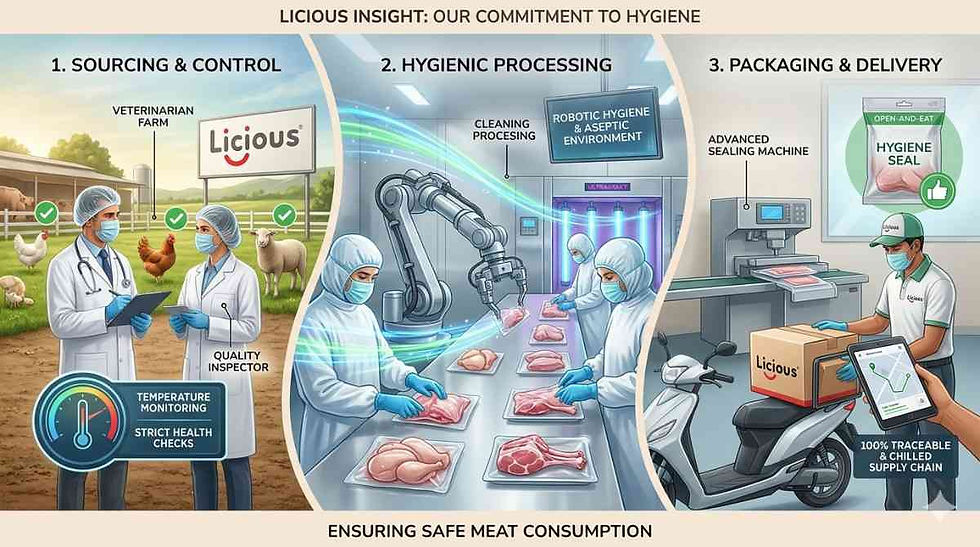
Public reports described the company's early thesis as addressing consumer discomfort with inconsistent meat quality and unhygienic retail conditions. The company’s messaging frequently emphasized controlled sourcing, temperature-managed processing, quality checks, and end-to-end cold-chain management.
Rather than framing itself solely as an e-commerce platform, Licious increasingly presented itself as a trust-led food brand operating in a category where consumer confidence represented a major barrier to premiumization.
Strategic Objective
Based on publicly documented company communication, Licious’ strategic objective was not simply to sell meat online.
The broader objective was to address consumer concerns regarding hygiene, freshness, safety, and quality consistency while creating a branded alternative to unorganized meat retail.
The company’s communication consistently focused on reducing uncertainty in meat consumption decisions. In a category where consumers traditionally relied on sensory inspection and local familiarity, Licious sought to replace informal trust mechanisms with standardized quality assurance signals.
The strategy reflected an important marketing insight: in categories associated with health and food safety concerns, reducing perceived risk can become a stronger value proposition than price competition.
Campaign Architecture & Execution
Publicly available information suggests that Licious built its marketing architecture around demonstrable hygiene and quality-control claims rather than purely emotional branding narratives.
Across company communications, safety pages, product information, and quality reports, the company repeatedly highlighted operational controls intended to reassure consumers about product handling and food safety.
The company publicly stated that its products undergo more than 150 quality and safety checks before delivery. It also emphasized temperature-controlled processing environments, biosecure sourcing practices, cold-chain management, vacuum packaging, and compliance with food-safety standards.
A notable aspect of execution was the decision to make laboratory testing information publicly accessible. The company published external lab reports related to products such as chicken and eggs, including testing information regarding antibiotic residues, microbiological parameters, contaminants, and quality indicators.
This approach moved beyond conventional advertising claims by incorporating third-party testing documentation into consumer-facing communication.
The company also emphasized certification and compliance credentials. Publicly available material states that Licious became India's first meat and seafood brand to receive FSSC 22000 certification, a globally recognized food-safety certification framework.
Rather than relying exclusively on promotional messaging, the company’s execution strategy increasingly used operational transparency as a marketing asset.
Positioning & Consumer Insight
The central consumer insight underlying Licious’ positioning appears consistently across public company communication and industry analyses.
Consumers purchasing meat frequently experience uncertainty regarding hygiene and safety but possess limited means of independently verifying quality.
In traditional retail environments, consumers often evaluate freshness through visual appearance, smell, texture, and personal trust in vendors. However, these mechanisms provide only partial assurance regarding sourcing, handling, contamination risks, or cold-chain integrity.
Licious positioned itself as a solution to this information asymmetry.
The brand’s messaging repeatedly focused on replacing subjective trust with process-based trust. Instead of asking consumers to personally inspect meat quality, the company emphasized standardized systems, documented checks, certifications, testing protocols, and controlled processing environments.
This represented a significant strategic shift in category positioning.
Rather than marketing meat as a commodity, Licious marketed certainty.
The company’s “If we wouldn't feed it to our own families, we won't sell it to you” statement reflected this broader positioning philosophy by connecting operational standards with consumer trust.
The same insight appeared in category-specific campaigns. For example, the company’s “Fresh Nahi Toh Fish Nahi” campaign directly addressed consumer anxiety regarding seafood freshness. Public reporting around the campaign noted that consumers often struggle to confidently assess fish freshness, even when relying on traditional sensory cues. The campaign explicitly framed freshness uncertainty as the core consumer problem and positioned the brand as a solution.
Media & Channel Strategy
No verified public information is available on the complete media-spending allocation for Licious campaigns focused on hygiene concerns.
However, publicly documented communications indicate a multi-channel strategy centered on owned digital platforms, product packaging, quality-report publication, public-relations coverage, and category-focused advertising campaigns.
A distinctive feature of the company’s communication approach was the integration of operational information into marketing communication. Quality reports, testing disclosures, certification claims, and safety explanations became part of the brand narrative rather than remaining purely technical documents.
This strategy allowed the company to communicate trust through evidence-based messaging rather than relying solely on brand storytelling.
Public reports also indicate that category campaigns frequently focused on addressing specific consumer concerns associated with meat and seafood purchases, including freshness assessment and quality assurance.
Business & Brand Outcomes
Only documented outcomes are included below.
Licious achieved significant scale within India's direct-to-consumer meat category and became one of the country's most visible organized meat brands.
The company achieved unicorn status in 2021 after raising funding that valued the business above $1 billion. This development was widely reported by major business publications and reflected investor confidence in the company's category-building strategy.
Public reporting consistently identified hygiene, freshness, quality assurance, and cold-chain control as core components of the company's brand differentiation.
The company also continued expanding public disclosure regarding quality and safety practices, including publication of laboratory testing reports and food-safety information.
No verified public information is available regarding the direct sales impact of individual hygiene-focused campaigns.
No verified public information is available regarding conversion rates, customer acquisition efficiency, retention outcomes, or campaign-specific return on investment associated with hygiene-focused marketing initiatives.
Strategic Implications
The Licious case demonstrates how trust deficits within a category can become the foundation of brand strategy.
In many consumer categories, brands compete by creating preference. In contrast, Licious operated in a market where reducing consumer anxiety represented a primary source of value creation.
The company’s approach suggests that categories characterized by information asymmetry may allow brands to differentiate through transparency, certification, process control, and quality assurance rather than through conventional product messaging alone.
A second strategic implication concerns premiumization.
Fresh meat historically functioned as a relatively undifferentiated category in India. By emphasizing hygiene, traceability, safety standards, and controlled processing, Licious attempted to redefine the basis on which consumers evaluated value.
The company’s marketing strategy effectively shifted the conversation from product attributes alone toward system reliability.
A third implication involves the role of operational capability in brand building.
Many consumer brands separate operations from marketing. In the Licious case, operational systems themselves became marketing assets. Cold-chain infrastructure, testing protocols, certification frameworks, and quality-control processes were incorporated directly into consumer-facing communication.
This integration illustrates how operational transparency can serve as a competitive advantage in categories where trust and safety concerns significantly influence purchase decisions.
At the same time, the case also highlights the challenges associated with trust-based positioning. Public consumer discussions across online forums demonstrate that food-safety perceptions remain highly scrutinized and continuously debated. In categories involving health and consumption, trust must be repeatedly reinforced rather than assumed.
Ultimately, Licious’ growth illustrates how consumer concerns about hygiene and food safety can evolve from a category problem into a brand opportunity when supported by visible quality-assurance mechanisms and verifiable operational standards.
Discussion Questions
How did Licious transform hygiene concerns from a category weakness into a source of competitive differentiation?
In what ways does information asymmetry influence consumer behavior in fresh-food categories?
Can operational transparency create sustainable brand equity in categories traditionally dominated by unorganized retail?
How does trust-based positioning differ from conventional product-based positioning strategies?
What risks do brands face when their differentiation depends heavily on claims related to safety, hygiene, and quality assurance?


Comments