Navratna Oil’s Insight into Heat Relief Needs in India
- 2 days ago
- 10 min read
Industry & Competitive Context
India's Fast-Moving Consumer Goods sector, particularly the personal care and hair oil segment, represents one of the most contested and culturally embedded markets in the world. The hair oil market in India has historically been dominated by a combination of coconut-based, light, and specialty oil categories, with established players such as Marico, Dabur, and Bajaj Consumer Care holding significant positions. Within this competitive landscape, Emami Limited — a Kolkata-headquartered FMCG conglomerate listed on the Bombay Stock Exchange and National Stock Exchange of India — identified and built an entirely differentiated sub-segment: the cooling hair oil category.
India's tropical climate presents a genuine physiological and psychological challenge. With average summer temperatures ranging from 35 to 48 degrees Celsius across large parts of North and Central India, and with humidity adding to discomfort in coastal and eastern regions, the sensation of heat is not a seasonal inconvenience but a persistent national reality for hundreds of millions of consumers. Traditional Ayurvedic practice has long associated head massage and specific herbal formulations with relief from heat and mental fatigue. This deeply embedded cultural belief — that a cool head translates to physical and mental comfort — created a consumer need that was neither adequately served nor explicitly called out by mainstream hair oil brands prior to the emergence of Navratna Oil.
The competitive environment for hair oils in India has traditionally been driven by functional claims around hair nourishment, hair fall prevention, and scalp health. Emami recognized that these were category conventions, and that no brand had yet claimed the psychological and functional territory of cooling relief with sufficient conviction or scale.
Brand Situation Prior to Campaign
Navratna Oil was introduced by Emami Limited as a cooling hair oil formulated with nine key herbal ingredients — the term "Navratna" literally translating to nine gems in Sanskrit, a reference to the nine Ayurvedic herbs used in the formulation. The product positioned itself within the overlap between Ayurvedic tradition and everyday mass-market personal care.
Prior to its sustained mass-market push, the cooling oil segment as a defined category barely existed in the organized FMCG market. Consumers seeking relief from heat largely relied on unbranded or locally manufactured oils, home remedies, or traditional formulations. The organized market had not packaged this need into a scalable, branded proposition with consistent distribution and consumer communication.
Emami's ability to create Navratna Oil as a brand — and subsequently as a category leader — reflects the company's documented strategic focus on identifying white spaces in the Indian personal care market. Emami's publicly available investor presentations and annual reports have consistently described Navratna as one of the company's flagship power brands and a key contributor to its domestic revenue. The brand has been marketed across both the mass and semi-premium segments, with pricing and packaging architecture designed to capture consumers across income tiers in rural, semi-urban, and urban geographies.
No verified public information is available on the specific internal market research instruments, consumer focus group data, or proprietary ethnographic studies that Emami may have commissioned prior to the brand's launch. However, the brand's subsequent communication strategy offers a transparent window into the consumer insight that anchored its positioning.
Strategic Objective
Emami's strategic objective with Navratna Oil was twofold. At the macro level, the company sought to create and own an entirely new functional category within the Indian hair oil market — the cooling oil segment — rather than compete directly in the already crowded nourishment-led hair oil space. At the brand level, the objective was to build mass consumer awareness and behavioral adoption of the cooling oil ritual among Indian consumers who had not previously considered a branded product for heat relief.
This is a textbook example of what marketing strategy scholars describe as market-creating rather than market-penetrating strategy. Instead of targeting existing users of a defined category, Emami needed to educate consumers about a new use occasion — the deliberate application of a cooling oil for heat relief — while simultaneously making the product available and affordable at the scale required to reach India's vast and heterogeneous consumer base.
A secondary strategic objective was brand building through celebrity endorsement and mass media saturation, which has been a hallmark of Emami's broader marketing philosophy across its portfolio. Emami has publicly disclosed its endorsement strategy across annual reports and press releases, and Navratna has been a key example of this approach.
Positioning & Consumer Insight
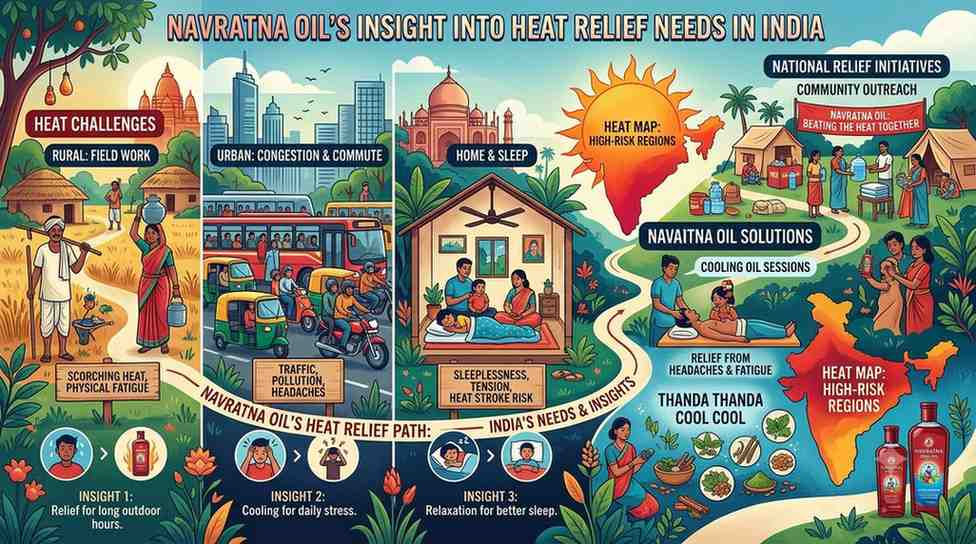
The foundational consumer insight driving Navratna Oil's positioning was elegantly simple and rooted in an observable behavioral truth: Indians living in hot climates experience heat as a source of physical discomfort, fatigue, and irritability, and they actively seek relief through culturally familiar rituals. Head massage with cooling ingredients was already a practiced remedy in millions of Indian households, particularly in North India, but it lacked a branded, organized form.
Emami translated this insight into a positioning statement that could be expressed at the mass-market level: Navratna Oil provides "thanda thanda cool cool" — a cooling, refreshing sensation that relieves the mental and physical burden of India's heat. This tagline, which became one of the most recalled advertising phrases in Indian FMCG history, worked because it spoke directly to an experiential truth rather than a functional claim. Consumers were not being sold hair nourishment or scalp health in the conventional sense; they were being offered relief — a far more emotionally resonant promise in the context of Indian summers.
The insight also leveraged the intersection of Ayurvedic credibility and modern consumer convenience. By grounding the formulation in nine herbal ingredients with traditional legitimacy, Emami ensured that the product did not feel alien or synthetic to consumers with deep cultural trust in natural remedies. At the same time, the branding, packaging, and distribution approach brought modern FMCG efficiency to a ritual that had previously existed only in unorganized or informal forms.
This dual positioning — traditional in ingredient heritage, modern in consumer communication — is a strategic pattern that Emami has deployed across several of its brands. In the case of Navratna, it proved particularly effective because the heat relief occasion is both culturally universal across large parts of India and emotionally high-stakes for the consumer experiencing discomfort.
Campaign Architecture & Execution
Navratna Oil's campaign architecture was built around the concept of experiential demonstration. The brand's advertising, which achieved widespread recall across Indian television audiences, focused not on ingredient education but on showing consumers the immediate, tangible sensation of cooling relief. The campaigns visualized the cooling sensation as a visceral, almost theatrical experience — an approach that effectively communicated a sensory promise through a non-sensory medium.
The brand's long-standing use of Bollywood and cricket celebrities as brand ambassadors was central to its communication strategy. Amitabh Bachchan, one of India's most widely recognized and trusted public figures, served as a brand ambassador for Navratna Oil. This endorsement was publicly visible across television commercials and print media and has been referenced in several credible media reports and advertising industry coverage. The strategic logic of this choice was consistent with Emami's broader documented approach of using high-trust, high-reach celebrity figures to accelerate brand adoption in mass markets where brand salience is a critical purchase driver.
Navratna Oil's advertising consistently used humor, exaggeration, and visual metaphor to make the cooling experience tangible and memorable. The campaigns depicted characters experiencing extreme relief — often in hyperbolic, comic formats — which served both as entertainment and as a mnemonic device. In the highly competitive Indian television advertising environment, this tonal choice differentiated Navratna from the more earnest, benefit-claim-heavy advertising typical of hair oil brands.
No verified public information is available on the specific media spends, campaign budgets, or return on advertising investment for individual Navratna campaigns. Emami Limited's publicly disclosed advertising and promotional expenditure is reported at the consolidated company level in its annual reports and does not break down expenditure by individual brand.
Media & Channel Strategy
Navratna Oil's media strategy, to the extent verifiable from public sources and credible media coverage, was anchored in mass reach television advertising, consistent with the brand's objective of building household penetration across India's diverse geography. Television remains the dominant mass medium for FMCG brands targeting broad Indian consumers, particularly in Tier 2, Tier 3, and rural markets where digital penetration, while growing, has not historically delivered the same reach as broadcast television.
The brand's distribution strategy, as referenced in Emami's public investor communications, leveraged the company's extensive FMCG distribution network across general trade and modern trade channels. Emami has publicly noted its distribution reach spanning millions of retail outlets across India, and Navratna Oil as one of its flagship brands would have been a priority stock-keeping unit within this network. This distribution depth was a critical enabler of the brand's mass-market ambition, ensuring that consumer pull generated by advertising was met with product availability at the point of purchase.
Navratna also extended its product line beyond the core hair oil, with documented variants targeting different consumer occasions and needs. Extensions into body cooling products were part of the brand's effort to broaden the cooling relief platform beyond hair care. These extensions have been referenced in company communications and media reports, indicating that the original consumer insight — India's heat as an unmet need — was seen by Emami as a platform with commercial depth beyond a single SKU.
No verified public information is available on specific digital marketing expenditures, social media campaign ROI, or influencer marketing strategies employed by Navratna Oil as distinct line items in Emami's public disclosures.
Business & Brand Outcomes
Emami Limited's publicly available annual reports and investor presentations have consistently identified Navratna Oil as one of the company's top-performing power brands and a significant contributor to the domestic business. The brand has been referenced in investor communications as a market leader in the cooling oil segment — a segment that Navratna itself played a defining role in creating.
Emami's public financial disclosures, including quarterly earnings presentations and annual reports available through the company's investor relations section and stock exchange filings, reflect the Navratna brand's sustained commercial relevance over multiple decades. The cooling oil category, having been built substantially around Navratna's positioning, represents an organized market space that did not exist in its current form prior to the brand's sustained marketing investment.
The brand's advertising effectiveness has been recognized through industry acknowledgment in Indian advertising circles, with Navratna's "thanda thanda cool cool" tagline achieving the kind of cultural penetration — spontaneous consumer recall, common usage as a colloquial reference to cooling relief — that represents the highest tier of brand salience achievement in consumer markets.
No verified public information is available on specific market share percentages, brand equity scores, or consumer loyalty metrics for Navratna Oil from independently published, publicly accessible research reports such as those from Nielsen, Kantar, or comparable measurement firms. Emami references category leadership in investor communications, but granular third-party market data for the cooling oil segment is not consistently available in the public domain.
Strategic Implications
Navratna Oil's trajectory offers several durable strategic lessons that merit examination at the MBA level.
The first and most significant implication is the value of category creation as a strategic alternative to category competition. Emami, facing a hair oil market dominated by entrenched players with deep distribution and consumer loyalty, chose not to compete on the existing dimension of product efficacy within established use occasions. Instead, it identified an adjacent consumer need — heat relief — that could be served by a personal care product, and built a brand around that need with sufficient consistency and investment to create a new category. This is a rare strategic achievement, and Navratna's sustained commercial performance suggests that the original insight was not only accurate but durable.
The second implication relates to the role of cultural insight in building mass consumer brands in emerging markets. Navratna Oil's success was not built on a technological breakthrough or a product formulation that competitors could not replicate. It was built on a culturally precise articulation of a need that was real, widespread, and emotionally resonant. The heat of India is not an abstraction; it is a lived reality for hundreds of millions of consumers whose daily comfort is materially affected by it. Brands that locate themselves within genuine cultural truths — as opposed to manufactured aspirations — tend to build more resilient consumer relationships.
The third implication concerns the strategic management of celebrity endorsement in mass-market contexts. Emami's decision to use Amitabh Bachchan for Navratna Oil was not simply about star power; it was about trust transfer. In markets characterized by low consumer information, high fragmentation, and significant first-time buyer populations, celebrity endorsement from a trusted figure functions as a credibility shortcut. The Navratna campaign demonstrated how, when the celebrity's cultural positioning aligns with the brand's promise — in this case, relief, accessibility, and mass appeal — endorsement can accelerate category adoption rather than merely improving brand preference within an existing category.
The fourth implication involves the portfolio logic of platform-based brand extension. By treating "cooling relief" as a consumer platform rather than a hair oil occasion, Emami created room for Navratna to expand into body care and beyond. This reflects a disciplined understanding that strong consumer insights can travel across product forms, as long as the brand's emotional and functional promise remains consistent. The risk in such extensions is brand stretch; the Navratna case suggests that when the extension is tightly anchored to the original insight — cooling relief from India's heat — it can deepen the brand's relevance rather than diluting it.
The fifth implication is about the sustainability of first-mover advantage in created categories. Creating a new category does not guarantee permanent leadership; it creates an obligation of continued investment and innovation to maintain the associative ownership of the category. Navratna's challenge as an established brand is to ensure that the cooling oil category it built does not become commoditized by private labels or undifferentiated competitive entries, and that the brand continues to evolve its consumer communication to remain relevant across generational cohorts whose relationship with heat, tradition, and personal care is shifting.
Discussion Questions
Question 1: Navratna Oil succeeded by creating a new product category rather than competing within an existing one. Using frameworks such as Blue Ocean Strategy or Jobs-to-be-Done theory, evaluate the strategic conditions that made category creation a more viable path for Emami than direct competition in the established hair oil market. What organizational and market conditions are necessary for category creation to be a sustainable strategy?
Question 2: The "thanda thanda cool cool" tagline achieved a level of cultural penetration that placed it in everyday Indian consumer vocabulary. Analyze the role of tagline and tonality in brand-building for mass-market FMCG brands in India. Under what conditions does humorous, experiential advertising outperform rational, benefit-led communication in consumer packaged goods?
Question 3: Emami's use of Amitabh Bachchan as a brand ambassador for Navratna Oil reflects a calculated trust-transfer strategy in a low-information consumer environment. As Indian consumers become increasingly digitally native and skeptical of celebrity endorsement, what adaptations should a brand like Navratna make to its media and endorsement strategy without losing the mass-reach advantage that television and celebrity visibility provide?
Question 4: Navratna Oil's positioning is built on a consumer need — heat relief — that is deeply rooted in India's climate geography. As climate change intensifies heat experiences across the Indian subcontinent, how might Navratna reframe its consumer insight and brand communication to remain relevant while also engaging with evolving consumer consciousness around sustainability and wellness?
Question 5: Emami expanded the Navratna platform beyond hair oil into body cooling products. Using the Brand Extension Matrix or similar analytical frameworks, evaluate the risks and opportunities of this extension strategy. Where does Navratna's brand permission end, and how should Emami manage the tension between brand coherence and commercial diversification across the Navratna portfolio?


Comments