Nivea’s Insight into Everyday Moisturization Habits
- 9 minutes ago
- 10 min read
Industry & Competitive Context
The global skincare market is among the most intensely contested segments in consumer goods. NIVEA's parent company, Beiersdorf AG, reported record group sales of €9.9 billion in fiscal year 2024, with organic growth of 6.5%. Within this, the Consumer Business Segment — where NIVEA sits as the flagship brand — generated €8.2 billion in sales, representing 7.5% organic growth. NIVEA itself delivered 9.0% organic growth, with sales reaching €5.6 billion, a milestone confirmed in Beiersdorf's official February 2025 earnings release.
Competitive pressure in the mass skincare category is structurally intense. NIVEA competes directly against Unilever's Dove and Pond's, L'Oréal's Garnier, Procter & Gamble's Olay, and Neutrogena in nearly every major market. Beyond these multinational peers, the category has been further disrupted by ingredient-led indie brands — brands like The Ordinary that have built large consumer followings by foregrounding scientific transparency, clinical vocabulary, and dermatologist credibility. A Mintel report, cited by skincare marketing practitioners, found that 52% of skincare consumers have shown increased interest in researching product ingredients, and that 71% of Spanish adult consumers agree beauty brands should provide more scientific evidence to support their claims. This shift in consumer sophistication has raised the cost of brand credibility for legacy mass-market players including NIVEA.
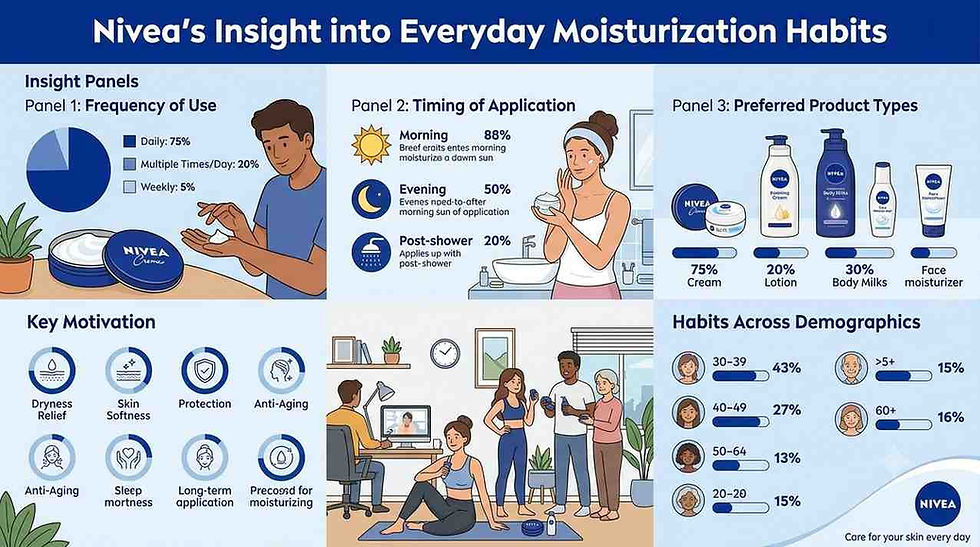
The category's structural characteristic — moisturization being a habitual, low-involvement, high-frequency behavior — creates both opportunity and strategic complexity. On one hand, repeat purchase rates are built into the category mechanics. On the other, brand differentiation is difficult when consumers default to autopilot. The strategic opportunity for NIVEA lies precisely in disrupting habitual autopilot — either by expanding the occasions, frequency, or depth of moisturization behavior, or by elevating the consumer's expectation of what a moisturizing product should accomplish.
Brand Situation Prior to Recent Strategic Initiatives
NIVEA, founded in Germany in 1911, is one of the oldest and most recognized skincare brands in the world, present in over 170 countries. Its iconic blue tin and white packaging carry significant brand equity built over more than a century. Yet this heritage simultaneously represents a strategic liability when competing for younger consumers who prioritize novelty, science, and cultural relevance over institutional familiarity.
Beiersdorf's own 2025 full-year results communication, released in March 2026, acknowledged that "growth at NIVEA slowed in a challenging mass-market environment" in fiscal year 2025, with organic growth at just 0.9% — a sharp deceleration from 9.0% in 2024. The company noted it had "initiated a focused rebalancing of the NIVEA portfolio to restore momentum." This strategic acknowledgment from the company's own executive communications confirms that the brand faces a genuine inflection point: sustained institutional equity alone is insufficient to maintain category leadership.
The brand's prior challenge has been documented from multiple directions. NIVEA's association with winter moisturization — reliable but reactive, seasonal rather than habitual — had created usage gaps. Consumers, particularly in younger cohorts, were not integrating NIVEA into year-round, daily rituals with the same consistency as the brand enjoyed in older segments. The company's communications described the challenge as the brand being "reliable yet conservative," language that signals the gap between trust as an asset and trust as a substitute for engagement.
Strategic Objective
Based on publicly documented campaign communications and Beiersdorf's stated strategic priorities, NIVEA's overarching objective has been to shift consumer behavior from episodic or seasonal moisturization toward consistent, daily body care rituals — while simultaneously elevating product expectations within that ritual. Two distinct documented objectives have emerged across different market initiatives.
The first is penetration-led: expanding the user base, particularly among Gen Z consumers who have not yet formed loyalty to any mass moisturizer brand. The second is usage intensity-led: increasing the frequency and depth of moisturization behavior among existing users, converting occasional application into a deliberate, efficacy-driven daily practice. These objectives, while related, require different creative strategies, channel mixes, and product propositions. NIVEA has pursued both simultaneously across different markets, as documented in its various publicly reported campaigns.
Campaign Architecture & Execution
The most clearly documented manifestation of NIVEA's insight-driven approach to everyday moisturization behavior is the 'Upar Upar Se' campaign, launched in India in June 2026 for the NIVEA Super 10 Serum Lotion. Confirmed through an official press release issued by the company, the campaign takes its name from a Hindi colloquial phrase meaning "on the surface only" — used in everyday speech to describe anything superficial or half-hearted. NIVEA's marketing team identified this phrase as a precise articulation of a documented consumer behavior: treating body care as a surface-level, low-effort task rather than as a performance-oriented skin health investment.
The Marketing Director of NIVEA India, Shweta Dalal, stated in the official press release: "Today's consumers are more informed and intentional, and they expect the same level of efficacy from body care as they do from facial skincare." This statement encapsulates the strategic insight: a gap exists between face care behavior — which younger Indian consumers have elevated to a multi-step, ingredient-conscious routine — and body care behavior, which has remained habitual and low-engagement. NIVEA's product response to this insight was the Super 10 Serum Lotion, formulated with Niacinamide, Vitamin C (120x concentration), Pro-Retinol, and UV filters, ingredients typically associated with premium face serums. The product positioning explicitly bridges this gap, bringing "face-inspired actives into daily body care routines."
The 'Upar Upar Se' campaign thus operates on two levels simultaneously: it provides social and cultural permission for the consumer to demand more from their body care, and it positions NIVEA Super 10 as the appropriate answer to that elevated demand. By appropriating a phrase consumers already use to critique superficiality in their own lives, NIVEA embeds the product conversation into an existing cultural vocabulary rather than constructing a new one.
A separately documented campaign in India — the NIVEA Body Milk launch — deployed a different creative architecture to address the same underlying habit formation objective. In a November 2025 press release, NIVEA India announced the campaign featuring actor Rohit Saraf. The stated consumer insight was that "your skin gets thirsty too," framing hydration as a biological necessity rather than a cosmetic indulgence. The campaign used the actor's pop-culture association — the idea that Saraf "soaks up all the attention" — as a metaphor for how skin needs to absorb lasting hydration. To extend reach beyond digital platforms, NIVEA activated branded cabs across cities, with NIVEA body lotion bottle installations on vehicle rooftops, physically inserting the product's visual language into urban daily life.
In the United Kingdom, NIVEA Soft's sampling campaign — independently documented by campaign technology partner Sampl and confirmed as the recipient of a Beiersdorf Award for Best Global Marketing Campaign — demonstrates a third documented approach to the same behavioral challenge. The campaign's explicitly stated objective was to increase frequency of use by educating consumers about NIVEA Soft's versatility, positioning it not merely as a moisturizer but as a multi-occasion daily staple. Gen Z was identified as the priority audience, described in campaign documentation as having "the biggest potential for achieving household penetration growth." The campaign combined influencer partnerships through agency Goat, targeted Meta advertisements, a seven-day product sampling experience, and unique Amazon discount codes to track purchase conversion. The multi-step consumer journey — sample request, shipping notification, and follow-up survey — was designed to sustain engagement across the purchase consideration window. Campaign outcomes reported include sales growth, expanded CRM database size, and the Beiersdorf global campaign award, though specific numerical uplift figures beyond these qualitative disclosures are not publicly available.
Positioning & Consumer Insight
Across these documented initiatives, a coherent underlying positioning logic is visible. NIVEA does not position moisturization as a beauty aspiration — it positions it as a universal daily necessity that most consumers are currently performing at a suboptimal level. The insight is behavioral rather than attitudinal: it is not that consumers do not care about their skin, but that their existing habits are inadequate relative to what their skin actually requires. This framing is strategically significant. It avoids the cultural fragility of aspiration-based positioning (which depends on the consumer feeling a desire gap) and instead addresses an empirical behavioral gap that the brand can document and close.
The brand's official characterization of its approach — that NIVEA "starts with universal emotions, then builds creative ideas around functional product truths" — supports this reading. The emotional anchor is not glamour or transformation; it is the credible recognition of a habit the consumer already knows is suboptimal. Whether that is framed as "upar upar se" body care, skin that needs to "drink" hydration throughout the day, or a one-time moisturizer application that fails to survive the Gen Z lifestyle — the insight is the same. NIVEA earns permission to enter the consumer's daily routine not by claiming superiority but by validating a behavioral gap the consumer is already dimly aware of.
Media & Channel Strategy
The documented media approach across NIVEA's moisturization campaigns reflects a deliberate hybrid architecture. In India, the NIVEA Body Milk and 'Upar Upar Se' campaigns combined digital video, influencer activations, social media challenges (including a documented Tongue Twister challenge), and out-of-home presence through branded vehicle activations. The official NIVEA India press release explicitly described this as designed to bridge "online chatter with offline visibility."
In the UK NIVEA Soft campaign, the channel strategy was more digitally concentrated, with Meta advertising, influencer seeding through a specialist agency, and an Amazon promotional tie-in. The use of unique discount codes to link sampling to documented purchase behavior is a notable feature — it demonstrates an intent to close the loop between awareness-stage sampling and conversion-stage commerce, addressing a documented weakness in mass-market beauty sampling programs where trial does not reliably translate to repurchase.
For the Luminous 630 product line — documented in Beiersdorf's 2024 annual report as achieving 34% organic growth — the media approach is separately documented as having deployed TikTok creator partnerships, user-generated content mechanics including a mantra-based participation format, and creator-first storytelling. Independently reported campaign metrics for the Luminous 630 TikTok activation include over 1.3 million interactions, a 5.2% lift in ad recall, a 6.3% increase in brand awareness, and a 4.2% rise in brand association with spot correction — as documented by campaign agency House of Marketers.
Business & Brand Outcomes
The most authoritative documented outcome data derives from Beiersdorf's own financial communications. In fiscal year 2024, NIVEA (including Labello) delivered 9.0% organic growth globally, with sales reaching €5.6 billion — the brand's highest recorded revenue. Beiersdorf's earnings release attributed this to both volume growth and successful pricing strategies, with all key product categories experiencing significant growth. The LUMINOUS630 range alone delivered 34% organic growth, according to the official 2024 annual report, driven by the Thiamidol-based anti-spot formulation. Market share gains in the Consumer Business Segment were confirmed in North America and Japan specifically, with notable share increases in Mexico, Sweden, and the Philippines.
Beiersdorf stated that its Consumer Business Segment EBIT margin excluding special factors reached 13.4% in 2024, up from 12.9% in 2023, confirming that the marketing investment driving category growth has been executed with improving financial efficiency.
The UK NIVEA Soft sampling campaign's documented outcomes include sales growth, CRM database expansion, enhanced brand engagement, and the Beiersdorf Best Global Marketing Campaign Award. Specific percentage uplift figures were not disclosed in public campaign documentation.
It should be noted that NIVEA's 2025 performance represents a documented deceleration, with Beiersdorf's March 2026 earnings release confirming NIVEA organic growth of 0.9% in fiscal 2025, and the company initiating a "focused portfolio rebalancing." No verified public information is available on the specific financial impact of individual moisturization-focused campaigns versus the broader NIVEA portfolio.
Strategic Implications
NIVEA's documented approach to everyday moisturization habits reveals several strategic lessons of broad applicability. First, behavioral insight — identifying what consumers actually do versus what they know they should do — is a more durable campaign foundation than attitudinal research alone. The 'Upar Upar Se' campaign succeeded in creating strategic coherence precisely because its insight was grounded in an observable behavioral gap, not a manufactured desire.
Second, the simultaneity of penetration and intensity strategies across different markets suggests that NIVEA is managing its moisturization positioning as a portfolio of consumer development challenges, not a single brief. Gen Z penetration in mature markets (UK) requires credibility-building through sampling and influencer endorsement. Habit upgrade in high-growth markets (India) requires cultural framing and product innovation that validates the consumer's aspiration to do more. These are structurally different briefs requiring different executions from the same strategic insight.
Third, NIVEA's 2025 deceleration — acknowledged publicly by Beiersdorf's own executive communications — highlights the limits of insight-driven marketing when the underlying product portfolio requires recalibration. Behavioral insight can drive purchase consideration and trial, but sustained growth requires that product innovation continuously renews the reason for the consumer to elevate their habit. The company's stated commitment to "portfolio rebalancing" indicates that the marketing strategy must now be supported by product development investment, not solely by communication.
Fourth, the documented integration of commerce-enabling mechanics — Amazon discount codes, CRM database expansion, retail partnership prioritization — reflects a maturation in NIVEA's approach to converting behavioral intent into documented sales. The gap between sampling and purchase has historically been a structural weakness in beauty marketing; NIVEA's UK campaign approach represents a publicly documented attempt to close it through data-linked campaign mechanics.
Finally, the tension between NIVEA's mass-market accessibility imperative and the ingredient-led premiumization visible in the Super 10 Serum Lotion product strategy is unresolved and strategically significant. If body care actives such as Niacinamide, Pro-Retinol, and high-concentration Vitamin C are introduced into the everyday moisturization ritual at accessible price points, NIVEA risks margin compression while potentially expanding its total addressable occasion. Whether this trade-off resolves favorably will depend on whether consumers accept the brand's credibility to deliver premium efficacy at mass-market prices — a question that Beiersdorf's forthcoming annual disclosures will begin to answer.
MBA Discussion Questions
NIVEA's 'Upar Upar Se' campaign appropriates an existing cultural phrase to frame a behavioral insight. What are the strategic risks and advantages of building campaign architecture around pre-existing cultural vocabulary, compared to constructing a new brand narrative from scratch?
Beiersdorf's 2025 earnings disclosure confirmed that NIVEA's organic growth decelerated to 0.9% after 9.0% growth in 2024, and announced a "portfolio rebalancing." To what extent does this signal a failure of consumer insight translation, a product innovation gap, or a structural mass-market category challenge? What evidence would you need to distinguish between these explanations?
The NIVEA Soft UK sampling campaign used influencer reach, Meta advertising, and Amazon conversion mechanics as an integrated sequence. How does this architecture address the documented weakness of traditional beauty sampling programs, and what trade-offs does it introduce in terms of brand control and consumer data ownership?
NIVEA is simultaneously pursuing two distinct behavioral strategies: penetration among non-users (Gen Z in the UK) and usage intensity upgrade among existing users (Indian consumers switching from surface-level to deep moisturization). Is it strategically sound to manage both objectives under a single brand architecture, or does this create positioning tension that constrains long-term brand equity?
The introduction of face-care actives (Niacinamide, Pro-Retinol, Vitamin C) into NIVEA's body care range bridges the face-body care occasion gap at mass-market price points. Evaluate the brand equity implications of this strategy: does it elevate NIVEA's perceived efficacy, or does it risk diluting the premium perception of these ingredients by associating them with a value-positioned mass brand?

Comments