Pepperfry’s Furniture Marketplace Model
Industry & Competitive Context
India’s furniture and home décor market has historically been highly fragmented, dominated by unorganized local carpenters and regional retailers. According to multiple reports by consulting firms such as RedSeer and BCG, the organized segment has grown steadily alongside rising urbanization, increasing disposable income, and digital adoption. E-commerce penetration in furniture, however, has lagged categories like electronics and fashion due to inherent challenges such as logistics complexity, high ticket sizes, customization expectations, and trust deficits.
Within this evolving landscape, online-first furniture platforms such as Pepperfry and Urban Ladder emerged to formalize demand and supply. Traditional players, including IKEA, have also entered India, intensifying competition with omnichannel models and global supply chain advantages.
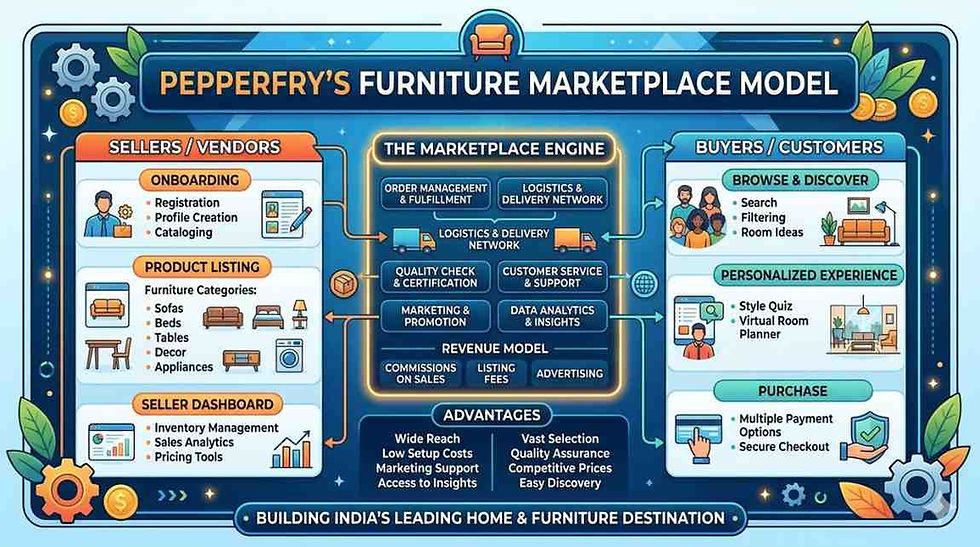
Pepperfry positioned itself not as a conventional inventory-led retailer but as a managed marketplace connecting consumers with a wide network of sellers, including manufacturers, brands, and artisans. This model became central to its differentiation strategy in a category characterized by supply-side fragmentation.
Brand Situation Prior to Marketplace Scaling
Founded in 2011 by Ambareesh Murty and Ashish Shah, Pepperfry initially focused on solving the discoverability and trust gap in online furniture buying. Early public statements and media coverage in outlets such as Economic Times and Mint indicate that the company recognized two core structural issues: lack of standardized quality and limited assortment visibility in offline markets.
Before scaling its marketplace model, Pepperfry operated in a hybrid format with some inventory ownership. However, the limitations of inventory-led expansion in furniture—particularly capital intensity, warehousing complexity, and SKU limitations—prompted a strategic shift toward a marketplace structure. This transition allowed Pepperfry to onboard a large base of sellers without assuming full inventory risk.
At this stage, the brand faced several challenges documented in public sources: consumer hesitation toward purchasing furniture online, logistical inefficiencies in last-mile delivery, and the need to establish credibility in a high-involvement category.
Strategic Objective
Pepperfry’s strategic objective, as articulated in various press interviews and company communications, was to build a scalable, asset-light platform that could aggregate supply while delivering a consistent customer experience.
The marketplace model aimed to achieve three key outcomes:
Expand product assortment significantly without proportional capital investment.
Enable small and medium manufacturers to access national demand through a digital platform.
Standardize customer experience through platform-controlled logistics, quality checks, and service layers.
This approach reflects a broader platform strategy seen in global marketplaces but adapted to the unique constraints of bulky goods and heterogeneous suppliers.
Campaign Architecture & Execution
Rather than a single campaign, Pepperfry’s marketplace strategy evolved as a multi-layered execution framework combining supply-side onboarding, demand generation, and service infrastructure development.
On the supply side, Pepperfry actively onboarded manufacturers, artisans, and brands, positioning itself as a demand aggregator. Publicly available information indicates that the company worked with thousands of sellers across India, offering them digital storefronts, cataloging support, and logistics integration.
On the demand side, Pepperfry invested in building trust through curated collections, detailed product descriptions, and visual merchandising. The company also introduced “Studio Pepperfry” offline experience centers, as reported in multiple news outlets, to bridge the online-offline gap. These studios allowed customers to physically experience products while completing transactions digitally.
Operationally, Pepperfry developed proprietary logistics and supply chain capabilities, including warehousing and last-mile delivery services, to ensure consistency in delivery and installation—key barriers in online furniture retail.
The marketplace model was therefore not a pure open platform but a “managed marketplace,” where Pepperfry retained control over critical aspects of the customer journey.
Positioning & Consumer Insight
Pepperfry’s positioning centered on making furniture buying “easy, accessible, and reliable” in a market traditionally associated with inconvenience and uncertainty.
The underlying consumer insight, supported by industry analyses, was that Indian consumers valued variety and customization but were constrained by limited local availability and inconsistent quality. Additionally, trust deficits in online transactions—especially for high-value items—required strong reassurance mechanisms.
Pepperfry addressed these insights through:
Extensive product assortment enabled by its marketplace model
Standardized pricing and transparent product information
Customer reviews and ratings to build social proof
Offline studios to reduce perceived risk
This positioning effectively combined the breadth of a marketplace with the assurance of a curated retail experience.
Media & Channel Strategy
Publicly available information indicates that Pepperfry adopted a multi-channel approach to customer acquisition and engagement.
Digital channels formed the core of its marketing strategy, including search, social media, and display advertising. The company also invested in brand campaigns to build awareness and trust in online furniture buying.
In addition, the launch of Studio Pepperfry experience centers represented a significant offline channel strategy. These studios functioned as both marketing and conversion touchpoints, allowing customers to interact with products physically while leveraging the full assortment available online.
Pepperfry’s omnichannel approach reflects a recognition that furniture purchases often involve extended decision-making cycles and benefit from tactile interaction.
No verified public information is available on specific media spend allocation or channel-level performance metrics.
Business & Brand Outcomes
Pepperfry has been consistently recognized as one of India’s leading online furniture platforms in credible media coverage and industry reports.
According to publicly reported information:
The company has built a large network of sellers and product listings through its marketplace model.
Studio Pepperfry expanded to multiple cities, indicating the scalability of its omnichannel approach.
Pepperfry has attracted investment from global investors, including Goldman Sachs and Norwest Venture Partners, as reported in financial news outlets.
No verified public information is available on profitability, customer acquisition costs, or detailed financial performance metrics.
Strategic Implications
Pepperfry’s marketplace model illustrates how platform strategies can be adapted for complex, high-involvement categories such as furniture.
First, the managed marketplace approach demonstrates that control over customer experience is critical in categories where product standardization is low. Unlike open marketplaces, Pepperfry’s model integrates logistics, quality assurance, and service delivery, reducing variability.
Second, the combination of online scale and offline experience centers highlights the importance of hybrid models in emerging markets. The Studio Pepperfry concept addresses trust barriers while maintaining the scalability of e-commerce.
Third, the supply-side aggregation strategy unlocks value for fragmented manufacturers by providing access to a national customer base. This creates network effects, where increased seller participation enhances assortment, which in turn attracts more consumers.
However, the model also involves operational complexity, particularly in logistics and quality control. The need to balance scale with consistency remains a structural challenge.
Finally, Pepperfry’s approach reflects a broader trend in Indian e-commerce: the evolution from pure-play digital platforms to integrated ecosystem players that combine technology, operations, and physical touchpoints.
MBA Discussion Questions
How does Pepperfry’s managed marketplace model differ from traditional e-commerce marketplaces, and what strategic advantages does it create in the furniture category?
In what ways does the Studio Pepperfry offline format complement the company’s online marketplace strategy?
What are the key operational risks associated with Pepperfry’s model, and how can they be mitigated without compromising scalability?
How should Pepperfry respond to increasing competition from global players like IKEA and domestic omnichannel retailers?
Can Pepperfry’s marketplace model be successfully replicated in other high-involvement categories, or is it uniquely suited to furniture?


Comments