Programmatic Advertising: Automation at Scale Explained
- 3 days ago
- 12 min read
Industry and Competitive Context
The global digital advertising industry entered the 2020s in a state of structural transformation. The long-dominant model of direct media buying — where advertisers negotiated placements with individual publishers through manual insertion orders — had become untenable at the scale and speed demanded by modern marketing. Programmatic advertising, defined as the automated buying and selling of digital advertising inventory using software, algorithms, and data, emerged as the dominant paradigm in response to this structural inadequacy.
Market sizing across research firms reflects this dominance, albeit with variation in methodology. Grand View Research valued the global programmatic advertising market at approximately $678 billion in 2023, with a projected CAGR of 22.2% through 2030. Separate estimates from market.us placed the 2023 figure at $42.2 billion in platform spend specifically — a figure more narrowly scoped to the technology layer rather than total ad inventory transacted. Regardless of methodology, the directional consensus is consistent: programmatic now constitutes the primary mechanism through which digital media is bought and sold. By 2023, programmatic advertising accounted for approximately 91% of all digital display ad spending in the United States, according to industry projections cited by multiple research bodies. North America led regional adoption with a 32.6% revenue share in 2023, while Asia Pacific was recorded as the fastest-growing region, projected at a 24.4% CAGR through 2030.
The competitive landscape is structured around a small number of dominant platform holders. Alphabet (Google), Meta (formerly Facebook), Amazon, Microsoft, The Trade Desk, Criteo, and Adobe collectively define the industry. These players operate across the demand side (advertisers), supply side (publishers), and the exchange infrastructure that connects them. The 2023 filing by The Trade Desk, a publicly listed independent demand-side platform, disclosed over 1,100 clients — primarily advertising agencies — that had signed master service agreements and spent more than $20,000 on the platform. This client base illustrates the agency-intermediated structure through which most programmatic spending flows.
The regulatory environment has become an increasingly material competitive variable. The enactment of the European Union's General Data Protection Regulation and subsequent regulatory frameworks across jurisdictions placed new constraints on the use of personal data in automated advertising systems. The EU Digital Services Act, which came into force in February 2024, introduced additional transparency and accountability mandates directly relevant to programmatic systems. These regulatory pressures catalyzed a broader industry reckoning with data practices, most visibly manifest in the extended multi-year debate over the deprecation of third-party cookies.
Brand Situation Prior to Campaign — The Structural Shift in Media Buying
Understanding programmatic advertising as a marketing concept requires situating it against the pre-automation baseline. Prior to the emergence of programmatic systems, digital advertising operated largely through direct deals between advertisers or their agencies and individual publishers. Advertising inventory was sold in advance in fixed packages, at negotiated CPM rates, with limited audience-level precision. Campaign execution required significant manual coordination, long lead times, and accepted substantial inefficiency in audience matching.
The limitations of this model became apparent as digital media inventory scaled exponentially. By the early 2010s, the volume of available digital impressions exceeded what any manual system could efficiently price, match, and execute. The first programmatic ad exchanges emerged around 2009, with Google's DoubleClick Ad Exchange serving as an early pioneer of real-time bidding infrastructure. By 2010, according to documented industry records maintained by the IAB Tech Lab, the OpenRTB Consortium — later renamed the Real-Time Bidding Project — had assembled technology leaders from both the demand and supply sides of the industry to develop a standardized API specification for automated media trading. At the time of the consortium's formation, programmatic had accounted for only 4% of the display advertising market.
The trajectory from 4% to 91% of display spending over roughly a decade represents one of the more rapid structural transformations in media history, driven not by any single brand campaign or strategic initiative, but by the cumulative adoption of a technological infrastructure that offered superior economics, precision, and scalability relative to manual alternatives.
Strategic Objective
The strategic objective of programmatic advertising as a system — and of the firms that build, deploy, and use it — can be stated at three levels. At the technological level, the objective is the automation of impression-level inventory transactions at millisecond speed across diverse publishers, channels, and geographies. At the advertiser level, the objective is the maximization of advertising return by serving the right creative to the right audience at the right moment, at the lowest defensible price. At the industry level, the objective is the creation of a liquid, standardized marketplace for digital media that reduces friction, improves price discovery, and scales globally without requiring proportional increases in human labor.
The Trade Desk's public filings articulate this value proposition with precision. In its fiscal year 2023 earnings release, CEO Jeff Green described the company's positioning as enabling advertisers to "buy media on the open internet with more precision and transparency than ever," and cited a record $9.6 billion of spend flowing through the platform in 2023. The company's January 2024 investor presentation, filed with the U.S. Securities and Exchange Commission, identified the total global advertising spending addressable market at approximately $830 billion, situating the programmatic opportunity explicitly within the ongoing migration of linear television budgets to digital and programmatic formats.
Campaign Architecture and Execution — The Programmatic Stack
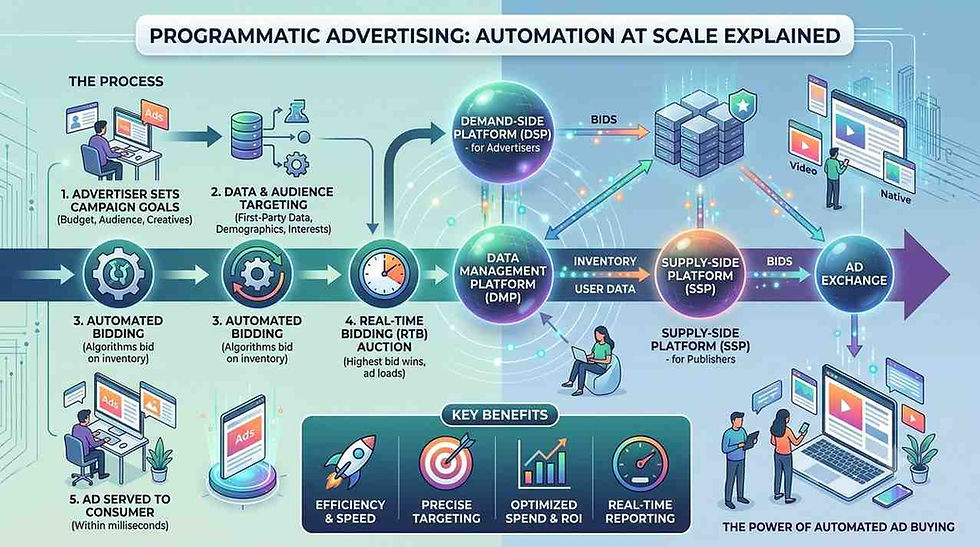
Programmatic advertising does not function as a single tool or platform. It is an ecosystem of interconnected technologies, each performing a distinct function in the automated transaction chain. Understanding this architecture is prerequisite to any strategic analysis of programmatic as a marketing mechanism.
The demand-side platform (DSP) is the advertiser's principal interface with the programmatic ecosystem. Within a DSP, advertisers or their agencies define campaign objectives, target audiences, budget parameters, pacing rules, frequency caps, bidding strategies, and creative assets. The DSP continuously evaluates available ad impressions against these parameters and decides, algorithmically, whether to bid and at what price. Google's Display and Video 360 (DV360) is the most widely used enterprise DSP. The Trade Desk operates as the leading independent DSP, distinguished by its position outside the walled gardens of Google and Meta's owned inventory.
The supply-side platform (SSP) functions as the publisher's equivalent: it packages available ad inventory, applies floor prices, brand safety rules, and deal configurations, and makes that inventory available to buyers through ad exchanges. The ad exchange is the neutral marketplace where bid requests from SSPs are broadcast to eligible DSPs, bids are received, an auction is resolved — typically in the first-price model that became industry standard around 2019 — and the winning creative is served.
The protocol that governs this machine-to-machine communication is OpenRTB, developed and maintained by the IAB Tech Lab. The IAB defines real-time bidding as "a way of transacting media that allows an individual ad impression to be put up for bid in real-time," with the process functioning analogously to financial markets. The entire sequence — from a user loading a webpage to the serving of a winning ad — occurs in under 120 milliseconds in most Tier 1 markets, according to market research cited in 2024 industry reports.
Within the programmatic ecosystem, several distinct buying models exist alongside open-market RTB. Private marketplace (PMP) deals allow publishers to offer inventory to a curated set of buyers through invite-only auctions. Programmatic direct, also known as programmatic guaranteed, allows advertisers and publishers to agree on a fixed price and guaranteed impression volume while still executing the transaction through programmatic infrastructure. Preferred deals offer buyers priority access to inventory at a fixed price before it enters open auction. Each model offers different trade-offs between scale, control, transparency, and pricing predictability.
As of 2025, real-time bidding accounted for approximately 41.3% of programmatic advertising market share, with private marketplace and programmatic direct arrangements comprising the remaining transaction volume, according to Mordor Intelligence's industry analysis.
Data is the asset that distinguishes programmatic execution from prior forms of digital advertising. Advertisers bring first-party data — typically customer records, CRM data, or behavioral signals from owned digital properties — into the DSP and match it against available inventory. Demand-side platforms also access second-party and third-party data segments to expand targeting reach. The IAB's data governance frameworks, including the Audience Taxonomy and Content Taxonomy standards, provide the common nomenclature through which audience and contextual signals are communicated across buyer and seller systems.
Positioning and Consumer Insight
The consumer insight underlying programmatic advertising's commercial logic is straightforward and documented: advertising relevance drives effectiveness, and relevance requires accurate audience identification at the moment of potential engagement. A user who has recently browsed a given product category represents a higher-value impression for a relevant advertiser than an anonymous user on the same page who has not signaled comparable intent. Programmatic systems attempt to operationalize this insight at industrial scale.
The IAB defines the capability that RTB enables as "Addressable Advertising: the ability to serve ads to consumers directly based on their demographic, psychographic, or behavioral attributes." This positioning shifts the unit of advertising value from the media property — the website or the television channel — to the individual impression and the audience characteristics associated with it. This is a fundamental conceptual departure from mass-media advertising models, where audience aggregation was the primary planning unit.
The practical consequence is a media buying framework oriented around audience segments rather than content contexts. Programmatic systems allow an advertiser targeting, for example, consumers in-market for a specific durable good to follow those consumers across publishers, devices, and channels rather than buying specific pages or programs where such consumers are assumed to congregate. The automation layer handles the bidding and placement logistics; the human strategic task shifts to audience definition, creative strategy, and measurement design.
Media and Channel Strategy
The documented channel expansion of programmatic advertising reflects the maturation of the underlying auction infrastructure across new inventory types. What originated as a mechanism for desktop display advertising has extended across mobile, digital video, connected television, digital out-of-home, digital audio, and retail media.
Mobile has become the dominant channel by impression volume. According to 2024 industry reporting, mobile captured approximately 63% of programmatic impressions, with over 1.4 trillion mobile ad impressions served globally in that year. The mobile and tablets segment was documented as accounting for 49.4% of programmatic market share by channel in 2023.
Connected television (CTV) is the most strategically significant growth channel. The Trade Desk's quarterly earnings filings across 2023 and 2024 consistently cite CTV as a primary growth driver. In its Q3 2024 results, The Trade Desk noted that "2024 has been a banner year for CTV" and that many of the largest media companies were working with the platform to deliver CTV advertising programmatically. U.S. CTV programmatic display ad spend was projected to reach $38 billion by 2026 and approach $47 billion by 2028, with a CAGR of approximately 14%, according to figures cited by Publift's 2024 analysis of industry trends. This projection reflects the structural migration of television viewing from linear broadcast to streaming environments, which are natively compatible with programmatic delivery.
Retail media represents the second major strategic frontier. The Trade Desk specifically disclosed its "retail data marketplace" as a growth area in its Q3 2024 earnings, enabling advertisers to use retailer first-party shopper data for targeting. The IAB Europe's 2023 AdEx Benchmark study documented increasing investment directed toward retail media within programmatic frameworks, driven by the deterministic targeting value of purchase-intent signals derived from retail transaction data.
Digital out-of-home advertising is a less mature but growing programmatic channel. Global DOOH advertising spend was valued at approximately $19 billion in 2023 and projected to expand to roughly $60 billion by 2033, representing an approximately 11.8% annual growth rate.
Business and Brand Outcomes
The Trade Desk's publicly reported financials provide the most granular verified evidence of programmatic advertising's commercial trajectory at scale. The company reported full-year 2022 revenue of $1.578 billion, representing 32% year-over-year growth. For fiscal year 2023, The Trade Desk reported $1.95 billion in revenue, representing 23% growth year-over-year, with a record $9.6 billion of advertiser spend flowing through the platform. In Q3 2024, the company reported quarterly revenue of $628 million, representing 27% year-over-year acceleration. These figures, derived directly from SEC filings, constitute verified public documentation of programmatic demand at scale for a single independent DSP.
On the industry's structural challenge — ad fraud — the Trustworthy Accountability Group (TAG) published its 2024 U.S. Ad Fraud Savings Report documenting that anti-fraud initiatives produced an estimated $10.8 billion in savings for the U.S. advertising industry in 2023. Without the implementation of anti-fraud standards, the report projected IVT losses would have reached $11.78 billion; actual losses were reduced to approximately $979 million — a documented 92% reduction attributable to industry-wide compliance with verification standards. More than 90% of U.S. digital ad revenue for video and display advertising in 2023 flowed through companies that had earned TAG's Certified Against Fraud Seal.
IAB Europe's Attitudes to Programmatic Advertising report, published in 2024, documented that 51.9% of non-social display advertising in Europe was purchased programmatically. The same report identified media quality — encompassing brand safety, fraud, viewability, and transparency — as the primary barrier to further programmatic adoption, cited by 31% of advertisers and agencies surveyed. The report also documented that 68% of agency budgets were being allocated programmatically, compared to 40% among direct advertisers.
Google's own internal analysis, disclosed during the cookie deprecation policy deliberations, documented that eliminating third-party cookies from Chrome without enabling the Privacy Sandbox would result in a 34% drop in programmatic revenue for Google Ad Manager publishers and a 21% drop for AdSense publishers. With Privacy Sandbox APIs enabled, the projected revenue declines moderated to 20% and 18% respectively. These figures were cited across multiple industry sources and reflect the material dependency of current programmatic revenue on third-party cookie infrastructure.
Strategic Implications
Several strategic implications emerge from a reading of the documented trajectory of programmatic advertising.
First, automation does not eliminate strategic complexity; it relocates it. The efficiency gains from programmatic execution are well documented, but the locus of competitive differentiation has migrated upstream to audience strategy, data quality, and measurement architecture. Brands that use programmatic as a cost-reduction mechanism without investing in proprietary data assets are likely to find diminishing differentiation relative to competitors who treat first-party data as a strategic resource.
Second, the identity infrastructure shift represents the most material near-term strategic uncertainty for the industry. Google's announcement in July 2024 that it would not proceed with a forced deprecation of third-party cookies in Chrome — reversing a multi-year commitment — removed an immediate operational crisis for advertisers and publishers, but did not eliminate the underlying structural trend toward consent-based, privacy-compliant targeting. Apple's Safari had already blocked third-party cookies by default well before Google's reversal. Firefox similarly restricts them by default. Chrome's eventual move toward user-choice frameworks, confirmed by Google's VP of Privacy Sandbox, means that addressable audiences reached through third-party tracking will continue to contract over the medium term, irrespective of the specific deprecation timeline. The Trade Desk's investment in Unified ID 2.0, an open-source identity framework based on encrypted, consented email addresses, represents one industry response to this constraint. Criteo, in its own 2024 SEC filings, disclosed a "multi-pronged addressability strategy" to build resilience against third-party identifier loss.
Third, the consolidation of the supply chain around a small number of dominant platforms raises structural questions about market power and transparency. The documented finding that 31% of programmatic advertisers identify transparency, fraud, and brand safety as significant adoption barriers indicates that the industry's operational infrastructure has not yet fully resolved the trust deficit created by supply chain opacity. IAB Tech Lab's standards — ads.txt, sellers.json, and supply chain object specifications — establish compliance baselines, but enforcement remains market-driven rather than mandatory.
Fourth, the channel expansion into CTV and retail media is strategically significant beyond simple inventory growth. CTV brings programmatic targeting precision to a medium — television — that has historically been planned and bought on reach and demographic estimates rather than individual audience signals. Retail media introduces purchase-intent data of a quality and specificity that contextual or behavioral inferences cannot match. Both channels expand the targeting fidelity available to programmatic campaigns while simultaneously increasing the dependency of the ecosystem on platform-specific, first-party data environments — a development that structurally advantages large platform holders at the expense of smaller independents.
Fifth, the economics of scale in programmatic advertising create a compounding advantage for large advertisers. Algorithmic bidding systems improve with signal volume, which means advertisers with larger data sets, more conversions to optimize toward, and longer historical records of campaign performance derive better algorithmic outcomes than smaller spenders. This dynamic favors enterprise advertisers over small and medium businesses and reinforces the structural position of large holding company agencies that aggregate spend across multiple clients.
Discussion Questions
The Trade Desk's publicly stated strategic position emphasizes the "open internet" as a superior alternative to the "walled gardens" of Google and Meta. Evaluate the sustainability of this positioning as a competitive strategy, given that Google's DV360 and Meta's own buying interfaces collectively account for a dominant share of global programmatic spend. Under what conditions does the open internet positioning create durable differentiation, and under what conditions does it become a structural liability?
Google's July 2024 reversal of its third-party cookie deprecation plan, after four years of industry preparation, created significant operational disruption. What does this decision reveal about the relationship between platform power, regulatory pressure, and industry standards governance? How should programmatic advertisers design their data strategies to remain viable regardless of Google's evolving cookie policy?
IAB Europe's 2024 report documented that media quality — specifically brand safety, fraud, and transparency — remains the primary barrier to programmatic adoption cited by advertisers and agencies. Given that the industry's self-regulatory frameworks have produced documented results (as evidenced by TAG's $10.8 billion savings figure), why does this perception gap persist? What structural changes in the programmatic supply chain would most effectively close the trust deficit?
Connected television represents the convergence of television's reach and production quality with programmatic advertising's targeting precision and real-time optimization. Evaluate the strategic implications of this convergence for traditional television broadcasters, streaming platforms, and legacy media agencies. Which category of incumbent faces the greatest disruption, and what strategic responses are available to them?
First-party data has been widely identified as the strategic asset that will determine competitive outcomes in a post-third-party-cookie advertising environment. However, first-party data assets are distributed highly unequally: platform companies, large retailers, and major media owners possess extensive first-party data, while the majority of brands have limited collection infrastructure. What strategic options are available to brands with limited first-party data assets, and what are the risks and trade-offs associated with each?


Comments