Spotify India’s Insight into Regional Music Consumption
- 25 minutes ago
- 11 min read
Industry & Competitive Context
When Spotify launched in India on February 26, 2019, it entered one of the world's most structurally complex and contested audio streaming markets. India's music streaming landscape had been shaped by nearly five years of intense competition among domestically rooted platforms with deep linguistic and cultural advantages. Gaana, owned by Times Internet and backed by Tencent, had reported over 75 million monthly active users at the time of Spotify's entry, eventually scaling to over 150 million monthly active users by late 2019, commanding approximately 30% market share. JioSaavn, formed through the merger of Saavn and Reliance Jio's music service, was the undisputed market leader with a monthly active user base estimated at nearly ten times that of Spotify at the point of entry. Wynk Music, backed by Bharti Airtel, benefited from direct telco distribution bundling. Spotify was, by its own account, the eighth major audio streaming service to enter India.
The structural conditions of the market presented compounding challenges. India's music streaming penetration was accelerating on the back of cheap mobile data — a product of Reliance Jio's 2016 market entry — and rising smartphone ownership. By 2019, streaming revenues had come to represent 73% of total revenue for the Indian music recording industry, up from 33% in 2014, reflecting a fundamental shift in how music was consumed. The competitive dynamic, however, was not primarily about catalogue size. Domestic platforms had spent years curating content in regional Indian languages and building product experiences calibrated to the listening habits of non-metropolitan India. The question Spotify faced was not whether the market was large enough — it clearly was — but whether a platform whose discovery architecture and editorial infrastructure had been built around Western listening behaviour could find genuine cultural resonance in a market with radically different consumption patterns.
Brand Situation Prior to Strategic Pivot
Spotify's initial user profile in India skewed toward urban, English-comfortable listeners consuming predominantly international music. The company's own platform data confirmed this: at launch, nearly 70% of listening on Spotify India was to international content, a consumption profile that looked similar to Spotify's performance in other early-stage markets globally. This was not simply a product gap — it represented a positioning gap. Spotify was perceived, and in many ways functioned, as a platform for Western music discovery in a country where, by industry data, approximately 83% of listening time was directed at local content, against a global average of 49%. Indians were also listening more intensively than global averages: approximately 22 hours of music per week, roughly 3.5 hours more than the global mean, with that consumption overwhelmingly anchored in film music, regional-language content, and culturally specific genres.
The competitive threat from local platforms was not abstract. JioSaavn and Gaana had entrenched catalogue relationships with Bollywood labels, regional film industries, and independent vernacular artists. Local platforms also had first-mover advantages in product localisation — including language-specific interfaces, voice search, and curated editorial in Tamil, Telugu, Punjabi, Bengali, and Kannada. Spotify's positioning as the world's leading streaming platform carried global brand equity but limited India-specific relevance among the mass listener segment it needed to reach to scale. The strategic imperative was clear: without meaningful engagement with India's regional music ecosystems, Spotify would remain a premium niche product serving a demographically thin slice of the total addressable listener market.
Strategic Objective
Spotify's articulated strategy was to build what its Global Head of Markets described at launch as a "custom-built experience" — a deliberate signal that the company would not port its global product into a new geography but would instead reconstruct the platform's editorial and product priorities around local consumption realities. The strategy operated on two levels simultaneously. The first was demographic expansion: moving beyond urban, English-comfortable early adopters to reach listeners in Tier 2 and Tier 3 cities whose musical world was overwhelmingly regional and vernacular. The second was competitive repositioning: differentiating Spotify not on the functional axes of catalogue breadth or pricing — where domestic incumbents held structural advantages — but on the cultural axis of editorial intelligence, curation quality, and artist discovery.
Embedded within this strategic objective was a recognition that India's music market could not be treated as a single entity. Unlike Western markets where artist and album identity anchor listening behaviour, Indian music consumption was structured around cinema, festivals, regional cultural calendars, and language-specific fan communities. Bollywood, Tollywood, Kollywood, Punjabi film music, and a constellation of language-specific independent scenes each functioned as self-contained cultural ecosystems with distinct artist hierarchies, label relationships, and listener expectations. An effective localisation strategy required not a single India initiative but a portfolio of language-level and region-level interventions executed in parallel.
Campaign Architecture & Execution
Spotify's localisation strategy unfolded across three identifiable phases between 2019 and 2024, combining product investment, editorial infrastructure, artist development, and consumer marketing into a coherent programme.
The first phase, running from launch through 2020, focused on establishing regional content credibility through targeted marketing campaigns aimed at the three most-streamed Indian languages after Hindi and English: Punjabi, Telugu, and Tamil. In 2020, Spotify ran a television commercial in Telugu and Tamil featuring South Indian film star Nagarjuna to promote Spotify Premium in South India — a decision that signalled the platform's intention to compete for the cultural attention of regional film music audiences rather than simply aggregating catalogue. In the same year, Spotify sponsored a season of the Telugu edition of reality television show Bigg Boss, gaining sustained audience exposure in one of India's most active regional television markets. Two digital campaigns were executed in Punjabi, the first in March 2020 featuring Neha Kakkar, Badshah, and Diljit Dosanjh — artists who had achieved crossover chart success — and the second in December centred on Spotify's Punjabi 101 playlist, with participation from Harrdy Sandhu and Sidhu Moosewala.
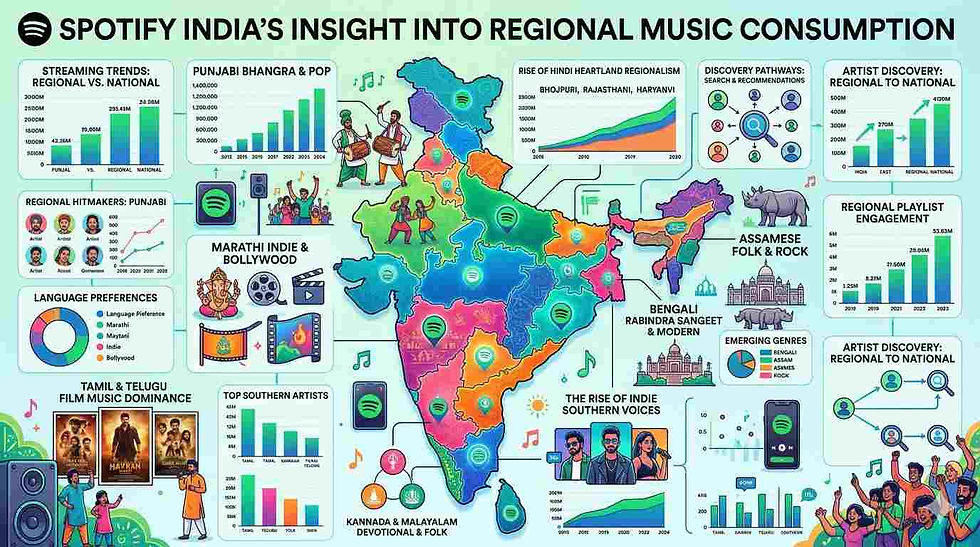
The second phase deepened from campaign-level localisation into systematic product and content architecture. In March 2021, Spotify launched its mobile app in 12 Indian languages — Hindi, Bengali, Bhojpuri, Gujarati, Kannada, Malayalam, Marathi, Odia, Punjabi, Tamil, Telugu, and Urdu — outpacing the 10-language availability that had until then been a differentiating feature of Gaana. The editorial infrastructure expanded to match: the number of locally curated playlists grew from approximately 100 at launch to over 600 by early 2021, a fivefold increase, with playlists designed to capture not just genre and language but mood, occasion, and regional cultural specificity — offerings such as "Bollywood Butter," "Indie India," "Romantic Punjabi," "Chill Tamil," and "Rap 91" reflected the breadth of India's listening identity. The company confirmed in 2021 communications that Spotify was being streamed in over 3,000 cities across India, evidence that the geographic reach of the platform had extended materially beyond its initial metropolitan concentration.
The third phase, through 2022 to 2024, focused on artist ecosystem development as a long-term platform strategy. Spotify invested in the Spotify for Artists infrastructure in India, enabling local artists and their management to analyse consumption data and reach global audiences. By March 2024, more than 28,000 Indian artists had claimed Spotify for Artists profiles, more than double the figure from a year prior. Spotify added approximately 8,700 Indian artists to local and global editorial playlists over the five-year period, providing direct distribution infrastructure for artists who had previously lacked access to international audiences. Festive-calendar marketing — including curated playlists for Diwali, Holi, and Eid, and cosmetic platform updates tied to festival periods — reinforced Spotify's presence in the cultural moments that structure Indian listening behaviour throughout the year.
Positioning & Consumer Insight
The foundational consumer insight driving Spotify India's strategy was that the Indian listener's relationship with music was not analogous to that of a Western streaming user. Indian music consumption was not primarily structured around artist fandom or album cycles. It was structured around life occasions — festivals, commutes, family gatherings, film releases, regional cultural events — and around linguistic identity. Music in India functions, as Spotify's India marketing communications acknowledged, as a "personal bubble" that listeners create within the ambient chaos of daily life. This framing — music as a space of personal sovereignty within collective experience — underpinned the tone and creative direction of Spotify India's advertising, which used situations drawn from everyday Indian life rather than artist-driven narrative.
The strategic implication of this insight was that Spotify needed to position itself not as a music library but as a cultural companion calibrated to the granularity of Indian regional identity. The platform's curated playlists were accordingly constructed as cultural products rather than song compilations — editorial expressions of regional sonic identity that justified Spotify's claim to cultural intelligence rather than mere catalogue aggregation. This positioning allowed Spotify to occupy a differentiated space relative to domestic competitors, which primarily competed on catalogue breadth and telco-bundled pricing, and relative to global competitors like Apple Music and Amazon Music, which had not invested comparably in local editorial infrastructure.
Media & Channel Strategy
Spotify's verified media and channel approach in India combined broadcast television, digital advertising, social media integration, and platform-native editorial as distinct but coordinated instruments. The television campaigns in Telugu and Tamil — including the Nagarjuna-fronted commercial and the Bigg Boss Telugu sponsorship — targeted the mass regional television audience in South India, a demographic that was digitally active but whose primary entertainment relationship was still mediated through film and broadcast content. These campaigns were notable for their use of regional celebrity capital rather than generic brand messaging, reflecting a considered decision to enter regional cultural conversations on their own terms.
Digital campaigns in Punjabi were executed through social media platforms and streaming advertising inventory, targeting a younger, musically engaged audience that had driven the global crossover of Punjabi pop. Spotify's social media presence in India was notably built around cultural participation — the use of meme culture, trending formats, and festival-specific content — rather than product feature promotion. The platform also integrated its sharing features with Instagram, Facebook, and Snapchat, enabling users to distribute their listening identity across social networks and expanding organic discovery. Spotify Wrapped, the annual personalised listening data report, functioned as a culturally significant marketing moment in India as elsewhere, generating significant organic social sharing and reinforcing listener identity around the platform.
During the pandemic period specifically, Spotify's management publicly acknowledged that India received disproportionate marketing investment relative to other markets, including sustained spending on nationwide and region-specific advertising including broadcast and streaming television, at a time when some competitors reduced their marketing expenditure. No verified public breakdown of the absolute India marketing budget has been disclosed.
Business & Brand Outcomes
The documented outcomes of Spotify India's regional localisation strategy represent one of the most material reversals of consumption profile publicly recorded by a global streaming platform in an emerging market. The headline metric, confirmed in Spotify's official newsroom communications in March 2024, is the inversion of the local-to-international listening ratio: from approximately 70% international at launch in 2019 to more than 70% local music by 2024 — a structural shift of roughly 40 percentage points in the composition of platform listening over five years.
The depth of this shift was reflected across multiple verified data points. In 2023, 84% of tracks on Spotify India's daily Top 50 list were by Indian artists. In the same year, artists from India were discovered by first-time listeners over 10 billion times on the platform. Close to two-thirds of Spotify royalties generated in India in 2023 were attributed to local artists — a financial distribution outcome that validated the platform's claim to genuine ecosystem investment rather than superficial content localisation. Global consumption of music from India grew 85% year-over-year in 2023 alone. Over the five-year period from 2019 to 2024, consumption of music by Indian artists in international markets grew by more than 2,000%, with the United States, Canada, Indonesia, the UAE, Turkey, Brazil, and Italy among the primary export markets. Approximately 40% of all royalties generated by Indian artists on Spotify in 2023 came from listeners outside India, indicating that Spotify had functioned as an export infrastructure for Indian music as well as a localisation vehicle within the country.
On competitive positioning, a RedSeer study reported that Spotify led India's music and audio streaming market in FY2023 with a 26% market share — ahead of JioSaavn, Wynk Music, Apple Music, YouTube Music, Amazon Prime Music, and Gaana. An IFPI and Indian Music Industry study found that 20.1% of respondents identified Spotify as their preferred music streaming service, compared with 4.9% who chose either JioSaavn or Wynk. In May 2026, Spotify publicly declared itself India's market leader in audio streaming at its Investor Day event. Several competitors that had been present at Spotify's India launch had by this time exited or severely contracted: Google Play Music, Hungama Music, Resso, and Wynk Music shut down, while Gaana transitioned to a subscription-only service after an attempted acquisition fell through and its valuation declined from approximately $580 million to a sale price of ₹25 lakh. The structural consolidation of the market had, by 2024–2026, left Spotify in a materially stronger competitive position than any observer of the 2019 landscape would have projected.
Strategic Implications
The Spotify India case offers several analytically rich implications for how global platforms should approach structurally complex, culturally diverse emerging markets — and for how localisation should be conceived as a strategic discipline rather than a marketing tactic.
The first implication concerns the sequencing of localisation investment. Spotify's approach was not to localise everything simultaneously at launch but to invest in credibility-building interventions at the language level — beginning with the highest-volume regional languages — before scaling product and editorial infrastructure. This sequencing avoided the trap of superficial pan-India localisation that speaks to no specific community with authority. The decision to execute separate campaigns in Punjabi, Telugu, and Tamil, using genre-specific artists and culturally specific creative, reflected an understanding that India's music market is better conceived as a set of overlapping regional markets than as a single national one.
The second implication concerns the artist ecosystem as a platform moat. Spotify's investment in Spotify for Artists in India — growing the community to 28,000 artists by early 2024 — created a supply-side network effect that is structurally difficult for competitors to replicate. When local artists adopt a platform's analytics and promotional infrastructure, they create listening communities that follow. The growth of Indian artists' international royalties through Spotify — with 40% of India-generated royalties coming from outside the country by 2023 — demonstrates that platform infrastructure investment created value for artists that a competitor could not match simply by offering a larger domestic catalogue.
The third implication concerns the relationship between consumer insight and competitive positioning. Spotify's insight — that Indian listening was structured around life occasions and linguistic identity rather than artist or album discovery — led directly to a positioning choice that competitors were poorly placed to contest. Domestic platforms competed primarily on catalogue and price; global platforms had not invested in regional editorial intelligence. Spotify occupied the position of a culturally informed global platform, offering both the discovery infrastructure of a world-class technology product and the editorial credibility of a locally embedded cultural institution. This dual positioning is precisely the axis on which the company's market share gains appear to have been built.
The fourth implication concerns the strategic value of the free tier and flexible pricing in price-sensitive markets. Spotify's introduction of the Premium Mini plan — offering daily subscriptions at ₹7 and weekly subscriptions at ₹25 — aligned its monetisation model with India's established pattern of small, frequent consumer payments. No verified public data on the conversion impact of the Mini plan has been disclosed, but its structural design reflects a disciplined response to a documented consumer behaviour: the preference for short-commitment, low-denomination purchases over annual or monthly subscription contracts. This pricing architecture, combined with a robust free tier supported by ad inventory, allowed Spotify to grow its listener base at scale while building a premium conversion pathway calibrated to Indian income and payment behaviour.
Discussion Questions
Question 01
Spotify's localisation in India involved inverting its global content profile — moving from 70% international to 70% local music consumption within five years. To what extent is this outcome attributable to intentional strategic design versus the organic preferences of a growing user base, and how would you design a study to distinguish between these two causal mechanisms?
Question 02
Spotify chose to differentiate itself in India not on price or catalogue breadth but on editorial intelligence and cultural positioning. Evaluate the long-term sustainability of this positioning in a market where telco-bundled competitors retain structural distribution advantages and domestic platforms can replicate curation over time.
Question 03
The Spotify for Artists programme in India grew to 28,000 active artist accounts by early 2024, and approximately 40% of Indian artists' royalties on the platform came from international listeners. What are the strategic trade-offs of positioning a streaming platform as an artist export infrastructure in an emerging market, and what risks does this create if the export growth reverses?
Question 04
Several of Spotify's direct Indian competitors — including Gaana, Resso, Hungama Music, and Wynk Music — have significantly contracted or exited the market since 2019. How much of Spotify's market share gain should be attributed to its own strategic execution versus the structural failures of domestic competitors, and what does this distinction imply for how Spotify should prioritise its next phase of Indian market strategy?
Question 05
Spotify's India strategy required sustained investment in market-specific editorial infrastructure, regional celebrity partnerships, and language-level product development — resources that may not have been available to a smaller global entrant. Under what conditions is deep cultural localisation a replicable strategic template for other global platforms entering linguistically diverse emerging markets, and where does it become a capability that only scaled incumbents can execute?


Comments