Uber Auto’s Platform Expansion Strategy
- 4 hours ago
- 12 min read
INDUSTRY AND COMPETITIVE CONTEXT
India's urban mobility sector is among the most structurally complex ride-hailing markets in the world. Auto-rickshaws alone account for up to 25% of all motorised trips in the country, functioning as a primary mode of transport for tens of millions of daily commuters across tier-1 and tier-2 cities. When app-based ride-hailing arrived in India around 2012, the market quickly coalesced into a duopoly between Uber and homegrown rival Ola. However, the decade that followed witnessed a fundamental disruption in the competitive architecture of the segment, driven not by superior technology but by a radical rethinking of driver economics.
The most consequential disruption came from Namma Yatri, launched in November 2022 in Bengaluru. Developed in consultation with auto-driver unions and built on the open Beckn protocol aligned with India's Open Network for Digital Commerce (ONDC), Namma Yatri introduced a subscription-based model in which drivers paid a flat daily fee — initially Rs 25 for autos and Rs 90 for cabs — and retained 100% of every fare. This was a direct challenge to the commission-based architectures of Uber and Ola, where platforms typically charged drivers between 25% and 40% per ride. The idea spread rapidly: Yatri Saathi in West Bengal, Odisha Yatri in Odisha, and Kerala Savaari all adopted variants of the same model. Rapido, which had previously built its dominance in the bike-taxi segment using the traditional commission structure, saw the opportunity and pivoted. In late 2023 and early 2024, it formally reclassified itself as a software-as-a-service provider to drivers and extended its subscription model across bikes, three-wheelers, and eventually cabs, with daily access fees ranging between Rs 9 and Rs 29 depending on city and vehicle category.
The competitive consequences were swift and documentable. According to Sensor Tower data cited in a Citi Research report and reported by the Economic Times, Rapido overtook Uber in Android monthly active users in India as early as January 2024. By July 2024, Rapido had reached approximately 50 million monthly active users, compared to Uber's 30 million. In the bike-taxi and auto-rickshaw segments, Rapido built a commanding position: Rapido controls approximately 31% of the scooter and three-wheeler market, while Ola holds approximately 26% in the same category. In the four-wheeler cab segment, Uber retains the leading position at approximately 50% market share, with Rapido having grown to between 14% and 20% share. The broader market is expected to reach over $3.7 billion by FY2032, with an estimated compound annual growth rate of approximately 18.78%, making the strategic positioning battle consequential for long-term platform dominance.
BRAND SITUATION PRIOR TO STRATEGIC PIVOT
When Uber first introduced its auto-rickshaw product in India in April 2015, it represented the company's initial attempt at product localisation beyond its core four-wheel cab offering. It was also the first time Uber had adapted its global model to accept cash as a payment mode, a structural concession to India's largely cash-driven consumer base. The service was suspended shortly after launch, with an Uber spokesperson stating at the time that the company was "temporarily removing this product to solve specific problems that need to be resolved to help it scale." The service was relaunched in 2018.
For much of the period between 2018 and 2022, Uber Auto operated as a secondary product rather than a strategic priority. Uber's competitive identity in India remained anchored to the premium cab segment, where safety features, in-app GPS tracking, digital payments, and driver verification gave it a reputational advantage. Its India Economic Impact Report 2024, commissioned by Uber and compiled by Public First, documented that 95% of female riders cited safety as their top reason for using Uber, and 84% described Uber as the safest way to get home — evidence of a deeply entrenched positioning as the safe, reliable premium option. The auto product was available in several cities but operated within a commission-based structure that was increasingly out of step with an industry shifting toward subscription economics.
The strategic vulnerability that emerged by 2022 and accelerated through 2023 was structural: Uber was losing the platform battle in the high-volume, low-fare, high-frequency segments — specifically autos and bike taxis — to competitors who had redesigned the supply-side economics. Without a compelling value proposition for auto drivers, Uber could not build the supply density needed to compete on availability and pricing in this segment. At the same time, the company faced a new category of competitor in the form of government-aligned platforms and open-network participants, whose political legitimacy posed a regulatory risk that purely commercial rivals did not.
STRATEGIC OBJECTIVE
The strategic imperative facing Uber India by 2024 was clear: evolve from a premium cab platform into a full-spectrum urban mobility platform capable of competing across vehicle categories, income segments, and use cases. This transition required addressing two simultaneous challenges. The first was the supply-side economics of the auto and two-wheeler segments, where the commission model had become a driver of platform switching and supply attrition. The second was the demand-side positioning problem, where Uber's premium brand identity limited its accessibility perception among price-sensitive commuters who formed the core ridership of the auto and bike-taxi segments.
The broader objective, as articulated by Uber CEO Dara Khosrowshahi during his May 2024 visit to India, was to position India not merely as a consumer market but as an innovation hub with a "local for global" mandate — building technology in India for deployment globally. This dual-axis strategy of market deepening and technological investment signalled that Uber's engagement with the auto segment was not a defensive tactical retreat but part of a deliberate repositioning of the company's long-term role in India's mobility infrastructure.
CAMPAIGN ARCHITECTURE AND EXECUTION
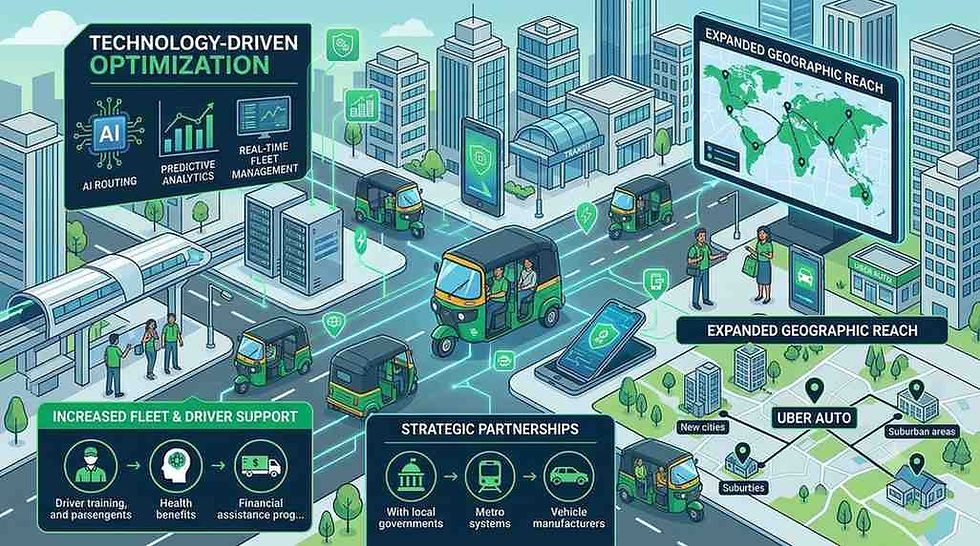
Uber's platform expansion strategy in India from 2024 onward was executed across four distinct but interconnected pillars: driver economics reform, multimodal integration, electric vehicle partnerships, and digital public infrastructure alignment.
On driver economics, Uber made its most consequential structural decision in February 2025, when it announced the rollout of a zero-commission, subscription-based model for auto-rickshaw drivers across India. An Uber spokesperson confirmed the shift in an official statement: "Given the industry's shift towards a subscription-based model for drivers, we have decided to align our approach accordingly so as not to be at a competitive disadvantage." Under the new model, drivers could purchase a Driver Pass — a 24-hour or 72-hour subscription — and thereafter retain 100% of the fare earned on each trip. The 72-hour pass was priced at Rs 341 inclusive of 18% GST. According to TechCrunch reporting, Uber had already been running Uber Auto on a subscription model across India prior to the formal national rollout, having piloted it in six cities including Chennai, Kochi, and Visakhapatnam, as reported by the Economic Times in April 2024. The formal national rollout in February 2025 marked the transition from pilot to strategic standard.
On multimodal integration, Uber moved to embed auto-rickshaw rides within a broader mobility ecosystem that extended to buses, bikes, and public transit. The most significant structural milestone was the integration with India's Open Network for Digital Commerce. This followed an MoU signed during CEO Dara Khosrowshahi's visit to India in 2024, in which Uber committed to collaborating with ONDC to advance India's digital public goods. In May 2025, Uber officially launched metro ticketing within its rider app beginning with Delhi Metro, enabling users to plan journeys, purchase QR-based tickets, and access real-time transit information — all within a single Uber interface. The company simultaneously announced plans to roll out metro integration in three additional cities within 2025. Payments for metro ticketing were structured exclusively through UPI. In the Uber newsroom announcement, the company described the ONDC integration as part of a strategy to build a "multimodal offering following two-wheelers, autos, cars, and buses," making it possible for users to "plan and complete their entire journey seamlessly within a single app."
On electric vehicle partnerships, Uber signed an MoU with the Small Industries Development Bank of India (SIDBI), making Rs 1,000 crore in low-interest financing available to fleet partners for the purchase of EVs and CNG vehicles. In the two-wheeler segment, Uber partnered with Zypp Electric to deploy 10,000 electric two-wheelers under the UberMoto category by 2024, with over 1,000 Zypp vehicles already operational on the platform in Delhi at the time of the announcement. Uber also partnered with BP pulse, JioBP, and GMR Green to develop high-speed EV charging infrastructure for its driver network across India. The green services extension, Uber Green, was launched in June 2023 — initially in Bengaluru, Mumbai, Delhi, and Kolkata — as documented through Uber's official newsroom, allowing riders to specifically request electric vehicles.
On digital infrastructure alignment, Uber announced a partnership with the Adani Group to establish its first data centre in India, as confirmed by CEO Khosrowshahi during his May 2024 visit. The company also announced plans for two major technology centres: a Bengaluru facility designed to be one of Uber's largest global tech hubs outside the United States, accommodating 5,000 employees across 1.1 million square feet, and a Hyderabad centre housing 4,600 employees. These investments framed Uber's India Auto strategy not as a local product adjustment but as part of a global platform architecture with India at its engineering core.
POSITIONING AND CONSUMER INSIGHT
The central consumer insight underlying Uber Auto's repositioning strategy was the recognition that India's urban mobility market is fundamentally segmented by trust and affordability, not merely by price. Safety, as documented in Uber's own commissioned research, functions as the primary selection criterion for female riders, who form a significant portion of the urban commuter base. The auto-rickshaw segment, historically characterised by opaque negotiated pricing and variable reliability, offered a structural opportunity for a platform that could deliver metered transparency, in-app trip tracking, and emergency response features within a vehicle category that many urban Indians already trusted for everyday commuting.
At the same time, Uber recognised that its historical positioning as a premium, digitally-native cab service had created a perception gap with price-sensitive auto users who associated the platform with cost rather than convenience. The subscription model pivot addressed this perception gap not through marketing communication but through structural redesign: by eliminating commissions for drivers, the platform created conditions under which driver earnings improved, supply availability increased, and fare competitiveness could be sustained without requiring riders to absorb a platform markup. This is a supply-side intervention with demand-side consequences — a characteristic move for two-sided platform businesses operating in price-elastic markets.
The ONDC integration carried a separate but complementary positioning logic. By embedding itself within India's government-backed digital public infrastructure, Uber was signalling institutional legitimacy at a moment when the Indian government was actively promoting decentralised, open-source mobility alternatives. In March 2025, India's Home Minister Amit Shah introduced the Sahkar Taxi initiative in Parliament — a government-run, commission-free ride-hailing service described as comparable in reach to Uber and Ola. In this regulatory environment, Uber's participation in ONDC was as much a political positioning move as a product strategy.
MEDIA AND CHANNEL STRATEGY
No verified public information is available on Uber Auto's specific paid media or campaign-level channel strategy for this platform expansion. The strategic communications visible in the public domain were primarily executed through official newsroom announcements, the CEO's public engagements and posts on platform X (formerly Twitter) during his India visit in May 2024, and confirmations to credible media outlets including TechCrunch, YourStory, the Economic Times, and Inc42. Driver-facing communication for the subscription model transition was conducted via direct email to auto-rickshaw drivers on the platform, as confirmed in reporting by TechCrunch. This suggests that Uber's primary channel investment for the supply-side transition was direct, operational communication rather than mass advertising.
BUSINESS AND BRAND OUTCOMES
The outcomes of Uber Auto's platform expansion strategy are documentable across several dimensions, though internal performance metrics such as driver retention, customer acquisition costs, or fare-level economics have not been publicly disclosed.
On platform scale, Uber's CEO confirmed during his May 2024 government meetings that the number of earners on Uber's platform in India had quadrupled since his last meeting with Finance Minister Nirmala Sitharaman in 2022. The platform crossed 10 million metro ride bookings through its app, as cited by Khosrowshahi in his public post on X during the Delhi visit. Uber's monthly active user base in India, measured across the January to October 2024 period by market intelligence firm Sensor Tower and cited in a Motilal Oswal brokerage report, stood at 33.6 million — the highest among all ride-hailing platforms in the country, followed by Rapido at 31.8 million and Ola at 28.6 million.
On competitive market position, Uber retains approximately 50% of India's four-wheeler online cab market as of 2025 reporting, a position it achieved by overtaking Ola in the cab segment for the first time in 2023. In the auto-rickshaw and scooter segment, however, Uber's position remains subordinate to Rapido and Ola. Rapido controls approximately 31% of the two- and three-wheeler market, with Ola at approximately 26% in the same category. Uber CEO Dara Khosrowshahi publicly acknowledged this competitive dynamic during a podcast with Nikhil Kamath, stating: "Ola used to be our main competition. Now, the tougher competition in India is Rapido."
On financial health, Uber's global first-quarter 2025 results reported free cash flow of $2.3 billion, up 65.5% year-over-year, with mobility revenue growing 15% to $6.5 billion. These figures are global and not disaggregated at the India market level in public disclosures. No verified public information is available on India-specific revenue, profitability, or contribution margins for the Uber Auto segment.
STRATEGIC IMPLICATIONS
Uber Auto's platform expansion strategy in India contains several lessons of enduring strategic relevance for platform businesses operating in emerging markets.
The first is the primacy of supply-side economics in two-sided platform markets. Uber's delayed adoption of the subscription model — following Namma Yatri in 2022 and Rapido in 2023 — illustrates how incumbency can produce a form of strategic inertia in which the dominant business model is protected until competitive pressure makes the cost of inaction greater than the cost of disruption. The commission model generated unit economics that the subscription model compromises in the short run, but the network effects of driver satisfaction — in the form of supply density, availability, and reduced cancellations — are difficult to recover once ceded to a more supply-friendly competitor. Uber's formal national adoption of the subscription model in February 2025 came after the competitive damage in the auto segment was already evident in MAU data and market share figures.
The second implication concerns the strategic value of digital public infrastructure alignment. ONDC represents an attempt by the Indian government to democratise digital commerce by reducing platform dependency. For Uber, joining ONDC was a calculated decision to participate in a government-mandated open ecosystem rather than resist it. In regulatory environments where the government is an active market participant — either as a promoter of open standards or as a potential direct competitor — platform businesses that embed themselves early within public digital infrastructure acquire a degree of regulatory legitimacy that serves as a competitive moat in its own right.
The third implication is the evolution of the ride-hailing platform from a mobility service to a mobility operating system. Uber's integration of metro ticketing, B2B logistics, two-wheelers, auto-rickshaws, four-wheel cabs, and EV infrastructure within a single consumer interface reflects a platform architecture strategy in which switching costs are created not through exclusive loyalty but through journey completeness. When a single app handles a commuter's last-mile auto ride, inter-city cab booking, metro ticket, and delivery requirement, the value of the platform expands beyond any single transaction. This is the logic behind Uber's multimodal ambition in India — and the reason the auto segment, despite its low-margin characteristics, is strategically irreplaceable within the broader platform narrative.
The fourth and most challenging implication is the question of profitability in price-war conditions. As reported by Rest of World in 2025, Uber has reportedly slashed cab fares in India by approximately 40% to retain its customer base — a figure cited by drivers speaking to journalists, to which Uber has not provided an official rebuttal. If sustained, fare compression of this magnitude at scale raises structural questions about the long-term unit economics of the India business. Uber's global financial strength — with $2.3 billion in Q1 2025 free cash flow — provides sufficient runway to absorb near-term losses in India. But the competitive dynamic between subscription-based platforms that do not carry GST obligations and commission-based platforms that do represents a structural regulatory asymmetry that Uber has not yet resolved through the public record.
DISCUSSION QUESTIONS FOR MBA
Uber's adoption of the subscription-based driver model in February 2025 came nearly three years after Namma Yatri pioneered it in November 2022. Using the framework of disruptive innovation, analyse why a dominant incumbent like Uber would delay structural model adoption despite observable competitive pressure, and what conditions typically accelerate that decision.
India's Open Network for Digital Commerce represents a government-backed open infrastructure that reduces platform lock-in by design. Evaluate the strategic logic of Uber's decision to integrate with ONDC in 2025. Does participation in open infrastructure strengthen or weaken Uber's competitive position in India over the next five years, and under what conditions does each outcome become more likely?
Uber retains approximately 50% of the four-wheeler cab market in India while lagging behind Rapido and Ola in the auto-rickshaw and two-wheeler segments. Assess whether Uber's strategy of maintaining premium positioning in cabs while pursuing volume growth in autos constitutes a coherent dual-segment strategy or an unresolved tension between two incompatible brand identities.
The Indian ride-hailing market features four major players — Uber, Ola, Rapido, and Namma Yatri — each with structurally different business models. Apply the theory of platform competition to analyse how the coexistence of commission-based, subscription-based, and open-network models will likely shape market consolidation or fragmentation over the next decade.
Uber's India strategy includes significant investment in technology infrastructure — including one of its largest global engineering centres — framed under a "local for global" mandate. To what extent does embedding India within Uber's global innovation architecture constitute a sustainable source of competitive advantage in the Indian domestic market, and how should this investment be evaluated against the more immediate competitive threats posed by Rapido's supply-side disruption and the government's Sahkar Taxi initiative?


Comments