ACT Fibernet’s Premium Broadband Service Model
- 58 minutes ago
- 10 min read
Industry and Competitive Context
India's wired broadband sector occupies a structurally paradoxical position within the country's broader telecommunications landscape. While mobile internet commands the vast majority of subscribers, fixed-line broadband has emerged as the infrastructure of preference for high-intensity digital households. According to reporting by Communications Today in April 2026, India's wired broadband segment expanded at a compound annual growth rate of approximately 19 percent over the three years ending FY25, and fibre-optic connections are projected to account for 94 percent of total broadband lines nationally by 2029.
This growth trajectory has attracted formidable competition. Reliance Jio, through JioFiber, brought its distribution muscle and aggressive pricing philosophy from the mobile market into the FTTH segment. Airtel Xstream Fiber reinforced its convergence play, bundling entertainment assets and offering premium tiers with OTT platforms. Against this backdrop of telco-grade incumbents, the competitive survival of a pure-play ISP with no wireless license and no captive mobile base represents a meaningful strategic question. ACT Fibernet, the consumer brand of Atria Convergence Technologies Limited (ACT), sits at the centre of that question.
The Indian wired broadband market remains highly fragmented, with a large number of regional cable and wireless local loop operators competing alongside national telecom service providers. According to a CARE Ratings press release from April 2024, ACT held a 6.31 percent share of the total wired broadband subscriber base as of March 31, 2023, even as the company maintained dominant positions within its specific operating geographies. Per its own corporate communications and confirmed by its LinkedIn corporate profile, ACT is the third largest ISP in the wired broadband category and the largest non-telco ISP in India.
Brand Situation Prior to Strategic Evolution
ACT was founded in 2000 by Sunder Raju in Bengaluru, and spent its first decade establishing a fibre-to-the-home network in the southern Indian metro market. The company initially offered a triple-play bundle encompassing broadband internet, digital TV, and voice services, drawing its consumer positioning from the convergence model. A significant equity event in 2015 brought in True North (formerly known as India Value Fund Advisors) and TA Associates as private equity backers, giving ACT capital to pursue network densification and urban expansion. TA Associates describes itself as a global growth private equity firm, and its investment provided ACT with both financial resources and strategic orientation toward premium service delivery and organisational capability building.
By the mid-2010s, ACT operated predominantly across the southern states of Karnataka, Andhra Pradesh, Telangana, and Tamil Nadu, with a capital city presence in Delhi from July 2016. Its subscriber base was built on the reliable delivery of fibre-optic connectivity in densely populated urban markets, but the service proposition had not yet undergone decisive differentiation in the premium tier. The existential challenge confronting ACT was becoming clear: without a wireless business to cross-subsidise its infrastructure or a mobile subscriber base to anchor household stickiness, ACT needed to win and retain customers through service quality and value architecture rather than through lock-in.
Strategic Objective
The strategic objective ACT chose to pursue was not mass-market subscriber aggregation but premium-tier market leadership within a defined geographic footprint. Rather than competing directly on volume with Jio's penetration pricing, ACT oriented itself toward the high-spending, high-usage urban household and SME segment. The company's stated corporate vision, published on its official website at actcorp.in, articulates building and operating high-performance networks and digital platforms with the goal of delivering the most delightful experience for homes and businesses, with market leadership framed as the consequence of excellent customer experience rather than a goal achieved through price competition alone.
The product market chosen was therefore not the mass middle of the Indian broadband funnel but its upper band, where consumers attach value to reliability, throughput consistency, and the in-home experience of connected devices, not merely the headline tariff per Mbps.
Service Architecture and Execution
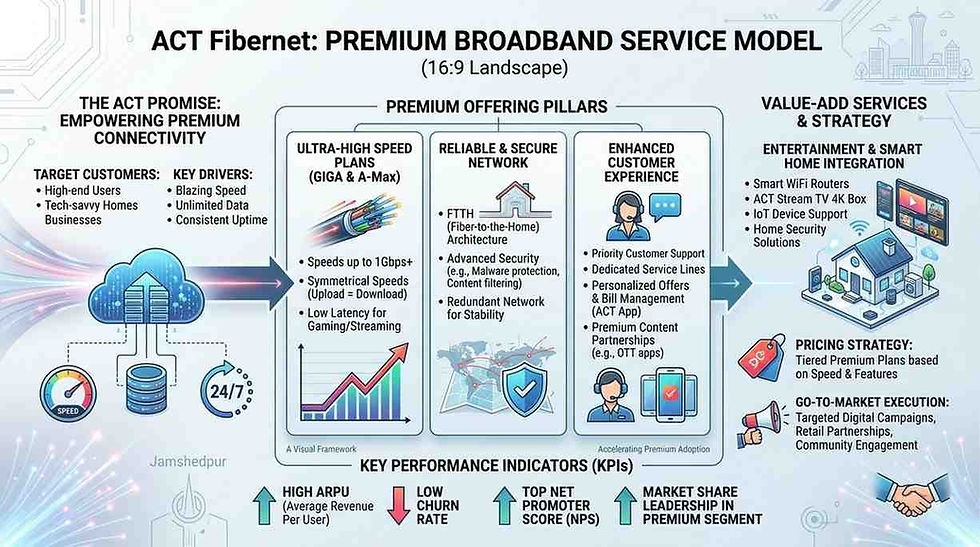
The most publicly documented inflection point in ACT's premium broadband strategy was the launch of 1 Gbps wired broadband in Hyderabad on March 30, 2017. Widely covered by technology outlets including The Next Web, Digit, TechWorm, and The News Minute, the launch made ACT the first ISP in India to offer citywide gigabit broadband access. The company invested Rs 100 crore to deploy the technology in Hyderabad, which was formally declared India's first "Giga City" at a government-attended launch ceremony. The 1 Gbps plan was priced at Rs 5,999 per month inclusive of taxes, with a fair usage policy of 1 TB. At the time of launch, this speed was approximately 400 times faster than India's average broadband speed of 2.5 Mbps, according to reporting at the launch event.
The ACT Giga service, as it was branded, was not positioned merely as a speed upgrade. CEO Bala Malladi stated at the Hyderabad launch that the target segment included startups, retail outlets, and technology companies, framing gigabit connectivity as enabling a category of digital use cases unavailable at prevailing speeds. By December 2017, ACT had extended the 1 Gbps plan to Bengaluru at an equivalent price point, with the plan carried over to other operational cities progressively.
The pricing architecture that ACT developed over subsequent years reveals the strategic logic of a tiered service model. Published plan listings confirm that ACT offers a portfolio ranging from approximately Rs 499 per month at entry speeds of 40 to 50 Mbps up to Rs 2,999 per month at 1 Gbps. This tiered structure allows ACT to present a clear premium ascent ladder while serving different household segments within the same fibre infrastructure. Crucially, the same physical network delivers all tiers, meaning the economics of the premium subscriber are significantly more favourable, as speed and data allocation differences represent primarily policy-level configuration rather than incremental physical investment.
The company also built an entertainment dimension into its service architecture. Official website content from actcorp.in confirms that ACT offers OTT streaming subscriptions as bundled elements within certain plan categories, with platforms including Netflix, Disney Hotstar, SonyLiv, Zee5, and Aha integrated across different plan tiers. This OTT bundling strategy serves a dual function: it raises the effective value-per-rupee of higher plans, making the price difference between base and premium tiers more justifiable to consumers, and it positions the broadband subscription as the household's gateway to entertainment rather than a mere utility.
Beyond the pipe and the content, ACT invested in the in-home quality layer. The partnership with Aprecomm, announced in February 2024 per TelecomTalk, introduced AI-driven Wi-Fi quality optimisation software deployed directly onto customer routers. ACT developed a proprietary router operating system called ACT Zippy in partnership with Aprecomm, transforming the customer premises equipment from a passive relay point into an active quality management device. The system performs real-time functions including channel switching, band steering, congestion monitoring, and device-level application optimisation. In March 2025, ACT issued a press release through PR Newswire confirming that during the initial deployment of ACT SmartWiFi across 250,000 homes over a 15-day period, users experienced an average of three times higher speeds delivered to all devices compared to homes without the smart Wi-Fi service. In August 2025, ACT launched AI-powered mesh router plans under the ACT SmartWiFi brand, priced from Rs 799, designed for homes exceeding 1,200 square feet where signal coverage presents a structural challenge.
Positioning and Consumer Insight
The positioning logic ACT executes is grounded in a consumer insight that distinguishes between the subscribed speed and the experienced speed. Indian broadband consumers have historically expressed dissatisfaction with the gap between advertised speeds and actual throughput, compounded by in-home Wi-Fi degradation that is structurally separate from the ISP's fibre performance. ACT's decision to extend its premium promise from the network edge into the in-home environment targets this experienced gap directly.
The brand positions itself around the idea that connectivity is an experience, not a commodity. Its official communications emphasise lag-free gaming, buffer-free streaming, seamless video calling, and work-from-home reliability as the real-world expressions of its service. This choice of outcome-based language, rather than technical specification advertising, reflects an understanding that the premium segment evaluates connectivity through use-case satisfaction rather than speed benchmarks alone. The ACT SmartWiFi brand, in particular, enables the company to market intelligence as a differentiator, making the claim that the network learns and adapts to the home environment rather than delivering uniform output.
The company's geographic concentration in southern India, particularly Bengaluru, Hyderabad, and Chennai, is itself a positioning asset. These cities host India's largest concentrations of technology professionals, startup employees, gaming communities, and work-from-home knowledge workers, all of whom fall squarely within the high-spending, high-usage profile that premium broadband pricing requires. The CARE Ratings report of April 2024 specifically noted that ACT's southern geography presents high entry barriers and greater customer stickiness, corroborating the strategic wisdom of deep market penetration in fewer cities over shallow presence across many.
Media and Channel Strategy
No verified public information is available on ACT Fibernet's paid media strategy, advertising expenditure, or formal campaign architecture through documented sources such as press releases or credible trade reporting. What can be confirmed through official corporate communications is that ACT maintains a digital marketing presence across social media channels, deploys an owned mobile application for plan management and speed testing, and has pursued public-facing announcements of product launches through channels such as PR Newswire, the ACT blog at actcorp.in, and trade publications including TelecomTalk and Voice and Data. The public launch of the 1 Gbps service in Hyderabad was conducted as a government-attended event with the Minister for IT of Telangana, KT Rama Rao, participating formally, which generated substantial earned media coverage and positioned the launch as a civic achievement rather than a purely commercial product announcement.
Business and Brand Outcomes
The documented business outcomes of ACT's premium broadband strategy reflect a company that has sustained competitive positioning without the structural advantages available to its telco competitors. According to a Communications Today report from April 2026, ACT held a 5.2 percent market share of India's wired broadband segment as of December 2025, operated in more than 30 cities, and recorded net subscriber additions of 3.3 percent in the first nine months of FY26. The company's operating profitability was reported at 35.35 percent, described by the same report as holding steady despite competition from Reliance Jio and Airtel. The same source confirmed that PE investors True North and TA Associates collectively hold 94.66 percent of the company and that investment banks Nomura and Ambit Capital had been appointed to explore a sale at an enterprise value of approximately one billion US dollars.
The CARE Ratings analysis from April 2024 characterised ACT's financial risk profile as stable, noting outstanding debt of Rs 363 crore as of March 31, 2024, with a gearing ratio of 0.29x and interest coverage exceeding 20x. The net profit after tax for FY24 was reported at Rs 276 crore, compared to Rs 353 crore in FY23, with the decline attributed to segment imbalances rather than broadband performance, specifically the secular decline of ACT's legacy cable TV business relative to broadband growth.
Regarding the SmartWiFi initiative, the company's March 2025 press release confirmed the three-times speed improvement metric across 250,000 homes during the initial launch window, the only publicly documented performance figure from the AI network layer.
Strategic Implications
The ACT Fibernet case presents a fundamentally instructive model for how a capital-constrained challenger can sustain premium positioning in a market dominated by vertically integrated incumbents with far larger balance sheets.
The first and most transferable implication is the strategy of owning the in-home experience layer as a competitive moat. ACT recognised early that the fibre pipe itself is increasingly commoditised and that the differentiation frontier had shifted into the home. The investment in ACT Zippy and the Aprecomm partnership represents a deliberate extension of the service boundary from the network edge to every room in the customer's home. This strategy raises switching costs because it makes the ISP relationship about experienced quality rather than subscribed specification.
The second implication concerns the power of geographic depth over breadth. ACT's decision to concentrate its network in urban technology hubs rather than pursue national coverage reflects a premium service logic, as the customers with the highest willingness to pay for broadband are disproportionately concentrated in a small number of Indian cities. By dominating these geographies before telcos had completed their FTTH buildouts, ACT established dense network infrastructure and brand recognition that are difficult to displace.
The third implication relates to the role of technology milestones as brand-building events. The 1 Gbps launch in 2017 was not merely a product launch. It was a positioning signal that ACT was a category pioneer, willing to invest ahead of consumer demand to establish a technology leadership narrative. This type of milestone-driven branding creates a long-lasting halo that continues to differentiate the brand even as competitive speed tiers eventually converge.
The fourth implication concerns the OTT bundling architecture as a demand-side lock-in mechanism. By embedding streaming subscriptions into its premium plans, ACT replicated elements of the telco bundle model without requiring a mobile license or a content library of its own. Each streaming subscription integrated into a higher-tier plan increases the effective value of the plan while raising the psychological switching cost for subscribers.
The risk inherent in ACT's model is equally instructive. Its reliance on a narrow urban footprint, the ongoing decline of its cable TV revenue stream, and the capital intensity of network densification all create vulnerabilities. The enterprise valuation exercise underway as of 2026 suggests that its PE investors are evaluating whether the premium positioning model can be sustained independently or whether it requires the scale economics of a larger acquirer. That question itself confirms that premium service strategy, without eventual network scale, carries structural limits.
Discussion Questions for MBA Students
ACT Fibernet occupies the position of the largest non-telco ISP in India without a mobile license, a distinguishing constraint relative to its largest competitors. Using the frameworks of competitive positioning and resource-based view, evaluate whether ACT's geographic concentration in southern India is a strategic asset, a necessary limitation, or both, and what conditions would alter your assessment.
The launch of 1 Gbps broadband in Hyderabad in 2017 preceded mass consumer demand for gigabit speeds by several years. Apply the concept of technology adoption lifecycle and market signalling theory to analyse what ACT sought to achieve through this early-mover launch, and whether the strategy delivered sustainable differentiation or only temporary positioning advantage.
ACT's decision to invest in ACT Zippy, a proprietary router operating system, and ACT SmartWiFi, an AI-powered in-home quality layer, represents a vertical extension of the service value chain. Evaluate this decision using the principles of service dominant logic and customer experience management. Under what conditions does extending the service boundary into the customer's home create durable competitive advantage versus unwanted complexity?
The integration of OTT platforms such as Netflix, Zee5, and SonyLiv into ACT's premium broadband tiers reflects a bundling strategy borrowed from the telco playbook. Assess the risks and rewards of this approach for a non-telco ISP that neither owns the content nor controls the streaming platforms, with specific attention to dependency risk, negotiation leverage, and consumer perceived value.
Communications Today reported in April 2026 that PE investors True North and TA Associates are seeking an enterprise value of approximately one billion US dollars for ACT, while the same report noted that a prior sale process collapsed in 2021. From a marketing strategy perspective, analyse how the strength or weakness of ACT's brand positioning and customer value proposition affects its acquisition valuation, and what strategic actions a potential acquirer might take to accelerate or protect that value post-transaction.


Comments