Ariel’s Insight into Premium Detergent Adoption
- Jul 25
- 11 min read
Industry and Competitive Context
India's detergent market is one of the most fiercely contested segments within the country's fast-moving consumer goods sector. The market is structurally oligopolistic, with Hindustan Unilever Limited commanding the largest share at approximately 38 percent through its multi-tier portfolio of Surf Excel, Rin, and Wheel, while Procter and Gamble holds approximately 31 percent of the market with premium brands Ariel and Tide. The remainder is distributed among value-segment players such as RSPL Group's Ghari and Nirma, both of which anchor the low-cost end of the category.
The competitive significance of the premium segment is disproportionate to its volume share. In a price-sensitive market where per capita detergent consumption in India stands at approximately 2.7 kilograms per year, well below comparable emerging markets such as the Philippines and Malaysia at 3.7 kilograms and far below the United States at nearly 10 kilograms, the premium tier is where brand equity and pricing power are most intensely contested. Within that tier, the primary rivalry is between Ariel and HUL's Surf Excel, not between Ariel and the mass-market brands that compete primarily on affordability.
A structural shift further complicated the premium battleground in the early 2010s. Washing machine penetration in India, while nationally low at approximately 8.8 percent as of 2015, was significantly concentrated in urban households at 27.5 percent of all urban homes, versus just 0.6 percent in rural households. This urban appliance penetration created a distinct and growing sub-category of machine-specific detergents, commonly marketed as "matic" formulations, which gave premium brands like Ariel Matic a product-relevant reason to re-engage consumers who were transitioning from hand-wash routines to machine-based laundry. The product category, in other words, was evolving structurally in ways that advantaged technically differentiated premium offerings.
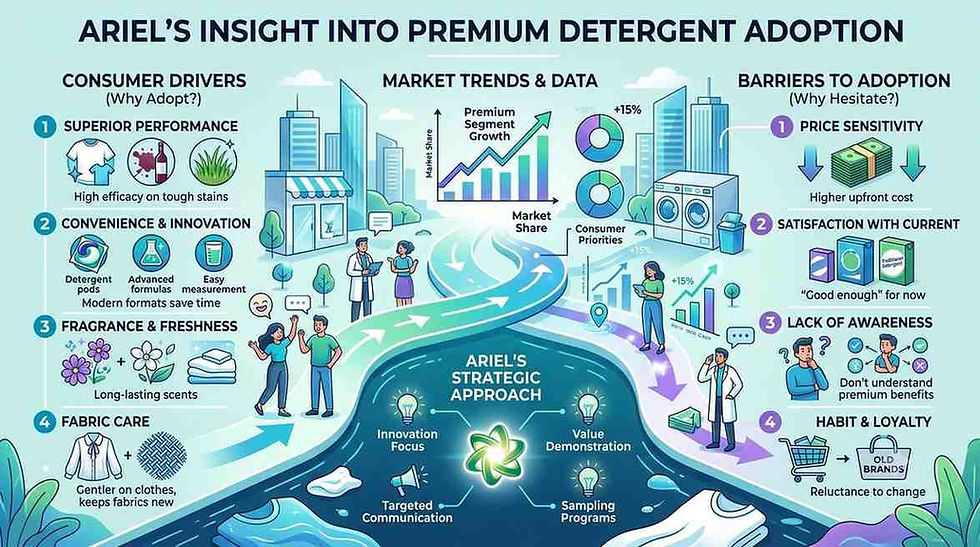
Brand Situation Prior to Camnpaig
Ariel entered the Indian market in 1991 as P&G's premium, technologically superior detergent. Its early communication followed the global P&G playbook: science-backed efficacy claims, stain-removal demonstrations, and category-standard product performance messaging. This approach established Ariel as a credible category participant among urban Indian consumers, particularly in the top ten metro markets.
By the early 2010s, however, the brand faced a strategic limitation that its product credentials alone could not resolve. Communication in the premium laundry detergent category in India had traditionally been dominated by functional performance claims and demonstration-style advertising. Ariel led the category in this mode, with its superior performance and stain-removal credentials well established. The problem was that Surf Excel, through its long-running "Daag Acche Hain" campaign, had successfully reframed the detergent category around emotional storytelling, specifically around childhood joy and the positive meaning of dirt as a sign of engaged living. This forced Ariel to confront the fact that functional superiority alone was insufficient to generate the emotional resonance that drives sustained premium pricing power, word-of-mouth, and social conversation at scale.
Ariel's share of voice in the premium detergent segment was significant, but the brand lacked the cultural depth that would allow it to move from being a preferred product to being a brand with which urban Indian women actively identified. The brand's premium price point, while justified by product performance, also created an adoption barrier for aspiration-driven but price-sensitive middle-income consumers who had not yet made the transition to premium detergent. The brand needed a repositioning architecture that could simultaneously deepen its relevance among existing urban premium consumers and justify the category upgrade for those approaching it from the mass segment.
Strategic Objective
The primary strategic objective that P&G India set for Ariel, working with agency partner BBDO India, was brand repositioning: moving Ariel from a category leader defined by functional superiority to a cultural force defined by a point of view on contemporary Indian life. The target consumer was specifically the urban Indian woman, concentrated in the top ten metropolitan markets, both working and non-working, but importantly defined by the aspiration to not be reduced to traditional domestic roles. A secondary commercial objective was to drive measurable sales growth and unaided brand awareness in the premium segment at a pace that outstripped category growth.
The strategic challenge was to identify a cultural insight authentic enough to carry a brand narrative for multiple campaign cycles without becoming disconnected from the product's core function. The risk of generic cause-related marketing, where the brand attaches itself to a broad social issue without any credible connection to what it actually does, was explicitly identified and rejected. As Rajat Mendhi, Executive Vice President of Planning at BBDO India, stated publicly at Cannes, there is a tendency in purpose-driven marketing to go broader into a topic than the brand can credibly own, leading to a tenuous connection between the social message and the brand itself. The discipline required was to find an issue that the product's functional truth could anchor authentically.
Campaign Architecture and Execution
The insight that gave Ariel its cultural platform came from third-party consumer research commissioned before the campaign's launch. The research, conducted across multiple cities with a sample of men and women, revealed that 79 percent of Indian men surveyed in November 2014, across five cities and a sample of 1,000 respondents through AC Nielsen, agreed that household chores were exclusively a woman's or daughter's job. Among women surveyed, almost two-thirds indicated that men did not help with laundry or household chores, and three-quarters felt that men preferred relaxing to assisting with domestic tasks.
The product logic that made this insight usable for Ariel, rather than for a generic gender equality advertiser, was elegant: if Ariel's formulation removes tough stains in a single wash without pre-treatment or expertise, then laundry ceases to be a skill-intensive task that could justify gender-based assignment. The product's ease of use became the functional proof-point for the social argument that men could and should do laundry. This alignment between a verified product truth and a genuine cultural tension is what separated the campaign from conventional corporate social responsibility advertising.
The first phase of the campaign, launched in 2015 under the hashtag ShareTheLoad, posed a single, deliberately open-ended question: is laundry only a woman's job? Rather than answering the question prescriptively, the creative execution allowed the question itself to generate public debate. Ariel launched an online petition urging men to pledge support for equal distribution of household chores, and over 1.5 million Indian men pledged to ShareTheLoad through various channels in the campaign's first phase. The petition mechanic transformed passive viewers into active participants, converting advertising exposure into documented attitudinal commitment.
The second phase, launched in 2016 as "Dads ShareTheLoad," shifted the narrative upstream by focusing on the intergenerational transfer of gender bias. The campaign's film showed a father who, upon visiting his daughter's home and witnessing the inequality of her domestic situation, recognizes his own role in modeling that imbalance through his behavior throughout her childhood. This phase was executed by BBDO Mumbai for Ariel Matic specifically. The third phase, launched in 2019 as "Sons ShareTheLoad," continued the socialization chain argument by focusing on mothers who recognize that they have inadvertently perpetuated inequality by raising sons differently from daughters. A sixth edition of the campaign, titled "See the Signs, Share The Load," was confirmed as active by The Drum in 2023, demonstrating a campaign lifespan of at least eight years from initial launch.
Positioning and Consumer Insight
The positioning architecture that Ariel established through the ShareTheLoad campaign represented a significant departure from conventional FMCG brand strategy. Rather than building on aspirational lifestyle imagery or direct product demonstration, the brand chose to occupy a clearly defined point of view on a social condition that its core consumer, the urban Indian working woman, experienced daily but which had not previously been addressed by any major detergent brand.
The consumer insight was grounded, not constructed. The research finding that Indian men spent an average of 19 minutes per day on routine housework, one of the lowest rates globally, while Indian women averaged 298 minutes, documented a disparity that the brand could legitimately address because its product was the object of that disparity. By placing itself in the corner of the Indian woman who was managing two jobs, one professional and one domestic, Ariel created a positioning that was simultaneously empathetic and commercially rational. The brand's premium price point became easier to justify to a consumer who saw Ariel as a brand that understood and respected her situation, rather than simply claiming superior cleaning performance.
The decision not to frame the campaign explicitly as feminist marketing was also strategically deliberate. BBDO's account of the creative strategy, shared publicly at Cannes, indicates that the team consciously avoided the label, instead framing the issue as a domestic relationship problem with a practical resolution that the product could facilitate. This framing made the campaign accessible to a broader audience, including men, rather than positioning it as a women's issue that men were being criticized over.
Media and Channel Strategy
Ariel's initial ShareTheLoad campaign used a combination of television, online video, cinema, and campaign-specific packaging to distribute its message. The first phase was structured to generate earned media through the inherent provocativeness of its central question, reducing the brand's dependence on paid reach alone. The petition mechanism and the hashtag were designed to seed social media conversation, which then drove organic distribution of the video content. Facebook's then-Chief Operating Officer Sheryl Sandberg publicly praised the campaign in a post, generating international earned media coverage at a scale that no paid media budget could have purchased.
By the campaign's second phase, the media strategy had shifted to weight digital and social channels more heavily relative to television, reflecting both the evolution of India's media consumption patterns and the campaign's established presence in public discourse. The WARC documentation of the Dads ShareTheLoad campaign lists the media channels as including cinema, online video, outdoor and out-of-home, packaging and design, print, social media, television, and word-of-mouth advocacy. The declared budget for the Dads ShareTheLoad phase was in the range of 500,000 to 1 million US dollars, a relatively modest investment against the scale of earned media it generated. P&G's figures indicate that the Dads ShareTheLoad phase alone generated 12.3 million US dollars in earned media coverage and conversations on social media.
Business and Brand Outcomes
The documented business outcomes of the ShareTheLoad campaign are among the most thoroughly verified in Indian FMCG marketing history, having been submitted to and validated by multiple international effectiveness award bodies.
On brand awareness, P&G's disclosed figures show that the first phase of the campaign drove a 42 percent increase in unaided brand awareness for Ariel Matic. Brand awareness as tracked across the campaign's first year grew by 34 percent in 2015 and a further 46 percent in 2016, as documented by P&G India and reported across multiple credible media properties including WARC and The Drum.
On sales performance, the most authoritative figure comes from the WARC 100 case submission, which documents that Ariel grew in both value and volume terms by approximately 95 percent when comparing 2014 and 2015. The market as a whole grew by 6 percent in value and 3 percent in volume during the same period, establishing that Ariel's growth was not a function of category tailwind. The brand's primary premium competitor grew by 29 percent in value and volume during the same period, confirming that Ariel's growth significantly outpaced even the favorable dynamics of the premium segment. A separate documented metric from the Dads ShareTheLoad phase records a 76 percent increase in sales attributed to that execution specifically.
On attitudinal movement, Ariel's official website documents measurable shifts in the attitudes the campaign sought to change. The proportion of Indian men surveyed who agreed that household chores were exclusively a woman's job fell from 79 percent in 2014 to 63 percent in 2016 and further to 52 percent by 2018, a trajectory that, while not solely attributable to the campaign, represents the social change the brand committed to driving.
On industry recognition, the campaign accumulated more than 10 awards at Cannes Lions, including Gold Lions in 2015, 2016, and 2017, as well as a Gold Glass Lion at Cannes in 2016. It also won multiple Grand Prix and Gold awards at Spikes Asia, and a Blue Elephant at Kyoorius Creative Awards. The campaign topped the WARC 100, the most rigorous global ranking of marketing effectiveness and business impact, for two consecutive years, making Ariel Matic the only brand to hold the top position in back-to-back cycles at the time.
Strategic Implications
The Ariel ShareTheLoad case offers several strategically significant lessons for premium brand management in price-sensitive, culturally complex markets.
The first and most consequential implication is the principle of anchored purpose. Ariel's campaign succeeded commercially because its social message was anchored to a specific, demonstrable product truth. The ease-of-use argument was not a rhetorical device appended to a social cause; it was the logical bridge between the brand's functional reality and the cultural argument it was making. Brands that attempt to replicate the purpose marketing formula without this anchor typically produce campaigns that generate awareness without commercial conversion, because the consumer cannot trace a coherent line from the message back to the product.
The second implication is the strategic compounding value of sustained cultural platforms versus episodic campaigns. Ariel maintained the ShareTheLoad narrative across at least six distinct campaign phases spanning more than eight years. Each iteration deepened the attitudinal intervention by addressing a progressively earlier point in the socialization chain, moving from adult women to fathers to mothers of sons. This architecture produced compounding returns on brand equity that a single-campaign approach could not have generated, regardless of the quality of the creative execution.
The third implication concerns the relationship between premium positioning and consumer identity. In a market where premium pricing is difficult to sustain because of intense price competition from mass-market alternatives, Ariel's repositioning demonstrated that a consumer's willingness to pay a premium is substantially influenced by whether the brand reflects back a version of the consumer's self-image that she finds aspirational. By positioning itself as a brand that understood and respected the urban Indian woman's dual burden, Ariel converted its premium price point from a potential adoption barrier into a signal of alignment with her values.
The fourth implication is about earned media as a strategic planning assumption, not an accidental outcome. The 12.3 million dollars in earned media generated by the Dads ShareTheLoad phase, against a declared budget of under one million dollars, was not a product of luck. It was the predictable outcome of a creative strategy designed to produce a reaction from audiences with large existing platforms, which was then sustained by a petition mechanic that gave individuals a concrete way to participate. The ratio of earned to paid media achieved here represents a model for how purpose-driven campaigns should be engineered in an environment of fragmented attention and declining paid media efficiency.
No verified public information is available on Ariel's specific customer acquisition costs, internal segmentation models, retailer-level margin structures, or proprietary digital targeting methodologies used across the campaign phases.
Discussion Questions
Ariel's functional proof-point, specifically that a product requiring no expertise to use cannot logically be assigned to one gender, was essential to distinguishing this campaign from generic cause marketing. How should brand managers evaluate whether a social insight is sufficiently anchored in their product's functional reality before committing to a purpose-driven positioning strategy?
The WARC-documented data shows that Ariel's premium competitor also grew by 29 percent during the same period in which Ariel grew by 95 percent. What does this differential reveal about the relative contribution of category tailwinds versus brand-specific strategy to Ariel's sales outcome, and how should such attribution be handled in post-campaign effectiveness assessments?
Ariel sustained the ShareTheLoad narrative across at least six campaign phases over eight or more years, each addressing a different point in the socialization chain. At what point does a sustained cultural platform risk audience fatigue or brand self-parody, and what signals should marketers track to determine when a platform has exhausted its commercial utility?
The campaign's target consumer was explicitly defined as the urban Indian woman in the top ten metro markets. Given that India's washing machine penetration in rural households was approximately 0.6 percent at the time of the campaign's launch, was Ariel's geographic and demographic focus strategically sound for a premium matic detergent, or did it permanently constrain the brand's total addressable market in ways that could have been avoided?
Ariel's attitudinal tracking, disclosed by P&G India, shows that the percentage of men who viewed laundry as exclusively a woman's job fell from 79 percent in 2014 to 52 percent by 2018. If a brand's stated purpose is to drive social change, and that change demonstrably occurs over time, what responsibility does the brand have to evolve the campaign's central argument, and how should the brand balance narrative progression against the risk of diluting the original positioning equity?


Comments