Ather Energy and Consumer Acceptance of Connected Electric Vehicles
Industry & Competitive Context
India’s electric two-wheeler (e2W) segment has moved from a niche, subsidy-dependent category to a meaningful share of overall two-wheeler sales over the past five years. Industry data reported in trade press puts e2W penetration at roughly 6.5% of total two-wheeler registrations in FY2026, with industry volumes rising about 22% year-on-year to approximately 1.4 million units. The competitive set spans legacy two-wheeler manufacturers that have added electric models to existing portfolios (TVS Motor, Bajaj Auto, Hero MotoCorp) and pure-play electric vehicle start-ups built around software-first product architectures, principally Ather Energy and Ola Electric. Reporting on the first half of a recent fiscal year noted that TVS, Bajaj, Hero and Ather collectively captured nearly all of the segment’s incremental growth, while Ola Electric lost market share over the same period a signal that the competitive advantage in this category is shifting away from pricing alone toward product reliability, service networks and after-sale experience.
Ather Energy was founded in 2013 by Tarun Mehta and Swapnil Jain, both IIT Madras alumni, and built its identity around vertically integrated hardware and software: its own battery packs, motor controllers, vehicle software stack (branded AtherStack) and a proprietary public fast-charging network (Ather Grid). The company’s flagship product line has evolved from the original Ather 450 (launched 2018) through successive 450-series updates to the Ather Rizta, a family-oriented scooter introduced in 2024 that, according to the company’s own sales disclosures, had crossed 300,000 cumulative units sold and accounted for roughly 76% of Ather’s portfolio volume in FY2026 making it the company’s primary growth vehicle. Ather listed on the BSE and NSE on May 6, 2025, following an IPO priced at ₹321 per share that raised approximately ₹2,980.76 crore, combining a fresh issue of about ₹2,626 crore with an offer for sale of roughly ₹355 crore. The stock’s listing-day closing figures were slightly below the issue price, reflecting a cautious initial market reception even as the company’s underlying volumes continued to grow.
Brand Situation Prior to Campaign
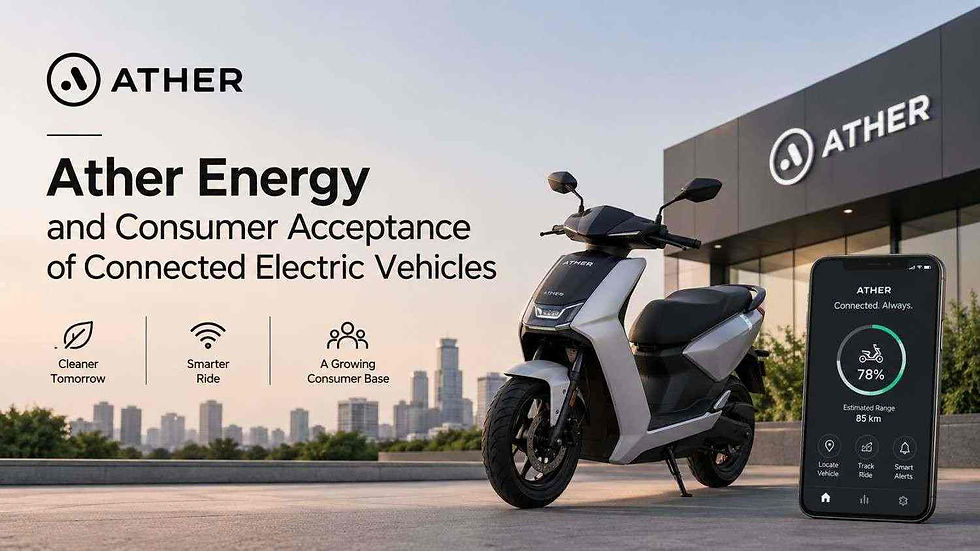
Unlike a conventional brand case built around a single advertising campaign, Ather’s positioning around “connected” electric vehicles has been constructed incrementally, through product and software releases rather than a discrete marketing push. Prior to its IPO and subsequent scale-up, Ather operated as a premium, technology-led challenger brand in a market where consumer trust in electric two-wheelers had been damaged by a well-documented cluster of battery fire incidents in 2022, several involving competitors’ vehicles and at least one involving an Ather 450X in Chennai. In the Ather case, the company’s own investigation and public statement attributed the fire to a faulty wiring harness assembly rather than a battery cell failure, a distinction the company made explicitly in its public communication at the time. Trade press coverage from that period noted that Ather responded relatively quickly and transparently compared with some competitors, issuing a detailed official statement on its community forum rather than a generic denial.
This episode is relevant to the case because it occurred at a moment when consumer willingness to adopt electric two-wheelers and particularly to trust the “connected” layer of software, remote monitoring and data-driven safety features layered on top of the vehicle was still forming. Ather’s pre-existing product architecture already included features such as theft and tow alerts (launched in 2021) and an owner-facing mobile app, giving it an installed base of users already experiencing connected functionality before the 2022 fire incidents raised broader category-level safety questions. The brand’s challenge was therefore not to introduce the concept of connectivity to a skeptical market, but to sustain consumer confidence in a connected-vehicle value proposition at a time when adjacent safety incidents could plausibly spill over onto perceptions of the entire e2W category, Ather included.
Strategic Objective
Based on publicly disclosed statements and the pattern of product releases, Ather’s strategic objective in this period can be read as twofold: first, to broaden the addressable market for its connected-vehicle proposition beyond early adopters and enthusiast riders reflected most clearly in the 2024 launch of the Rizta, positioned explicitly as a family and mass-market scooter rather than a performance-oriented product like the 450X and second, to use software and connected features as a differentiator and a recurring-revenue lever rather than a one-time hardware sale. The company’s Q2 FY26 results disclosure, reported in business press, explicitly broke out “non-vehicle revenue” described as software subscriptions, charging, accessories, spares and maintenance as a distinct line item making up about 12% of total income, which indicates that monetizing the connected layer of the product (not just the vehicle itself) had become an explicit, disclosed financial objective by that point, not merely a marketing narrative.
CEO Tarun Mehta’s public commentary, as relayed in business press coverage of the company’s quarterly results, framed the period’s priority as sustaining “steady growth in market share” alongside “continued progress on our path to profitability,” with explicit reference to demand strength in what the company calls “Middle India” a geographic expansion objective distinct from the company’s original urban, metro-centric customer base. Read together, these disclosures point to a strategic objective centered on geographic and demographic broadening of the customer base, converting connected features from a differentiator for early adopters into an ordinary expectation for mainstream buyers, and building a disclosed, recurring non-hardware revenue stream around that connectivity.
Campaign Architecture & Execution
The clearest verifiable unit of “campaign” activity in this case is Ather’s recurring Community Day event, used as the public platform for major software and hardware announcements. At the third Ather Community Day (reported by trade and business press in 2025), the company unveiled AtherStack 7.0, a software update rolled out over the air (OTA) to existing vehicles rather than requiring a dealership visit or new purchase itself a notable element of execution, since it demonstrates the company delivering on its connected-vehicle promise to its existing installed base rather than reserving new features for new buyers only. The update was reported as backward-compatible with the Rizta Z and Ather 450X up to Generation 3, extending the practical lifespan of the connected feature set for owners of older vehicles.
The features announced as part of this release, as documented in trade press, included a voice assistant operating through Ather’s Halo smart helmet line; proactive prompts encouraging riders to share live location on late-night trips; tyre pressure reporting; “ParkSafe,” extending the theft and tow-alert functionality first introduced in 2021; “LockSafe,” allowing owners to remotely immobilize the vehicle through the mobile app; remote start/stop of charging and vehicle shutdown via the app; and road-hazard alerts (speed bumps and potholes) delivered through the Halo helmet’s voice assistant in major cities. Alongside the software update, the company previewed a new vehicle architecture (the “EL platform”) intended for future scooters, which according to CTO Swapnil Jain’s public remarks was designed to reduce component count, cut assembly time by roughly 15%, and extend service intervals to as long as 10,000 km, while integrating advanced electronic braking and combining the onboard charger with the motor controller. Execution of the broader connected-ecosystem strategy also included continued build-out of the Ather Grid charging network, which the company’s Q2 FY26 disclosures put at 4,322 fast-charging and neighbourhood charging points across India, Nepal and Sri Lanka (up from 4,032 the prior quarter), alongside an expansion of physical retail touchpoints to 524 Experience Centres.
Positioning & Consumer Insight
Ather’s positioning, as evidenced through its product communication, rests on treating software and connectivity not as an add-on feature but as integral to the ownership experience and to rider safety a framing made explicit through features such as late-night location-sharing prompts and remote immobilization, which address personal-safety and theft concerns rather than purely performance or convenience concerns. This differs from positioning connectivity as a lifestyle or entertainment feature (as some competitors have emphasized dashboard app ecosystems or music integration); Ather’s publicly documented feature set leans toward safety, maintenance transparency (tyre pressure, service alerts) and theft deterrence as the primary consumer benefits of connectivity.
No independently verified, publicly disclosed consumer-research report (from a named source such as RedSeer, BCG, McKinsey, or a published survey) specifically measuring Indian consumer acceptance of connected-EV features for Ather was identified in the sources reviewed for this case. No verified public information is available on a dedicated third-party consumer-insight study underpinning Ather’s connected-vehicle positioning. What can be documented instead is behavioral and transactional evidence: the shift in portfolio mix toward the Rizta (a mass-market, family-oriented model) commanding roughly 76% of the company’s FY2026 volume, and the growth in the “Middle India” region’s share of Ather’s sales (from 8.8% to 14.6% year-on-year per the company’s Q2 FY26 disclosure) as cited by the CEO in connection with “robust consumer demand.” These figures are company-reported and relayed through business press rather than independently audited, and should be read with that caveat; they nonetheless constitute the most direct publicly available proxy for consumer acceptance of Ather’s connected-vehicle proposition, since they reflect actual purchase behavior across a widening geographic and demographic base rather than stated purchase intent.
Media & Channel Strategy
Ather’s primary public-facing channel for major connected-feature announcements is its own owned platform the Ather Community Day event and the company’s community forum rather than conventional paid advertising campaigns, based on the sources reviewed. The company’s official statement following the 2022 Chennai fire incident was likewise issued through its community forum, indicating that Ather treats its owned digital community as the primary channel for both product news and crisis communication regarding its connected and safety features. Beyond owned channels, the company’s financial and operational disclosures (quarterly results, stock-exchange filings via NSE and BSE corporate announcement archives) serve as a secondary, investor-facing channel through which specific metrics on non-vehicle revenue, charging infrastructure scale, and market share are made public.
Business & Brand Outcomes
Several outcomes are documented through company disclosures relayed in financial and trade press and should be treated as the verifiable results of this period. In Q2 FY26 (quarter ended September 30, 2025), Ather reported total income of ₹940.7 crore, up 57% year-on-year, with units delivered rising 67% year-on-year to 65,595. The company’s national e2W market share rose to 17.4%, up from 12.1% a year earlier, with the South region reaching 25% share and Middle India rising to 14.6%. Net loss after tax narrowed to ₹154.1 crore from ₹197 crore a year earlier, and EBITDA loss narrowed to ₹90.7 crore with an EBITDA margin of approximately 10%, an improvement of over 1,100 basis points year-on-year. Non-vehicle revenue the category most directly tied to the connected-vehicle and services proposition constituted 12% of total income in the quarter, a figure the company chose to disclose separately, indicating it views this as a strategically significant metric rather than an incidental one. For the full fiscal year FY2025, the company reported selling more than 155,000 electric scooters with revenue up 29% to approximately ₹2,255 crore, alongside a net loss of ₹812.3 crore for the year.
On market standing, trade press reported Ather becoming the third Indian e-scooter maker to sell over 300,000 units in a given year, and separately that TVS, Bajaj, Hero and Ather together captured nearly all of the segment’s incremental first-half growth while Ola Electric’s share declined positioning Ather favorably relative to its most direct pure-play EV competitor, though still well behind the diversified incumbents in absolute volume. On the capital-markets side, the IPO’s modest listing-day performance (closing slightly below the ₹321 issue price) indicates that public investors approached the connected-EV growth story with some caution at the point of listing, even as subsequent quarterly volume and market-share trends moved in the company’s favor.
Strategic Implications
The Ather case illustrates a pattern increasingly relevant to technology-intensive consumer hardware categories: the “connected” layer of a product is most credibly validated not through marketing claims but through disclosed financial and operational metrics that investors and analysts can scrutinize directly in this instance, a separately reported non-vehicle revenue line, a transparent charging-infrastructure count, and OTA software delivery to an existing installed base rather than only to new buyers. This suggests that in categories where consumer trust was previously damaged by safety incidents (as occurred across the Indian e2W sector in 2022), the credible path to rebuilding and extending acceptance runs through demonstrated reliability and continued feature delivery to existing owners, rather than through a single reassurance campaign.
The shift in Ather’s portfolio and geographic mix toward the Rizta and toward Middle India also suggests that connected-vehicle features, once established as a premium differentiator among early, urban, tech-forward adopters, can migrate toward being baseline expectations for a broader, more price- and utility-sensitive buyer base provided the core value proposition (safety alerts, theft protection, maintenance transparency) addresses concerns that are broadly shared across customer segments rather than remaining a novelty feature for enthusiasts. Finally, the gap between Ather’s quarterly operational momentum (rising market share, narrowing losses, growing non-vehicle revenue) and its comparatively subdued IPO reception points to a broader strategic tension for connected-hardware start-ups: operational and product traction with consumers does not automatically translate into immediate capital-markets confidence, particularly in a category still working through the aftermath of category-wide safety concerns and competing against better-capitalized, diversified incumbents.
Discussion Questions
How should a hardware company weigh the strategic value of disclosing a specific “non-vehicle revenue” metric (software, services, charging) separately from vehicle sales, given that this figure remained a relatively small share (about 12%) of total income in the period examined?
Given that Ather’s connected-feature rollout (AtherStack 7.0) was delivered via OTA update to existing vehicle owners rather than reserved for new buyers, what does this choice suggest about the relative strategic priority of retention and trust-building versus new-customer acquisition in a connected-hardware business model?
In the absence of independently published third-party consumer research on acceptance of connected EV features in this case, what alternative public indicators (financial, operational, or behavioral) are most defensible as proxies for consumer acceptance, and what are the limits of relying on company-disclosed figures for this purpose?
How should a company in a safety-sensitive hardware category (electric vehicles) sequence its crisis communication (such as Ather’s 2022 fire-incident statement) relative to its ongoing product and connectivity marketing, to avoid either under-addressing safety concerns or allowing them to dominate the broader product narrative?
As Ather’s customer base broadens from urban early adopters toward “Middle India” and family-oriented buyers (via the Rizta), what trade-offs might arise between maintaining connected features as a premium differentiator and ensuring those same features remain simple and accessible enough for a more mainstream, less tech-forward customer segment?


Comments