BharatPe and the Changing Payment Habits of Small Merchants
Industry & Competitive Context
India’s digital payments landscape shifted decisively after the 2016 demonetisation drive and the rollout of the Unified Payments Interface (UPI), which created a low-cost, interoperable rail for instant bank-to-bank transfers. Early UPI adoption was concentrated among urban, tech-savvy consumers and large organised retailers, while small and informal merchants kirana (neighbourhood grocery) stores, street vendors, and micro-retailers continued to rely overwhelmingly on cash. These merchants faced a structural problem: most digital payment acceptance tools of the time required merchants to hold a separate QR code or device for every payment app a customer might use (Paytm, PhonePe, Google Pay, and so on), creating clutter, confusion, and reconciliation difficulty at the point of sale. At the same time, small merchants had little access to formal credit, since most lacked the collateral, credit history, or paperwork that banks and NBFCs required.
BharatPe entered this environment positioning itself specifically around the small-merchant segment rather than the end consumer, differentiating itself from consumer-first players such as Paytm, PhonePe, and Google Pay, which primarily competed for consumer wallet share and only secondarily served merchants.
Brand Situation Prior to the Company’s Entry
BharatPe was founded in 2018 and is headquartered in New Delhi. According to company and media sources, the company was founded by Ashneer Grover and Shashvat Nakrani, with Bhavik Koladiya also named as a co-founder in some company materials. At founding, BharatPe’s core insight was that small merchants needed two things that existing fintech products did not adequately provide: (1) a single, interoperable way to accept payments regardless of which app the customer used, and (2) access to working-capital credit based on their digital transaction history rather than traditional collateral.
BharatPe raised a Series A round of approximately $15.5 million in April 2019, led by Insight Partners along with Sequoia Capital and Beenext, according to reporting from YourStory, Inc42, and Business Standard. This capital supported early merchant acquisition for its interoperable QR code product.
Strategic Objective
BharatPe’s stated strategic objective, as described in company and press materials, was to build financial inclusion infrastructure for India’s small-merchant economy by combining (a) free, interoperable QR-code payment acceptance, (b) data-driven unsecured merchant lending based on transaction history, and (c) an expanding suite of merchant and consumer financial products built on top of that transaction relationship. The company’s goal was not simply to process payments but to use the resulting transaction data as an underwriting input for credit a product category largely unaddressed by incumbent payment apps at the time.
Campaign Architecture & Execution
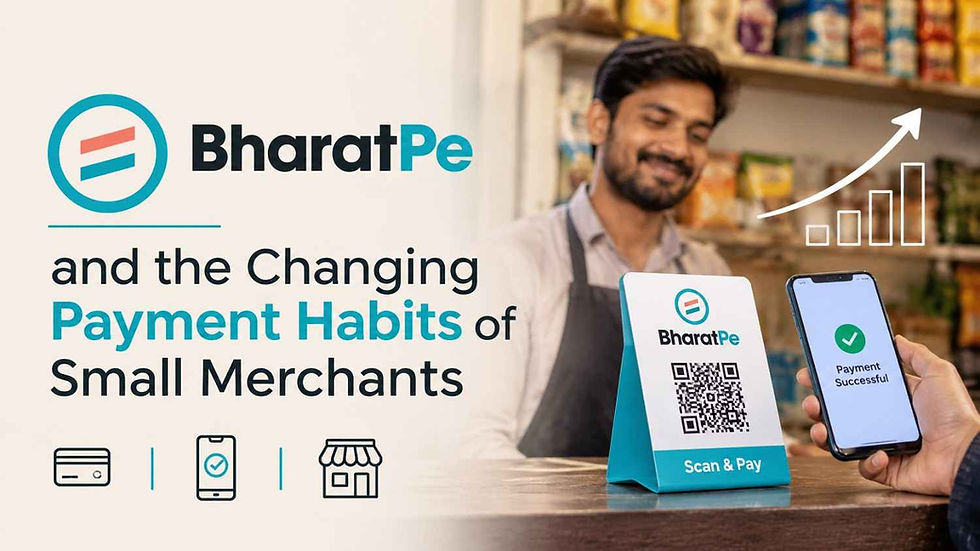
BharatPe’s core merchant-facing product was a single interoperable QR code that allowed merchants to accept payments from multiple UPI-linked apps without needing separate codes for each provider, removing a point-of-sale friction that had been common among small retailers. The company also offered point-of-sale (POS) devices and, per company statements, charged merchants zero merchant discount rate (MDR) on UPI transactions, consistent with the zero-MDR regulatory framework that applied to UPI transactions in India more broadly.
On the credit side, BharatPe extended unsecured working-capital loans to merchants using their BharatPe transaction history as an underwriting signal, a product designed to serve merchants who were typically excluded from formal bank lending. The company’s FY24 disclosure (via Business Standard) described a secured-lending partnership with OTO Capital for two-wheeler loans and Volt Money for loans against mutual funds, both of which were added in August 2024.
Beyond payments and merchant credit, BharatPe diversified into adjacent financial products: it acquired the loyalty programme Payback India in June 2021; it launched a peer-to-peer investment and lending product called “12% Club” in August 2021, which offered a fixed 12% annual return to retail investors whose funds were on-lent to merchants and small businesses through NBFC partners, as reported by Business Standard, Inc42, and YourStory; and it launched a buy-now-pay-later consumer credit product, “PostPe,” around October 2021, according to YourStory.
In October 2021, a consortium led by Centrum Financial Services and BharatPe received an in-principle Small Finance Bank licence from the Reserve Bank of India, as reported by Business Standard and BloombergQuint; this consortium subsequently amalgamated the stressed Punjab and Maharashtra Co-operative (PMC) Bank into the newly formed Unity Small Finance Bank, extending BharatPe’s ecosystem into formal banking infrastructure, including reported plans (per Business Standard, January 2025) for BharatPe’s parent to sell up to a 25% stake in Unity SFB.
Positioning & Consumer (Merchant) Insight
BharatPe’s core positioning insight was that a small merchant’s primary pain points were operational simplicity (one QR code instead of many) and access to capital (credit without collateral), rather than brand loyalty to any single payment app. This differed from the positioning used by many consumer-first payment apps, which competed primarily on consumer-side rewards, cashback, and app engagement. By anchoring its value proposition to merchant economics free acceptance, fast settlement, and credit access BharatPe sought to build merchant relationships based on utility rather than promotional incentives.
A documented real-world test of this positioning occurred in early 2024. Following restrictions imposed on Paytm Payments Bank by the Reserve Bank of India (effective January 31, 2024), BharatPe told BusinessLine that its merchant onboarding rose 77% month-on-month in February 2024, with onboarding-related website inquiries up more than 47%. The company reported that Tier I city onboarding rose 76%, Tier II rose 63%, and Tier III and smaller towns rose over 83% in that period, and that its merchant base crossed 1.3 crore (13 million) by February 29, 2024. The article also noted that in the first half of February, merchant signups rose 100% month-on-month, with growth of 104% in metro cities and 95% in Tier II/III cities. BusinessLine attributed part of this shift to incentives BharatPe offered during the period, including free QR code setup, flat earnings of up to ₹300, and instant settlements, and reported that merchants previously served by Paytm (which the article said held roughly 69% market share among kirana stores) migrated across multiple platforms, including BharatPe, Mobikwik, PhonePe, and Google Pay not exclusively to BharatPe.
Media & Channel Strategy
Publicly documented channel activity consists of direct merchant onboarding (field sales and digital sign-up, referenced in the BusinessLine reporting above), product press releases, and funding-related media coverage.
Business & Brand Outcomes (Documented Results)
BharatPe’s funding history is well documented in the press. After its $15.5 million Series A in April 2019, the company went on to raise a Series D round of approximately $108 million in February 2021, led by Coatue Management, valuing the company at approximately $900 million, as reported by Inc42 and Business Standard. In August 2021, BharatPe raised a Series E round of approximately $370 million led by Tiger Global, at a valuation of approximately $2.85 billion, according to Entrepreneur India and Business Standard, at which point the company attained unicorn status.
On financial performance, Business Standard reported that BharatPe’s FY21 revenue grew more than six-fold to approximately ₹700 crore, and reported FY22 revenue growth of roughly four-fold to around $100 million (with a reported monthly cash burn of approximately $4 million at that time). Separate reporting (Outlook Business/Startup Outlook) cited BharatPe’s annualised revenue surpassing ₹1,500 crore, a 31% increase from FY23, alongside a reported reduction in EBITDA burn and a first profitable month in October of that fiscal year. Company disclosures reported by Business Standard for FY24 cited revenue of approximately ₹1,700 crore (around $180 million) and a net income of approximately ₹66 crore (around $6.9 million).
As of company-reported figures on BharatPe’s own website, the company states it has over 17 million merchant partners (described elsewhere as “over 1.7 crore”) across 450+ cities in India, with total payment value exceeding ₹1,700 billion and business loans facilitated exceeding ₹14,600 crore. These are self-reported company figures and are not independently audited public data; they are presented here as the company’s own public disclosure rather than as independently verified metrics.
On governance, BharatPe underwent a significant leadership disruption beginning in 2022, when an internal governance review into alleged financial irregularities involving co-founder Ashneer Grover led to his resignation and a multi-year legal dispute between Grover and the company, including a petition filed by BharatPe in November 2023 over alleged disclosure of confidential information, and a counter-allegation by Grover in February 2023 regarding data handling by another co-founder. The dispute was reported as settled on September 30, 2024, with a portion of Grover’s shares transferring to the Resilient Growth Trust and both parties agreeing to end litigation. Nalin Negi, previously CFO, became interim CEO in January 2023 and was elevated to CEO in April 2024, according to the company’s reported leadership record.
Strategic Implications
BharatPe’s trajectory illustrates several points relevant to merchant-facing fintech strategy in markets with large informal retail sectors. First, interoperability itself can function as a competitive differentiator when market fragmentation (multiple single-purpose QR codes) creates real operational friction for the end user in this case, the merchant rather than the consumer. Second, transaction data generated through a payments relationship can be monetised as a credit-underwriting asset, allowing a payments company to expand into lending without traditional collateral-based underwriting, though this also exposes the business to credit risk that a pure payments business does not carry. Third, the documented 2024 merchant-onboarding surge following competitor-specific regulatory restrictions shows that in markets with low switching costs and limited merchant loyalty, usage shifts can occur rapidly in response to a rival’s regulatory or operational disruption, rather than solely through a company’s own marketing or product efforts a dynamic that benefits incumbents positioned to absorb displaced demand quickly. Finally, the prolonged governance dispute involving a founding executive demonstrates that in high-growth fintech ventures, governance and leadership stability can materially affect brand and investor confidence independent of underlying product-market fit, underscoring the importance of governance structures keeping pace with growth-stage fintech scaling.
Discussion Questions
To what extent can “interoperability” alone serve as a durable competitive advantage in a market where regulatory frameworks (such as UPI’s zero-MDR rule) make core payment features easy for competitors to replicate?
What are the risks and benefits of a payments company expanding into unsecured lending using its own transaction data as the primary underwriting signal, particularly when serving an underbanked small-merchant segment?
The 2024 merchant-onboarding surge BharatPe experienced followed a competitor’s regulatory setback rather than a BharatPe-led campaign. What does this suggest about the limits of marketing-led growth strategies in low-switching-cost merchant markets, and how should a company plan for opportunistic versus planned growth?
How should investors and boards weigh founder-related governance risk against product-market fit when evaluating high-growth fintech ventures, based on the BharatPe-Ashneer Grover dispute?
BharatPe diversified from core merchant payments into P2P lending (“12% Club”), BNPL (“PostPe”), loyalty programmes (Payback India), and banking infrastructure (Unity Small Finance Bank). What strategic logic justifies this breadth of diversification, and what risks does it introduce relative to a narrower, payments-focused strategy?


Comments