BharatPe’s Merchant-Focused Fintech Business Model
Industry & Competitive Context
India’s digital payments industry expanded rapidly after the 2016 demonetisation drive and the rollout of the Unified Payments Interface (UPI), which allowed interoperable, real-time transactions across banks and payment apps at no cost to the consumer. Within this environment, most well-funded fintech players — Paytm, PhonePe, and Google Pay — built their businesses around the Indian consumer, competing primarily for wallet share, cashback-led adoption, and transaction volume on the payer side of a transaction. The offline merchant side of this economy, particularly small kirana stores, roadside vendors, and neighbourhood retailers, remained comparatively underserved: these merchants typically had to display multiple, brand-specific QR codes (one for each app with which they wished to accept payments), had limited or no access to formal working-capital credit, and had thin or non-existent credit histories that excluded them from traditional bank lending.
BharatPe was founded in 2018 in New Delhi by Ashneer Grover, Shashvat Nakrani, and Bhavik Koladiya to address this specific gap. Rather than competing for consumer attention, the company positioned itself as a business-to-business fintech built around the small merchant as the primary customer, with consumer-facing payment flows acting as the entry point into a broader suite of merchant financial services. This put BharatPe in a different competitive lane from consumer wallets, even though it operated on the same UPI rails, and placed it in more direct competition with merchant-focused offerings from Paytm for Business, PhonePe for Business, and, in point-of-sale hardware and merchant lending, companies such as Pine Labs.
Brand Situation Prior to the Business Model’s Formation
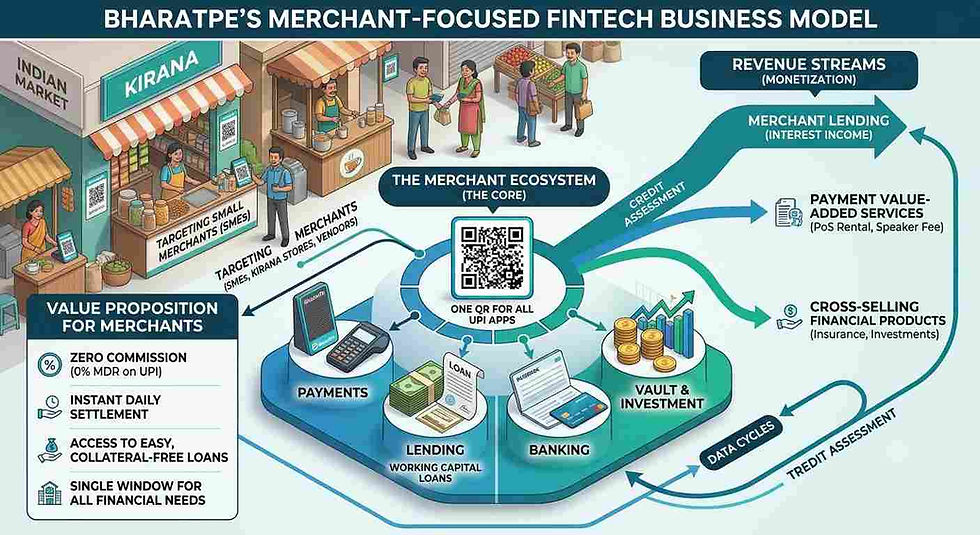
Before BharatPe’s launch, a merchant accepting digital payments in India typically needed to display separate QR codes for each UPI app or wallet a customer might use, creating friction at the point of sale and fragmenting transaction data across providers. Small merchants were also largely excluded from institutional credit: formal lenders generally required collateral, audited financials, or a multi-year banking relationship that most small shop owners could not produce, pushing many toward informal, high-interest moneylenders. BharatPe identified this unmet need a single, interoperable payment-acceptance tool combined with credit access based on observed transaction behaviour rather than traditional collateral as its founding insight.
Strategic Objective
BharatPe’s stated strategic objective, as reflected in its product launches and public statements by its leadership over time, was to become the primary financial services platform for India’s small and medium merchants by first winning merchant acquisition through a free, interoperable QR payment-acceptance product, and then monetising that merchant relationship through adjacent financial products working-capital loans, point-of-sale devices, savings and investment products, and, more recently, secured lending categories such as two-wheeler loans and loans against mutual funds. The objective was therefore sequential: acquire merchants at low cost through a payments utility, build a transaction-data-based understanding of each merchant’s cash flows, and use that data to underwrite credit that traditional lenders would not extend.
Business Model Architecture & Execution
The foundation of BharatPe’s model is its interoperable QR code, which allows a merchant to accept payments from any UPI-enabled app — PhonePe, Google Pay, Paytm, or any bank’s UPI app through a single BharatPe-issued code, without the merchant needing accounts on each competing platform. BharatPe did not charge merchants a transaction fee (merchant discount rate) on UPI payments accepted through this QR code, consistent with the broader zero-MDR regime that the Indian government mandated for UPI transactions from January 2020 onward. This made customer acquisition for the QR product effectively free to the merchant, which supported rapid onboarding.
On top of this payments layer, BharatPe built a lending business, commonly referred to as BharatPe Lending, that extended short-tenure working-capital loans to merchants using the QR code. Rather than lending from its own balance sheet as a regulated bank would, BharatPe operated as a lending marketplace, originating loans that were disbursed by partner non-banking financial companies (NBFCs) and banks, using the merchant’s transaction history on the BharatPe QR code as an input into underwriting. In August 2021, the company launched the “12% Club,” a peer-to-peer lending product in partnership with NBFC partners that allowed individual investors to lend funds to earn a fixed return (around 12% per annum), while merchants and other borrowers could access loans at a comparable headline interest rate. The company also operated a buy-now-pay-later product, PostPe, which was later folded into and rebranded under the main BharatPe app as the company moved toward a more unified app experience, including an expansion into consumer-facing payments, according to the company’s own disclosures reflected in public reporting around August 2024.
BharatPe also pursued vertical expansion into banking infrastructure. In October 2021, the Reserve Bank of India granted a small finance bank licence to a consortium of Centrum Financial Services and BharatPe, enabling them to take over the operations of the troubled Punjab and Maharashtra Co-operative (PMC) Bank, which had been under RBI-imposed restrictions since 2019 following a fraud-related collapse. The resulting entity, Unity Small Finance Bank, began operations in November 2021, giving BharatPe’s consortium a regulated banking license and access to PMC Bank’s existing depositor base. Former State Bank of India chairman Rajnish Kumar joined to guide this transition and has since served as BharatPe’s chairman. In 2021, BharatPe also acquired Payback India, a multi-brand loyalty rewards programme, adding a loyalty and engagement layer to its merchant and consumer offerings. In August 2024, the company further extended its merchant lending stack into secured credit categories by partnering with OTO Capital for two-wheeler loans and Volt Money for loans against mutual funds, moving the lending business beyond unsecured working-capital credit.
BharatPe’s capital-raising history reflects investor confidence in this merchant-first thesis during the 2019–2021 period. The company raised a Series B round of roughly $50 million in 2019 from investors including Ribbit Capital, Sequoia Capital India, and Steadview Capital. By August 2021, it raised approximately $370 million in a Series E round led by Tiger Global, which valued the company at roughly $2.85 billion and conferred unicorn status.
Positioning & Consumer Insight
BharatPe’s core insight was that the Indian merchant, not the Indian consumer, was the underserved party in the digital payments shift. While competitors fought for consumer app downloads and transaction share through cashback incentives, BharatPe wagered that merchants who had no existing loyalty to any single UPI app would gravitate toward whichever provider removed friction and offered something competitors did not: interoperability and access to credit. Because UPI’s zero-MDR rule meant payment acceptance itself could not be a source of revenue, BharatPe’s positioning treated the QR code as a customer-acquisition and data-generation tool rather than a monetisable product in its own right, with the monetisation intended to occur downstream through lending and other financial services built on the resulting transaction data. This is consistent with a broader “fintech funnel” approach in which a free, high-frequency product builds the data and trust needed to cross-sell a lower-frequency, higher-margin product such as credit.
Media & Channel Strategy
Public information on BharatPe’s merchant-facing channel strategy centres on on-ground merchant onboarding through field sales and partner networks, rather than mass-media brand advertising of the kind used by consumer-facing fintech apps. The company has reported geographic expansion milestones, including reaching a stated footprint across roughly 400 cities in India, though the granular composition of its acquisition channels (field agent networks, referral programmes, or partnerships) is not broken out in detail in public disclosures available for this case.
Business & Brand Outcomes
BharatPe’s documented financial trajectory shows a company that scaled revenue quickly in its early years while sustaining significant losses, followed by a period of loss reduction from fiscal year 2023 onward. For the fiscal year ended March 2023 (FY23), the company reported consolidated revenue of approximately ₹1,029 crore alongside a consolidated loss of approximately ₹941 crore. For the fiscal year ended March 2024 (FY24), BharatPe reported consolidated revenue of approximately ₹1,426 crore, an increase of about 39% year-on-year, while its consolidated loss narrowed to approximately ₹474 crore, roughly a 50% reduction from the prior year. The company also reported that its EBITDA loss narrowed sharply in FY24, and stated that it reached EBITDA-positive status for the first time in October 2023. Within the lending business specifically, the company reported that its average merchant lending portfolio grew by approximately 40% year-on-year in FY24.
The company’s growth also appears to have benefited from disruption to a major competitor: following restrictions placed on Paytm Payments Bank by the Reserve Bank of India in early 2024, BharatPe reported a 77% jump in merchant onboarding in February 2024, as merchants who had relied on Paytm’s payments infrastructure sought alternative providers. This illustrates how, in a market where the underlying UPI rails are standardised and commoditised across providers, competitive disruption to one player can translate into rapid share gains for another, independent of any change in BharatPe’s own product or marketing.
The period following BharatPe’s rapid fundraising also included significant governance turbulence. In early 2022, the company initiated an internal governance review into alleged financial irregularities involving co-founder Ashneer Grover, who subsequently resigned from his executive role in March 2022. A multi-year legal dispute between Grover and the company followed, including a February 2023 allegation by Grover that co-founder Bhavik Koladiya (who has since left the company) was involved in data-related misconduct, and a November 2023 petition filed by BharatPe against Grover concerning alleged disclosure of confidential information. These proceedings were resolved through a settlement reached on 30 September 2024, under which part of Grover’s shareholding was transferred to a trust associated with the company and both parties agreed to end the litigation. Leadership stabilised over this period under Suhail Sameer and subsequently Nalin Negi, who was appointed interim CEO and CFO in January 2023 and formally elevated to CEO in April 2024.
Strategic Implications
BharatPe’s trajectory illustrates several dynamics relevant to platform strategy in regulated, infrastructure-dependent fintech markets. First, when a core transaction layer (UPI, in this case) is standardised, free, and interoperable by regulatory design, competitive differentiation and monetisation must occur in adjacent layers in BharatPe’s case, merchant lending, banking infrastructure via Unity Small Finance Bank, and loyalty through Payback India rather than in the base transaction itself. This is a structural constraint that shaped the company’s entire product roadmap, from its initial QR launch through its 2024 expansion into secured lending categories.
Second, the model demonstrates both the opportunity and the risk inherent in data-based underwriting for underserved segments. Using merchant transaction history as an underwriting signal allowed BharatPe to extend credit to merchants who would likely have been excluded by traditional, collateral-based lending criteria, and the reported growth of its average lending portfolio in FY24 suggests this approach scaled. At the same time, the company’s sustained losses through FY23, even as revenue grew nearly threefold, indicate that building and monetising this merchant base required substantial, sustained capital investment well before profitability was achieved a pattern common to fintechs pursuing a “free product, monetise downstream” strategy in price-sensitive, high-volume markets.
Third, BharatPe’s governance crisis arising at the same company and in the same period as its rapid scale-up and unicorn valuation is a documented instance of the broader tension between high-velocity capital deployment and internal governance maturity that has recurred across several heavily funded Indian startups. The eventual narrowing of losses and stabilisation of leadership under Nalin Negi, occurring in parallel with the September 2024 settlement of the Grover dispute, suggests that resolving founder-level governance disputes was a precondition for the company’s ability to present a stable operating and financial narrative to the market.
Finally, the company’s reported merchant-onboarding surge following disruption at a competitor underscores a structural feature of UPI-based merchant acquisition: because the underlying payment rail is shared and merchants face low switching costs between QR-code providers, competitive position in this market can shift quickly based on a rival’s regulatory or operational setbacks, independent of a company’s own strategic execution. This places a premium on reliability and regulatory compliance as much as on product innovation, since a competitor’s compliance failure can be as significant a source of share gain as a company’s own product advantage.
Discussion Questions
In a market where the core payment rail (UPI) is free and interoperable by regulatory mandate, where should a fintech platform like BharatPe seek to build defensible competitive advantage, and how sustainable is an advantage built primarily on proprietary transaction data?
BharatPe pursued expansion into regulated banking (Unity Small Finance Bank) alongside its core non-bank lending marketplace model. What are the strategic trade-offs between operating as a lending marketplace reliant on NBFC/bank partners versus acquiring direct balance-sheet lending capability through a banking license?
BharatPe’s merchant-onboarding surge following Paytm Payments Bank’s regulatory restrictions in 2024 suggests that a competitor’s compliance failure can materially benefit a rival with no change in the rival’s own strategy. How should a fintech’s leadership plan for and respond to this kind of externally driven opportunity, and what risks does over-reliance on competitor disruption pose to long-term strategy?
The 2022–2024 governance dispute involving BharatPe’s co-founders coincided with the period in which the company needed to demonstrate a path to profitability to investors. What governance structures might mitigate the risk of founder-level conflict derailing a high-growth, heavily funded startup at a similarly early stage?
BharatPe’s financial disclosures show revenue growth significantly outpacing the narrowing of losses between FY23 and FY24. From a strategic standpoint, how should a merchant-fintech balance continued investment in scaling its lending and merchant base against the market and investor pressure to demonstrate a near-term path to sustained profitability?


Comments