Blue Star: Extending a Commercial Cooling Franchise into Consumer Cooling
Industry & Competitive Context
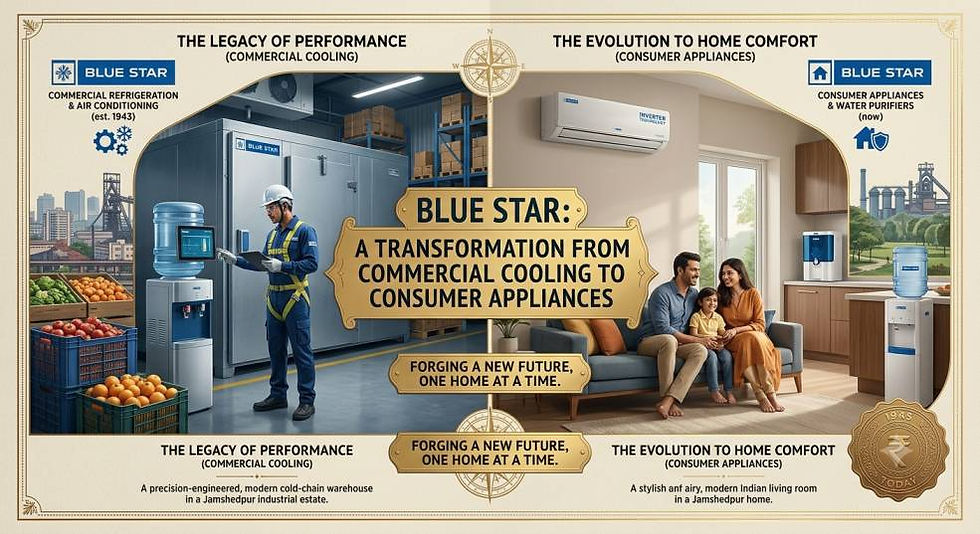
Blue Star was founded in 1943 by Mohan T. Advani, initially reconditioning air conditioners and refrigerators, and within its first years moved into ice candy machines, bottle coolers, central air conditioning and water coolers. The company today describes itself as an HVAC&R business and claims that one in three commercial buildings in India relies on its products. Its reporting is organised into three segments: Electro-Mechanical Projects and Commercial Air Conditioning, Unitary Products (cooling and purification products), and Professional Electronics and Industrial Systems.
India's cooling industry therefore contains two structurally different customer relationships: B2B project buyers and individual households. Blue Star's management has framed the household opportunity as demand-led. In a March 2024 stock-exchange filing, the company said room air conditioners are increasingly seen as a necessity rather than a luxury, with first-time buyers, especially in Tier 2, 3 and 4 markets, and replacement demand driving growth. It also cited industry estimates that the market will more than double by 2030. At a May 2023 press meet, the managing director put the domestic residential AC market at around 8 million units.
On competition, the 2019 press coverage of the Virat Kohli appointment reported the company describing itself as among the top five room AC manufacturers, with only a slight difference between the third and fifth positions.
Brand Situation Prior to Campaign
Blue Star's reputation was built in engineering and projects. Its corporate chronology records central air conditioning, industrial projects and a dedicated Industrial Division through the 1970s. It lists 2011–15 as a period of focus on the residential segment, with significant growth in room AC sales. The company's March 2024 release likewise dates its foray into the residential AC segment to 2011 and says it has outperformed the industry year after year since.
Summaries of the company's earlier history (for example Goodreturns) mention room and split air conditioners being introduced in the early 1990s. The sources reviewed do not reconcile this with the 2011 framing. This case therefore treats 2011 as the company's own description of when its current residential strategy began, not as the date of its first room AC.
By the late 2010s the consumer portfolio was not limited to air conditioners. Blue Star's corporate timeline records an expansion of its residential portfolio into water purifiers, air purifiers and air coolers. A trade-press report on a water purifier launch said the entry phase had been "successfully accomplished" and that sales and service had been integrated with room ACs to leverage that business's strengths. Trade coverage of a platinum jubilee launch also noted a new air cooler range under the "Windus" sub-brand and a new range of air purifiers. The company's own brand description links these categories under a single idea: enhancing air, food and water.
Strategic Objective
The stated objective was scale and reach beyond the brand's established customer base. In March 2021, the managing director linked the new range to the company's earlier aim of "shifting orbit" and accelerating growth through mass appeal across geographies and demographics. The same release said Kohli's mass appeal was helping widen the target group from Tier 1 and Tier 2 towns to Tier 3, 4 and 5 towns.
The share ambition has been restated several times. In October 2019, coverage reported the company aiming for 15 per cent market share within a couple of years. In May 2023, the managing director targeted 15 per cent by FY2025 from 13.5 per cent. The March 2024 release moved the target to 15 per cent by FY26.
Campaign Architecture & Execution
The programme had three documented layers.
1. An endorsement platform (2019). In October 2019 Blue Star named Indian cricket captain Virat Kohli as brand ambassador on a 14-month contract, under the line "Owned by Virat, Loved by Virat". A Business Standard report on the company's announcement said the festive campaign was conceptualised by FCB Interface and highlighted a range delivering up to 30% extra cooling when needed. The association has been renewed in successive company releases through at least March 2024.
2. A price-tier repositioning (2020–21). On 17 March 2021, Blue Star announced a "Mass Premium" split AC range, saying it had strategically repositioned its brand to include that category. The range comprised 3-, 4- and 5-star inverter splits from 0.8 to 2 TR, starting at ₹25,990, with the stated value proposition of affordable cooling backed by the brand's quality. Feature claims included a wide operating voltage range that removes the need for an external stabiliser, and full cooling output beyond 35°C. The release also described financing at zero percent interest with EMI options, and an extended compressor warranty on inverter models.
A later company release says the mass-premium repositioning began in 2020 with affordable splits aimed at price-sensitive and first-time buyers. The company's timeline places the affordable range in 2021. This case follows the company's usage: the repositioning began in 2020 and was formally announced in March 2021.
3. Range breadth and capacity. A 2022-season release reported nearly 50 models, a strengthened direct-to-consumer presence through the company's online portal, and a 14% share target for 2022. The March 2024 release reported over 100 models across inverter, fixed-speed and window ACs, with prices starting at ₹29,990. The Summer 2026 launch comprised 125 room AC models, all compliant with the new BEE standards effective 1 January 2026. Supply followed demand ambition. The Sri City plant of subsidiary Blue Star Climatech began commercial production in January 2023, alongside two room-AC-dedicated plants in Himachal Pradesh.
Positioning & Consumer Insight
Blue Star's documented consumer premise is that room AC demand is broadening: first-time buyers, smaller towns and rising necessity, within a tropical and increasingly urban-heat setting. The 2021 release leans on that last point. It argues that typical ACs lose rated capacity above 35°C, whereas Blue Star's units hold full cooling beyond it. The company's own label for the strategy was "Masstige", combining affordability with premium build quality.
The positioning transferred trust from two sources. The first was the firm's engineering heritage, which the annual report calls its "Built on Trust" proposition resonating with consumers and B2B customers. The second was Kohli, whom the 2021 release described as "trusted" in his field in the same way Blue Star is in its own. Functional proof sat underneath the endorsement. The 2021 commercial centred on a "fast-cooling AC" idea, and the 2024 commercials centred on the personification of heat. The company's service claim, "Gold Standard Service" with over 2,100 service centres, addresses the main risk for a newer consumer brand, which is after-sales confidence.
Media & Channel Strategy
Verified elements only:
2019: advertising was planned across all media platforms ahead of the festive season.
2021: a new Kohli TV commercial; availability at 7,000 outlets across 650 locations, 200 exclusive brand stores with a target of 250 by the end of FY22, e-commerce listings, and 150-plus service vans.
2022: online marketing through e-commerce investment and offline through brand stores.
FY24: the annual report says TV, digital and outdoor creatives were simplified to appeal to a wider audience including the aspirational middle class.
2024: planned advertising spend of over ₹40 crore for the summer season, in-store demonstrators, and continued e-commerce and modern-trade investment.
Business & Brand Outcomes
Market share and volume. The annual report states estimated room AC share of 13.75% in FY24, up from 13.50% in FY23, with sales crossing 1 million units. The FY25 investor update states share close to 14% and sales volume above 1.53 million units. The company did not reach the 15% target set in 2019 within the periods covered by these disclosures.
Segment financials. Unitary Products revenue was ₹4,592.20 crore in FY24 and ₹5,621.11 crore in FY25, with segment results of ₹360.31 crore (7.8%) and ₹471.26 crore (8.4%). In FY26, revenue fell 5.1% to ₹5,332.36 crore with a segment result of ₹434.82 crore (8.2%). The company attributed FY25 strength to a hot summer and channel stocking, and the FY26 decline to unseasonal rain and an early monsoon. Trade coverage of the earnings call said the company gained market share marginally in FY26.
Commercial segment. The Electro-Mechanical Projects and Commercial AC segment reported ₹5,997.99 crore in FY25 and ₹6,762.80 crore in FY26, larger than Unitary Products in both years.
Brand attribution. The annual report credits Kohli's role with significantly boosting presence in Hindi-speaking markets and Tier 3–5 towns, particularly among young consumers. The March 2024 release says he significantly helped build brand awareness and equity. Neither document quantifies the effect or separates it from product launches, pricing, channel expansion and weather.
Strategic Implications
The following is analysis built on the documented facts above.
Transformation here meant rebalancing, not replacement. In both FY25 and FY26 the commercial segment out-earned the consumer segment in revenue. The consumer push added a second engine, and the case is best read as portfolio extension rather than exit from commercial cooling.
Trust was the transferable asset. Blue Star did not build a new brand identity. It extended an existing trust proposition downward in price and outward in geography, using a mass-recognised endorser as the bridge. The risk, visible in its own phrasing, is that "mass premium" asks one brand to hold two price signals.
Capacity commitments raised the stakes. Plant investment, including the roughly ₹350 crore Sri City plant reported by Business Standard, means consumer demand now directly affects utilisation and margin. Capacity stands at 1.4 million units, scalable to 1.8 million.
Weather is a structural variable. The company's own explanations for FY25 and FY26 show that seasonal conditions can move segment revenue by double digits in either direction. That complicates attributing outcomes to brand investment alone.
Share is sticky. A 15% target stated in 2019 has been restated with later dates. In a market the company expects to grow, holding share while growing volume is a different achievement from gaining share, and the disclosures show the former more clearly than the latter.
Discussion Questions
Blue Star's commercial segment remains larger than its unitary segment. Under what conditions would it be rational to continue building a consumer brand that has not exceeded roughly 14% share?
The company combined an engineering-heritage proposition with a mass celebrity endorser. What brand-architecture risks arise when a "premium build" reputation is extended into an affordable tier, and how might they be monitored?
The documented evidence links the Kohli ambassadorship to reach in Hindi-speaking and Tier 3–5 markets but does not isolate the effect. Design an evaluation framework a CMO could use to separate endorsement, price, distribution and weather effects.
Blue Star invested in manufacturing capacity alongside demand creation. Assess the strategic trade-offs of committing capex ahead of proven share gains in a weather-sensitive category.
Evaluate the "air, food, water" portfolio logic that links ACs, commercial refrigeration, water purifiers and air purifiers. Is it a coherent core-benefit extension or diversification that risks diluting a cooling-expertise association?


Comments