Britannia Marie Gold "Rishta Wahi, Shuruaat Nayi": Preserving Legacy Messaging in a Changing Market
- Jan 14
- 16 min read
Executive Summary
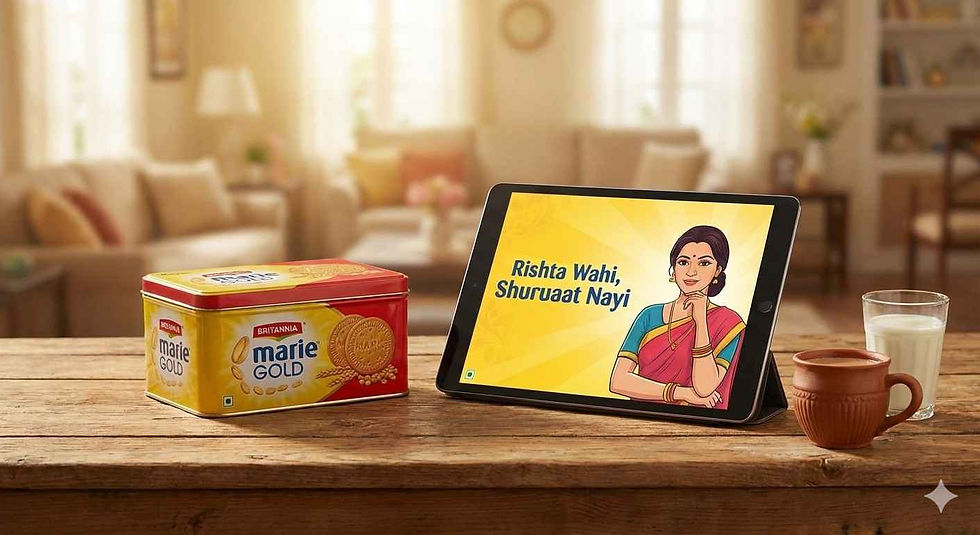
Britannia Industries Limited's Marie Gold biscuit brand represents one of India's most enduring FMCG success stories, with a history spanning over five decades. The brand's long-standing tagline "Rishta Wahi, Shuruaat Nayi" (Same relationship, new beginning) encapsulates a strategic approach to balancing heritage preservation with contemporary relevance. This case study examines how Britannia has maintained Marie Gold's legacy messaging while adapting to evolving consumer preferences, competitive pressures, and market dynamics in India's highly competitive biscuit category. The case explores the challenges of sustaining emotional brand equity built over generations while remaining relevant to younger consumers in a rapidly modernizing market.
Company and Brand Background
Britannia Industries: Company Overview
Britannia Industries Limited is one of India's leading food companies, with origins dating back to 1892 when the company was established in Kolkata. According to Britannia's Annual Report 2022-23, the company operates across multiple categories including biscuits, bread, cakes, rusk, and dairy products, with a distribution network reaching millions of retail outlets across India.
The company reported in its Annual Report 2022-23 that it held leadership positions in several categories within the Indian biscuit market. Britannia's portfolio includes brands spanning value, mid-premium, and premium segments, with Marie Gold positioned as one of the company's flagship offerings in the glucose biscuit category.
Marie Gold: Brand Heritage
Marie biscuits have a global history dating back to the 19th century, with the product originating in England. According to reports in The Economic Times (March 2017), Britannia launched Marie Gold in India in 1971, making it one of the company's older brands with over five decades of presence in the Indian market.
As documented in Business Standard (January 2019), Marie Gold established itself as a tea-time companion biscuit, positioned as a light, digestible option suitable for all age groups. The brand became particularly associated with health-conscious consumption occasions and as an acceptable snack for children and elderly family members due to its relatively simple ingredient profile and non-sweet taste compared to cream biscuits.
According to industry reports cited in The Hindu BusinessLine (September 2016), Marie Gold emerged as one of India's largest-selling biscuit brands by volume, competing primarily in the glucose biscuit segment alongside brands like Parle-G. The glucose biscuit category represents one of the largest segments within India's biscuit market, characterized by relatively lower price points and high-volume consumption.
The "Rishta Wahi, Shuruaat Nayi" Campaign
Campaign Origins and Messaging
The tagline "Rishta Wahi, Shuruaat Nayi" translates to "Same relationship, new beginning" in English. According to Campaign India (April 2014), this messaging platform has been associated with Marie Gold for an extended period, becoming one of the brand's defining communication properties.
As reported in The Economic Times (February 2018), the campaign's core theme centered on continuity of relationships across generations while acknowledging that life circumstances and contexts evolve. The messaging typically featured familial relationships—particularly between mothers and daughters, or grandmothers and grandchildren—using Marie Gold as a connecting element that remained constant even as family members moved through different life stages.
Afaqs (March 2015) reported that the "Rishta Wahi" campaign resonated with Indian consumers by tapping into cultural values around family continuity and intergenerational bonds. The brand positioned itself as a witness to and facilitator of these relationships, present during significant family moments and everyday interactions alike.
Creative Executions
Various creative executions under the "Rishta Wahi" platform have been documented in advertising trade publications. According to Campaign India (November 2016), one prominent campaign showed a mother and daughter relationship evolving from the daughter's childhood through her own journey into motherhood, with Marie Gold featuring as a constant presence during tea-time conversations across the years.
Another execution reported in Afaqs (January 2017) depicted a grandmother-granddaughter relationship, showing how despite changing times and the granddaughter's modern lifestyle, their bond over evening tea and Marie Gold biscuits remained unchanged. These narratives consistently emphasized emotional continuity rather than product attributes.
The Economic Times Brand Equity (August 2018) documented that Marie Gold's advertising approach differed markedly from competitors in the glucose biscuit segment. While some competing brands emphasized value for money or nutritional fortification, Marie Gold's communication focused primarily on emotional associations and relationship moments, with the product serving as an accompaniment rather than the central focus.
Strategic Context: The Indian Biscuit Market
Market Structure and Competition
India's biscuit market is one of the largest globally by volume. According to data from the Indian Council for Research on International Economic Relations (ICRIER) cited in The Hindu BusinessLine (June 2019), biscuits represent a significant portion of the packaged food consumption in India, with penetration across urban and rural markets.
The glucose biscuit segment, where Marie Gold competes, represented a substantial share of the overall biscuit market. As reported in Business Standard (September 2017), this segment was characterized by intense price competition, with Parle Products' Parle-G holding a dominant market position built over decades. Other competitors in the glucose segment included ITC's Sunfeast Marie Light and various regional brands.
According to The Economic Times (July 2020), the biscuit market in India witnessed increasing premiumization trends, with consumers showing growing willingness to pay more for perceived health benefits, specialized ingredients, or premium brand positioning. This trend created both opportunities and challenges for established brands positioned at accessible price points.
Competitive Dynamics
Competition in the glucose biscuit category extended beyond branded players. As noted in Mint (October 2018), the segment also faced competition from unbranded and local manufacturers, particularly in rural and semi-urban markets where price sensitivity remained high.
Britannia's primary competitor, Parle Products, maintained its Parle-G brand positioning around value for money and nutrition, particularly targeting children. According to reports in Business Today (March 2019), Parle-G's communication strategy emphasized the brand's role as an affordable, nutritious food option, with campaigns often featuring children and highlighting the product's energy-giving properties.
In this competitive context, Marie Gold's emotional, relationship-focused positioning represented a distinct strategic choice. Rather than competing primarily on functional attributes or price-value equations, the brand sought to build emotional differentiation through its association with family moments and intergenerational relationships.
The Heritage Preservation Challenge
Balancing Tradition and Modernity
As documented in various industry publications, heritage brands face a fundamental tension between maintaining the equity built through long-standing associations and remaining relevant to contemporary consumers with evolving preferences and values.
According to analysis in The Economic Times (February 2019), Marie Gold confronted this challenge as the Indian consumer base transformed. Younger consumers—millennials and Generation Z—grew up in a dramatically different India compared to the generation that first encountered Marie Gold in the 1970s and 1980s. Urbanization, nuclear family structures, digital connectivity, and changing food habits all influenced how consumers related to traditional brands.
Business Standard (May 2020) reported on broader trends in the Indian FMCG sector, noting that established brands increasingly struggled to maintain relevance with younger cohorts while simultaneously retaining loyalty from older consumer segments who associated these brands with their own childhood or family history.
For Marie Gold specifically, the challenge involved maintaining the "Rishta Wahi" message's emotional resonance while ensuring the depicted relationships and contexts felt authentic to contemporary audiences. No verified public information is available on specific consumer research Britannia conducted regarding generational differences in brand perception.
Communication Continuity Strategy
Britannia's approach to this challenge, as observable through its publicly documented advertising campaigns, involved maintaining core messaging consistency while updating the contextual details and execution style.
According to Campaign India (July 2018), Marie Gold continued using the "Rishta Wahi, Shuruaat Nayi" tagline in campaigns even as creative executions evolved. This represented a strategic decision to preserve the established emotional platform rather than pursuing complete brand repositioning or new tagline development.
Afaqs (September 2019) documented that newer Marie Gold campaigns incorporated more contemporary visual styles, modern settings, and acknowledgment of changing family dynamics (such as working mothers or geographically dispersed families) while maintaining the fundamental message about relationship continuity.
The brand's communication strategy appeared to rest on the premise that fundamental human emotions around family relationships remained constant even as surface-level societal changes occurred. By keeping the core message consistent while updating contextual elements, Marie Gold attempted to bridge generational divides.
Product and Portfolio Evolution
Product Variants and Innovation
Alongside messaging continuity, Marie Gold's product portfolio evolved over time. According to reports in The Economic Times (November 2017), Britannia introduced variants of Marie Gold including different pack sizes, specialized formulations (such as Marie Gold Premium with oats), and format variations to address diverse consumer needs and usage occasions.
Business Standard (April 2018) reported that Britannia launched Marie Gold in convenient pack formats suitable for on-the-go consumption, acknowledging changing snacking behaviors particularly among urban consumers. These product innovations occurred while maintaining the core Marie Gold brand identity and heritage associations.
According to The Hindu BusinessLine (January 2020), the company also introduced Marie Gold in different price points and pack sizes to address various consumer segments and purchase occasions, from small packs for individual consumption to family packs. This portfolio breadth helped maintain market coverage while preserving the unified brand image.
No verified public information is available on whether product innovations faced internal tensions with heritage preservation objectives or how Britannia's management balanced innovation imperatives with brand consistency requirements.
Packaging Evolution
Packaging represents another dimension where heritage and modernity intersect. According to documentation in Campaign India (December 2017), Marie Gold's packaging underwent periodic updates over the years, incorporating more contemporary design elements while maintaining recognizable brand colors and the product's distinctive rectangular shape visualization.
The Economic Times Brand Equity (March 2021) noted that updated packaging designs for established brands like Marie Gold typically attempted to signal freshness and relevance to younger consumers while avoiding changes so dramatic that they alienated existing loyal consumers or damaged brand recognition.
The balance between heritage preservation and contemporary appeal in packaging design required careful management, as packaging serves as both a point-of-purchase differentiator and a carrier of brand equity built over decades. No verified public information is available on specific packaging research or testing methodologies Britannia employed for Marie Gold.
Distribution and Availability Strategy
Distribution Network
Britannia's distribution capabilities provided crucial support for Marie Gold's market position. According to the company's Annual Report 2022-23, Britannia's products reached millions of retail outlets across India, spanning urban supermarkets, traditional kiranas (small retail stores), and rural distribution points.
For a heritage brand like Marie Gold, wide availability reinforced the "Rishta Wahi" message by ensuring the product remained accessible to consumers across geographies and retail formats. As reported in The Hindu BusinessLine (August 2019), Britannia maintained distribution intensity as a strategic priority, recognizing that impulse purchases and habitual consumption patterns depended on consistent product availability.
The company's distribution network evolved to incorporate modern trade channels (organized retail) and e-commerce platforms alongside traditional trade. According to Mint (February 2021), Britannia expanded its presence on e-commerce platforms including Amazon, Flipkart, and quick-commerce apps, ensuring Marie Gold remained accessible through channels preferred by younger, digitally-native consumers.
This distribution strategy complemented the brand's messaging by making Marie Gold available wherever and however consumers chose to shop, whether through traditional neighborhood stores or digital platforms. The ubiquity reinforced the brand's positioning as a constant presence across changing circumstances.
Media Strategy and Channel Evolution
Traditional Media Presence
Marie Gold maintained consistent presence in traditional advertising media, particularly television. According to data from the Broadcast Audience Research Council (BARC) referenced in The Economic Times (January 2019), biscuit brands including Marie Gold featured among regular television advertisers, with particular presence during family viewing time slots and programming.
Afaqs (June 2018) reported that Marie Gold's television advertising typically appeared during family-oriented programming, including daily soap operas popular with homemakers—a strategic choice aligned with the brand's focus on family relationships and tea-time consumption occasions.
Print media also featured in Marie Gold's media mix, according to reports in Campaign India (October 2017), with advertisements appearing in general-interest and women's magazines. The print campaigns complemented television advertising by providing longer-form storytelling opportunities for relationship-focused narratives.
No verified public information is available on specific media budget allocations across channels or how these evolved over time in response to changing media consumption patterns.
Digital and Social Media Presence
As digital media grew in importance, Marie Gold extended its presence to digital platforms. According to The Economic Times (September 2020), Britannia expanded digital marketing efforts across its portfolio, including Marie Gold, recognizing that younger consumers increasingly consumed content through digital channels.
Marie Gold established presence on social media platforms including Facebook, Instagram, and YouTube, according to publicly available information from these platforms. The brand's digital content strategy, as observable through its public social media presence, included both repurposed television commercials and digital-specific content.
Afaqs (December 2020) reported that heritage FMCG brands including Marie Gold faced the challenge of translating their traditional brand messages into digital formats that resonated with digitally-native audiences. The relatively slow-paced, emotion-driven storytelling that worked in television commercials required adaptation for digital platforms where content consumption patterns differed.
Britannia created digital campaigns for Marie Gold that attempted to maintain the "Rishta Wahi" emotional core while adopting formats and pacing more suitable for digital consumption. However, no verified public data is available on engagement metrics, reach, or effectiveness of these digital initiatives compared to traditional media.
The Role of Cultural Continuity in Brand Strategy
Cultural Resonance
Marie Gold's "Rishta Wahi" messaging derived significant power from its alignment with Indian cultural values emphasizing family relationships, intergenerational continuity, and respect for tradition. According to analysis in Business Standard (July 2019), brands that successfully tapped into deep cultural themes could build emotional connections transcending functional product attributes.
The concept of continuity across change—maintaining relationship essence despite evolving circumstances—resonated with Indian consumers navigating rapid social and economic transformation. As reported in The Hindu (March 2018), India experienced significant socioeconomic changes in recent decades including urbanization, rising incomes, nuclear family structures, and women's workforce participation, all affecting traditional family dynamics.
In this context, Marie Gold's messaging acknowledged change ("Shuruaat Nayi" - new beginnings) while affirming continuity ("Rishta Wahi" - same relationship), potentially offering emotional reassurance to consumers experiencing cultural dislocation. The brand positioned itself as a stable element connecting past and present.
Generational Brand Transmission
For heritage brands, transmission of brand loyalty across generations represents a critical success factor. According to research on intergenerational brand preferences cited in The Economic Times (May 2017), brands consumed within family contexts had higher likelihood of being adopted by younger generations compared to brands associated primarily with individual consumption.
Marie Gold's association with tea-time family gatherings and the explicit focus on intergenerational relationships in its advertising potentially facilitated such transmission. By depicting scenarios where mothers introduced daughters to the brand, or grandmothers shared the product with grandchildren, the advertising modeled the very behavior of generational brand transmission the company sought to encourage.
However, no verified public research data is available measuring whether Marie Gold successfully achieved higher-than-average intergenerational loyalty transmission or whether the advertising's depiction of such transmission correlated with actual consumer behavior.
Challenges in Sustaining Legacy Messaging
Market Environment Changes
Several environmental changes challenged the continued relevance of Marie Gold's heritage messaging approach. According to Mint (August 2021), the Indian biscuit market witnessed increasing health consciousness, with consumers seeking products positioned around specific health benefits such as digestive health, protein content, or absence of maida (refined flour).
Competitors introduced biscuits with explicit health positioning, fortified with nutrients, or made with alternative ingredients like oats or multigrain. As reported in Business Today (June 2020), brands like Britannia's own NutriChoice and competitors' health-focused offerings gained traction with health-conscious consumers.
In this context, Marie Gold's emotional relationship positioning potentially faced challenges from consumers prioritizing functional health benefits over emotional associations. The brand's relatively simple ingredient profile could be framed as either authenticity (simple, traditional) or as lack of innovation (absence of fortification or specialized ingredients).
The Economic Times (April 2021) reported on growing preference for premium biscuits among urban consumers, with willingness to pay higher prices for perceived quality, specialized ingredients, or premium brand positioning. This premiumization trend created opportunities for brands that could justify premium pricing through explicit functional or aspirational benefits, potentially challenging brands positioned primarily on emotional heritage.
Changing Family Structures and Consumption Patterns
Evolving family structures and consumption behaviors also impacted heritage brands focused on family consumption occasions. According to census data analysis reported in The Hindu (September 2018), nuclear family households increased as a proportion of total households in urban India, with rising numbers of single-person households and smaller family units.
These demographic shifts potentially reduced the frequency of extended family gatherings where multi-generational tea-time occasions—the archetypal consumption situation for Marie Gold—occurred. As reported in Business Standard (November 2019), snacking behaviors evolved toward individual consumption occasions, on-the-go eating, and meal replacement rather than traditional sit-down tea-time gatherings.
The COVID-19 pandemic and subsequent lockdowns in 2020-2021 created temporary shifts in consumption patterns. According to reports in The Economic Times (July 2020), the pandemic initially increased at-home consumption and family time, potentially benefiting brands associated with family occasions. However, longer-term impacts on consumption patterns remained uncertain.
Competitive Communication Evolution
Competitors' communication strategies also evolved, potentially influencing the relative effectiveness of Marie Gold's heritage-focused approach. As documented in Campaign India (February 2020), various biscuit brands explored diverse positioning territories including adventure and exploration (targeting children), fitness and active lifestyles, indulgence and pleasure, or functional nutrition.
Some competitors adopted more contemporary, dynamic brand personalities that potentially appealed more directly to younger consumers. According to analysis in Afaqs (August 2020), brands seeking to attract millennials and Gen Z consumers often employed faster-paced storytelling, humor, celebrity associations, or alignment with contemporary social issues rather than traditional emotional family narratives.
In this evolving communication landscape, Marie Gold's commitment to its heritage "Rishta Wahi" message represented both strategic consistency and potential risk of appearing outdated relative to more contemporary brand positioning approaches. No verified public information is available on whether Britannia conducted testing comparing the "Rishta Wahi" approach's effectiveness against alternative positioning strategies.
Strategic Responses and Adaptations
Message Consistency Amid Tactical Flexibility
Britannia's observable approach involved maintaining the core "Rishta Wahi, Shuruaat Nayi" message while allowing flexibility in execution. According to Campaign India (May 2021), more recent Marie Gold campaigns incorporated acknowledgment of contemporary issues such as women's career aspirations, long-distance family relationships enabled by technology, or modern parenting approaches, while maintaining the fundamental theme of relationship continuity.
This strategy attempted to demonstrate that the brand's core message remained relevant even as specific family contexts evolved. By showing Marie Gold present in both traditional joint family settings and contemporary nuclear family scenarios, the advertising sought to maintain heritage associations while signaling contemporary relevance.
The Economic Times Brand Equity (September 2021) noted that this approach required careful calibration to avoid alienating traditional consumer segments through excessive modernization or losing younger consumers through insufficient contemporary relevance.
Product Innovation Within Brand Framework
On the product side, Britannia introduced innovations while maintaining Marie Gold brand identity. According to Business Standard (March 2022), the company launched Marie Gold variants addressing specific needs such as Marie Gold Oats targeting health-conscious consumers, while keeping these innovations within the Marie Gold brand architecture rather than creating separate brands.
This approach allowed the company to address evolving functional needs and consumption occasions while leveraging the equity in the Marie Gold name and maintaining the brand's position as a consistent family presence across different usage contexts.
The Hindu BusinessLine (July 2022) reported that Britannia continued investing in both product innovation and communication for Marie Gold, indicating management's commitment to sustaining the brand despite competitive pressures and market changes.
Measuring Success: Observed Market Indicators
Market Presence and Visibility
Public indicators suggested Marie Gold maintained significant market presence. According to Britannia's Annual Report 2022-23, the company's flagship brands including Marie Gold continued to hold strong market positions, though specific brand-level market share data was not disclosed.
Industry reports cited in The Economic Times (January 2023) indicated that Marie Gold remained among India's widely-recognized biscuit brands, with high awareness levels across consumer segments. The brand's continued investment in advertising and prominent retail presence suggested sustained commercial viability.
Business Standard (October 2022) reported that Britannia's overall biscuit portfolio performed well in the Indian market, with Marie Gold mentioned as one of the company's key offerings contributing to this performance. However, specific volume or value metrics for Marie Gold were not publicly disclosed.
Brand Health Indicators
While detailed brand tracking data is proprietary, some public indicators provided insight into Marie Gold's brand health. According to brand valuation reports cited in The Economic Times (June 2021), Britannia's brand portfolio collectively held substantial brand equity, with Marie Gold identified as one of the company's valuable brand assets.
The brand's continued presence in Britannia's advertising investment and management commentary in annual reports and investor presentations suggested that company leadership viewed Marie Gold as a strategically important asset worth sustained investment, rather than a declining heritage brand requiring repositioning or phase-out.
No verified public information is available on specific brand health metrics such as unaided awareness, consideration scores, emotional connection measures, or purchase intent tracking over time that would allow definitive assessment of whether the heritage preservation strategy successfully maintained or strengthened Marie Gold's equity.
Broader Implications for Heritage Brand Management
Lessons from Marie Gold's Approach
The Marie Gold case illustrates several principles relevant to managing heritage brands in evolving markets. The brand's sustained commitment to a core emotional message over an extended period demonstrated that consistent positioning could be maintained even as market conditions changed, provided the core message remained culturally relevant and execution adapted to contemporary contexts.
The "Rishta Wahi, Shuruaat Nayi" formulation itself embodied a philosophy of heritage management—explicitly acknowledging change while affirming continuity. This messaging structure provided flexibility to update executions while maintaining strategic consistency, potentially offering a model for other heritage brands navigating tradition-modernity tensions.
Marie Gold's approach also demonstrated that emotional positioning focused on cultural values and human relationships could serve as a differentiation strategy in categories otherwise dominated by functional claims and price competition. By occupying distinct psychological territory, the brand potentially built barriers to competitive replication even without proprietary functional advantages.
Unanswered Questions
Despite publicly available information, significant questions about Marie Gold's heritage preservation strategy remain unanswered. No verified public data exists comparing the effectiveness of the "Rishta Wahi" approach against alternative strategies Britannia might have pursued, such as repositioning around functional health benefits or pursuing more contemporary emotional positioning.
Similarly, no public information details how Britannia's management evaluated trade-offs between heritage preservation and contemporary relevance, what metrics guided decision-making, or whether the company considered more dramatic repositioning before committing to message continuity.
The long-term sustainability of heritage-focused positioning amid continuing market evolution also remains uncertain. While Marie Gold maintained market presence as of 2023, whether the brand can sustain relevance with future consumer generations increasingly distant from the product's heritage era represents an ongoing strategic question.
Conclusion
Britannia Marie Gold's "Rishta Wahi, Shuruaat Nayi" messaging represents a sustained attempt to preserve heritage brand equity while remaining relevant in a transforming market. By maintaining core message consistency focused on intergenerational relationship continuity while adapting executional elements to contemporary contexts, the brand sought to bridge tradition and modernity.
The case demonstrates both the potential and challenges of heritage preservation strategies. Marie Gold's approach succeeded in maintaining market presence and brand visibility over an extended period characterized by significant market evolution. However, the brand confronted ongoing challenges from changing consumption patterns, competitive dynamics, and evolving consumer preferences that test the continued relevance of traditional emotional positioning.
For brand managers, the Marie Gold case underscores that heritage preservation is not passive maintenance but active strategic management requiring continuous calibration between consistency and adaptation. The brand's experience suggests that culturally resonant emotional messages can sustain relevance across changing circumstances, provided execution remains authentic to contemporary consumer realities while honoring the essence that gives heritage brands their distinctive equity.
Discussion Questions for MBA Analysis
Heritage vs. Relevance Trade-offs: How should brand managers evaluate when to preserve heritage messaging like "Rishta Wahi, Shuruaat Nayi" versus pursuing more contemporary repositioning? What specific market signals or brand health indicators would suggest that heritage preservation has become a liability rather than an asset, and at what point should management consider more dramatic strategic change?
Emotional vs. Functional Positioning in Commodity Categories: Marie Gold competes in the glucose biscuit segment where functional attributes are relatively undifferentiated and price competition is intense. What are the advantages and limitations of emotional positioning (family relationships) versus functional positioning (health benefits, nutrition) in such categories? Under what conditions can emotional differentiation create sustainable competitive advantage when functional parity exists?
Intergenerational Brand Loyalty: Marie Gold's strategy appears to rely on transmission of brand loyalty across generations through family consumption occasions. What factors determine whether such intergenerational transmission succeeds? How can brand managers actively facilitate generational transmission beyond simply depicting it in advertising? What happens to this strategy as family structures and consumption occasions evolve away from traditional patterns?
Message Consistency vs. Executional Flexibility: Marie Gold maintained the "Rishta Wahi" core message while updating executional contexts. What framework should guide decisions about which elements to preserve (consistency) versus which to adapt (relevance)? How can managers determine whether executional updates remain true to brand heritage or drift into messaging that conflicts with established equity? Where should the boundary lie between authentic evolution and brand dilution?
Portfolio Strategy for Heritage Brands: Should Britannia consider launching sub-brands or variant brands under the Marie Gold umbrella to address specific needs (health-focused, premium, convenient formats) that may not naturally fit the heritage positioning, or does this risk fragmenting brand equity? What principles should guide decisions about whether to extend a heritage brand into new territories versus maintaining focus on its traditional positioning and creating separate brands for new opportunities?


Comments