Country Delight’s Insight into Trust Deficit in Milk Supply:
- Apr 17
- 5 min read
Industry & Competitive Context
India is one of the largest producers and consumers of milk globally, with a highly fragmented supply chain that includes cooperative institutions, private dairies, and informal local vendors. The sector is dominated by established players such as Amul and Mother Dairy, alongside numerous regional and unorganized suppliers.
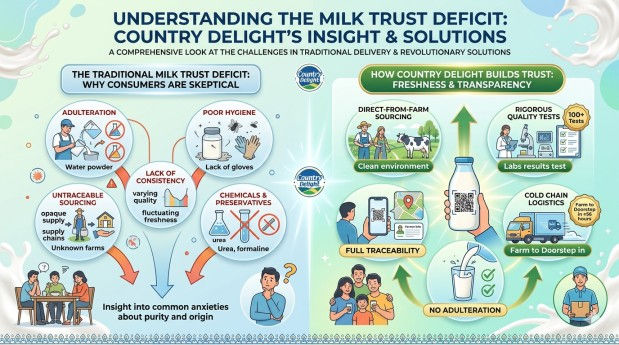
Despite scale and penetration, the Indian dairy market has long faced documented concerns related to adulteration, quality inconsistency, and lack of transparency. Reports from government bodies such as the Food Safety and Standards Authority of India (FSSAI), along with coverage by credible media outlets, have highlighted issues around milk adulteration and contamination in certain parts of the supply chain. These concerns have contributed to a broader trust deficit among urban consumers, particularly in unbranded or loosely regulated milk sources.
At the same time, increasing urbanization and rising income levels have led to higher demand for quality assurance, traceability, and convenience in food consumption. This has created opportunities for new entrants leveraging direct-to-consumer (D2C) models, subscription-based delivery, and digital platforms to address gaps in the traditional supply chain.

Brand Situation Prior to Campaign
Country Delight entered this market as a digital-first, direct-to-consumer brand focused on delivering fresh milk and daily essentials. At the time of its early growth phase, the company operated in a competitive landscape that included both established dairy brands and emerging D2C players.
Publicly available information from credible media coverage indicates that Country Delight positioned itself around freshness and quality assurance. However, as a relatively new entrant without the legacy trust enjoyed by cooperative brands like Amul, it faced the challenge of building credibility in a category where trust is deeply entrenched and often inherited.
The broader category dynamics were marked by consumer skepticism not only toward unorganized vendors but also toward packaged milk, with recurring concerns about processing methods, storage, and potential dilution or adulteration. This environment created both a challenge and an opportunity for Country Delight to differentiate itself.
Strategic Objective
The strategic objective for Country Delight was to address the existing trust deficit in the milk supply chain by establishing itself as a transparent and reliable provider of fresh dairy products.
Rather than competing purely on price or convenience, the company sought to build a value proposition centered on quality assurance and credibility. This required not only delivering a consistent product but also communicating trust in a way that resonated with consumers who were already skeptical of existing options.
Campaign Architecture & Execution
Country Delight’s approach to addressing trust deficit was reflected in its product design, communication, and operational transparency as documented in company statements and media reports.
The company emphasized farm-to-home sourcing, highlighting that milk was procured directly from dairy farms and delivered to consumers with minimal processing. This claim has been consistently referenced in credible news coverage and official company communication.
It also focused on quality testing protocols, stating in public communications that milk undergoes multiple quality checks before delivery. Additionally, the company introduced features such as subscription-based delivery through its mobile application, allowing users to manage orders and receive products regularly without reliance on intermediaries.
Packaging and delivery timelines were also positioned as indicators of freshness, with communication emphasizing early morning delivery schedules. These elements were integrated into the brand narrative to reinforce reliability and control over the supply chain.
Importantly, the company’s messaging across its website and media coverage consistently highlighted transparency in sourcing and quality checks, rather than relying solely on promotional claims.
Positioning & Consumer Insight
The central consumer insight underpinning Country Delight’s strategy was that milk, as a daily essential, is associated with high perceived risk if quality is uncertain. This is particularly relevant in urban India, where consumers may be physically distant from the source of their food.
Industry reports and media coverage have documented that concerns about adulteration and freshness significantly influence purchasing decisions in the dairy category. Country Delight’s positioning directly addressed these concerns by emphasizing:
Direct sourcing from farms
Minimal processing
Regular quality testing
Reliable home delivery
The brand’s positioning can be interpreted as an attempt to shift consumer perception from “packaged milk as a commodity” to “milk as a trusted, traceable product.” This reframing aligns with broader trends in food consumption, where provenance and transparency are increasingly valued.
Media & Channel Strategy
Verified public information indicates that Country Delight has primarily leveraged digital channels for customer acquisition and engagement. Its mobile application serves as the primary interface for subscriptions, order management, and communication.
The company has also used digital advertising and app-based notifications to reinforce its value proposition. Coverage in credible business media such as Economic Times, Mint, and CNBC has contributed to brand visibility, particularly around funding announcements and expansion plans.
No verified public information is available on detailed media spend allocation or specific campaign-level channel performance.
Business & Brand Outcomes
As reported in credible media outlets, Country Delight has achieved significant scale in terms of customer base and geographic presence across major Indian cities. The company has raised multiple rounds of funding from institutional investors, indicating market confidence in its business model.
Publicly available information also confirms that the company has expanded its product portfolio beyond milk to include other daily essentials such as bread, eggs, and groceries, leveraging its existing distribution network.
However, no verified public information is available linking specific trust-focused marketing initiatives to quantified improvements in brand perception metrics or financial performance.
Strategic Implications
Country Delight’s approach illustrates how trust can be operationalized as a core strategic differentiator in a commoditized category. Rather than relying on brand heritage, the company has attempted to build trust through process visibility and direct consumer engagement.
One key implication is that in categories with inherent quality uncertainty, trust can be created by reducing information asymmetry. By emphasizing sourcing, testing, and delivery processes, Country Delight has sought to make invisible aspects of the supply chain visible to consumers.
Another implication is the role of digital platforms in enabling trust. The company’s app-based model allows for direct communication and recurring engagement, which can reinforce reliability over time.
The case also highlights the limitations of trust as a marketing construct in the absence of verifiable metrics. While the company’s growth and funding suggest market acceptance, publicly available data does not isolate trust as a measurable driver of performance.
Finally, the case underscores a broader shift in consumer markets toward transparency-led differentiation. As consumers become more informed and selective, brands that can substantiate their claims with observable practices may gain a competitive advantage.
Discussion Questions
How can new entrants like Country Delight build trust in categories traditionally dominated by legacy brands with established credibility?
To what extent can operational transparency substitute for brand heritage in influencing consumer trust?
How should companies measure the impact of trust-building initiatives in the absence of publicly disclosed metrics?
What role do digital platforms play in reducing information asymmetry in essential goods categories such as dairy?
Can trust-based positioning be sustained as a long-term competitive advantage, or is it likely to be replicated by competitors over time?


Comments