Decathlon India’s Private Label Brand Strategy in Sports Retail
Industry & Competitive Context
India’s sports retail market has historically been small relative to the country’s size and structurally fragmented. In a 2021 Outlook Business feature, a Boston Consulting Group partner said more than 70% of the market is unorganised. The same article reported that the segment had grown on a small base at 7–10% over the previous decade, with faster growth expected. Technopak’s retail lead noted that “sports retail” is loosely defined, and estimated the combined market of sports shoe, garment and athleisure brands at about $15 billion annually.
Competition was thin at the organised end. Outlook Business wrote that Decathlon, Adidas and Puma were the only significant players, while Indian attempts such as Future Retail’s Planet Sports had shut down after losses. BCG’s Rachit Mathur identified pricing as the single most important reason for the low penetration of other global brands, because those brands struggled to keep aspirational value while driving volume in a low per-capita-income market. He added that Indian brands had matched lower price points but under-invested in design, functionality and distribution.
The structure of Decathlon’s offer is distinctive. The Economic Times reported in 2023 that Decathlon sells only private labels, which lets it control pricing, design and distribution. At that point it had more than 100 large warehouse-style stores covering 85 sporting disciplines, and the ET judged it bigger in India than Adidas, Nike and Asics combined.
More recent pressure comes from delivery speed. Decathlon’s India CEO has described quick commerce as the future, citing consumers who decide to play a sport at short notice. This is the CEO’s own framing and I found no independent measurement of the shift.
Brand Situation: Entry and Early Positioning
Decathlon was manufacturing in India well before it retailed there. According to Outlook Business, it had produced in India since the 1990s, opened its first cash-and-carry store in Sarjapur, Bengaluru in 2009, and opened to all customers in 2013 after winning approval for 100% FDI in single-brand retail.
The early perception was unfavourable to the model’s economics. The same feature recalled that in 2009 the company was seen as another expensive international name. Over roughly a decade it became a leader, and Decathlon India’s total income for FY20 was reported at Rs 22.31 billion, up 75% from Rs 12.78 billion in FY18.
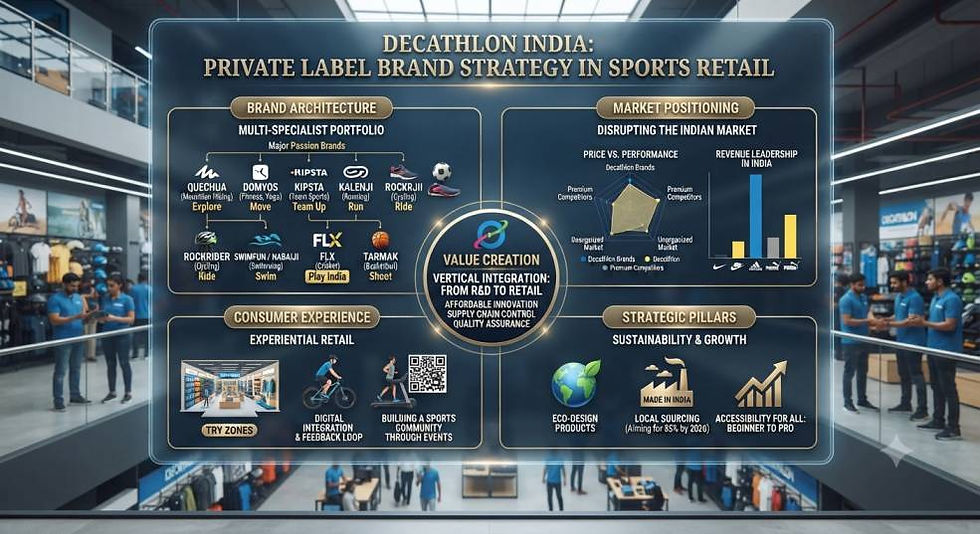
The portfolio behind the stores was broad. A 2019 Il Post report described about 5,000 products across 80 sports under 24 own brands, including B’Twin for cycling, FLX for cricket, Kalenji for running and Quechua for hiking. Decathlon’s own sustainability site shows its “passion brands” were created over decades, starting with Tribord and Quechua in 1996, and that as of 31 December 2023 Decathlon offered 36 brands.
Strategic Objective
Decathlon’s stated objectives for India, as reported, centre on scale, localisation and accessibility.
Accessibility. Per Outlook Business, the India spokesperson said the strategy from day one was accessibility: all products under one roof, experience zones and playgrounds, and products adapted to Indian users.
Growth. CEO Sankar Chatterjee has stated an expectation of consistent double-digit growth over five years. He has cited a revenue ambition of about Rs 8,000 crore and a presence in over 90 cities by 2030.
Localisation and sourcing. In July 2025 Decathlon said it would raise India sourcing for its global operations to USD 3 billion by 2030, lifting India from 8% to 15% of global sourcing quantities. Reports put current sourcing at about US$480 million. The company also targets 90% local production for Indian demand by 2030.
Strategy Architecture & Execution
Brand architecture. Decathlon has restructured its portfolio globally. Its own materials describe an overhaul of the brand portfolio, with category brands such as Quechua, Tribord, Rockrider, Domyos, Kuikma, Kipsta, Caperlan, B’twin and Inesis plus four “expert” brands: Van Rysel, Kiprun, Simond and Solognac, rolled out over three years. Trade coverage described this as nine category specialists and four expert brands alongside a new brand identity. The portfolio separates broad category brands from expert brands for demanding users. No verified public information is available on how this consolidation is sequenced for Indian stores, including which legacy brand names are being retired in India. decathlonafaqs
India’s clearest expert-brand move is in running. Outlook Business reported that Decathlon introduced Kiprun in India while aiming to double its running business over four years. Franchise India reported a target of ₹1,000+ crore running turnover by 2030, serving over 5 million active runners. Apparel Resources reported that the running segment generated slightly less than Rs 500 crore at the time. The company planned 35 new Kiprun products that year, including 17 high-performance running shoes.
Manufacturing as brand infrastructure. Private-label control extends into production. The Economic Times reported that Decathlon combines in-house manufacturing and outsourcing. Storyboard18 reported that Indian manufacturing, across Punjab, Haryana, Bhubaneswar and the south, runs on a contract-manufacturing model. The IANS reported a network of 113 facilities, 83 suppliers, seven production offices and a design centre. Localisation proceeded unevenly by category. The CEO said that about 12 years earlier only 2% of Decathlon’s cycles were made in India, against more than 98% now. Cricket and yoga were reported as fully conceptualised and produced in India. On the overall share, the company’s spokesperson said in 2021 that 54% of products sold in India were made there, with a plan to reach 75% within two years. Later reports put the share at 68% and 70%. I found no verified source confirming whether the 75% target was met by its original date.
Retail format. The stores are the brand’s main communication asset. Outlook Business described large, warehouse-like stores outside city limits with playgrounds and trial areas, and knowledgeable staff chosen for sport expertise. The format is now evolving, with experience centres and compact stores in city centres such as Phoenix Mall in Mumbai, Pondy Bazaar in Chennai and Cyber Hub in Gurgaon. The company has said it plans 10–15 store additions a year, targeting 175 stores within five years from 132 stores in 55 cities.
Positioning & Consumer Insight
Decathlon has not published consumer research behind its India positioning. What exists are the company’s stated intent and outside analysts’ readings, and the sources are explicit that the positioning is built on value, not discounting.
Industry commentators quoted by the Economic Times pointed to pricing about 30–40% lower than competing products, combined with a full range sold under its own brands. Outlook Business quoted analysts on the mechanics. One said the brand’s main target group is beginners who can be converted into lifetime customers. Technopak’s Ankur Bisen argued that “low-priced” is the wrong label and “value fashion” is more accurate, because pricing follows from simple retail spaces, low rental and marketing costs, and vendor involvement in manufacturing rather than from discounting. These are analyst assessments, not audited price comparisons.
Interpretation: the documented pieces fit together. Private label controls design and cost, and low-rent store locations plus modest marketing keep the cost base low. The experience-led store format then compensates for the absence of the brand-name pull that rivals buy through endorsements. Attribution of the price outcome to these mechanisms rests on the analyst commentary above, not on company-published unit economics. The BCG observation about rivals’ difficulty combining aspiration with volume explains why this position was open.
Decathlon’s own India comment also ties product relevance to local demand. The ET reported that FY23 growth was driven by fitness wear and equipment for disciplines other than cricket and football, and that nearly all cricket merchandise Decathlon sells globally is designed and made in India.
Media & Channel Strategy
Media. Public information on media is limited. Storyboard18 reported that the brand’s media strategy had shifted decisively to digital, with little focus on traditional advertising. Reported spend was Rs 87.49 crore in FY24, up 33%, and Rs 89.05 crore in FY25, up 1.78%. The 2021 Outlook Business feature said the company never believed in raising marketing spend or pouring money into sponsorships.
Channels. The FY24 RoC filing, as reported by PTI and Business Standard, showed store sales of Rs 3,430.67 crore and B2B sales of Rs 117.68 crore, with e-commerce down 2.2% to Rs 437.07 crore from Rs 446.75 crore. The CEO described the FY24 mix as 84% physical stores, 10–11% D2C and 5–6% wholesale. A later PTI report quoted the wholesale director saying wholesale had grown 20-fold in five years to about 10% of the business. The reported wholesale shares differ, and the sources do not say whether this reflects different periods or definitions. Wholesale is aimed at reach beyond store cities: over 3,000 resellers, especially in tier 3 and 4 cities without stores.
Quick commerce. Decathlon partnered with Zepto in 2024 and reportedly works with Blinkit, Zepto and Swiggy Instamart. It also introduced its own two-hour delivery in seven major cities. Business Standard later reported plans to scale quick commerce to 10 more cities. The channel logic follows the CEO’s own point that product must be available at short notice.
Business & Brand Outcomes
Financial results below come from RoC filings as reported by named outlets. Decathlon Sports India is an unlisted entity, 99.99% held by Decathlon SE, and I found no annual report published by the company.
Operating revenue rose from Rs 2,208.39 crore in FY20 to Rs 2,049.28 crore in FY21 and Rs 2,897.77 crore in FY22. For FY23 the ET reported sales up 37% to Rs 3,955 crore with a net loss of Rs 18.6 crore. Note that ET’s FY23 figure is described as sales and may not use the same basis as the RoC operating revenue series. In FY24, revenue from operations was Rs 4,008.26 crore, up 2.24%, with a profit of Rs 197.19 crore.
FY25 broke the pattern. Revenue grew 3% to Rs 4,133 crore while total expenses rose 12.3% to Rs 4,264.5 crore, producing a net loss of Rs 65 crore against a Rs 197 crore profit the year before, with positive EBITDA of Rs 174 crore. The same report said other expenses, including store operations and overheads, rose 13.7% to Rs 952.5 crore. I did not find a verified public explanation from the company for the FY25 result beyond these reported expense movements.
Brand outcomes are less documented than financial ones. No verified public information is available on brand awareness, brand equity or private-label brand-level sales in India. The only third-party positioning claims are analyst commentary, such as the ET’s size comparison with Adidas, Nike and Asics.
Strategic Implications
The case supports three observations, each tied to the facts above.
First, private label here is a system, not a labelling choice. Pricing, design, manufacturing and store experience are controlled by one company, and the reported 30–40% price gap is attributed by analysts to that integration. This explains why rivals with lower control found the same price points harder to reach, though the explanation comes from commentary, not company-disclosed margins.
Second, localisation is the main lever Decathlon has named for the next phase. Rising local share, the USD 3 billion sourcing goal and category-level examples such as cycles, cricket and yoga show manufacturing and brand strategy being planned together. The documented risk is that results have not yet matched ambition. FY25 revenue grew 3% while expenses grew 12.3%.
Third, the channel architecture is shifting away from a pure destination-store model. Wholesale, quick commerce and compact city stores all broaden access, but the reported figures for wholesale share do not reconcile, and the public record does not show how these channels change the economics of a private-label range.
Discussion Questions
Analysts attribute Decathlon’s price advantage to low-rent locations, restrained marketing and vendor involvement. Which of these advantages would erode as stores move to malls and city centres, and what would the strategy need to compensate?
FY25 revenue grew 3% while expenses grew 12.3%. Using only the reported figures, how would you separate expansion-related costs from structural margin pressure, and what additional disclosure would you need?
Decathlon’s global portfolio now separates category brands from expert brands such as Kiprun. What are the benefits and risks of introducing an expert sub-brand in a market where the master brand is positioned on value?
Wholesale to resellers in tier 3 and 4 cities places private-label products on third-party shelves. How does this affect control over experience, which analysts credit for repeat purchases?
With a 90% local-production target by 2030, how should Decathlon balance manufacturing localisation with its commitment to the same price-value proposition across categories?


Comments