Dr. Fixit: Building a Specialist Brand in India's Waterproofing Category
Industry & Competitive Context
India's construction chemicals and waterproofing industry has historically been fragmented, with much of the country's building stock treated using unbranded, contractor-applied methods rather than manufactured, branded systems. Independent market research firms tracking the category including Future Market Insights and Nexdigm identify the competitive set as a mix of multinational specialty-chemical majors and diversified paint/adhesive companies: Sika India, BASF India (Master Builders Solutions), Fosroc, Mapei, Saint-Gobain Weber (which acquired Menkol Industries in December 2023), Ardex Endura, MYK Laticrete, Asian Paints, and Berger Paints, alongside Pidilite Industries.
A structural distinction repeatedly noted in trade coverage is that most competitors Sika, BASF, Fosroc, Ardex Endura are primarily infrastructure- and B2B-project-led businesses, serving large contractors and developers. Pidilite's construction and paint chemicals business, built around the Dr. Fixit and Roff brand families, is described by trade publication NBM&CW (National Building Material & Construction World, May 2026) as a consumer- and small-contractor-facing business instead, supported by a distribution network of roughly 4,800 distributors reaching over 200,000 dealers, retailers and contractors, with a rural outreach programme ("Small Town Gold") targeting more than 65,000 villages with populations under 10,000.
Pidilite itself, in its FY2024–25 Annual Report, discloses that its consolidated business spans Consumer & Bazaar products (adhesives, sealants, art materials, construction and paint chemicals) and an Industrial segment. Independent commentary compiling Pidilite's reported segment results (via financial-data aggregator Screener.in, as referenced in trade analysis) attributes approximately 20% of standalone revenue to the Construction & Paint Chemicals segment that houses Dr. Fixit and Roff, against roughly 53% for Adhesives & Sealants. Beyond this segment-level split, no verified public information is available on Dr. Fixit's standalone revenue, profitability, or unit sales as a distinct sub-brand, since Pidilite does not disclose Dr. Fixit financials separately from the broader Construction & Paint Chemicals segment.
Brand Situation Prior to the Campaign Era
Dr. Fixit originated as a Pidilite umbrella brand for waterproofing and building repair/maintenance products; the company's own Annual Report for FY2001–02 records that a business "for waterproofing as well as repair and maintenance of buildings was introduced under the umbrella brand of Dr. Fixit," positioned as a "prescription for healthy construction," supported by trained personnel. This confirms the brand's formal existence in Pidilite's portfolio from at least the early 2000s.
For much of its early history, Dr. Fixit operated in a low-involvement, low-awareness category: waterproofing was traditionally treated by Indian homeowners and masons as a generic afterthought a patch-repair activity rather than a planned, branded investment made at the construction stage. A widely cited marketing-practice analysis (published on the blog "Marketing Practice," authored by an IIM Kozhikode graduate and former advertising professional, August 2017) describes the brand's founding communication challenge as twofold: first, to create category-level awareness that waterproofing was a necessary discipline rather than an optional afterthought, and only then to build brand preference. Company press material corroborates that Dr. Fixit's advertising, developed with agency Ogilvy & Mather (O&M), has historically leaned on humour as a stylistic device, consistent with the tone used across other Pidilite brands such as Fevicol.
Strategic Objective
Pidilite's own communications, reviewed cumulatively across multiple years, point to a consistent two-part strategic objective rather than a single campaign goal. Announcing the appointment of Amitabh Bachchan as brand ambassador in August 2016, Pidilite's Chief Marketing Officer, Vivek Sharma, stated in the company's official press release that "Dr. Fixit is the market leader in the water-proofing segment and it continues to play the role of creating the market for water-proofing using modern methods," explicitly framing the mandate as changing consumer behaviour through "messages that are relevant, persuasive and delivered in a memorable way."
This category-creation objective building demand for proactive, branded waterproofing at the point of construction, rather than reactive leak repair recurs in later company statements. A December 2020 press release quoted in trade publication Exchange4media reiterates the same CMO's description of Dr. Fixit's role as continuing "to build and grow the category with innovative new products." In its FY2024–25 Annual Report, describing the brand's entry campaign in Kenya, Pidilite states the objective was "to build brand awareness and establish Dr. Fixit as the waterproofing expert in the region" language that mirrors the domestic Indian positioning and suggests the same category-plus-authority objective has been extended to new geographies.
Campaign Architecture & Execution
Publicly documented evidence shows Dr. Fixit's brand-building effort as a layered, multi-year programme rather than a single campaign, combining three elements: celebrity-led mass communication, brand/technical infrastructure, and trade or community engagement.
Celebrity-led mass communication. Pidilite's official press release (17 August 2016) confirms the signing of Amitabh Bachchan as Dr. Fixit's brand ambassador, with the first campaign launched on India's Independence Day that year across television, digital, retail activation, radio and outdoor media. The launch film depicted Bachchan playing a character whose home had been proactively waterproofed "at the construction stage itself," dramatizing the brand's preventive-rather-than-reactive positioning. Bachchan continued as the face of the brand through subsequent campaigns; Exchange4media (December 2020) reported a further Dr. Fixit TVC with Bachchan built around the Roofseal product, developed with Ogilvy & Mather, using what creative director Talha Bin Mohsin described as a "humorous analogy" to communicate technical differentiation in an accessible way. According to brand-endorsement trackers (Startuptalky; Tring), Bachchan's association with Dr. Fixit ran from 2016 through at least the December 2020 campaign. Pidilite's FY2024–25 Annual Report separately documents an association with the 25th season of the television programme Kaun Banega Crorepati, framed by the company as marking "the brand's legacy of expert solutions for waterproofing."
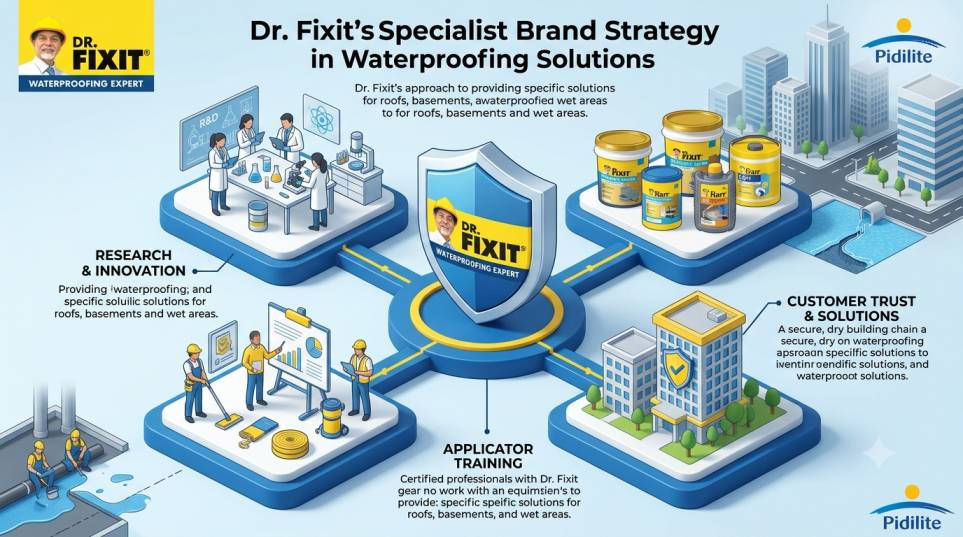
Brand and technical infrastructure. Pidilite's own website (Dr. Fixit consumer-brand page) documents the establishment of Dr. Fixit Institute experience centres and describes the brand's product architecture spanning tile fixing, sealants, coatings and paints, grouts and anchors, and industrial flooring. Company and HR trade press (HRKatha, July 2025) confirm that the Dr. Fixit Institute delivers specialised waterproofing training to contractors, applicators, engineers and painters, forming part of a broader Pidilite skilling effort that has trained over one lakh (100,000) youth across trades including plumbing and waterproofing, delivered in partnership with more than 600 Industrial Training Institutes (ITIs) across Gujarat, Maharashtra, Himachal Pradesh and Rajasthan.
International extension. Pidilite's Annual Report 2022–23 documents a Dr. Fixit digital campaign in Bangladesh featuring cricketer Mashrafe Mortaza, aimed at building waterproofing-category awareness at the point of new home construction. Nepal's Himalayan Times (July 2015) reported that Dr. Fixit's technical team, drawn from its Institute of Structural Protection and Rehabilitation, engaged directly with the Nepal Engineers' Association following the 2015 earthquake to advise on structural repair solutions an instance of expertise-led brand engagement rather than mass advertising. The FY2024–25 Annual Report further documents a market-entry campaign in Kenya framed around establishing Dr. Fixit as "the waterproofing expert in the region."
Positioning & Consumer Insight
The recurring, publicly evidenced consumer insight underlying Dr. Fixit's communication is that Indian consumers and small contractors have historically treated water leakage as a problem to be patched after the fact typically through painting or ad hoc repair rather than prevented through planned, technically correct waterproofing at the construction stage. Pidilite's own 2016 campaign press release names this behaviour change explicitly as the task: shifting consumers toward "pro-active water-proofing using modern methods." The 2020 campaign press material, as reported by Exchange4media and Mediainfoline, reinforces this insight directly, describing the TVC as urging customers "to prefer technically correct solutions" over "the common notion of painting or patch repair."
The choice of Amitabh Bachchan as brand ambassador maps onto a specific positioning logic articulated by Pidilite's own CMO: authority and trust. In the August 2016 press release, Vivek Sharma stated the rationale for the choice was to build "authority to the brand," given Bachchan's status as an actor "loved and admired by all" who could credibly deliver a persuasive behaviour-change message. This positions Dr. Fixit as an expert analogous to a medical specialist, consistent with the "Doctor" framing embedded in the brand name itself rather than as a mass commodity product, a reading independently echoed in the 2017 "Marketing Practice" analysis, which characterises the brand as projecting "authority" and "expertise" to consumers throughout its campaign history.
Media & Channel Strategy
Pidilite's own 2016 press release confirms that the Bachchan campaign launch used a multimedia mix spanning television, digital, retail activation, radio, and outdoor advertising. The December 2020 campaign, per Mediainfoline, incorporated a direct-response mechanic an SMS short-code ("SMS ROOF to 57575") indicating a lead-generation layer alongside brand-building creative. Beyond these confirmed channels, no verified public information is available on Dr. Fixit's channel-wise media spend allocation, digital targeting strategy, or comparative spend versus competitors, as Pidilite does not disclose brand-level media plans publicly.
Business & Brand Outcomes
Publicly available, company-sourced figures on scale are limited but present. Pidilite's own materials, as referenced in industry commentary, state that the Dr. Fixit contractor and homeowner network processes on the order of 10 lakh (1,000,000) home waterproofing projects annually, and that roughly 3 lakh (300,000) contractors have been trained through the brand's programmes cumulatively figures the company presents as measures of category penetration and applicator-network scale, not as outcomes attributable to any specific advertising campaign.
At the segment level, Pidilite's Annual Report 2022–23 states that the company received more than 20 industry awards that year for its advertising and marketing work across its brand portfolio, and specifically credits the Dr. Fixit Raincoat campaign (again featuring Amitabh Bachchan) with effectively conveying the product's combined paint-and-waterproofing proposition with warranty backing. Independent trade-press and market-research coverage (Nexdigm, Future Market Insights, Makreo) consistently identifies Pidilite/Dr. Fixit as one of the leading branded participants in India's construction chemicals and waterproofing market, alongside Sika, BASF, Fosroc, and Asian Paints, though none of these reports discloses an audited, brand-specific market-share percentage for Dr. Fixit that Pidilite itself has confirmed.
Strategic Implications
Three interpretive observations follow from the verified public record and are offered as analysis rather than as additional factual claims.
First, Dr. Fixit's documented history from its formal introduction as an umbrella brand in Pidilite's FY2001–02 Annual Report through campaigns disclosed as recently as FY2024–25 indicates a category-creation strategy sustained over roughly two decades, an unusually long horizon for a single sub-brand's marketing mandate within a diversified industrial-consumer company. This suggests Pidilite's leadership has treated waterproofing-category education as a structural, long-run investment rather than a short-cycle campaign objective, consistent with the CMO's own stated framing of "creating the market" rather than merely capturing existing demand.
Second, the continuity of a single celebrity ambassador (Amitabh Bachchan, engaged from 2016 through at least 2020 per the brand's own and third-party timelines) across multiple distinct creative executions, each addressing a different product line (the general waterproofing message, Roofseal, Raincoat), indicates a strategy of using one consistent authority figure to carry a changing technical message reducing the risk that frequent ambassador changes would dilute the "expert" positioning the brand has built around its name and its "Doctor" metaphor.
Third, the combination of mass-media brand communication with parallel investment in applicator training infrastructure (the Dr. Fixit Institute and its documented ITI partnerships) points to a dual-sided go-to-market model: building consumer pull through advertising while simultaneously building trade "push" credibility through the masons and contractors who physically influence product selection at the point of sale. Independent commentary (the 2018 Medium analysis by Sushil Luniya and the 2017 "Marketing Practice" analysis) both identify this applicator-training dimension as distinctive relative to competitors more narrowly focused on B2B/infrastructure channels, though neither source is a Pidilite-published document and both should be read as third-party interpretation rather than company-verified fact.
Readers should note that this case draws on company disclosures spanning more than two decades (2001–2025) alongside independent news, trade-press, and market-research sources; figures and positioning statements reflect what each named source stated at the time of publication and have not been independently re-verified beyond citation to the original source.
Discussion Questions
Pidilite has sustained a category-creation objective for Dr. Fixit building awareness of waterproofing as a planned investment rather than a reactive repair across roughly two decades of disclosed communications. What are the risks and rewards of a marketing mandate defined at the category level rather than the brand-share level, and how would you design a way to know when "category creation" has succeeded?
Dr. Fixit used a single celebrity ambassador (Amitabh Bachchan) continuously across several distinct campaigns and product lines between 2016 and 2020. Evaluate this choice against the alternative of rotating ambassadors per product launch. What does the "authority" rationale articulated by Pidilite's CMO suggest about how celebrity endorsement functions differently for a technical/expert-positioned brand versus a mass lifestyle brand?
Pidilite's disclosed strategy combines consumer-facing advertising with contractor and applicator training through the Dr. Fixit Institute. Using only the publicly available evidence in this case, assess whether this dual-channel (consumer pull + trade push) approach is a source of durable competitive advantage against infrastructure-focused multinational competitors such as Sika, BASF, and Fosroc.
This case highlights that no verified public information exists on Dr. Fixit's campaign-attributable sales uplift, brand-tracking scores, or standalone financials. As a marketing leader reporting to the board, how would you construct an internal measurement framework for a decades-long category-building brand, given that conventional short-cycle campaign ROI metrics may not capture the intended effect?
Dr. Fixit has extended its category-education playbook celebrity communication plus expert positioning into Bangladesh, Nepal, and Kenya, per Pidilite's own disclosures. What are the key contextual factors (market structure, consumer behaviour, competitive intensity, media infrastructure) that a company should verify before assuming a domestic Indian brand-building formula will transfer successfully to a new international market?


Comments