Ecom Express’ E-Commerce-Focused Delivery Model
INDUSTRY AND COMPETITIVE CONTEXT
India's third-party logistics (3PL) sector serving e-commerce emerged as one of the most capital-intensive and operationally demanding verticals in the country's startup economy through the 2010s and early 2020s. The structural challenge was distinctive: unlike traditional courier companies serving diverse industries, e-commerce logistics demanded the simultaneous management of high-volume, low-value parcels, cash-on-delivery transactions, a high frequency of returns, and geographic reach into India's Tier 2, Tier 3, and rural markets where e-commerce adoption was accelerating fastest. Incumbents like Blue Dart were built around premium, time-sensitive freight for corporate clients and were structurally ill-suited to absorb the economics of mass-market consumer parcel delivery at scale.
The competitive field that emerged comprised a small group of purpose-built players. Delhivery, founded in 2011, pursued a fully integrated multi-segment model handling both B2C parcels and B2B freight. Xpressbees, founded in 2015, carved out a similar niche. Shadowfax focused on hyperlocal and gig-economy delivery. Against this backdrop, Ecom Express occupied a distinctive strategic position: it was India's most explicitly e-commerce-exclusive third-party logistics company, with no material exposure to B2B freight, part-truckload services, or general courier business. This deliberate concentration defined both its growth trajectory and, ultimately, its vulnerability.
According to a RedSeer report cited in the company's Draft Red Herring Prospectus filed with SEBI in August 2024, B2C e-commerce shipments originating from Tier 2 and beyond grew to represent 62% of total volume in FY2024 and were projected to grow at a 35% compound annual growth rate through FY2029, eventually accounting for 70 to 80% of all B2C e-commerce shipments nationally. This was the structural demand wave Ecom Express had spent over a decade positioning itself to capture.
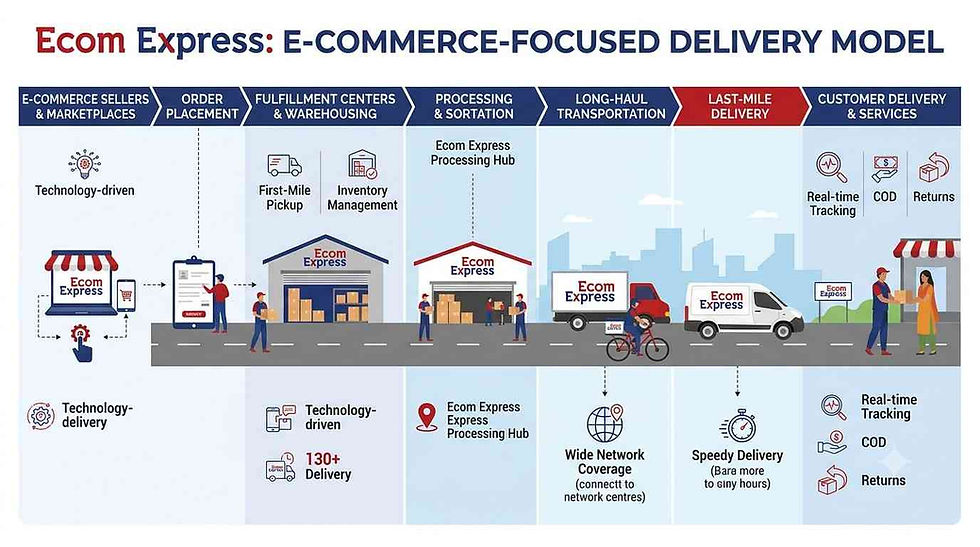
COMPANY SITUATION AND STRATEGIC ORIGINS
Ecom Express was incorporated in August 2012 by four former executives of Blue Dart Express: T. A. Krishnan, Manju Dhawan, K. Satyanarayana, and Sanjeev Saxena, bringing a combined logistics expertise exceeding 25 years in the Indian market. The company was headquartered in Gurugram, Haryana, and launched with a stated focus on express delivery, cash-on-delivery, and reverse logistics, the three service categories that e-commerce sellers identified as their most pressing operational gaps. The founders' Blue Dart background gave the company immediate credibility with enterprise clients and a working understanding of network operations at scale.
The founding thesis was straightforward and well-timed. India's e-commerce sector was nascent but growing rapidly, and existing logistics infrastructure was fragmented, unreliable, and oriented toward non-consumer freight. By designing every aspect of its operating model specifically around the needs of online retailers, rather than retrofitting a general courier business, Ecom Express aimed to become the preferred logistics partner for the country's growing digital commerce ecosystem.
The company launched with 311 employees and 42 delivery centers across 35 cities concentrated in North India, then expanded steadily over the following decade. By the time it filed its DRHP with SEBI in August 2024, the network comprised 115 pick-up and processing centers, 81 sorting hubs, 32 fulfilment centers, 3,421 delivery centers, and 89 return centers, collectively reaching over 27,000 PIN codes and connecting to 97% of India's population, with a stated emphasis on Tier 2 and beyond.
STRATEGIC OBJECTIVE
The company's core strategic objective from inception was to become the dominant end-to-end logistics partner for India's e-commerce industry by building infrastructure and service capabilities that general logistics players could not match in depth or speed. This encompassed three interconnected goals: first, achieving nationwide last-mile reach into geographies underserved by established courier networks; second, building a technology-enabled operating platform capable of managing the complexity of high-volume, return-heavy consumer parcel logistics; and third, establishing Ecom Express as the logistics backbone of choice for major e-commerce marketplaces and direct-to-consumer brands.
The longer-term objective, formalized by the early 2020s, was to achieve a public listing. The company filed its first Draft Red Herring Prospectus for a proposed IPO in 2022, targeting a fundraise of approximately INR 4,860 crore. A subsequent DRHP was filed in August 2024 after the first attempt was shelved amid market conditions, this time targeting INR 2,600 crore. In December 2024, SEBI granted its nod for the public issue.
SERVICE MODEL AND OPERATIONAL ARCHITECTURE
The Ecom Express model was organized around a flagship service called Ecom Express Services, which covered the full logistics chain: first-mile pickup from sellers, mid-mile sorting and linehaul, last-mile delivery to end customers, and reverse logistics for returns. The reverse logistics offering was differentiated by a quality-check feature in which trained delivery personnel conducted product inspections at the point of pickup from the customer before returning goods to the seller or warehouse, reducing disputes and improving efficiency in the returns cycle.
In addition to its core parcel delivery business, the company offered Ecom Digital Services, which provided e-KYC using Aadhaar-based biometric verification as well as collection of cash, cheques, and documents, and Contact Point Verification services for clients in financial services, banking, and insurance. This represented an attempt to leverage the company's last-mile network density for adjacent B2B use cases beyond e-commerce.
In February 2023, the company launched Ecom Magnum, which combined Warehouse Management Solutions and Order Management Solutions into a single offering for e-commerce sellers. This positioned Ecom Express further upstream in the supply chain, moving from pure delivery execution toward integrated fulfillment. In April 2023, Ecom Express launched three new time-definite services: Same Day Delivery, Same Day Delivery Plus, and Next Day Delivery, addressing the accelerating demand from D2C brands and larger marketplaces for faster fulfillment guarantees.
POSITIONING AND MARKET INSIGHT
The foundational positioning of Ecom Express rested on the insight that e-commerce logistics was not simply traditional courier delivery applied to online retail. It was a distinct operational and commercial category requiring purpose-built infrastructure, tailored service products, and different cost economics. The company positioned itself accordingly, branding around speed, safety, and reliability specifically within the context of e-commerce delivery rather than logistics generally.
A critical dimension of this positioning was the emphasis on Tier 2, Tier 3, and rural reach. As noted in the British International Investment press release from 2019 announcing its $36 million equity investment, more than 85% of Ecom Express's network presence was in Tier 2, Tier 3, and Tier 4 cities and hinterlands at the time of investment. This was not coincidental. The company identified early that the next phase of Indian e-commerce growth would be driven not by metropolitan consumers, who were already well-served, but by the hundreds of millions of first-time online shoppers in smaller cities and towns. Building deep into these geographies before competitors achieved comparable density was the company's primary source of defensible competitive advantage.
The B2B model structure reinforced this positioning. Ecom Express served e-commerce companies as its direct clients rather than individual consumers, which meant that its commercial relationships, pricing, and service design were calibrated around the operational and contractual needs of large platforms and brands. Its declared client roster included Amazon, Flipkart, Myntra, Nykaa, Paytm, and Meesho, among others.
TECHNOLOGY AND INFRASTRUCTURE STRATEGY
Technology investment was central to the Ecom Express operating thesis from early in the company's history. Warburg Pincus, which became the company's first institutional investor through a Series B investment in June 2015, described the company's proprietary technology platform as a key element of its competitive strength. In the Partners Group press release from 2020 announcing that firm's investment of over $250 million to become an equal shareholder alongside Warburg Pincus, CEO T. A. Krishnan cited the company's operational investment and focus on customer satisfaction as the foundations of its market position.
The DRHP disclosed that the company's regulatory filings included plans to deploy capital toward technology upgrades, including installation of CCTV hardware and software tracking devices and X-ray machines across its processing network. These investments were oriented toward shipment security, damage reduction, and quality control in transit, all concerns that are heightened in high-return-rate e-commerce logistics relative to conventional freight.
BUSINESS AND FINANCIAL OUTCOMES
The financial trajectory of Ecom Express tells a story of strong early growth followed by stagnation and structural fragility. The company reported revenue of INR 1,254 crore in FY2020 and saw this grow to INR 1,627 crore in FY2021, representing a 33% increase, alongside a swing from a net loss of INR 313.5 crore in FY2020 to a net profit of INR 43.4 crore in FY2021. By FY2024, consolidated revenue had reached INR 2,653 crore, though this represented growth of only 2.3% over FY2023's INR 2,554 crore, the slowest revenue expansion among the major e-commerce logistics players.
The financial vulnerability that was less visible in the headline revenue figures lay in the concentration of the company's commercial base. According to the DRHP filed with SEBI in August 2024, a single customer accounted for 52% of total revenue, with multiple credible reports identifying that customer as Meesho, the social commerce platform. This degree of revenue concentration in a single client represented an extreme strategic risk in a B2B logistics market where major platform clients had both the scale and the economic incentive to internalize logistics operations.
In early 2024, that risk materialized. Meesho launched its own logistics vertical, Valmo, after months of internal testing, and began shifting volume away from Ecom Express. Simultaneously, other major clients including Reliance and Amazon scaled back their business with the company. Industry sources cited by Inc42 indicated that revenue in the January-to-March 2025 quarter fell approximately 30% year-on-year as clients continued to exit. The company also experienced significant leadership attrition from late 2023 onward, which further impacted service quality and commercial relationships.
The consequences were rapid and severe. Despite receiving SEBI's approval for its IPO in December 2024, Ecom Express was unable to proceed with the listing. In April 2025, Delhivery announced the acquisition of a 99.4% controlling stake in Ecom Express for a purchase consideration not exceeding INR 1,407 crore in an all-cash transaction. The sellers included Warburg Pincus, British International Investment, Partners Group, and the company's founders. This acquisition price represented an approximately 80% discount to the company's last reported private valuation of INR 7,000 crore. The Competition Commission of India approved the acquisition on June 17, 2025, and the transaction was completed on July 18, 2025, with Ecom Express becoming a subsidiary of Delhivery.
STRATEGIC IMPLICATIONS
The Ecom Express case offers several analytically significant lessons for students of marketing strategy, competitive positioning, and business model design in emerging markets.
The first and most fundamental implication concerns the structural danger of customer concentration in a B2B platform business. Ecom Express built an operationally impressive nationwide network and achieved genuine depth in Tier 2 and beyond, but the commercial architecture of the business placed the majority of its revenue in the hands of a single client whose own strategic interests were eventually served by reducing that dependency. The DRHP's disclosure of 52% revenue concentration from one client, filed even as the company sought a public listing, reflects a governance and strategic planning failure that no amount of operational excellence could compensate for once that client began building internally.
The second implication concerns the misalignment between infrastructure investment and commercial defensibility. The company invested heavily in physical assets, processing centers, sorting hubs, delivery centers, and return facilities, as well as in technology. These investments were real and measurable, and they created genuine service capability. However, they did not create switching costs for clients of sufficient scale to build their own logistics operations. In e-commerce logistics, large platform clients represent both the revenue source and the most credible competitive threat. A logistics provider serving Meesho was, simultaneously, helping Meesho accumulate the operational knowledge, shipment data, and scale that eventually made Valmo viable.
The third implication concerns the strategic tension between specialization and diversification. Ecom Express's decision to remain exclusively focused on e-commerce logistics was a coherent choice that generated real competitive differentiation in its growth years. However, the absence of diversification into B2B freight, part-truckload services, or other logistics segments left the company without revenue buffers when its primary market segment came under pressure. Delhivery's multi-segment model, by contrast, provided it with financial stability that supported its first reported quarterly profit in Q3 FY2024.
The fourth implication is the strategic importance of timing in the public markets. Ecom Express filed its first DRHP in 2022 and shelved it, then filed again in 2024 after operational conditions had already begun deteriorating. The company received regulatory approval in December 2024 but was unable to execute the listing before the commercial damage became too severe to present to public investors. The window between operational strength and market access was narrow, and the company missed it.
DISCUSSION QUESTIONS
Ecom Express disclosed in its DRHP that a single customer accounted for 52% of total revenue. What frameworks from strategic marketing and competitive analysis would you apply to evaluate when client concentration of this magnitude represents an acceptable growth strategy versus an existential risk, and at what threshold should management have proactively restructured the revenue base?
The company's Tier 2 and rural network depth was described as its primary source of competitive advantage by its institutional investors. Evaluate whether geographic reach in logistics constitutes a durable competitive moat when platform clients such as Meesho have the data, capital, and operational access to replicate that reach internally.
Ecom Express launched Same Day Delivery, Same Day Delivery Plus, and Next Day Delivery services in April 2023, and Ecom Magnum in February 2023. Assess the strategic logic of these service expansions. Do they represent a coherent response to competitive pressure from D2C demand trends, or do they reflect an attempt to add complexity to a business model that needed structural revenue diversification instead?
Delhivery acquired Ecom Express at approximately 80% below its last private valuation. From a marketing and brand strategy perspective, what is the likely rationale for Delhivery to pay even a distressed price for a company with deteriorating client relationships, rather than simply competing for the same market share organically?
The British International Investment press release from 2019 cited that over 85% of Ecom Express's network presence was in Tier 2, Tier 3, and Tier 4 cities. Given the RedSeer projection that these geographies will represent 70 to 80% of total B2C e-commerce shipments by FY2029, how should Delhivery leverage the acquired infrastructure to reposition itself in this segment, and what are the key marketing and operational risks in that integration strategy?


Comments