Ecom Express's Delivery Network Optimization Strategy
Industry & Competitive Context
India's business-to-consumer (B2C) e-commerce logistics sector grew rapidly through the 2010s and 2020s on the back of e-commerce expansion, with third-party logistics (3PL) providers competing to serve online marketplaces, direct-to-consumer (D2C) brands, and quick-commerce platforms. According to Ecom Express's DRHP, citing a RedSeer Report, Ecom Express was India's only pure-play B2C e-commerce logistics solutions provider as of FY2024, distinguishing its positioning from competitors that also serve B2B freight or diversified logistics segments.
The competitive set included Delhivery described in its own disclosures as India's largest fully integrated logistics services provider, operating across more than 18,850 pin codes as well as in-house logistics arms built by e-commerce platforms themselves, such as Amazon Transportation Services and Meesho's Valmo. This shift toward "captive" logistics by large marketplaces represented a structural threat to independent 3PL players like Ecom Express, since platform-owned logistics reduces the volume that would otherwise flow to third-party partners.
Ecom Express reported a pan-India network covering over 27,000 pin codes, which the RedSeer Report cited in its DRHP described as the widest coverage among its peers as of March 31, 2024, with that pin-code footprint collectively accounting for approximately 97% of India's population.
Brand Situation Prior to the Strategy Period
Ecom Express was incorporated in 2012 by T. A. Krishnan, Manju Dhawan, K. Satyanarayana, and the late Sanjeev Saxena, several of whom brought prior experience from established logistics players. Per company and media descriptions, the company built its early differentiation around extending delivery reach into Tier II, Tier III, and rural markets segments where several competitors had comparatively limited presence at the time, and where cash-on-delivery (COD) handling and reverse logistics (returns processing) were operationally critical given prevailing Indian e-commerce payment and return patterns.
As of March 31, 2024, per the DRHP, Ecom Express operated a network of 317 facilities (comprising sorting hubs, processing centers, return centers, and fulfilment centers) and 3,421 delivery centers. The company disclosed 33 automated sortation systems deployed across its hub network to process, bag, and weigh shipments. Its workforce delivery model relied heavily on a gig workforce, with 71.42% of deliveries completed through gig workers, as stated in company-linked IPO disclosures.
Financially, for the fiscal year ended March 31, 2024 (FY24), Ecom Express reported:
Revenue of approximately ₹2,609 crore (up from ₹2,548–2,554 crore in FY23, depending on source)
A net loss of ₹248.5 crore, narrower than the prior year's loss (reported elsewhere as a 40% narrowing to ₹256 crore)
EBITDA improving from ₹3.27 crore to ₹103.58 crore year-on-year
Operating cost per shipment declining from ₹45.40 in FY23 to ₹39.65 in FY24
Shipment volume of over 51.4 crore (514 million) shipments handled in FY24, up from 46.8 crore in FY23
A 27% market share, ranked second-largest, in third-party B2C e-commerce logistics shipments in FY24 (RedSeer Report, as cited in the DRHP)
6,384 active customers as of March 31, 2024, a 68% year-on-year increase in active customer count, including named clients such as Meesho, Amazon, Nykaa, and Puma
Notably, one customer Meesho reportedly accounted for a majority (over 50%) of Ecom Express's shipment volumes at points in its recent history, according to industry commentary cited in business media. This customer concentration became strategically significant once Meesho began scaling its own in-house logistics arm, Valmo.
Strategic Objective
Ecom Express's publicly disclosed strategic objective, as articulated through its DRHP filed with SEBI on August 15, 2024, centered on funding an Initial Public Offering (IPO) of up to ₹2,600 crore, comprising a fresh issue of ₹1,284.5 crore and an offer-for-sale of ₹1,315.5 crore by promoters and existing investors (including Warburg Pincus and Partners Group, via Eaglebay Investment Ltd and PG Esmeralda Pte Ltd respectively).
The company's stated use-of-proceeds plan, as disclosed in the DRHP, was explicitly network- and technology-oriented:
₹387.44 crore for capital expenditure toward new processing centers with automation and new fulfilment centers
₹239.23 crore for enhancing technology, data science capabilities, and cloud infrastructure
₹73.71 crore for computers and IT equipment
₹87.92 crore for repayment of existing borrowings (against total borrowings of ₹165.65 crore as of June 2024)
Remaining proceeds earmarked for general corporate purposes and potential acquisitions
In public remarks to Business Today, Ajay Chitkara, MD & CEO of Ecom Express, stated that the company intended to expand its reach into Tier II and Tier III cities, citing that B2C e-commerce shipment growth was increasingly originating from smaller regions beyond metro India. This reflects a stated strategic emphasis on deepening network density in under-penetrated geographies rather than solely defending metro market share.
Strategic Architecture & Execution
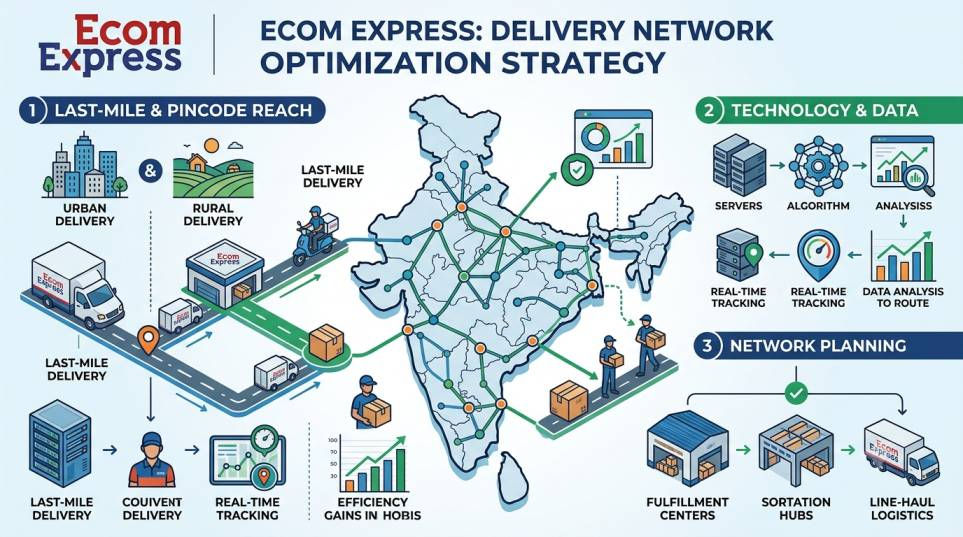
Based on disclosures in the DRHP and corroborating industry reporting, Ecom Express's network optimization approach rested on four verifiable pillars:
Hub-and-spoke network architecture. The company operated a multi-tier structure: first-mile pickup from sellers and warehouses, mid-mile transportation via sorting hubs, processing centers, and gateways, and last-mile delivery through a distributed network of delivery centers. This structure was supplemented by dedicated return centers to support reverse logistics a function the company identified as operationally important given the prevalence of COD transactions and product returns in Indian e-commerce.
Automation deployment at sortation. The DRHP disclosed 33 automated sortation systems used for processing, bagging, and weighing shipments at hub facilities, positioned as a mechanism to increase throughput and reduce manual handling costs.
AI-based address correction. Public reporting (Medianama, December 2024) referenced an AI-driven address correction platform, described in that reporting as "Bulls.ai," which the company used to predict and correct erroneous delivery address entries a documented response to the address-quality challenges endemic to India's e-commerce delivery environment. A separate secondary source referenced a similarly named machine-learning address-normalization tool ("Bullseye") reported to have been deployed in 2024; this claim, including the specific RTO-reduction figure attributed to it, could not be corroborated against Ecom Express's own regulatory filings or official press materials, and is therefore not presented here as verified.
Capital-funded network expansion. The IPO's stated capital allocation nearly ₹390 crore toward new automated processing and fulfilment centers, and over ₹230 crore toward technology and cloud infrastructure represented the company's most concrete, quantified, and independently verifiable commitment to network optimization as a forward-looking strategy at the time of the DRHP filing.
Positioning & Market Insight
Ecom Express's positioning, as evidenced through its DRHP and RedSeer-sourced market data, rested on two verifiable claims: being India's only pure-play B2C e-commerce logistics provider (as of FY2024, per RedSeer), and holding the widest pan-India pin-code coverage among peers, particularly in Tier II, Tier III, and rural geographies. This coverage-led positioning reflected an underlying market insight repeated across company statements and independent reporting that a large share of incremental e-commerce demand growth in India was originating outside metro cities, and that COD and returns-handling capability were prerequisites for serving that demand profile.
This is a structural/operational positioning claim rather than a brand or communications positioning claim.
Media & Channel Strategy
The company's primary public communication channels for the network strategy described in this case were regulatory and financial: the SEBI DRHP filing, subsequent business/trade media coverage of the filing (Business Today, Medianama, Indian Startup News, StartupArticle, BizzBuzz), and, following the 2025 acquisition announcement, Delhivery's stock exchange filings and an official investor FAQ document published on Delhivery's corporate website.
Business & Brand Outcomes
The most significant, publicly documented outcome of Ecom Express's network and capital strategy was not a successful IPO, but its acquisition by rival Delhivery. On April 5, 2025, Delhivery's board approved, and the two companies entered into definitive agreements for, Delhivery's acquisition of at least 99.4% of Ecom Express's issued and paid-up share capital for a cash consideration not exceeding ₹1,407 crore (approximately $169.5 million). The Competition Commission of India (CCI) granted approval for the transaction on June 17, 2025.
Multiple business media outlets (Business Today, Groww, YourStory) characterized the deal as a distressed sale: Ecom Express had last raised private capital at a reported valuation of approximately ₹7,300 crore, implying a valuation decline of roughly 78% by the time of the Delhivery transaction. Contributing factors cited in reporting included a September 2024 public dispute in which Delhivery alleged Ecom Express had used misleading figures in its DRHP (as reported by Moneycontrol), and the loss of shipment volume from Meesho as that customer scaled its in-house logistics arm, Valmo a factor attributed to Datum Intelligence advisor Satish Meena in reporting on the deal. YourStory additionally reported that approximately 150 mid-level and regional operations employees voluntarily resigned ahead of the merger's completion, and that CEO Ajay Chitkara and other senior executives were expected to exit following regulatory clearance.
In its official FAQ document on the acquisition, Delhivery stated that it expected the integration to deliver scale-driven operating efficiencies and greater reach, with profitability expansion to come through reduction of overlapping network assets and central overhead costs indicating that Delhivery's own strategic rationale for the deal was explicitly network-consolidation-driven rather than growth-driven.
Ecom Express's planned IPO, for which the DRHP had been filed in August 2024, was not completed as an independent public listing; the company's path to capital markets was superseded by the acquisition.
Strategic Implications
Several analytically grounded implications follow directly from the documented facts above, without extrapolation beyond what is disclosed.
First, network breadth and cost-per-shipment improvement the two operational metrics Ecom Express most consistently disclosed (27,000+ pin codes; cost per shipment falling from ₹45.40 to ₹39.65) were insufficient on their own to offset customer concentration risk. The reported dependency on a single large customer (Meesho, at times over 50% of shipment volume) illustrates a structural vulnerability common to third-party logistics providers serving platform customers that retain the option to internalize logistics once they reach sufficient scale.
Second, the trajectory from DRHP filing (August 2024, targeting a ~₹7,300 crore-adjacent valuation range implied by prior fundraising) to acquisition (April 2025, at ₹1,407 crore) demonstrates how rapidly capital-market sentiment and strategic value can shift for asset-heavy, thin-margin logistics businesses in a compressed timeframe, particularly amid public disputes over IPO disclosure accuracy and shifting customer relationships.
Third, Delhivery's own stated rationale network consolidation and elimination of overlapping assets, rather than acquiring Ecom Express's customer base or brand suggests that in India's 3PL sector, physical network infrastructure (sorting hubs, delivery centers, pin-code coverage) was, by 2025, viewed by the acquiring market leader as a substitutable and rationalizable asset rather than a durable competitive moat in itself.
Fourth, the case illustrates a broader industry dynamic documented in the sourcing above: the rise of platform-owned, in-house logistics arms (Valmo, Amazon Transportation Services) alongside compressed-delivery-window quick-commerce competitors created margin and volume pressure on independent 3PL providers, a pressure that the available public record indicates Ecom Express's network optimization investments were not able to fully offset before the company was acquired.
Discussion Questions
Ecom Express invested significant IPO proceeds toward automated processing centers, cloud infrastructure, and network expansion, yet was acquired at a valuation roughly 78% below its last private fundraising round. What does this suggest about the relationship between operational efficiency metrics (cost per shipment, automation deployment) and enterprise valuation in capital-intensive logistics businesses?
Given that Meesho reportedly represented over 50% of Ecom Express's shipment volume at points in its history, and that Meesho's subsequent build-out of its in-house logistics arm (Valmo) is cited as a contributing factor in Ecom Express's decline, how should third-party logistics providers structurally manage customer concentration risk when their largest clients have the technical and financial capacity to internalize logistics?
Delhivery's official rationale for acquiring Ecom Express emphasized "reduction of overlapping network assets and central overhead costs" rather than customer or revenue synergies. What does this reveal about how physical network infrastructure is valued in logistics M&A, compared to how it is typically valued in a growth-stage funding round?
Ecom Express positioned itself around the "widest pan-India coverage" and deep penetration into Tier II/III/rural markets. Evaluate whether geographic network breadth alone constitutes a defensible competitive advantage in e-commerce logistics, versus a cost of entry that all major players must eventually match.
The public dispute between Delhivery and Ecom Express over the accuracy of DRHP disclosures occurred shortly before the two companies entered acquisition talks. What governance and disclosure lessons can be drawn for companies pursuing an IPO in a competitive, disclosure-sensitive sector, particularly when a direct competitor is positioned to scrutinize the filing?


Comments