Freshworks' SaaS Subscription Model
Industry & Competitive Context
The global Software-as-a-Service market in which Freshworks competes is structurally divided. At one end sit large enterprise incumbents — Salesforce in customer relationship management, ServiceNow in IT service management, Zendesk in customer support — whose products require months-long implementations, dedicated professional services, and annual contract values typically running into six figures. At the other end, a vast population of small and medium-sized businesses historically made do with spreadsheets, disconnected email threads, and low-capability point solutions. The gap between these two poles — enterprise sophistication on one side, SMB accessibility on the other — represented both a market failure and a commercial opportunity.
Freshworks was purpose-built to exploit that gap. Founded in 2010 by Girish Mathrubootham and Shan Krishnasamy in Chennai, India, the company's original insight was that the incumbent customer support software on the market — most visibly Zendesk — was prohibitively complex and expensive for small businesses that simply wanted to manage customer queries more effectively. The company began as Freshdesk and was later renamed Freshworks as the product portfolio broadened. Its headquarters moved to San Mateo, California, but its engineering and operations remained anchored in Chennai, a structural decision that allowed it to serve developed markets globally while maintaining a meaningful cost advantage over US-based competitors.
By the time of its NASDAQ IPO in September 2021, the cloud-based SaaS industry was in a period of peak capital availability and rapid adoption, driven partly by accelerated digital transformation following the COVID-19 pandemic. Freshworks entered the public markets as the first Indian-founder-led, venture-backed SaaS company to list in the United States — a milestone with both symbolic and commercial significance.
Company Situation Prior to Strategic Scaling
For its first decade, Freshworks was defined by its focus on the SMB segment. Its customer acquisition model relied heavily on inbound digital marketing, free trials, and a self-service onboarding experience that allowed businesses to begin using the software with minimal friction and no requirement for an enterprise sales team. This product-led growth motion — in which the product itself drives discovery, adoption, and conversion — kept acquisition costs low and enabled Freshworks to serve tens of thousands of small customers simultaneously.
By the time of its IPO, Freshworks had expanded its portfolio well beyond the original Freshdesk customer support product. It offered Freshservice for IT service management, Freshsales for CRM, Freshchat for conversational messaging, and Freshmarketer for marketing automation — all built on a shared cloud infrastructure and sold on the same subscription-based, per-seat pricing model. As disclosed in the S-1 filing with the US Securities and Exchange Commission in 2021, the company's customer count stood at approximately 52,500 paying customers as of June 2021.
However, the company's IPO prospectus also revealed a structural tension: while Freshworks had built a wide customer base, a large proportion of its revenue came from small accounts with low annual contract values. The company was growing rapidly — revenue increased from $172.4 million in 2019 to $249.7 million in 2020 and $371 million in 2021, as documented in its SEC filings — but the path to durable, profitable scale required moving beyond purely SMB-driven growth. The IPO valued the company at approximately $10.1 billion after raising $1.03 billion.
Strategic Objective
Freshworks has pursued two distinct but overlapping strategic objectives, sequenced across phases of its public company life.
In the first phase, broadly corresponding to the period before and around the 2021 IPO, the strategic objective was to demonstrate the scale and repeatability of the freemium-to-paid subscription model across a broadening product suite. The company needed to show that its SMB-first, product-led approach could generate consistent revenue growth and that cross-selling across a multi-product portfolio was commercially viable.
In the second phase, explicitly articulated in the company's 2023 Investor Day presentation filed with the SEC, the strategic objective shifted toward what the company described as moving upmarket — winning mid-market and enterprise customers with higher annual contract values, longer contract durations, and greater expansion potential — while sustaining the SMB base that constituted its founding identity. The 2023 Investor Day presentation described a goal of reaching more than $1 billion in annual revenue and documented that, as of mid-2023, mid-market and enterprise customers already represented 59% of total annual recurring revenue, up from 44% in 2019. Customers contributing more than $100,000 in annual recurring revenue grew at a 56% compound annual growth rate between 2019 and the second quarter of 2023, according to the same filing.
The third and most recent strategic layer, clearly evident in investor communications from 2024 and 2025, involves embedding artificial intelligence — specifically the Freddy AI product family — as a primary upsell mechanism, a competitive differentiator, and a means of expanding revenue per customer beyond seat count alone.
Subscription Model Architecture & Execution
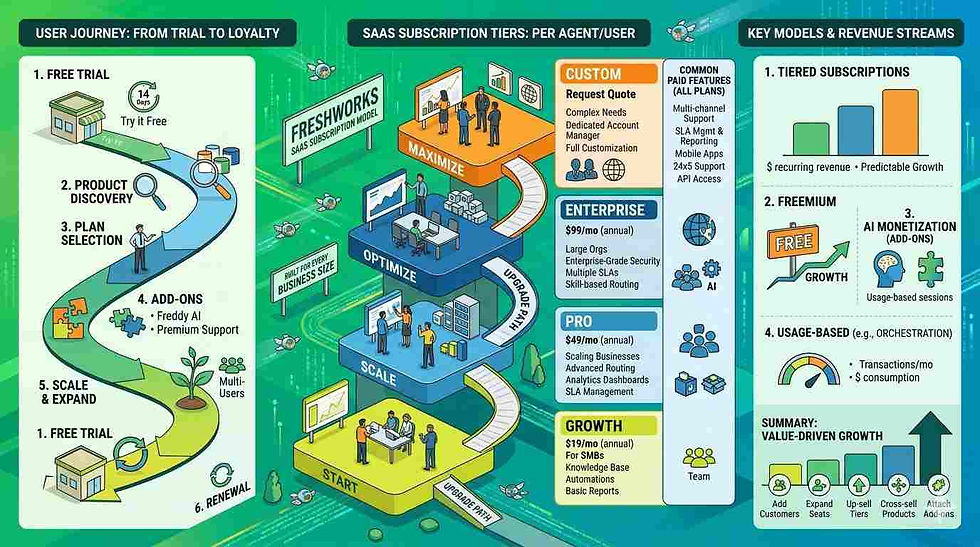
Freshworks' subscription model is built on a freemium-to-tiered architecture that is consistent across its product portfolio. Each product — Freshdesk, Freshservice, Freshsales, and others — is offered in multiple tiers: a free or entry-level plan designed to reduce friction for first-time adopters, followed by progressively feature-rich paid tiers (typically labeled Growth, Pro, and Enterprise) with pricing structured on a per-user, per-month basis. Annual prepayment is incentivized through discounts. This architecture serves multiple strategic functions simultaneously.
First, the free tier functions as a customer acquisition channel, reducing the cost and friction of the initial sale by allowing potential customers to experience product value before committing financially. Second, the tiered structure creates a natural upgrade path: as a business grows in headcount or operational complexity, the free or entry plan's limitations — in automation, analytics, integrations, or AI features — create commercial pressure to move to a higher tier. Third, the multi-product portfolio creates cross-sell opportunities, enabling Freshworks to expand revenue within an existing customer account by introducing adjacent products rather than relying exclusively on seat count expansion or tier upgrades.
The company earns subscription revenue on a per-seat basis, meaning revenue grows organically when a customer's employee base expands and they add more licensed users. This creates a natural revenue expansion mechanism that does not require active selling for every incremental dollar of growth, which is a defining characteristic of well-designed SaaS subscription models.
The Freddy AI product family — launched progressively from 2018 and significantly expanded with generative AI capabilities in 2023 — introduces an additional upsell layer on top of the tiered architecture. Freddy AI includes three components: Freddy Copilot, which assists human agents in real time; Freddy Insights, which provides analytical intelligence to managers; and Freddy AI Agent, which enables fully autonomous customer and employee interactions without human involvement. As disclosed in the company's quarterly earnings communications, by the second quarter of 2024, Freddy AI ARR had crossed $20 million, more than doubling year over year. Over 5,000 customers were paying for Freddy Copilot or AI Agent products by that period, and Freddy Copilot was included in more than 55% of new large customer deals (defined as those exceeding $30,000 in annual recurring revenue). By 2025, Freddy AI ARR had surpassed $25 million across more than 8,000 customers, with attach rates above 50% in large deals, as reported in Freshworks' 2025 Investor Day materials.
The product infrastructure also includes the Freshworks Marketplace, which, as of the 2025 annual report, offers over 1,200 third-party applications and integrations. This ecosystem deepens product stickiness by increasing the switching costs associated with migrating to a competitor, since customers who have integrated Freshworks into their broader technology stack face friction and cost when considering alternatives.
Positioning & Consumer Insight
Freshworks' foundational positioning insight — which has remained consistent even as the company moved upmarket — is that enterprise-grade functionality does not need to come with enterprise-grade complexity or cost. The company consistently positioned its products as faster to deploy, easier to use, and more affordable than the incumbents it competed against. The S-1 filing characterized Freshworks as a company that provides solutions enabling organizations to "acquire, engage, and better serve their customers and employees" — a framing that emphasizes operational outcomes rather than technology specifications.
This positioning was particularly powerful in the SMB segment, where IT departments are often absent or under-resourced, and where a sales cycle measured in days rather than months is commercially necessary. As documented in the S-1, Freshworks' typical sales cycle for SMB customers was approximately 30 days, compared to 90 days for enterprise and mid-market customers. The product-led model — where users could sign up, configure, and begin using the software without implementation consultants — was not merely a cost-saving measure but an expression of the brand promise: software that businesses could actually use without extensive training or professional services.
As the company moved upmarket, the positioning evolved without abandoning its roots. The 2024 earnings communications positioned Freshworks as "the AI-powered service platform that enables companies to scale with exceptional customer and employee experiences" — language that speaks to mid-market and enterprise buyers evaluating scalability and outcome metrics, while retaining the emphasis on experience and usability that defined the SMB proposition.
Media & Channel Strategy
No verified public information is available on Freshworks' specific paid media expenditure allocation, channel-by-channel attribution, or the precise composition of its digital marketing investment across identifiable platforms. However, the company's go-to-market model as disclosed in SEC filings indicates a deliberate reliance on inbound digital marketing and self-service acquisition for the SMB segment, while deploying a direct sales force — including inside sales teams and, for larger accounts, field sales representatives — for mid-market and enterprise customers. The S-1 distinguished between these two motion types and noted that enterprise and mid-market customers often require more extensive sales engagement and negotiation. As the company moved upmarket, it invested in expanding its direct sales capacity, partner programs, and system integrator relationships. In 2024, for instance, the company announced a strategic agreement with Unisys, a global systems integrator, to broaden its enterprise reach.
The Freshworks Marketplace and its developer ecosystem also function as a channel strategy: by enabling third-party partners to build and sell applications that extend Freshworks' core products, the company creates a network of channel participants with a commercial interest in promoting and embedding Freshworks within customer environments.
Business & Brand Outcomes
The documented financial trajectory of Freshworks' subscription model provides the most direct evidence of strategic execution. Revenue grew from $596.4 million in 2023 to $720.4 million in 2024, representing 21% year-over-year growth, and to $838.8 million in 2025, representing 16% growth, as reported in the company's official earnings press releases and 10-K filings. The company achieved its first full-year net income of $183.7 million in 2025, compared to a net loss of $95.4 million in 2024, though it carried an accumulated deficit of $3.6 billion as of the 2025 annual report, reflecting the scale of historical investment required to build the business.
The customer base reached approximately 75,000 companies across approximately 170 countries as of December 31, 2025, per the 2025 10-K. The upmarket shift is visible in the composition of that base: by the end of 2025, over 60% of annual recurring revenue came from customers with more than 250 employees. Customers contributing more than $5,000 in annual recurring revenue — Freshworks' reported proxy for higher-value customer relationships — numbered 22,558 as of the fourth quarter of 2024, growing 11% year over year.
The Net Dollar Retention Rate, a metric that measures whether the revenue from existing customers grows or shrinks over time through expansion, churn, and contraction, was 118% as of the IPO in mid-2021, indicating strong expansion dynamics within the customer base. By the fourth quarter of 2024, the NDRR had moderated to 103% on a reported basis (105% adjusting for constant currency), compared to 108% in the fourth quarter of 2023. While a retention rate above 100% still means that existing customers are spending more on net, the trend indicates a moderation of organic expansion within the existing base.
Freshworks generated $153.3 million in adjusted free cash flow in 2024, up from $77.8 million in 2023, demonstrating improved cash generation as the business matured. The Board of Directors authorized a $400 million share repurchase program in November 2024, signaling confidence in the company's financial durability.
The Freddy AI product line generated over $25 million in ARR by 2025 and achieved AI-specific net dollar retention of 116%, rising from 112% in the prior period, indicating that customers who adopt AI products expand their spending at a faster rate than the overall base.
Strategic Implications
Freshworks' journey from an SMB-focused freemium customer support tool to a multi-product, AI-augmented SaaS platform illustrates several principles with broad strategic applicability.
The freemium architecture, when designed with deliberate upgrade pressure built into tier limitations, can function as a scalable customer acquisition engine that reduces reliance on expensive outbound sales for the initial conversion. However, the model's long-term economics depend on whether the acquired customer base can be expanded — through seat growth, tier upgrades, cross-sell, or add-on products — at a rate that justifies the initial low-cost acquisition. Freshworks' historical NDRR above 100% confirmed that this expansion was occurring, but the moderation of that metric from 118% to 103% between 2021 and 2024 raises a structural question about the ceiling of organic expansion within a predominantly SMB base.
The deliberate upmarket migration from SMB-dominant to mid-market and enterprise-dominant ARR is a well-documented strategic shift in the SaaS industry, often described as "moving upmarket." This transition brings higher average contract values, lower per-account churn risk, and greater expansion potential, but it introduces complexity: longer sales cycles, more demanding implementation requirements, increased competition from established enterprise vendors, and a potential dilution of the simplicity and speed that differentiated the original SMB product. Freshworks' management of this transition — maintaining a freemium SMB presence while building upmarket sales capacity — is a strategic balancing act that is visible in the customer composition data disclosed in its SEC filings.
The AI upsell strategy through Freddy AI represents a structurally important evolution of the subscription model. Rather than relying solely on seat count growth or tier upgrades to expand revenue per customer, Freshworks is introducing AI capabilities as discrete, premium-priced add-ons that sit above the core product tiers. The 50%+ attach rate in large deals and the higher NDRR among AI customers, as disclosed in investor communications, suggest that this layer of the model is functioning as intended. However, the durability of this advantage depends on whether AI capabilities remain sufficiently differentiated — as competing products from Salesforce, ServiceNow, and Zendesk incorporate similar generative AI features — and on whether customers' willingness to pay for AI add-ons holds as these capabilities become more commoditized.
Freshworks also demonstrates the strategic value of building a technology company with an engineering base in India and a go-to-market presence in high-value global markets. The inside sales model operated from Chennai — which allowed Freshworks to target US and European SMBs with a cost structure significantly more favorable than locally-based competitors — was a structural competitive advantage in the company's early growth phase. This model has since been replicated widely across the Indian SaaS industry, with Freshworks often cited as a foundational reference point.
Discussion Questions for MBA
1. Freshworks' Net Dollar Retention Rate declined from 118% at the time of its IPO in 2021 to 103% by the fourth quarter of 2024. What structural factors — including the upmarket shift, product mix changes, and macroeconomic conditions — might explain this moderation, and what are the strategic implications for a SaaS company whose subscription model depends on within-base expansion?
2. Freshworks' freemium-to-tiered pricing architecture is designed to convert free users into paying customers and paying customers into higher-tier subscribers. At what point does the presence of a free tier become a liability rather than an asset, and what conditions would signal that Freshworks should reconsider the freemium layer of its model?
3. The company's upmarket migration has shifted the ARR mix from SMB-dominant (56% in 2019) to mid-market and enterprise-dominant (59% in mid-2023). How should Freshworks manage the inherent tension between the simplicity and speed that defined its SMB brand positioning and the customization, integration depth, and professional services that enterprise customers typically require?
4. Freddy AI is positioned both as a product differentiator and as a premium upsell layer within the subscription model. As enterprise SaaS competitors — Salesforce, ServiceNow, and Zendesk — accelerate their own AI integrations, what is the durability of Freshworks' AI-driven pricing premium, and what strategic options does the company have if AI features become commoditized across the category?
5. Freshworks achieved its first full-year net income in 2025 after years of net losses and an accumulated deficit of $3.6 billion. To what extent does the achievement of profitability represent a genuine inflection in the business model, and how should the company balance continued investment in growth — through R&D, sales capacity, and AI development — against the expectations of a public market that now values profitability alongside revenue growth?


Comments