From Chatbots to AI Agents: The Next Evolution of Customer Engagement
- 3 days ago
- 10 min read
Industry and Competitive Context
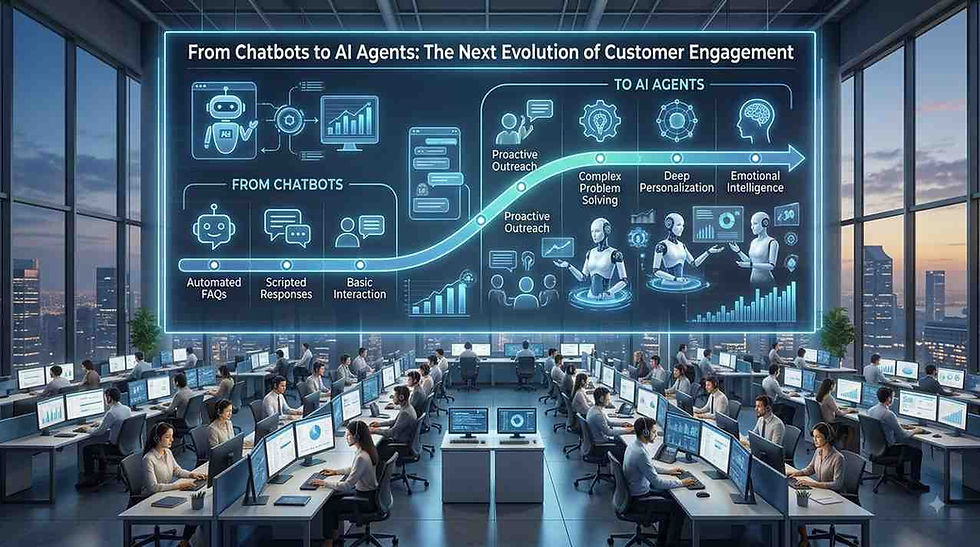
The global customer engagement technology landscape has undergone a structural inflection point that few industries experience within a single decade. For the better part of two decades following the emergence of digital commerce, rule-based chatbots served as the dominant self-service mechanism in enterprise customer support. These systems operated on rigid decision trees, keyword triggers, and scripted responses, functioning essentially as interactive FAQs dressed in conversational syntax. They resolved the simplest possible queries while deflecting everything else to human agents, often at the cost of customer frustration and operational efficiency.
The introduction of large language models and, subsequently, generative AI broke the ceiling on what automated customer interaction could achieve. Conversational AI is forecast to grow to $41.39 billion by 2030, expanding at a compound annual growth rate of 23.7 percent from 2025, according to Grand View Research. More meaningfully for strategy, Gartner published in March 2025 that agentic AI will autonomously resolve 80 percent of common customer service issues without human intervention by 2029, leading to an estimated 30 percent reduction in operational costs. The same analyst firm noted that by 2028, 33 percent of enterprise software applications will include agentic AI, up from less than one percent in 2024, a 33-fold expansion in four years.
The competitive structure of the sector reflects this momentum. Salesforce, Microsoft, Google Cloud, Intercom, and a new wave of verticalized AI platforms have moved aggressively to establish infrastructure leadership. Simultaneously, enterprises across financial services, retail, travel, and staffing have begun deploying AI agents not as experimental pilots but as production-grade infrastructure. McKinsey's 2024 State of AI reporting confirmed that 72 percent of organizations worldwide had adopted at least one AI-based automation solution. The customer engagement function has consistently ranked among the earliest and most-deployed use cases in enterprise AI adoption surveys, establishing the domain as a critical competitive battleground for both technology vendors and the brands that deploy their solutions.
The Enterprise Situation Prior to AI Agent Adoption
To understand the strategic significance of the shift from chatbots to AI agents, it is essential to diagnose what rule-based systems could not solve. Traditional chatbots were designed as deflection tools rather than resolution engines. Their value proposition rested on containing inbound volume before it reached human agents, not on independently completing customer tasks. They lacked the capacity to reason across multiple data sources, exercise contextual judgment, or take autonomous action within backend systems such as order management, refund processing, or account modification.
The consequences of these structural limitations were measurable. Contact center costs remained stubbornly high despite chatbot deployment, because the percentage of interactions that chatbots could genuinely resolve to customer satisfaction was low enough that most volume still required human handling. Customer satisfaction scores for chatbot interactions lagged well behind those for human agent interactions. And as digital commerce scaled, the volume of routine but multi-step customer inquiries grew faster than enterprise hiring budgets could absorb.
At the same time, customer expectations were rising. The widespread adoption of generative AI in consumer applications had recalibrated what users expected from automated systems. Customers experiencing fluid, context-aware conversations in consumer AI tools were less willing to tolerate the brittle, menu-driven failures of legacy chatbots. The gap between what automated service could deliver and what customers now expected created a commercially untenable situation for enterprises relying on first-generation conversational automation. Gartner separately reported in July 2024 that 64 percent of customers said they would prefer companies not use AI for service, a finding that reflected dissatisfaction with chatbot-era AI rather than opposition to AI itself.
Strategic Objective
The strategic imperative driving the transition to AI agents is fundamentally different from the one that drove chatbot adoption. Whereas chatbots were deployed primarily to reduce inbound volume reaching human agents, AI agents are being deployed to achieve complete autonomous resolution of customer issues, end-to-end. This is a shift from deflection to completion, and it changes the entire value equation.
Enterprises adopting AI agents have pursued several interconnected objectives. The first is operational scale without proportional headcount growth, enabling companies to serve expanding customer bases without linear increases in support costs. The second is quality parity with human agents on routine and semi-complex interactions, specifically in accuracy, tone, and task completion rate. The third is always-on availability across time zones, languages, and channels, which first-generation chatbots claimed to offer but in practice delivered poorly due to resolution failures. The fourth, and strategically most significant, is the repositioning of human agents toward high-value interactions requiring empathy, negotiation, and judgment that AI cannot replicate, a reallocation of human capital rather than a reduction of it.
Technology Architecture and Deployment Strategy
The architecture of AI agents differs from chatbots in three foundational dimensions: reasoning capability, system access, and action execution. Rather than matching keywords to scripted outputs, AI agents use large language models to analyze the full context of a customer interaction, reason through an appropriate response or action sequence, and execute that action directly within connected enterprise systems, all within a single interaction.
Salesforce's Agentforce platform, introduced at Dreamforce in September 2024 and commercially released in October 2024, exemplifies the architectural philosophy underlying this category. The platform integrates directly with Salesforce CRM and Data Cloud, enabling agents to access real-time customer data rather than static knowledge bases. Agentforce operates through what Salesforce terms an Atlas Reasoning Engine, which governs how agents plan, decide, and act within defined guardrails. The platform underwent four major releases between its launch and mid-2025: the initial October 2024 release, Agentforce 2 in December 2024 which improved grounding and predictability, Agentforce 2dx in March 2025 which embedded agents proactively into cross-functional workflows, and Agentforce 3 in June 2025 which enhanced interoperability and enterprise governance for scaled deployments.
The deployment pattern for AI agents differs meaningfully from chatbot rollouts. Where chatbots were typically installed at a single digital touchpoint, AI agents are deployed across multiple channels simultaneously, including self-service portals, messaging platforms, voice interfaces, and internal employee tools. The Salesforce Agentic Enterprise Index documented in its H1 2025 analysis that employee interactions with AI agents grew at an average monthly rate of 65 percent in the first half of 2025, while the volume of agent actions triggered per employee engagement grew at 76 percent month over month during the same period.
The Klarna deployment, which predates many of the enterprise platforms, offers a documented reference architecture for large-scale AI agent rollout. Klarna built its AI customer service assistant in partnership with OpenAI, integrating it with its account and transaction APIs, grounding responses in structured help-center content, and routing low-confidence or high-complexity cases to human agents. The system went live globally in late January and February 2024 across 23 markets and more than 35 languages.
Positioning and Consumer Insight
The positioning tension embedded in AI agent deployment is among the most strategically complex challenges facing enterprise marketing and CX leaders today. Consumer insight research reveals a divided audience: customers simultaneously expect faster, frictionless service and express resistance to the perception that they are being served by a machine.
The Klarna case illuminates both sides of this tension. Klarna's February 2024 press release documented that its AI assistant handled 2.3 million conversations in its first month, representing two-thirds of all customer service chats, with an average resolution time of under two minutes compared to eleven minutes for human agents. The company projected a $40 million profit improvement for 2024 from the deployment. By Q3 2025, Klarna's updated reporting put the assistant doing the equivalent work of 853 agents, with response times 82 percent faster than pre-AI benchmarks and a 25 percent reduction in repeat inquiries. These are metrics from Klarna's own public press releases and investor communications.
Yet the same deployment ultimately demonstrated the limits of pure AI-first positioning. By May 2025, Klarna's CEO Sebastian Siemiatkowski publicly told Bloomberg that the company had overcorrected and was reopening hiring for premium customer service roles. The company's public framing evolved to emphasize that AI provides speed while human agents provide the quality of interaction that premium segments expect. Klarna's spokesperson Clare Nordstrom stated explicitly that the strategy would evolve to ensure customers always have the option to speak with a human.
This evolution carries significant positioning implications. The brands most successfully navigating the transition are those framing AI agents not as replacements for human service but as infrastructure that enables human agents to operate at a higher tier. Gartner's February 2026 research predicted that by 2027, 50 percent of organizations that expected to significantly reduce their customer service workforce because of AI would abandon those plans. This finding aligns with the empirical trajectory observed in early-adopter deployments. The consumer insight is this: customers accept AI resolution when it works and they accept it faster than through human channels; they reject AI positioning when it signals that human escalation is unavailable or difficult.
Business Outcomes
The documented outcomes from AI agent deployments across verified enterprise cases establish a pattern that is analytically distinct from chatbot-era performance benchmarks.
Salesforce's publicly disclosed customer data from its October 2025 Agentforce 360 press release documents the following verified results: OpenTable resolved 70 percent of diner and restaurant inquiries autonomously within weeks of deployment, a marked improvement over the chatbot solution it replaced according to the company's own SVP of Global Customer Success. Adecco handled 51 percent of candidate conversations outside standard working hours using Agentforce agents, enabling recruiters to redirect capacity toward higher-complexity engagement. Engine, a business services company, reduced average handle time by 15 percent and reported over $2 million in annual savings attributable to the deployment. 1-800Accountant reported Agentforce resolving up to 60 percent of incoming requests including routine tax return status inquiries.
Salesforce's own Agentic Enterprise Index data for H1 2025, published as an aggregated analysis of production deployments, documented that the longest time U.S. consumers spent resolving a single customer service issue decreased by three hours since October 2024 across the measured base. The Index also documented that escalations to human agents increased from 22 percent in Q1 2025 to 32 percent in Q2 2025, a finding that Salesforce interpreted not as a failure of AI resolution but as evidence of more intelligent triage: AI agents appropriately identifying which interactions require human judgment and routing them accordingly.
The Klarna deployment provides the most longitudinally documented public case. Starting from first-month metrics of 2.3 million conversations and a two-minute average resolution time, the company's later updates confirmed an 82 percent improvement in response times since launch, a 25 percent reduction in repeat issues, and projected cost avoidance growing from $40 million annually at launch to approximately $60 million by Q3 2025. The cost avoidance figure represents avoided hiring during growth rather than headcount reduction, a distinction Klarna's CEO has been explicit about in public statements.
Strategic Implications
The transition from chatbots to AI agents represents a structural shift in how customer engagement functions as a business capability, not merely a technological upgrade. Several strategic implications emerge from the verified evidence across this case.
The first implication concerns the redefinition of automation's value horizon. Chatbots created value by deflecting volume; AI agents create value by completing work. This distinction makes AI agents a direct influence on revenue, not just cost. When an AI agent independently schedules a meeting, processes a refund, updates an account, and sends a confirmation, it has executed a complete customer lifecycle step that previously required human labor across multiple system interfaces. The strategic value is no longer measured in deflection rate but in task completion rate and customer outcome quality.
The second implication concerns organizational design. The documented evidence from both the Salesforce customer base and Klarna's own trajectory demonstrates that the human-AI model converging across the industry is not replacement but reallocation. Human agents are migrating toward complex, emotionally sensitive, or commercially significant interactions while AI agents absorb the high volume, repetitive, and process-bound tier. This bifurcation requires enterprises to redesign agent training programs, incentive structures, and performance metrics around qualitatively different work, a human capital challenge that sits largely outside technology strategy.
The third implication concerns trust architecture. Gartner's July 2024 finding that 64 percent of customers would prefer companies not use AI for service cannot be dismissed as technophobia. It reflects years of accumulated dissatisfaction with systems that promised resolution and delivered deflection. The brands building durable competitive advantage in this space are investing in what might be called explainable handoff design: making it transparent to customers when they are interacting with an AI agent, what the agent can and cannot do, and how human escalation works. This is not regulatory compliance; it is brand equity management.
The fourth implication concerns data as the binding constraint. Salesforce documented in its Customer Zero experience with Agentforce that AI agents encountering conflicting information within their dataset will attempt to reconcile contradictions, potentially generating inaccurate responses. The quality of the underlying enterprise data architecture, specifically its consistency, recency, and structural integrity, determines the ceiling on what an AI agent can reliably deliver. Enterprises that have historically underinvested in data governance are discovering that AI agent deployments expose and amplify legacy data quality failures.
The fifth implication is market speed. Gartner's projection that 33 percent of enterprise software will include agentic AI by 2028, up from less than one percent in 2024, implies a window of competitive differentiation that is compressing rapidly. Organizations that develop AI agent deployment competency, including the institutional knowledge to train, monitor, and iterate on agent behavior, earlier in this adoption curve will carry that compounding operational advantage into a market environment where agentic AI is standard infrastructure.
MBA Discussion Questions
Klarna achieved documented efficiency gains from its AI agent deployment in 2024 but publicly reversed elements of its strategy by May 2025, reintroducing human agents for premium support tiers. Evaluate the strategic decision to walk back a publicly celebrated AI-first positioning. What does this reveal about the relationship between operational metrics and brand equity in customer engagement strategy?
Gartner projects that by 2027, 50 percent of organizations expecting significant workforce reductions from AI will abandon those plans. Given this prediction and the Klarna precedent, how should a Chief Marketing Officer frame the business case for AI agent investment to the board without overstating displacement outcomes?
The documented evidence suggests AI agents deliver resolution-speed advantages but that consumer trust remains a structural barrier, with 64 percent of customers preferring companies not use AI for service. Design a brand communication strategy that addresses this trust deficit while still deploying AI agents at scale. What principles should govern the disclosure and framing of AI-powered service?
Salesforce's Agentforce deployment data shows escalations from AI to human agents increasing from 22 percent to 32 percent between Q1 and Q2 2025. Interpret this trend from both a pessimistic and an optimistic strategic perspective. What metrics would a firm need to track over the following four quarters to determine which interpretation is correct?
The shift from chatbots to AI agents requires enterprises to reconfigure not only technology but also human capital, data infrastructure, and performance measurement systems. Using the frameworks of resource-based view and dynamic capabilities, assess whether the core competency required to win in AI-powered customer engagement is primarily technological, organizational, or data-driven, and what the implications are for competitive durability.


Comments