Hindware's Brand Portfolio Strategy Across Sanitaryware and Kitchen Solutions
- 13 hours ago
- 12 min read
Industry & Competitive Context
India's building-products and consumer-appliances industries spanning sanitaryware, faucets, tiles, plastic pipes, and kitchen appliances are large, fragmented, and increasingly premiumizing categories tied to housing construction, urbanization, and rising disposable incomes. Hindware Home Innovation Limited (NSE/BSE: HINDWAREAP), the listed entity that houses the Hindware brand, has described itself as having transformed "from being a sanitaryware company with an addressable market size of ~Rs. 4,000 crore to a multi-segment consumer-facing company," according to a brokerage note published by Sharekhan (November 2024) summarizing management commentary.
Within organized sanitaryware and faucetware, Hindware holds an estimated 23% and 6% market share respectively, according to an equity research report by Nuvama Wealth Management. The same report states that Hindware Home Innovation Limited (HHIL) ranks among the top three players in the sanitaryware, faucet, and kitchen-chimney categories in the domestic market, and is one of the fastest-growing companies in plastic pipes. A February 2026 report by Whalesbook noted that, compared with peers such as Cera Sanitaryware and Kajaria Ceramics, Hindware's Bathware segment was showing "strong growth and margin expansion."
The industry is also undergoing structural change: CARE Ratings (April 2025) and multiple company disclosures note that Indian home-improvement demand is shifting toward premium and technology-enabled products sensor faucets, smart WCs, BLDC (Brushless DC motor) chimneys while Tier-II and Tier-III cities are emerging as new demand centers, as described in a July 2025 press release covering Hindware Smart Appliances' kitchen portfolio expansion (Tribune India / Technical Textiles Today).
Brand Situation Prior to the Campaign
Corporate lineage
Hindware's corporate history traces to 1960, when the company was incorporated as Hindusthan Twyfords Ltd. by the Somany family in technical collaboration with Twyfords Ltd., UK, to manufacture vitreous china sanitaryware in India (HSIL Group corporate website; M&A Critique/LinkedIn analysis, 2018). The company was renamed Hindustan Sanitaryware & Industries Limited in 1969, and then HSIL Limited in March 2009. The "Hindware" brand itself was introduced in 1991, after which the company diversified into faucets, pipes and fittings, and other adjacent categories over the following two decades (YourStory/SMBStory).
The 2017–2018 demerger
In 2017, HSIL Limited approved a demerger that separated its glass-packaging business from its consumer-facing "Building Products" and "Consumer Products" businesses. Under the scheme, Somany Home Innovation Limited (SHIL) later renamed Hindware Home Innovation Limited (HHIL) was created to house Consumer Products and retail distribution, while Brilloca Limited (later renamed Hindware Limited) became SHIL's subsidiary carrying the Building Products (sanitaryware, faucets, pipes) marketing and distribution business. The scheme became effective on April 1, 2018 (Screener.in company profile; CARE Ratings press release, 2025). HSIL itself was subsequently renamed AGI Greenpac Limited and retained the glass-packaging business. In FY2022, manufacturing assets for both divisions were transferred to the resultant companies via a slump-sale transaction valued at approximately ₹699.96 crore (CARE Ratings, April 2026).
Brand architecture prior to the current campaign
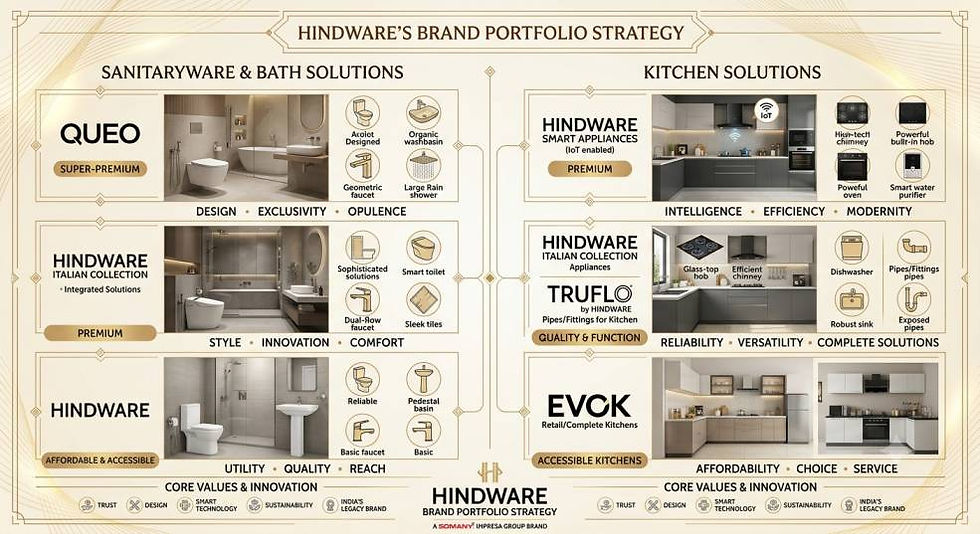
Publicly available company information (Hindware's official corporate website, hindware.com, and HHIL's investor materials) describes a multi-brand portfolio architecture rather than a single master brand covering all price tiers:
Hindware: the flagship, mass-to-mid-premium brand covering sanitaryware and faucets.
Queo: a premium bathware brand. Hindware acquired UK-based boutique sanitaryware manufacturer Barwood Products Ltd. in 2010 and introduced the Queo brand in India in 2011, positioned around "premium bathware solutions" and "classical elegance."
Truflo by Hindware: the plumbing and pipes brand, covering CPVC/UPVC plumbing, SWR piping, PVC pressure pipes, and storage tanks.
Benelave by Hindware :described on the company's own website as offering "elegant bath and kitchen essentials."
Moonbow by Hindware :air purifiers and water purifiers, per SHIL/HHIL's official "our story" page.
Hindware Smart Appliances: the brand covering kitchen and home appliances: chimneys, hobs, cooktops, built-in ovens, microwaves, dishwashers, sinks, cooking ranges, air coolers, and room heaters.
Hindware Atlantic: water heaters, manufactured through Hintastica Private Limited, a joint venture with French heating major Groupe Atlantic.
FGV Powered by Hindware: furniture and kitchen fittings (hinges, drawer systems, lift-ups), sourced through a strategic tie-up with Italian firm Formenti & Giovenzana (India Infoline company summary).
Hindware Italian Collection : premium tiles.
Evoke: a furniture retail brand referenced in Sharekhan's November 2024 institutional research note.
This architecture a "branded house with sub-brands" model allowed Hindware to address distinct price tiers and use-occasions (mass sanitaryware vs. premium bathware; plumbing vs. finished fixtures; appliances vs. fixtures) while still trading on the overarching "Hindware" name and its six-decade heritage.
Financial and operational context immediately preceding the campaign
HHIL's consolidated revenue stood at ₹25,635 million in FY25, down 8.9% from ₹28,127 million in FY24, according to an annual-report analysis published by Equitymaster. Consolidated operating profit margin fell to 4.5% in FY25 from 9.5% in FY24. Within this, the Consumer Products Division (which includes Hindware Smart Appliances) reported revenue of approximately ₹237 crore over nine months of FY25 with a 7.2% EBITDA margin, but recorded net losses in both FY24 and FY25, per a Whalesbook report citing company results. By contrast, the Building Products Division (Bathware, Pipes & Fittings) generated approximately ₹1,611 crore over the same nine-month period with a 9.8% EBITDA margin. A CARE Ratings press release (April 2025) explicitly flagged "ongoing losses in the consumer appliances division" as a factor behind a ratings downgrade of HHIL's bank facilities.
It was against this backdrop of a structurally profitable Building Products business and a loss-making, sub-scale Consumer Appliances business that Hindware undertook two major strategic moves in 2025: a corporate demerger separating the two businesses into independently listed entities, and an integrated brand-positioning campaign ("Designed for Sukoon") intended to unify the customer-facing brand experience across Bathware, Tiles, and Kitchen Appliances.
Strategic Objective
Two distinct but related strategic objectives are documented in public filings and press materials:
(a) Structural/corporate objective: On March 27, 2025, HHIL's Board approved a Composite Scheme of Arrangement to demerge the Consumer Products Business (kitchen appliances, water heaters, fixtures and fittings) into a new entity, HHIL Limited, while amalgamating the remaining Building Products Business (sanitaryware, faucets, tiles, plastic pipes and fittings) into subsidiary Hindware Limited. Chairman Sandip Somany stated the scheme was "designed to unlock significant shareholder value by capitalizing on the distinct characteristics of each business, including differing distribution channels, competitive landscapes, capital requirements, and investor profiles" (The Hans India, March 29, 2025). The Scheme's appointed date was set as April 1, 2025, subject to shareholder, creditor, SEBI, stock-exchange, and NCLT approvals; NCLT-convened meetings for shareholder and creditor approval were held on March 7, 2026, per a company results summary published by Scanx (July 2026).
(b) Brand/positioning objective: Concurrently, at the customer-facing level, Hindware pursued a unification strategy bringing its Bathware, Tiles, and Kitchen Appliances categories under a single brand positioning rather than allowing them to be perceived as disconnected product lines. This objective was made explicit in the launch communication for the "Designed for Sukoon" campaign in late September/early October 2025: Shashvat Somany, Head of Strategy at Somany Impresa Group and a Non-Executive Director at Hindware Limited, stated that the campaign marked "an exciting new chapter that unifies our entire portfolio of Bathware, Tiles, and Kitchen appliances under one cohesive brand positioning" (Impact on Net; Mediabrief; The Hans India all October 2025).
Notably, this brand-unification objective runs in an apparently different direction from the corporate demerger objective of separating Bathware/Tiles from Kitchen Appliances into distinct listed companies.
Campaign Architecture & Execution
The "Designed for Sukoon" campaign was launched around September 29–October 3, 2025 (multiple trade press reports: Afaqs, Mediabrief, The Hans India, RP Realty Plus, Impact on Net, Passionate in Marketing). Documented elements of the campaign's architecture include:
Positioning statement: "Designed for Sukoon" built around the Hindi/Urdu word Sukoon, connoting serene peace and comfort.
Creative and strategic authorship: The campaign was "conceptualised and created by MullenLowe Lintas Group" (multiple sources cite this attribution consistently).
Thematic pillars: Company and agency communications describe the campaign as built around five emotional pillars Calm, Care, Comfort, Love, and Playfulness intended to move the brand narrative "beyond functionality" toward emotional relevance.
Category integration: The campaign explicitly spans three business lines Bathware, Tiles, and Kitchen Appliances/Consumer Appliances under one brand idea, rather than running as category-specific product advertising.
Product proof-points cited in the campaign: a "Multifunction Shower with Thermostat" designed to mimic monsoon rain, a "Smart WC" with a warm seat, splash-free faucets, washbasins in colour variants, an "IoT Chimney with Maxx Silence Technology," and premium tiles (cited consistently across Mediabrief, The Hans India, and Interiors N Decor).
Executives quoted in the launch materials include Shashvat Somany (Head of Strategy, Somany Impresa Group; Non-Executive Non-Independent Director, Hindware Limited), Nirupam Sahay (CEO, Hindware Limited), Arunima Yadav (Head of Marketing, Hindware Limited), and Ram Cobain (Chief Creative Officer, Mullen Lintas). Sahay's stated framing was that the campaign shows "how innovation and design excellence come together across our portfolio of Bathware, Tiles and Consumer Appliances to transform a house into a home."
No verified public information is available on the campaign's media budget, production cost, target reach/frequency metrics, or any pre/post brand-tracking study data, as none of the reviewed sources company press releases or trade publications disclose these figures.
Positioning & Consumer Insight
The publicly stated consumer insight underpinning the campaign is that, in the words of MullenLowe Lintas's Ram Cobain, "technology can often feel cold. But done right, it can be warm and human." This suggests a strategic diagnosis that Hindware's expanding portfolio of technologically advanced products (IoT-enabled chimneys, sensor faucets, smart WCs) risked being perceived as feature-led and impersonal, and that the brand needed an emotional throughline to differentiate a broad, technical product catalogue from category commoditization.
This is consistent with Hindware's separately documented premiumization strategy. A community-authored equity narrative on Simply Wall St (an investment-research platform, cited here only for its description of publicly reported strategy rather than as a primary source) references "premiumization in sanitaryware, faucets and institutional Bathware, supported by higher ASP products and brand investments like the Designed for Sukoon campaign," suggesting that, at least in analyst interpretation, the campaign is linked to a broader mix-shift toward higher-average-selling-price products. A Nuvama Wealth research report separately notes that Hindware's premium-to-economy product mix stood at 47:53 in Q1FY2025, compared with 53:47 a year earlier indicating that, prior to the campaign, the company's own reported product mix had shifted toward economy products, a trend the premiumization narrative and the "Designed for Sukoon" campaign appear intended to reverse.
The Indian Retailer interview (April 2026) with a Hindware retail executive reinforces this insight at the point-of-sale level, noting "the growing demand for smart products… From spa toilets and sensor-free faucets to AI-enabled kitchen appliances, technology is increasingly driving" purchase decisions, and that bathroom and kitchen products are "becoming an extension of [consumers'] lifestyle."
Media & Channel Strategy
Per Afaqs (September 2025), the campaign was designed to run "across TV, OTT, digital, print, cinema, OOH, and social platforms with influencer collaborations to expand its reach."
At the retail/distribution level, a separate but related initiative is documented: Hindware's retail strategy, as described in an April 2026 Indian Retailer interview, involves expanding "Experience Centres," with the company "eyeing 10–12 locations over five years." The stated retail rationale is category consolidation: the current portfolio "sanitaryware, faucets and fittings, wellness products such as bathtubs and jacuzzis, tiles under the Hindware Italian collection, pipes under the Truflo brand, kitchen appliances including chimneys, hobs, cooktops, built-in microwaves and ovens, and water heaters" is presented to retailers and consumers as a single-brand, complete-solution offering, which the company states is intended to "increase basket size and improve store productivity." The same interview notes that Hindware's stated strategy for the year was to "deepen its presence in existing [categories]" rather than "expanding indiscriminately into new ones."
Separately, in the Consumer Appliances business specifically, a Whalesbook report (February 2026) states that the company is "strategically focusing on kitchen appliances, water heaters, and coolers, particularly through e-commerce," with a targeted 15–20% compound annual growth rate for kitchen appliances over the following two to three years indicating e-commerce as a distinct, digitally native channel priority alongside the brand campaign's broadcast/digital media mix.
Business & Brand Outcomes
Because "Designed for Sukoon" launched in late September/early October 2025, publicly available financial results provide only limited post-campaign visibility, and no source reviewed attributes specific financial outcomes directly and exclusively to the campaign. The following are the documented, dated data points available:
Immediate market reaction to the demerger announcement (a related but distinct corporate action): Following the March 27, 2025 demerger announcement, HHIL's stock "surged 7.77%, closing at ₹209.49 on March 28, 2025," although the same source notes the stock had still seen "a one-year decline of 45.27%" reflecting broader volatility (Business News Today, March 30, 2025).
FY26 consolidated results (year ending March 31, 2026): HHIL reported consolidated revenue of ₹2,510 crore, with Bathware as the largest contributor at ₹1,520 crore, followed by Pipes at ₹673 crore. Consolidated EBITDA and profitability figures are reported with some variation across sources: one Scanx-syndicated report (Whalesbook, referencing company results) cites consolidated EBITDA of ₹198 crore and consolidated PBT of ₹10 crore for FY26, while a related Scanx headline separately references EBITDA "up 25% to ₹233 crore" a discrepancy likely attributable to differing treatment of continuing versus discontinued (Consumer Products) operations following the pending demerger; the underlying company disclosure was not independently accessible for this case study, so both figures are reported here for transparency rather than reconciled.
Standalone FY26 performance: Standalone operations (reflecting the entity ahead of full demerger completion) reported revenue of ₹317 crore with negative EBITDA of −₹41 crore for FY26 (Scanx/Whalesbook).
Segment commentary: The same FY26 results commentary states that "the 25% jump in EBITDA indicates successful premiumisation strategies in the high-margin bathware segment," while noting that "the continued loss in the Consumer Products vertical suggests that the rationalisation process is still in its early stages."
Capacity/infrastructure outcomes: The company's Roorkee (Uttarakhand) greenfield plant began commercial production on January 30, 2026, adding 12,500 tonnes per annum of initial capacity and taking total installed pipes-and-fittings capacity to 78,500 tonnes per annum, establishing a North India manufacturing presence (CARE Ratings, April 2026; Scanx, July 2026).
Balance-sheet actions: The company divested a joint-venture manufacturing facility in Telangana in December 2025 for ₹115 crore, using proceeds to repay outstanding debt, and had earlier raised ₹250 crore through a rights issue in December 2024 to reduce leverage (CARE Ratings; Scanx).
Corporate restructuring status: As of the July 2026 reporting cited above, the demerger scheme had received approval from unsecured creditors and equity shareholders at NCLT-convened meetings (March 7, 2026) but remained subject to "final sanction by the tribunal" indicating the two-entity structure (HHIL Limited for Consumer Products; Hindware Limited for Building Products) had not been fully completed as of that date.
Strategic Implications
Three analytically distinct strategic threads run through Hindware's documented brand-portfolio approach, and they are worth separating rather than conflating, since public sources sometimes present them together without fully reconciling the tension between them.
First, portfolio architecture as risk and margin segmentation. The historical brand structure — Hindware (core), Queo (premium acquisition-led), Truflo (category-extension into pipes), Hindware Smart Appliances (appliances), and joint-venture brands such as Hindware Atlantic and FGV Powered by Hindware reflects a classic house-of-brands-within-a-branded-house strategy, allowing entry into adjacent categories (pipes in 2018, per Nuvama; appliances in 2015) without diluting the core sanitaryware equity, while using acquisitions (Barwood/Queo in 2010) and joint ventures (Groupe Atlantic; Formenti & Giovenzana) rather than organic-only development to access premium design and technical capability. The documented financial split between a high-margin, cash-generative Building Products business (9.8% EBITDA margin on ~₹1,611 crore in 9M FY25) and a structurally loss-making Consumer Appliances business is the direct commercial consequence of this diversification and is the explicit, stated rationale for the 2025 demerger.
Second, the corporate demerger and the brand-unification campaign appear to pull in opposite directions, and public sources do not resolve this. The demerger separates Bathware/Tiles/Pipes from Kitchen/Consumer Appliances into distinct legal entities with, per Chairman Sandip Somany's own words, "differing distribution channels, competitive landscapes, capital requirements, and investor profiles." Yet "Designed for Sukoon," launched roughly six months after the demerger announcement, is explicitly framed by company executives as unifying "Bathware, Tiles, and Kitchen appliances under one cohesive brand positioning." This suggests a deliberate strategic choice to preserve a single consumer-facing brand promise and shared marketing identity even as the underlying corporate and capital structures diverge a pattern comparable to other Indian corporate demergers (e.g., in FMCG and financial services) where operating companies are separated for capital-market reasons while brand licensing keeps a common customer-facing identity.
Third, premiumization is the stated lever for margin recovery, and the brand campaign is one visible expression of it, but its incremental financial contribution is not independently measurable from available data. The shift in premium-to-economy product mix (from 53:47 to 47:53 between Q1FY24 and Q1FY25, per Nuvama) shows that, ahead of the campaign, the business was trending toward lower-margin economy products a headwind for the OPM compression the company reported in FY25. Management guidance cited in brokerage reports (Sharekhan) targeted 100 bps of EBITDA margin expansion in Bathware and double-digit EBITDA margins in Pipes for FY2025, alongside a "growth revival" in Consumer Appliances leveraging "synergistic benefits from the bathware segment" language that, together with the FY26 results commentary attributing EBITDA growth to "premiumisation strategies in the high-margin bathware segment," supports a plausible link between the emotionally-led, design-forward brand positioning of "Designed for Sukoon" and the company's margin-recovery objective. That said, this remains an interpretive connection drawn from adjacent, separately reported facts rather than a causal claim made explicitly in any single source.
Discussion Questions
Hindware pursued a corporate demerger separating Bathware/Tiles from Kitchen Appliances into two listed entities, while simultaneously launching a brand campaign that unifies these same categories under one positioning. Is this a coherent strategy, or does it create a structural tension between capital-markets logic and brand logic? What governance mechanisms would you recommend to manage shared brand equity across two independently listed companies?
Hindware's premium-to-economy product mix shifted toward economy products between Q1FY24 and Q1FY25 (53:47 to 47:53), even as the company pursued a premiumization narrative reinforced by the "Designed for Sukoon" campaign. What does this suggest about the gap between stated brand strategy and realized product-mix outcomes, and what internal or external factors might explain such a gap?
Hindware operates a portfolio of sub-brands (Hindware, Queo, Truflo, Benelave, Moonbow, Hindware Smart Appliances) built through a mix of organic brand-building, acquisition (Queo, via the Barwood Products acquisition), and joint ventures (Hindware Atlantic, FGV Powered by Hindware). Evaluate the trade-offs of this "branded house with acquired/JV sub-brands" architecture versus a single master-brand approach, using Hindware's documented segment margin differences (Bathware ~9.8% EBITDA margin vs. Consumer Appliances' reported losses in 9M FY25) as evidence.
The Consumer Appliances division reported EBITDA losses in FY24 and FY25 even as management targeted a 15–20% CAGR for the category over the next two to three years, partly through e-commerce. What strategic risks are associated with pursuing aggressive growth targets in a loss-making division ahead of profitability improvement, and how might the pending demerger into a standalone entity (HHIL Limited) affect the capital discipline applied to this business going forward?
As an MBA analyst advising the company's marketing leadership, what specific, business-linked KPIs would you recommend Hindware disclose (or at minimum track internally) to evaluate whether an emotionally-positioned, portfolio-unifying campaign is translating into the premiumization and margin-recovery outcomes management has publicly targeted?


Comments