Hotstar’s Subscription and Advertising Hybrid Revenue Model
- Aug 18
- 8 min read
Industry & Competitive Context
India's video streaming industry occupies a distinctive position among global over-the-top markets. It combines one of the largest internet user bases in the world with among the lowest average revenues per user, a combination that has forced every major streaming operator to rethink monetization models built for wealthier markets. Cricket, and specifically the Indian Premier League, functions as the single most powerful demand driver in this industry, capable of moving tens of millions of viewers onto a platform within weeks of a rights acquisition or loss. This dynamic has made live sports rights the central battleground of Indian streaming competition, with billions of dollars committed by rival platforms to secure exclusive access to cricket audiences. Disney+ Hotstar operated within this environment as the dominant streaming service in India for most of the period between 2015 and 2023, before losing its position as the exclusive digital home of the IPL. The competitive landscape shifted decisively when Reliance-backed Viacom18 won the IPL digital rights for the 2023 to 2027 cycle for a sum of approximately twenty-three thousand seven hundred and fifty-eight crore rupees, ending Disney's long-standing digital monopoly over the tournament and setting up a direct rivalry with Viacom18's JioCinema platform. This loss reshaped Hotstar's monetization strategy and is central to understanding the hybrid subscription-and-advertising model examined in this case.
Brand Situation Prior to the Strategic Pivot
Hotstar began as Star India's digital platform, launched in February 2015 to extend the broadcaster's television content, films, and live sports rights into a mobile-first product. Star India's parent company at the time was 21st Century Fox. In 2019, The Walt Disney Company completed its acquisition of 21st Century Fox's entertainment assets, bringing Star India, and with it Hotstar, under Disney's ownership. The platform was rebranded Disney+ Hotstar in April 2020, integrating Disney's international content library, including titles from Marvel, Pixar, Star Wars, and National Geographic, into a service that had until then been built primarily around Indian television and cricket. Disney made IPL cricket content a paid offering on Hotstar starting in 2020, and the company's internal expectations at the time anticipated a subscriber base that could scale to as many as one hundred million users. This expectation was disrupted in 2022, when Viacom18 won the IPL digital streaming rights and subsequently made IPL content available at no cost on JioCinema. The consequences for Hotstar were immediate and severe: the platform's paid subscriber base fell from sixty-one million users in October 2022 to roughly forty million by July 2023, a loss of about twenty-one million subscribers in nine months. For the financial year ending March 2022, the last full year for which Disney disclosed India streaming results, the India streaming business reported a loss of forty-one and a half million dollars on revenue of three hundred and ninety million dollars. Disney's own quarterly disclosures also showed that average revenue per paid subscriber for Disney+ Hotstar stood at approximately fifty-nine cents per month, compared with seven dollars and thirty-one cents for the Disney+ service in the United States, underscoring the structural pricing ceiling imposed by Indian consumer willingness to pay.
Strategic Objective
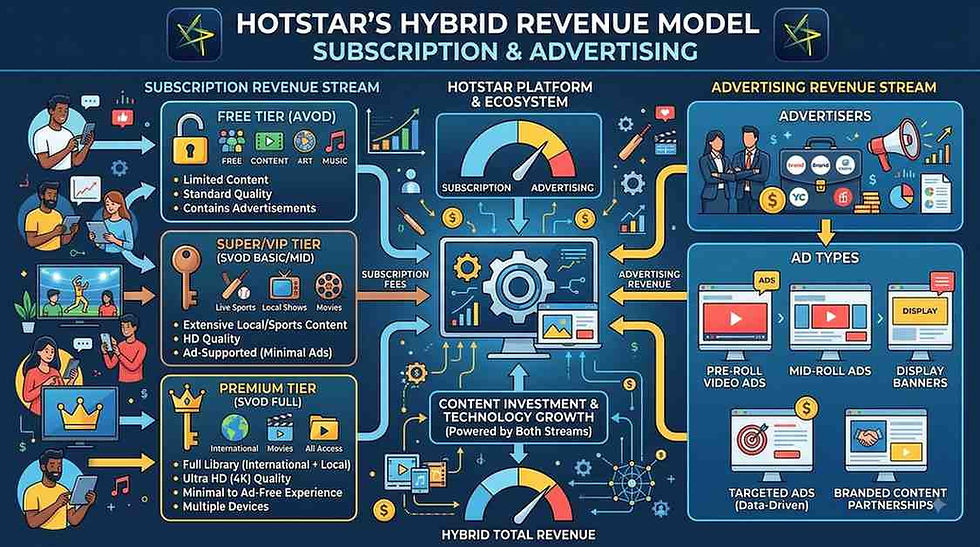
Facing subscriber attrition, a widening cost base driven by cricket rights spending, and pressure from Disney's global leadership to accelerate the streaming business's path to profitability, Disney+ Hotstar's India leadership under Sajith Sivanandan articulated an explicit strategic objective: shift the platform's primary revenue engine away from a single dependence on subscription fees and toward a dual-stream model in which advertising revenue, powered by mass free viewership, would work alongside a smaller, more resilient subscription base built around premium content and ad-free viewing on connected television. Sivanandan described the intent directly as building a model that would allow the company to drive two revenue streams more meaningfully, rather than relying on cricket exclusivity alone to sustain subscription growth. The objective was not to abandon subscriptions but to rebalance the platform's economics so that advertising, which could scale rapidly with free mobile viewership, would compensate for a subscriber base that had proven unwilling to sustain premium payments once cricket exclusivity was lost.
Campaign Architecture & Execution
The centerpiece of this pivot was Disney's decision to stream the 2023 Asia Cup and the ICC Men's Cricket World Cup free of charge, in standard definition, to mobile and tablet users in India, while continuing to reserve premium features such as high-definition viewing and connected television access for paying subscribers. This represented a direct reversal of the 2020 decision to paywall IPL cricket, and it consciously mirrored the free-streaming approach that JioCinema had used to build mass reach during the IPL. Disney retained the digital and broadcast rights to ICC tournaments from 2024 to 2027 through a rights renewal costing approximately three billion dollars, while licensing the television broadcast component to Zee Entertainment for approximately one and a half billion dollars, a structure that allowed Disney to concentrate its own commercial focus on digital advertising monetization. Execution extended beyond the free-access decision itself. Disney presented advertisers with a "Festival of Cricket 2023" pitch projecting that the World Cup could draw over four hundred fifty million viewers across the tournament's forty-eight days, and it set a target of fifty million peak concurrent viewers, a figure it ultimately exceeded. To make advertising more accessible to smaller marketers, the company lowered the entry threshold for ad campaigns to budgets as low as two hundred thousand rupees, widening the base of advertisers who could participate rather than relying solely on large national brands. The execution also included interactive ad formats that connected viewers to a brand's WhatsApp channel to enable direct purchases, and a subscription-conversion partnership with Coca-Cola in which QR codes placed on an estimated four hundred million Coke bottles offered a Hotstar trial, with an internal target of converting eighty thousand of those trials into paid subscriptions.
Positioning & Consumer Insight
The consumer insight underlying this pivot was that Indian streaming demand and Indian streaming willingness-to-pay are two structurally different behaviors that cannot be assumed to move together. Disney's own executives acknowledged internally that the company had overestimated Indian subscribers' propensity to pay, noting that consumers signed up for Hotstar specifically to access IPL cricket but did not remain as paying subscribers once that specific draw was unavailable or available elsewhere for free. This reframed the addressable opportunity: rather than treating India as a market where subscription revenue could scale in the manner of Disney's developed markets, Hotstar repositioned India as a market where the primary monetizable asset was attention at scale, captured through free access, and converted into revenue through advertising rather than direct payment. The positioning shift also carried a competitive dimension. Earlier in 2023, Disney had run advertising asserting that cricket was best watched on television, a message crafted to differentiate its TV rights holding from JioCinema's mobile-first free streaming approach. The subsequent decision to offer free mobile streaming represented an explicit repositioning away from that earlier message, with new campaign language stating that viewers could now watch tournament matches on mobile, anywhere, for free.
Media & Channel Strategy
Hotstar's channel strategy for the pivot centered on mobile as the primary access point for the free tier, reflecting the reality that a substantial share of India's cricket-viewing population accesses content on smartphones rather than television or larger connected devices. The company's own reporting to advertisers referenced a reachable smartphone base of roughly six hundred million users in India, framing the free mobile tier as the vehicle for maximizing advertising reach. Distribution was also supported by bundling arrangements, including earlier tie-ups with Reliance Jio that had allowed Jio's prepaid subscribers to access free or discounted Hotstar VIP subscriptions as part of data plans, a mechanism that had already demonstrated the platform's willingness to use telecom partnerships to expand its user base beyond direct subscription payment. Within the app itself, the channel architecture bifurcated by device and content tier: premium, ad-free, high-definition access remained gated behind subscription plans and was positioned toward connected television and long-form content consumption, while free, advertising-supported, standard-definition access was directed at mobile viewership of live sports.
Business & Brand Outcomes
The documented outcomes of this strategy are primarily viewership records rather than disclosed financial results, since Disney has not published India-specific revenue or profitability figures for the period after the fiscal year 2022 disclosure. During the 2023 World Cup, Disney+ Hotstar broke its own global concurrent viewership record four times within the tournament. Concurrent viewership progressed from thirty-five million during an India-Pakistan pool match to fifty-three million during the India-New Zealand semifinal, before reaching a peak of fifty-nine million concurrent viewers during the India-Australia final on November 19, 2023, which the company confirmed as a new global streaming record. Disney also reported that five hundred eighteen million Indian viewers watched World Cup matches across its television channels over the tournament's forty-eight days. These figures gave Hotstar a clear concurrency lead over JioCinema, which had peaked at thirty-two million concurrent viewers earlier in 2023. Despite these viewership outcomes, subscriber numbers continued to decline over the same broader period; Disney reported cumulative subscriber losses exceeding twenty-three million over the prior year even as the free-cricket viewership records were being set, illustrating that the strategy succeeded in driving reach and advertising-relevant scale without reversing the erosion of the paid subscriber base. In November 2024, Disney's India streaming and television operations, including Hotstar, were merged with Reliance's Viacom18 media assets to form a joint venture valued at approximately seventy thousand three hundred fifty-two crore rupees, or roughly eight and a half billion dollars, on a post-money basis. In that transaction, independent valuers assessed Disney+ Hotstar's digital business at a revenue multiple of three point eight one times, notably higher than the one point seven five times multiple applied to Star's traditional television business, indicating that despite subscriber attrition, external valuers placed a premium on the digital platform's underlying revenue-generating capacity, including its advertising base, relative to linear television. The merged entity subsequently launched as JioHotstar in February 2025, unifying Hotstar and JioCinema under a single platform and ending the standalone Disney+ Hotstar service examined in this case.
Strategic Implications
The Disney+ Hotstar experience illustrates the limits of subscription-first strategies in price-sensitive, sports-driven streaming markets, and the conditions under which a hybrid advertising-subscription model becomes not merely an optional revenue diversification but a structural necessity. The case demonstrates that content exclusivity, particularly cricket rights, can drive short-term subscriber acquisition without producing durable subscription retention if the underlying consumer relationship with the platform is transactional and event-specific rather than habitual. It further demonstrates that free, advertising-supported access can generate viewership scale and advertiser interest even while a platform's core subscriber metrics are deteriorating, suggesting that reach-based and payment-based value creation can move in different directions simultaneously within the same platform. The eventual absorption of Disney+ Hotstar into a Reliance-controlled joint venture also illustrates a broader strategic implication for global media companies operating in India: sustaining a capital-intensive, rights-dependent streaming business independently in a market defined by low willingness to pay may be less viable than consolidating scale, distribution, and advertising inventory with a domestic partner possessing complementary telecom and consumer reach. For streaming operators more broadly, the case suggests that hybrid revenue models are not simply a monetization tactic layered onto an existing subscription business, but often represent a fundamental repositioning of what the platform is monetizing, shifting the core value proposition from access-for-payment to attention-for-advertising, with subscription retained as a secondary premium layer rather than the primary revenue driver.
Discussion Questions
Under what market conditions does a shift from a subscription-first to an advertising-first revenue model represent sound strategic adaptation, and under what conditions might it signal an inability to build sustainable premium value?
Disney's internal assessment concluded that Indian consumers subscribed for cricket access specifically rather than developing broader platform loyalty. What does this suggest about the limits of using a single tentpole content category to build a multi-category subscription business?
Evaluate the decision to reverse the 2020 paywalling of cricket content by making the 2023 World Cup free. What are the risks of using pricing reversals as a competitive response, particularly regarding brand credibility and consumer price expectations?
Independent valuers assigned Disney+ Hotstar's digital business a higher revenue multiple than Star's television business despite significant subscriber losses. What does this valuation gap suggest about how the market assessed the long-term worth of advertising-supported digital reach relative to subscription revenue?
The Reliance-Disney merger consolidated two previously competing platforms, Hotstar and JioCinema, into a single entity. What are the strategic advantages and risks of resolving a hybrid-monetization competitive battle through consolidation rather than continued independent competition?


Comments