Hyperlocal Marketing: How Location Data Is Driving Sales in Real Time
Industry & Competitive Context
Hyperlocal commerce has emerged as one of the most significant shifts in digital retail and consumer services over the last decade. The model is built around fulfilling consumer demand within highly localized geographic zones through real-time logistics, inventory visibility, and location-enabled digital engagement. In India, the category expanded rapidly through food delivery, quick commerce, restaurant discovery, and on-demand retail platforms.
Public filings from Swiggy and Zomato show that the industry evolved beyond restaurant aggregation into broader “convenience ecosystems” integrating food delivery, grocery delivery, dining-out services, events, and hyperlocal logistics. Swiggy described itself in its FY2025 annual report as a “pioneer in hyperlocal commerce,” while Zomato’s investor disclosures positioned quick commerce as a major strategic growth driver.
The competitive landscape intensified as companies sought differentiation beyond discounts and assortment. Speed, relevance, and contextual engagement became critical. This led to increased investment in location intelligence, real-time operational data, and geographically targeted promotions. Hyperlocal marketing evolved from basic geographic segmentation into dynamic, real-time consumer targeting driven by traffic conditions, store inventory, rider availability, delivery radius optimization, and localized demand patterns.
Industry reports referenced in Swiggy’s Red Herring Prospectus highlighted that hyperlocal commerce categories are characterized by high purchase frequency, low transaction friction, and time-sensitive consumption behavior. The report further noted that digital ordering demand spikes during festivals, sporting events, and localized consumption occasions, creating strategic value for real-time location-based engagement.
Within this context, location data became not merely an advertising tool but a core operating capability linking consumer demand generation with fulfillment infrastructure.
Brand Situation Prior to Campaign
Swiggy entered the hyperlocal commerce category initially through food delivery and later expanded into quick commerce through Instamart, dining-out services through Dineout integration, and hyperlocal logistics.
According to Swiggy’s FY2025 annual report and corporate presentations, the company’s strategic challenge evolved alongside category maturation. Early-stage consumer acquisition in metro markets gradually shifted toward increasing order frequency, improving engagement, penetrating underserved geographies, and expanding usage occasions.
The company disclosed that roughly one-third of dark store additions in FY2025 occurred in new cities, including Tier 2 markets. Swiggy also stated that innovations such as Bolt and Instamart were designed to increase order frequency and create additional consumption occasions. This expansion required increasingly localized marketing execution because consumer demand patterns varied substantially across neighborhoods, city clusters, delivery windows, and usage occasions.
The challenge was operational as much as promotional. Hyperlocal commerce depends on matching consumer intent with local fulfillment capacity in real time. Traditional mass-media advertising could not efficiently address this requirement.
Swiggy’s investor materials repeatedly emphasized its “modular tech stack,” “hyperlocal network,” and “unified app ecosystem” as competitive advantages enabling rapid experimentation and localized engagement. These disclosures indicate that location-based targeting became embedded within the company’s broader growth strategy rather than functioning as a standalone campaign tactic.
Strategic Objective
The primary strategic objective in hyperlocal marketing was to increase transaction frequency and category penetration by connecting localized consumer demand with nearby supply infrastructure in real time.
Swiggy’s annual reports and investor presentations suggest four interconnected strategic priorities:
Expanding engagement across multiple use cases within the same geographic ecosystem.
Improving convenience perception through faster and contextually relevant fulfillment.
Increasing penetration in underserved and emerging urban markets.
Creating higher operational efficiency by aligning demand stimulation with local delivery capacity.
The broader objective was not simply customer acquisition but behavioral conditioning. Hyperlocal platforms aimed to integrate themselves into routine consumer decision-making by becoming immediately available during localized moments of need.
This strategic approach reflected an important shift in digital marketing economics. Rather than broadcasting broad category messaging, hyperlocal commerce platforms increasingly optimized for “moment relevance” — targeting consumers based on proximity, timing, inventory availability, and contextual triggers.
Campaign Architecture & Execution
Swiggy publicly described elements of its hyperlocal engagement architecture in annual reports, investor materials, and corporate presentations.
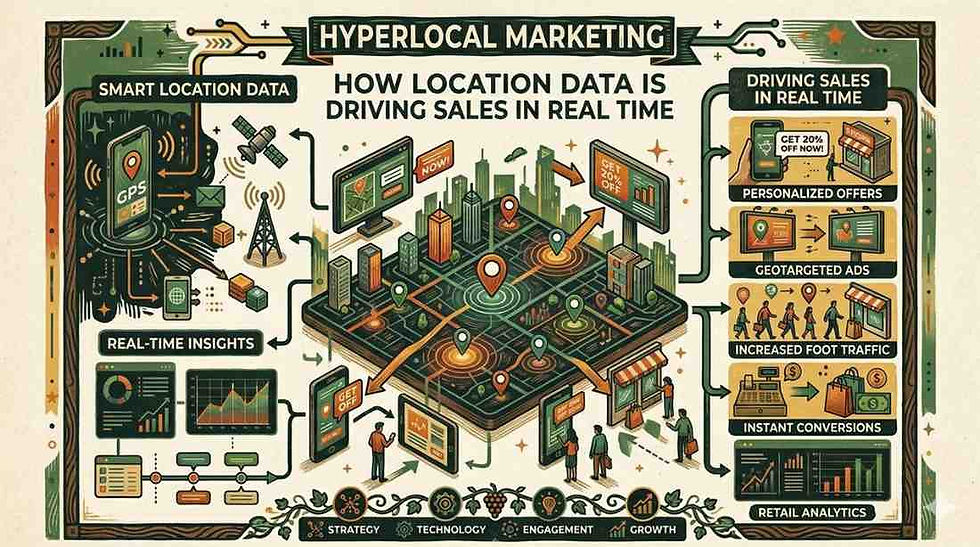
The company stated that its “hyperlocal engine” utilized location intelligence, delivery infrastructure, and operational data to drive customer engagement. Publicly available reports referenced the use of location-based notifications highlighting restaurants or Instamart stores currently operational within a user’s area.
The company also disclosed that real-time conditions such as rider availability, traffic conditions, and store inventory influenced consumer messaging and operational decisions.
This architecture reflects a tightly integrated marketing-operational system composed of several verified components:
Real-Time Geographic Targeting
Swiggy’s public materials indicate that promotions and visibility varied by location and delivery readiness. This enabled the company to market only those offerings that could realistically be fulfilled within operational thresholds.
The strategic significance of this model lies in reducing the gap between advertising promise and service delivery capability. Hyperlocal marketing therefore became deeply linked with operational reliability.
Expansion into New Consumption Occasions
Swiggy’s FY2025 disclosures highlighted the scaling of Bolt and quick commerce categories targeting “spontaneous” and “time-sensitive” purchases. This represented a deliberate effort to create new localized demand moments beyond traditional meal ordering.
The company’s reports specifically referenced impulse consumption categories, top-up grocery needs, and event-driven purchasing behavior.
Unified App Cross-Pollination
Investor presentations emphasized Swiggy’s strategy of using a unified app ecosystem to scale complementary services. This allowed the company to cross-promote food delivery, grocery delivery, dining reservations, and event services within the same geographic user base.
The strategic value of this model was that each additional service increased the relevance and frequency of location-triggered engagement opportunities.
Geographic Expansion
Swiggy stated that it expanded aggressively into new cities and underserved urban clusters. Public disclosures noted that many newly launched dark stores in emerging markets demonstrated performance potential comparable to metro locations.
This geographic diversification increased the importance of localized marketing intelligence because consumer density, purchasing patterns, and logistics economics varied substantially across regions.
Positioning & Consumer Insight
The positioning logic underlying hyperlocal marketing was fundamentally built around immediacy, convenience, and contextual relevance.
Industry reports cited in Swiggy’s prospectus identified several consumer behavior drivers shaping hyperlocal commerce adoption:
Time-sensitive purchasing behavior.
Increased demand for convenience-driven consumption.
Growth in spontaneous and event-driven ordering.
Preference for standardized digital experiences.
Higher comfort with frequent low-value transactions.
Swiggy’s positioning consistently emphasized “speed,” “reliability,” and “everyday convenience.” Importantly, this positioning was reinforced operationally through localized delivery infrastructure and geographically optimized fulfillment systems.
Consumer insight in hyperlocal marketing differs materially from traditional demographic segmentation. The relevant variable is often not who the consumer is, but where the consumer is, what nearby infrastructure exists, and whether fulfillment can occur within a narrow time window.
This creates a form of “contextual demand marketing” in which relevance is determined dynamically rather than statically.
Public disclosures from Swiggy also suggest that the company recognized the increasing fragmentation of consumption moments. Food ordering, grocery replenishment, impulse snacking, and event-driven purchases became separate micro-occasions requiring distinct hyperlocal engagement strategies.
Media & Channel Strategy
Verified public information indicates that hyperlocal commerce platforms relied heavily on app-based engagement ecosystems supported by localized digital communication.
Swiggy’s annual reports and presentations referenced:
Push notifications.
Personalized discovery experiences.
Localized offers.
In-app engagement mechanisms.
AI-led service innovation.
Unified cross-category app experiences.
The company also emphasized the importance of digital visibility in underserved markets and emerging cities.
No verified public information is available on Swiggy’s detailed media allocation strategy, paid advertising mix, or proprietary targeting algorithms.
However, public disclosures confirm that digital channels were tightly integrated with fulfillment infrastructure and consumer behavior data.
This represents a broader strategic evolution in media planning. Hyperlocal marketing increasingly merges media delivery with operational systems, creating closed-loop engagement environments where inventory, logistics, and communication interact continuously.
Business & Brand Outcomes
Swiggy’s public disclosures provide several documented outcomes associated with its hyperlocal commerce expansion strategy.
According to the FY2025 annual report:
B2C Gross Order Value increased 33% year-on-year to INR 46,549 crore.
Quick commerce scaled to over half the size of the food delivery business within four years.
Instamart Gross Order Value reached INR 14,683 crore in FY2025.
Dark store footprint expanded to 4 million square feet.
The company added nearly 2 million average monthly transacting users.
Bolt scaled to over 500 cities within six months of launch.
Dineout achieved profitability according to company disclosures.
Swiggy also reported that approximately one-fifth of its customer base was engaging with expanded category assortments enabled by larger dark stores.
Investor presentations further stated that the company operated across:
7,181 cities for food delivery.
1,241 cities for Instamart.
561 cities for dining-out services.
These results indicate that hyperlocal engagement strategies supported both geographic expansion and category diversification.
No verified public information is available on campaign-level conversion rates, customer acquisition costs, lifetime value metrics, or attribution models specifically linked to hyperlocal marketing initiatives.
Strategic Implications
The rise of hyperlocal marketing demonstrates a broader transformation in how digital platforms create competitive advantage.
Historically, digital marketing focused heavily on audience targeting through demographics, interests, and behavioral segmentation. Hyperlocal commerce introduced a new strategic variable: operational proximity.
In this model, marketing effectiveness depends not only on communication quality but also on fulfillment capability within specific geographic microzones. This creates tighter integration between operations, logistics, inventory management, and consumer engagement.
Swiggy’s public disclosures suggest that competitive advantage increasingly derives from the ability to coordinate:
Local supply density.
Delivery infrastructure.
Real-time operational data.
Consumer demand prediction.
Cross-category engagement.
This integration creates barriers that are difficult to replicate through advertising alone.
The case also illustrates how location data has evolved from a tactical advertising input into a strategic infrastructure asset. In hyperlocal commerce, location intelligence influences assortment visibility, promotional timing, delivery feasibility, and user experience simultaneously.
Another important implication is the shift from broad-based consumer acquisition toward frequency optimization and occasion expansion. Hyperlocal marketing seeks to increase the number of consumption moments captured within existing geographic ecosystems.
Finally, the case highlights the growing convergence between marketing and operations. In hyperlocal commerce, the distinction between “promotion” and “service delivery” becomes increasingly blurred because consumer expectations are tied directly to fulfillment speed and contextual relevance.
MBA Discussion Questions
How does hyperlocal marketing differ strategically from traditional digital performance marketing?
In what ways does location data create sustainable competitive advantage in hyperlocal commerce?
How can companies balance operational efficiency with highly localized consumer personalization?
What organizational capabilities are required to integrate marketing, logistics, and real-time fulfillment systems effectively?
As hyperlocal commerce expands into smaller cities and new categories, what risks could emerge regarding scalability and profitability?


Comments