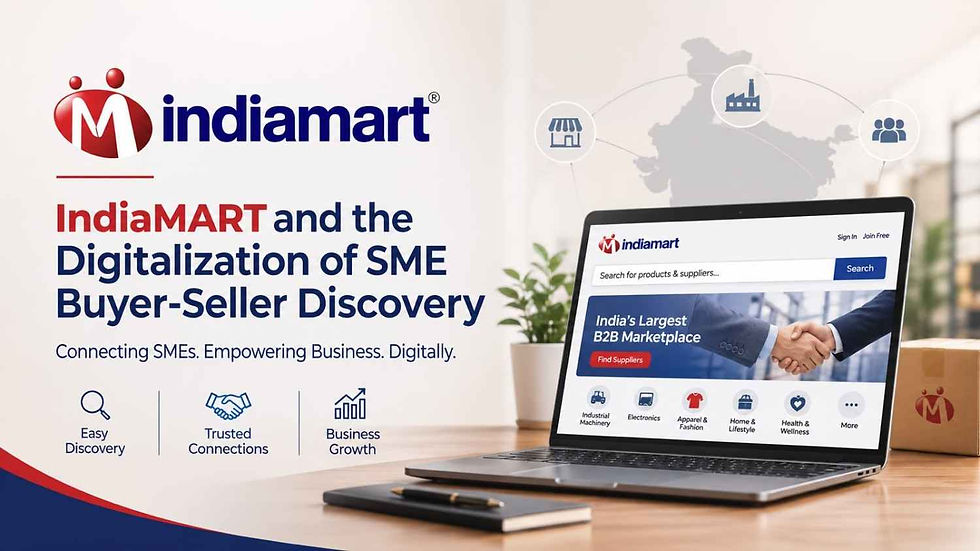
IndiaMART and the Digitalization of SME Buyer-Seller Discovery
Industry & Competitive Context
India’s micro, small, and medium enterprise (MSME) sector has historically transacted through fragmented, relationship-based channels: trade fairs, local associations, word-of-mouth referrals, and printed trade directories. Buyer-seller discovery in this market was slow, geographically limited, and difficult to scale, particularly for smaller manufacturers who lacked the capital or sales infrastructure to reach buyers beyond their immediate region. This fragmentation created a structural opportunity for a digital intermediary that could aggregate supply and demand information at scale.
IndiaMART InterMESH Limited was founded on April 1, 1996, by cousins Dinesh Agarwal and Brijesh Agrawal, at a time when India had an estimated 15,000 internet users. The company began as a web-based directory and website-development service, listing Indian manufacturers and exporters for international buyers. Its early business model was export-oriented, reflecting the limited domestic adoption of internet commerce in the late 1990s and early 2000s.
By the late 2010s, IndiaMART had become India’s largest online B2B marketplace by listings and supplier base. According to a 2019 KPMG estimate cited around the time of its public listing, the company held approximately 60 percent share of the Indian B2B marketplace category. Its competitive set, as described in Indian business press coverage from 2020 onward, included global entrants such as Amazon and Alibaba, Flipkart’s wholesale arm, domestic peers TradeIndia and ExportersIndia.com, and beginning in late 2020 Justdial, which announced plans to launch a direct B2B competitor called JD Mart.
Separately, industry research from RedSeer on India’s broader electronic B2B (eB2B) market has estimated the category at roughly $5–6 billion in 2022, with projections to reach $90–100 billion by 2030 at a 40–45 percent compound annual growth rate, driven substantially by retailer-replenishment platforms such as Udaan, which the same report credited with 55–60 percent share of that retailer-led segment. This retailer-restocking segment is distinct from IndiaMART’s core discovery-and-lead-generation model connecting manufacturers, wholesalers, and institutional buyers, and the RedSeer report referenced does not name IndiaMART specifically; it is included here only to illustrate the scale of digitalization occurring across adjacent segments of India’s B2B commerce landscape.
Brand Situation Prior to Campaign
Unlike a conventional brand case built around a single advertising campaign, IndiaMART’s relevant “campaign” is better understood as a two-decade platform and business-model evolution: from an export-focused directory to a domestic lead-generation marketplace, and subsequently into a broader SME software and services ecosystem.
Around 2008–09, IndiaMART shifted its strategic focus from export-oriented listings toward the domestic Indian market. This repositioning was prompted by two external shocks: rupee appreciation between 2005 and 2007, which reduced the competitiveness of Indian exporters relying on the platform, and the 2008–09 global financial crisis and accompanying US recession, which depressed export demand. This pivot is a documented inflection point in the company’s history and represents the moment IndiaMART began building the domestic buyer-seller discovery model that defines its business today.
The company’s growth was supported by successive institutional funding rounds: investment from The Times Group and Intel Capital, reported in January 2009; reported discussions with Warburg Pincus around a ₹150 crore investment in 2011; and a Series C round from Amadeus Capital Partners and Quona Capital in March 2016, intended to scale both the core IndiaMART platform and its then-subsidiary Tolexo. The company also made an investment in ProcMart in 2016 and led a Series A funding round in the accounting software company Vyapar in 2019.
By FY20, per figures attributed to UBS in Indian business press coverage from October 2020, IndiaMART reported approximately 150,000 paid subscribers (representing about 2.5 percent of its total listings), over 68 million product listings across 100,000 categories, and FY20 revenue of approximately $90 million. Its monetization model at that time and one that continues to characterize the platform was a freemium structure: free basic listings for suppliers, paid lead generation, and a paid premium subscription tier offering enhanced visibility and buyer-lead access.
Strategic Objective
IndiaMART’s publicly stated strategic objective, articulated by founder and CEO Dinesh Agarwal in company communications reported in March 2023, was to double revenue from a run-rate of approximately ₹1,000 crore to ₹2,000 crore by 2027. Agarwal described the underlying growth algebra explicitly: customer (paid subscriber) growth of 15–20 percent per annum combined with average revenue per user (ARPU) growth of 5–7 percent per annum, yielding an approximate 25 percent revenue CAGR and, in his words, a revenue-doubling cycle of every four to five years.
This objective rested on three stated levers: increasing ARPU among existing paying suppliers, expanding into new product and industry categories, and growing the overall base of paid subscribers particularly in underpenetrated geographies beyond India’s top metros. At the time, 55–57 percent of paying customers were concentrated in the top eight metros, and the company identified Bengaluru, Hyderabad, and Kolkata, along with deeper Tier II supplier penetration, as expansion priorities.
A second, parallel strategic objective was diversification beyond the core discovery-and-lead-generation business into adjacent SME software and services accounting, logistics technology, and distribution management on the premise that SMEs already using IndiaMART for buyer discovery represented a captive audience for complementary digital tools.
Campaign Architecture & Execution
The execution of this strategy took the form of a sustained acquisition and investment program rather than a conventional marketing campaign. Per reporting from March 2023, IndiaMART had deployed over ₹900 crore across roughly 14 companies in the preceding two to three years. Named acquisitions and investments in this program include Zimyo (HR technology), Fleetx (AI-enabled freight and logistics technology), Shipway (shipping and delivery tracking), and Busy Infotech.
The Busy Infotech transaction is the most material and well-documented component of this diversification. IndiaMART agreed in January 2022 to acquire 100 percent of Busy Infotech, a GST-compliant accounting software provider, for approximately ₹500 crore; the acquisition was completed in April 2022. In the same period, IndiaMART made a further investment of ₹61.55 crore into Vyapar’s Series B round, a separate accounting-software company in which it had led the earlier Series A. In May 2024, the company was also reported to hold a 10 percent stake in IDfy, a know-your-customer (KYC) verification provider a logical adjacency given IndiaMART’s need for supplier verification and trust infrastructure on its marketplace.
On the core platform side, execution involved extending the product beyond passive discovery into transactional capability, including a “Pay with IndiaMART” payment facilitation feature and deeper integration with logistics and order-tracking partners, with management indicating without providing full detail publicly a future mix of subscription and transaction-based revenue.
Analyst commentary from the period contextualizes the financial trajectory of this strategy: ICICI Securities estimated that revenue from IndiaMART’s new (non-core) businesses would rise from approximately 0 percent of total revenue in FY22 to approximately 10 percent by FY25 (estimated), while Motilal Oswal projected a 23 percent revenue CAGR for the company between FY23 and FY25.
Positioning & Consumer Insight
IndiaMART’s enduring positioning, reflected in Dinesh Agarwal’s own public characterization of the platform, is captured in his widely quoted remark: “If you can’t find something on IndiaMart, you won’t find it on the internet.” This statement, made in the context of the company’s response to rising competition in 2020, reflects a positioning built on exhaustiveness and incumbency the idea that IndiaMART’s scale and first-mover advantage (24 years of operating history as of 2020) made it the default destination for B2B sourcing in India, regardless of category.
The underlying insight guiding the company’s SME-facing value proposition was that Indian MSMEs face a persistent demand-generation problem: they lack the capital, sales infrastructure, and digital marketing sophistication of larger enterprises, and a platform that could supply qualified buyer leads addressed a core operational pain point rather than a discretionary marketing want. This is reflected in the freemium model itself free listings lower the barrier to initial adoption, while paid lead-generation subscriptions monetize suppliers only once they experience tangible buyer interest, aligning platform revenue with perceived supplier value.
The parallel insight behind the diversification into accounting and logistics software was that SMEs already trusting IndiaMART for buyer discovery represented a lower-acquisition-cost audience for adjacent operational software, consistent with Agarwal’s description of the accounting category as a potential “billion-dollar market” opportunity for the company.
Media & Channel Strategy
Public documentation of IndiaMART’s channel strategy is limited primarily to its core digital platform rather than traditional media or advertising campaigns. The principal “channel” is the IndiaMART marketplace itself, comprising supplier storefronts, buyer search and request-for-quotation functionality, and a lead-distribution mechanism to paying suppliers. No verified public information is available on specific advertising campaigns, media spend, or creative executions associated with IndiaMART’s brand marketing during this period.
What is documented is platform scale as a distribution mechanism: by FY24, the company reported approximately 119 million product listings across 56 industry groups and 98,000 product categories, serving more than 8 million sellers and 211 million buyers on the platform. By FY25, the company reported 8.4 million supplier storefronts (up 6 percent year-on-year) and 27 million unique business enquiries (up 10 percent year-on-year), indicating that buyer-side engagement, rather than paid advertising, functioned as the primary growth channel for supplier acquisition and retention.
Business & Brand Outcomes
Financial outcomes through FY25 provide the clearest documented evidence of the strategy’s results. In FY24, IndiaMART reported consolidated revenue of ₹1,196 crore (approximately $120 million) and net income of ₹334 crore (approximately $35 million), with a workforce of 5,384 employees. In FY25, consolidated revenue from operations rose to ₹1,388 crore, a 16 percent year-on-year increase, with standalone EBITDA of ₹513 crore at a 39 percent margin.
Quarterly results for Q4 FY25 showed consolidated revenue of ₹355 crore, up from ₹315 crore in the prior-year quarter (a 13 percent increase), with standalone revenue of ₹336 crore (up 12 percent) and Busy Infotech subsidiary revenue of ₹18 crore (up 28 percent). Net profit for the quarter was ₹181 crore at a 39 percent margin, with operating cash flow of ₹271 crore and customer collections of ₹541 crore (up 12 percent year-on-year). The company’s balance sheet as of March 31, 2025, showed cash and investments of ₹2,885 crore and deferred revenue of ₹1,678 crore, up 17 percent year-on-year a figure of particular relevance for a subscription-based business, as deferred revenue represents future revenue recognition from subscriptions already billed to suppliers. The board approved a total dividend for FY24–25 of ₹50 per share, comprising a ₹30 final dividend and a ₹20 special dividend.
On subscriber metrics, paid supplier counts grew from 150,000 in FY20 to 156,000 in Q3 FY22, 194,000 in Q3 FY23, and 217,000 by Q4 FY25 (an increase of approximately 2,100 from the prior quarter). ARPU was reported at ₹48,000 in Q3 FY22 and ₹49,400 in Q3 FY23. As of Q3 FY23, 90-day repeat buyer rates stood at 54 percent, and industrial plants and machinery, together with construction and raw materials, represented the largest paying-subscriber category shares at approximately 8 percent each.
It is also material to note a documented regulatory concern: since 2018, the Office of the United States Trade Representative (USTR) has included IndiaMART on its “Notorious Markets” list, citing reports of counterfeit products and illegal pharmaceutical listings on the platform a recurring reputational and governance issue for a marketplace operating at this scale with relatively limited per-listing verification. Separately, in November 2020, IndiaMART filed suit against Justdial in the Delhi High Court alleging copyright infringement related to website compilations, in connection with Justdial’s planned JD Mart launch indicating that the company has used legal, as well as commercial, mechanisms to defend its competitive position.
Strategic Implications
IndiaMART’s documented trajectory illustrates several strategic principles relevant to platform businesses serving fragmented, underdigitized customer bases. First, the company’s pivot from an export-oriented directory to a domestic lead-generation marketplace in 2008–09 demonstrates the value of strategic flexibility in response to macroeconomic shocks: rather than persisting with a structurally disadvantaged export model after rupee appreciation and the global financial crisis, the company redirected its core value proposition toward a market with greater addressable scale.
Second, the freemium-to-paid-subscription model free listings paired with paid, performance-linked lead generation reflects a monetization approach well suited to price-sensitive, risk-averse SME customers: it defers payment until suppliers can observe tangible demand signals, likely lowering adoption friction relative to upfront subscription or advertising-fee models.
Third, the acquisition-led diversification into accounting software (Busy Infotech, Vyapar), logistics technology (Fleetx, Shipway), HR technology (Zimyo), and KYC verification (IDfy) represents a platform strategy of expanding wallet share within an existing, trusted customer base rather than pursuing new customer acquisition in adjacent markets a strategy that carries integration risk (evidenced by the sizable ₹900 crore-plus committed capital) but potentially lower customer-acquisition cost than entering entirely new markets independently.
Fourth, the company’s sustained profitability and cash generation a 39 percent EBITDA margin and substantial deferred revenue balance in FY25 stand in contrast to the cash-burn profiles common among venture-backed Indian internet platforms during the same period, suggesting that a scaled, incumbent lead-generation marketplace with high switching costs for paying suppliers (sunk marketing spend, established buyer relationships) can sustain durable profitability even as the company invests in new growth vectors.
Finally, the USTR “Notorious Markets” listing is a reminder that platform scale and profitability do not eliminate trust and safety liabilities; marketplaces built on wide, lightly verified seller onboarding carry recurring reputational exposure that can affect regulatory relationships and international buyer confidence even as domestic financial performance remains strong.
Discussion Questions
IndiaMART’s 2008–09 pivot from an export-focused directory to a domestic-focused marketplace was prompted by rupee appreciation and the global financial crisis. What does this episode suggest about the risks of building a platform business around a single macroeconomic tailwind, and how should platform strategists design for resilience against such external shocks?
The company’s freemium model monetizes suppliers only once they begin receiving buyer leads. What are the trade-offs of this performance-linked pricing approach compared to flat subscription or pay-per-listing models, particularly as the supplier base scales into the millions and the platform’s own lead-quality claims become harder to independently verify?
IndiaMART committed over ₹900 crore to acquiring and investing in roughly 14 adjacent businesses (accounting, logistics, HR technology, and KYC) over two to three years. Evaluate this diversification strategy against the alternative of reinvesting that capital entirely into core marketplace growth (ARPU expansion, Tier II penetration, new industry categories). Under what conditions is platform-adjacent diversification the superior capital allocation choice?
The USTR has listed IndiaMART as a “Notorious Market” since 2018 due to reported counterfeit and illegal pharmaceutical listings. How should a marketplace of IndiaMART’s scale balance the commercial incentive to maximize open, low-friction supplier onboarding against the reputational and regulatory costs of inadequate listing verification?
IndiaMART’s stated growth algebra 15–20 percent annual paid-subscriber growth combined with 5–7 percent annual ARPU growth, yielding roughly 25 percent revenue CAGR assumes continued expansion into Tier II geographies and new industry categories, where paying-customer concentration (55–57 percent from the top eight metros) remains uneven. What organizational capabilities or go-to-market changes would be required to replicate metro-level subscriber economics in less digitally mature Tier II and Tier III markets?


Comments