Kajaria Bathware's Brand Expansion Strategy Beyond Tiles
Industry & Competitive Context
Kajaria Ceramics Limited, founded in 1985 and headquartered in New Delhi, is India's largest ceramic and vitrified tile manufacturer, commanding roughly 25% share of the organised domestic tile market (StockAxis Research, 2021). The Indian tile industry has historically been cyclical, tracking residential and commercial real-estate activity, and increasingly fragmented by low-cost, high-volume manufacturing clusters such as Morbi, Gujarat.
Adjacent to tiles sits India's bathware ecosystem sanitaryware and faucets which analysts describe as large but comparatively unorganised. Independent market-research estimates place the India Bath Fittings Market at roughly USD 11.49 billion in 2025, growing at a 7.74% CAGR to reach USD 16.67 billion by 2030, and the India Faucet Market at USD 1.89 billion in 2026, growing at 7.12% CAGR to USD 2.66 billion by 2031 (Mordor Intelligence, 2025–2026). The domestic faucetware industry alone was estimated at roughly ₹110 billion, growing faster than sanitaryware over FY17–FY21 (Prabhudas Lilladher Sector Report, 2023).
Competitively, the bathware category is led by Jaquar Group (~25% share; ₹7,493 crore turnover and 45.9 million units in FY 2024–25), followed by Hindware (~20%) and Cera Sanitaryware (~18%), alongside Parryware (Roca Group), Kohler, TOTO, RAK Ceramics, Simpolo, Duravit and Somany's own bathware line (Medium/Harshita Soni, 2024; Mordor Intelligence Faucet Market Report, 2026). This is the competitive field Kajaria entered as a comparatively late mover, using its tile-business scale an extensive dealer network and established brand recall as its point of entry.
Brand Situation Prior to Campaign
Kajaria's core tile business had, according to its own FY2023–24 Integrated Annual Report, "transformed the Kajaria brand into a household name," built through sustained investment in advertising and India's largest tile product portfolio. However, this strength was concentrated almost entirely in one category: tiles accounted for approximately 88% of consolidated revenue in FY23, with all non-tile categories combined bathware, plywood and laminates contributing the remaining ~12% (Screener.in company data, citing FY23 results).
The bathware entry was structured through a step-down subsidiary, Kajaria Bathware Private Limited (KBPL), which is approximately 85% owned by Kajaria Ceramics Limited, with the remaining ~15% held by Aravali Investment Holdings, Mauritius a wholly owned subsidiary of WestBridge Crossover Fund, LLC (StockAxis Research, 2021; ICRA Rating Rationale for KBPL). KBPL commissioned a sanitaryware manufacturing facility in Morbi, Gujarat with a capacity of 7 lakh (700,000) pieces per annum in August 2014, and a faucet manufacturing facility at Gailpur, Rajasthan, which commenced commercial production in July 2015 with an initial capacity of 1 million pieces per annum (later reported at 1.6 million pieces per annum in Kajaria's June 2025 Corporate Presentation). The bathware brand created under this structure was named Kerovit. A further wholly owned operating entity, Kerovit Global Private Limited, functions as a subsidiary of KBPL and step-down subsidiary of Kajaria Ceramics Limited (ICRA, 2023).
Strategic Objective
The earliest publicly stated objective for the brand-building push appears in a December 2017 announcement of Kerovit's first major marketing campaign. Rishi Kajaria, then Joint Managing Director of Kajaria Ceramics Limited and now Managing Director of Kajaria Bathware, stated the company's aim to become "amongst the Top 5 players in the sanitary ware and bath solutions market by 2020" and to "double our topline by 2020" (Exchange4media, December 2017). A subsequent 2019 campaign announcement reiterated this ambition, stating Kerovit "aims to double its top line" (BestMediaInfo, September 2019).
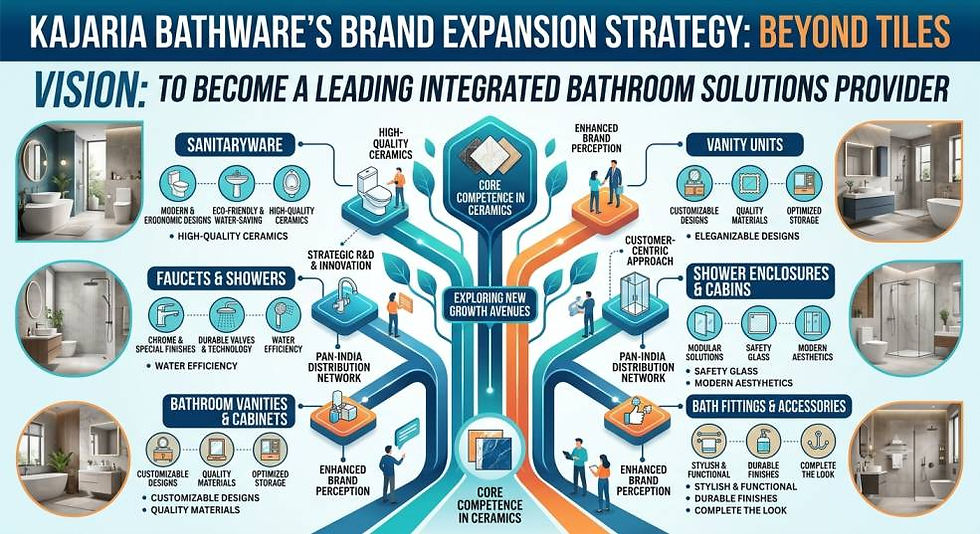
At the group level, industry commentary and investor material frame the broader objective as reducing dependence on the cyclical tile category by diversifying into complementary, higher-margin home-solution categories bathware, plywood/laminates and tile adhesives thereby capturing a larger share of spend on any single construction or renovation project (Tradebrains, 2026; Kajaria Ceramics FY2023–24 Integrated Annual Report). Kajaria's own Q3 FY24 investor update lists a "higher focus on premium sanitaryware and faucets" among its stated growth enablers.
Campaign Architecture & Execution
Kerovit's brand-building has been executed in clearly documented phases:
2017 Launch phase. Kajaria Bathware launched Kerovit's first major "360-degree marketing campaign," engaging Bollywood actress Anushka Sharma as brand ambassador (Exchange4media, December 2017).
2019 "Freedom 2.0." Kerovit released a follow-up brand campaign with Anushka Sharma, timed to Ganesh Chaturthi, spanning digital, outdoor, television and cinema, and credited to agency Crayons Advertising/Crayons Communications, whose Executive Creative Director Rondeep Gogoi was quoted describing the "Kerovit is Freedom" idea as "a massive idea and therefore extendable" (BestMediaInfo, September 2019).
2021 "Freedom 3.0." Actor Ranveer Singh was engaged as an additional brand ambassador in October 2021, joining Anushka Sharma in a new TVC titled "Freedom 3.0." Rishi Kajaria described Kerovit's brand personality as "young, bold, and lively," possessing an "Everyman" archetype intended to be "relatable, friendly and approachable" (Exchange4media; afaqs; Indian Retailer all December 2021).
2026 "Log Toh Poochenge Hi." Actress Rashmika Mandanna joined Ranveer Singh as a new brand ambassador in a campaign integrating messaging for both Kajaria's tile business and Kerovit bathware within a single narrative-led television commercial. Rishi Kajaria (now MD, Kajaria Ceramics Limited) stated the objective was to "elevate the brand conversation towards emotion and brand ownership while showcasing modern design and uncompromised quality," positioning the combined portfolio as a "complete premium home solutions" offering (Rishi Kajaria, LinkedIn, and Campaign India, both dated 2026).
Alongside media campaigns, Kajaria has built an integrated retail format "Kajaria Eternity World" showrooms that physically co-locates premium Kajaria Eternity tiles and Kerovit bathware products. The company's 100th such showroom, spanning 11,000 sq. ft. in Lajpat Nagar, Delhi, and described by the company as India's largest, opened in September 2022, divided into a Kerovit-themed zone and a GVT-tiles zone, and designed to double as a "resource centre" staffed by professionals who advise customers on bathroom design (Indian Retailer, September 2022).
Kajaria's Q3 FY24 investor update (January 2024) discloses that branding spend runs at approximately 3% of revenue and states that Kajaria is the "only tile company to rope in two brand ambassadors for brand building."
Positioning & Consumer Insight
Across the 2017–2021 campaign cycle, Kerovit's positioning was anchored to a single consumer insight, expressed through the tagline "Kerovit is Freedom" — the idea that the bathroom is the space where an individual feels most free to express emotion, identity and personal style (afaqs, December 2021). This insight was aimed explicitly at a youth demographic, per company statements that the campaigns sought to "capture the imagination of the youth" (Exchange4media, December 2021).
The 2026 campaign reflects an evolved insight, articulated by Rishi Kajaria: "Today's consumers see their homes as an expression of identity, and Kajaria's tiles and Kerovit... bathware play a central role in enabling that aspiration" (Campaign India, 2026). This marks a documented shift from positioning Kerovit as a stand-alone youth-oriented bath brand toward positioning it as one component of a unified, identity-driven "home solutions" narrative co-branded with the parent Kajaria tile business.
Media & Channel Strategy
Documented channels include television (TVC), digital, outdoor and cinema advertising, executed as "360-degree" campaigns (BestMediaInfo, 2019). The creative agency of record for at least the 2019 campaign was Crayons Advertising (BestMediaInfo, 2019).
On distribution, Kajaria leverages the parent company's dealer network to cross-sell bathware: an ICRA credit-rating note (2023) records a pan-India network of 1,840 dealers and 10,000 touchpoints for Kajaria Ceramics Limited, which it states supports KBPL's market access. A March 2026 equity-research note (Arihant Plus) references "over 1,900 exclusive tile dealers across the country" as "a natural cross-selling engine" for bathware.
Business & Brand Outcomes
Revenue. KBPL reported standalone operating income of approximately ₹334 crore in FY2023 (ICRA Rating Rationale, 2023). At the consolidated Kajaria Ceramics level, bathware quarterly revenue stood at ₹103 crore in Q3 FY26, up 9% year-on-year (Arihant Plus, March 2026).
Category mix. Tiles accounted for approximately 88% of consolidated revenue in FY23, with bathware, plywood and other non-tile categories together contributing the remaining ~12% (Screener.in, citing FY23 results).
Capacity investment. In January 2022, the Kajaria Bathware board approved an investment of up to ₹80 crore in Kerovit Global Private Limited to convert it into a wholly owned subsidiary and to set up an additional sanitaryware manufacturing facility with capacity of 6 lakh (600,000) pieces per annum in Gujarat, targeted for completion by March/April 2024 (Kajaria Ceramics Q3 FY24 Investor Update, January 2024).
Retail footprint. The Kajaria Eternity World showroom format reached its 100th store, in Delhi, by September 2022 (Indian Retailer).
Governance disclosure. In December 2025, Kajaria Ceramics disclosed that Dilip Kumar Maliwal, Chief Financial Officer of Kajaria Bathware Private Limited, had committed fraud over a period of approximately two years through embezzlement and unauthorised diversion of funds at Kerovit Global Private Limited, reportedly using forged senior-management signatures and a fabricated vendor entity during a capital-expenditure and vendor-onboarding process. The estimated amount involved was approximately ₹20 crore, discovered during a systems/vendor-onboarding audit tied to an internal initiative described as "Kajaria 2.0." A criminal complaint was filed with the Economic Offences Wing of Delhi Police on 18 December 2025; Maliwal was terminated with immediate effect; approximately ₹0.6 crore had been recovered as of early January 2026, and the company stated full recovery was "not possible" (Moneylife, Business Standard, BusinessToday, December 2025–January 2026). Brokerage estimates placed the fraud at approximately 6.6% of Kajaria Ceramics' consolidated FY24–25 net profit of ₹300 crore, and roughly 15% of the company's most recent quarterly profit of ₹134 crore at the time of disclosure (Moneylife, December 2025). Brokerages including PL Capital and Emkay Global characterised the event as a "governance negative" with limited expected impact on medium-term earnings; PL Capital retained a "Hold" rating while cutting its target price from ₹1,288 to ₹1,083 per share (Business Standard, January 2026).
Strategic Implications
Kajaria's documented actions indicate a deliberate category-adjacency strategy: extending from a single, cyclical product category (tiles) into complementary home-solution categories (bathware, and separately plywood/laminates and adhesives) in order to increase revenue capture per construction or renovation project and reduce reliance on real-estate-cycle-driven tile demand (Tradebrains, 2026; Kajaria Ceramics Integrated Annual Report, 2023–24). The execution approach mirrors the playbook used to build the core tile brand sustained above-the-line advertising anchored by national celebrities rather than an organic, distribution-only entry, suggesting that Kajaria viewed brand-led awareness-building as necessary to compete against entrenched category leaders such as Jaquar, Hindware and Cera.
The sequencing of ambassador engagements a single ambassador in 2017, expansion to two ambassadors from 2021, and a refreshed ambassador pairing in 2026 spans roughly nine years and four distinct campaign phases, indicating sustained, iterative brand investment in bathware rather than a one-time launch push. The integration of Kerovit's messaging into a joint tile-and-bathware narrative in the 2026 "Log Toh Poochenge Hi" campaign is a notable architectural shift, moving Kerovit from a semi-independent brand voice toward a unified "complete home solutions" master-brand positioning under Kajaria.
Finally, the December 2025 fraud disclosure at Kerovit Global is a documented governance event relevant to case discussion: it illustrates a risk that can accompany rapid, multi-layered subsidiary structures (Kajaria Ceramics → Kajaria Bathware → Kerovit Global) used to execute diversification, and highlights the tension between the speed of category expansion and the maturity of internal financial controls at newly scaled subsidiary entities.
Discussion Questions
Kajaria pursued bathware diversification through a multi-layered subsidiary structure (Kajaria Ceramics → Kajaria Bathware → Kerovit Global) rather than direct in-house operation. What are the brand-management and governance trade-offs of this structure, as illustrated by the 2025 fraud disclosure?
Kerovit's positioning evolved from a stand-alone "Kerovit is Freedom" youth brand (2017–2021) to an integrated "complete home solutions" narrative co-branded with Kajaria tiles (2026). What strategic and financial conditions might justify shifting from a house-of-brands to a branded-house architecture at this stage of category maturity?
Kajaria discloses branding spend of approximately 3% of revenue and states it is the "only tile company" to use two brand ambassadors simultaneously. Evaluate whether celebrity-led brand building is an efficient strategy for entering a category (bathware) where market leaders like Jaquar and Hindware have decades of category-specific brand equity.
Using the documented category-mix data (tiles ~88% vs. non-tile categories ~12% of FY23 revenue), assess whether Kajaria's bathware diversification has meaningfully reduced its dependence on the cyclical tile business to date, and what additional disclosures would be needed to evaluate this more rigorously.
The Kajaria Eternity World showroom format physically integrates tiles and Kerovit bathware under one roof. What does this retail-format decision suggest about Kajaria's view of cross-category customer decision-making in home renovation, and what risks might arise from bundling a new, less-established brand's retail presence with an established one's?


Comments