Kansai Nerolac Paints: The "Ghar Ki Raunak" Strategy — Leveraging Heritage, Emotion, and the Family Insight in a Disrupted Market
- 14 minutes ago
- 12 min read
Industry & Competitive Context
The Indian paint industry is one of the country's most strategically contested consumer goods sectors. As of 2025, it remains dominated by four large-scale producers — Asian Paints, Berger Paints, AkzoNobel, and Kansai Nerolac — though the competitive landscape has been disrupted by the emergence of new entrants including Birla Opus, JSW Paints, and Pidilite Industries, all subsidiaries of large business conglomerates with deep financial pockets, established distribution networks, and familiarity with wholesale and retail business.
This structural disruption has intensified competitive pressure precisely when Nerolac was seeking to sharpen its brand narrative. Competitive realignment in 2025 has been expected to intensify as current market leaders do their utmost to defend their share, while new entrants attempt to gain market share at the expense of established companies. Kansai Nerolac Paints Limited (KNPL) is principally engaged in the manufacturing of paints and is a market leader in industrial coatings. The company is a subsidiary of Kansai Paints Co. Ltd., Japan, from whom it continuously gets support and guidance in improvement of quality standards and technology upgrades. Financially, the company reported revenue of ₹8,052 crore and profit of ₹576 crore, with promoter holding at 75%. The decorative paint segment, which carries higher margins and greater brand sensitivity than industrial coatings, has historically been the arena in which Nerolac has been most challenged to differentiate itself from the market leader, Asian Paints. In the 1990s Indian paint industry, Nerolac had a predominant proportion of sales in the industrial paint segment and a minor proportion from the decorative paint segment. Higher margins were in the lucrative decorative paint segment and its competitor, Asian Paints, dominated this segment. While Nerolac has grown its decorative presence significantly since then, the asymmetry in brand equity between the two has been a persistent strategic challenge.
Brand Situation Prior to Campaign
Nerolac's communication history is inseparable from its most famous asset: the "Jab Ghar Ki Raunak Badhani Ho" jingle. After first being aired in 1990, the jingle enjoyed high recall, which was only reinforced by the famous "Painters" ad created by Draft FCB Ulka in 1998. The jingle, which was sung by Bollywood playback singer KK and associated with a visually warm depiction of painters transforming a family's home, became one of the most recalled pieces of sonic branding in Indian advertising history. Research has consistently shown that the jingle is one of the core brand assets that Nerolac owns in the consumer's mind — people knew every word of the jingle even when it had not been on air for many years. The brand's celebrity strategy evolved over time. Shah Rukh Khan was appointed as the ambassador of Kansai Nerolac Paints in 2010. His appearance endorsed the brand to a higher level. Ranveer Singh is the current brand ambassador, roped in to increase popularity with a new face. The jingle itself was periodically revived: in 2015, Nerolac revived the original jingle "Jab ghar ki raunak badani ho..." with two new TVCs featuring brand ambassador Shah Rukh Khan — one made for Durga Puja and the other for Diwali. According to Nerolac's then director of decorative paints, "Our research shows that consumers still have a strong connect with the jingle. However, if we continue its use, the interest level goes down. Taking it off and bringing it back after some time creates recall and excitement." This periodic revival strategy reflects an understanding that nostalgia is a depletable resource — one that must be rationed and refreshed rather than continuously spent. By 2025, the brand found itself at another inflection point: a new celebrity ambassador had been installed, competition had intensified, and consumer culture had shifted markedly toward digital fragmentation and individual screen-time behaviour within family households. At the same time, Nerolac had been building its digital and service infrastructure. The company expanded its Nerolac NxtGen Shoppe to more than 80 stores at country level, increased digital marketing spend substantially resulting in increased website traffic and lead generation, and connected with 5,000+ architects in its 'Illuminati' programme. The company also won three notable media awards for its 'Har Din Diwali' campaign: a Gold award from e4m Maddies, a Gold Award from Mobexx, and a Silver award from MMA Smarties. Prior to the 2025 campaign, the brand therefore presented a mixed profile: strong industrial heritage, an iconic but intermittently deployed jingle asset, a digital-first push underway, a new celebrity ambassador, and a competitive context that demanded a clearer consumer-facing brand story.
Strategic Objective
The 2025 campaign, as publicly stated by Nerolac and its creative agency FCB Ulka, pursued two interlocking objectives.
The first was brand legacy management: to bring the iconic jingle back in a form that felt contemporary, thereby preserving its nostalgic equity while making it legible to younger consumers and families who had not grown up with the original. As Managing Director Pravin Chaudhari stated in the campaign press release: "The Nerolac jingle has always been more than just a catchy tune — it's a feeling. It brings back memories of home, warmth, family, and togetherness. By bringing it back in a fresh new way, we're not just celebrating our legacy — we're making sure it connects with today's generation too."
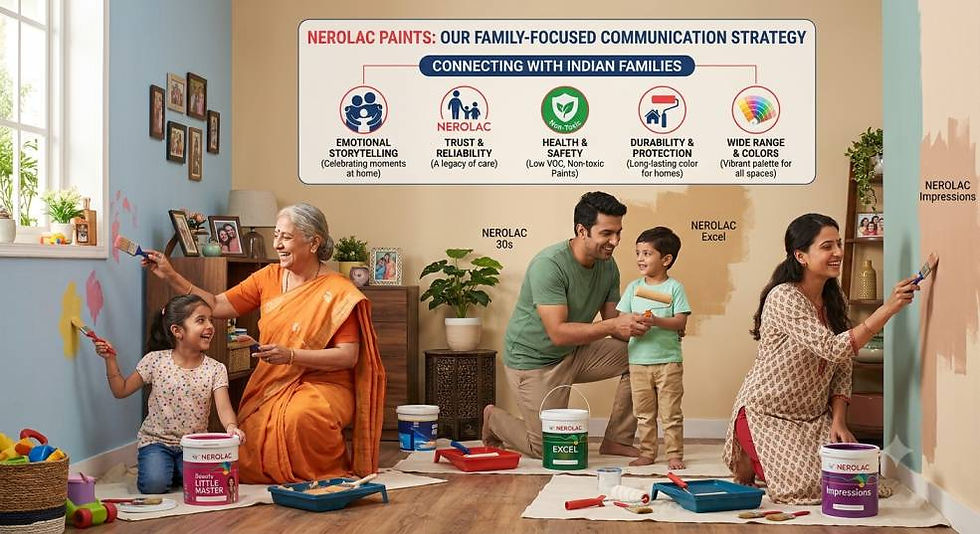
The second objective was to reclaim emotional relevance in the category. The creative brief, as articulated by FCB Ulka's Digital Creative Partner Kartikeya Tiwari, was rooted in a specific behavioural insight: "Family members under one roof are spending time in isolation, hidden behind doors and screens. So, 'Make the living rooms come alive again' became the creative brief."
Together, these objectives positioned the campaign as simultaneously backward-looking (reviving heritage) and forward-looking (diagnosing a contemporary social problem). This dual-temporal positioning is strategically significant: it allowed Nerolac to speak to multiple consumer cohorts — those with nostalgic attachment to the original jingle and those encountering the brand fresh — without fragmenting the campaign into separate executions.
Campaign Architecture & Execution
The campaign, titled "Ghar Ki Raunak Lautani Ho", was launched on September 18, 2025, developed in partnership with FCB Ulka — one of India's longest-standing advertising agencies and Nerolac's partner of several decades. The pivot from the original line "Jab Ghar Ki Raunak Badhani Ho" (When the home's vibrancy is to be enhanced) to "Ghar Ki Raunak Lautani Ho" (The home's vibrancy needs to be brought back) represents a single-word substitution that fundamentally reframes the brand's relationship to the consumer's problem. By changing just one word, FCB Ulka sought to create a pause, a nudge, a smile — and hopefully remind people that while trends may come and go, the joy of togetherness will be timeless. The word "Badhani" (to enhance/grow) implies forward aspiration; "Lautani" (to bring back/return) implies loss and recovery. The shift in verb encodes an entire diagnostic: something once present in the home has receded, and Nerolac is the agent of its restoration. This is a more emotionally urgent proposition than mere home beautification. The television commercial featured Ranveer Singh entering the life of an everyday Indian family. In the TVC, Ranveer steps into the life of an everyday Indian family whose home has lost a bit of its charm, with members spending time by themselves. Using Kansai Nerolac's wide range of products, he helps them rediscover joy, warmth, and togetherness through a stunning home evolution. The film beautifully weaves the emotional bond between families and their homes, emphasised by the unforgettable Nerolac tune that generations have grown up humming. The creative production was handled by Mangata Films, directed by Karan Kapadia and produced by Ashi Dua. The campaign credits confirm cross-functional depth: the FCB Ulka team included senior leadership across creative (Vishal Nicholas, Chandrashekhar Dey, Paresh Jadhav), account management (Abhimanyu Juneja, Ricky Barretto, Shivam Dave), strategy (Akhil Vadan), and national planning (Ajay Ravindran), with overall oversight from CEO Kulvinder Ahluwalia and Group CEO Dheeraj Sinha. The choice of a TVC-first execution is consistent with Nerolac's historical media approach. Television has long been the primary medium through which the jingle achieves mass recall — its power is acoustic as much as visual, and broadcast television remains the most effective channel for audio-led brand memory in India's diverse market.
Positioning & Consumer Insight
The campaign represents a sophisticated deployment of what marketing scholars sometimes call "cultural insight" positioning — where the brand's message is anchored not in product attributes but in an observable sociological shift in consumer behaviour. The insight — that co-resident family members are increasingly spending time in isolation from each other, retreating behind individual screens and physical boundaries within the shared home — is not a Nerolac invention. It reflects a widely observed phenomenon accelerated by smartphone proliferation, streaming media, and remote-work culture. What is strategically notable is Nerolac's decision to name this problem publicly and position the physical act of home repainting as a catalyst for its resolution. This moves the brand out of the conventional decorative paint territory of aesthetics, durability, or value and into the more emotionally resonant domain of family relationships. A freshly painted home, in this framing, is not merely more visually appealing — it is a shared project that reactivates family bonds, makes common spaces feel inviting again, and signals investment in collective life. The product becomes a means to a relational, not merely aesthetic, end. The celebrity casting reinforces this positioning. Ranveer Singh's public persona — energetic, inclusive, and associated with exuberance rather than exclusivity — is well-suited to the role of a catalytic outsider who enters a family's emotional stasis and disrupts it constructively. As Singh himself stated in the campaign press release: "Walls of our homes are silent witness to our laughter, our stories, and the bonds we build as a family. That spirit of togetherness and celebration is what Kansai Nerolac has always stood for." The decision to frame Ranveer as a brand ambassador who "carries the legacy forward," in the words of the Managing Director, also signals a careful intergenerational bridging strategy. As Pravin Chaudhari noted, "His ability to connect with people of all ages makes him the ideal choice to carry this very legacy forward." The tension the campaign must navigate is one common to nostalgia-based marketing: the risk that the revived jingle is received as backward-looking at precisely the moment the brand needs to appear innovative. Nerolac's historical solution to this — acknowledged explicitly by its own research director — has been to refresh the jingle's instrumentation and context while preserving its harmonic identity. The 2025 execution extends this approach by changing the lyrical meaning of the jingle's title phrase itself, making the nostalgia argumentatively functional rather than merely sentimental.
Media & Channel Strategy
What can be established from the company's own annual report disclosures is Nerolac's broader media orientation in FY 2023–24. The company increased digital marketing spend substantially, resulting in increased website traffic and lead generation, and won three notable media awards for its 'Har Din Diwali' campaign: a Gold award from e4m Maddies, a Gold Award from Mobexx, and a Silver award from MMA Smarties. The "Har Din Diwali" campaign, which preceded the 2025 initiative, was documented by InMobi — a technology partner on the campaign — as having used location-based targeting, high personalization, and an immersive rich media interstitial on mobile, aimed at connecting digital-first consumers with local dealers. Leveraging InMobi Audiences, the brand identified Diwali-celebrating Indians aged between 24 and 44 years from major cities and engaged them on their favorite music, utility, and news apps. This prior campaign's architecture — using digital targeting to bridge national brand campaigns with local dealer networks — indicates that Nerolac's media strategy has been evolving toward performance marketing integration alongside traditional brand-building television. Historically, Nerolac has also invested in outdoor advertising and experiential media. As documented in industry media, the company has used outdoor brand communication in specific marketing campaigns as a display medium rather than plain messaging, including murals painted across the country including at the Kumbh Mela, and brand installations at airports. The company has also maintained a content presence via a website, YouTube channel, and social platforms on Facebook, Instagram, and Twitter. The broader pattern that emerges is a media philosophy that combines high-reach television for emotional brand narratives with digitally precise targeting for conversion and dealer linkage. The 2025 jingle revival appears structurally consistent with this bifurcated approach — a TVC-led national emotional campaign, likely supported by digital amplification, though the latter's specifics are not publicly confirmed.
Business & Brand Outcomes
What can be established from the company's public financial disclosures is the broader trajectory of the business. As of 2024, the company made a revenue of ₹77.42 billion, a marginal increase over the revenue of ₹77.28 billion in 2023. The company's current trailing twelve-month (TTM) revenue stands at ₹84.69 billion. From the FY 2024–25 Directors' Report, the company noted continued strategic investments in service infrastructure: Nerolac expanded its NxtGen Painting Services to over 250 towns, positively impacting a broader ecosystem of consumers, painters, and channel partners. Premium Wood Coating and Construction Chemicals segments sustained strong performance. The project business also maintained its growth momentum in FY 2024–25. The earlier "Har Din Diwali" campaign provides the closest available data point on what Nerolac's integrated campaigns can achieve in measurable terms — earning three industry awards across platforms — but no directly comparable outcome data for the 2025 family campaign is in the public domain.
Strategic Implications
The Depletable Asset Problem in Sonic Branding
The Nerolac jingle case illustrates a fundamental tension in brand heritage management. A sonic or creative asset with very high unprompted recall can become over-associated with a past era rather than a living brand if deployed continuously. Nerolac's documented approach — of deploying the jingle intermittently, allowing it to recede, then reviving it — reflects an implicit theory of nostalgia economics: that emotional memory appreciates when it is not constantly drawn upon. The deliberate scarcity of the jingle maintains its value as a periodic event in Indian advertising culture rather than ambient background noise. The 2025 revival goes further by changing the semantic content of the jingle's most famous phrase, not just its production values. This represents a strategic evolution from reviving a memory to redirecting one — preserving the trigger while updating the argument it makes.
From Aesthetics to Relationships: The Category Redefinition Play
Decorative paint has traditionally been marketed on functional and aspirational dimensions — durability, colour range, premium finish, and the social recognition that comes from a well-maintained home. Nerolac's 2025 campaign attempts to shift the category's emotional territory from individual aspiration to collective relationship. This is a genuine category positioning move, not merely a campaign theme. By arguing that the home's "raunak" (vibrancy/liveliness) has receded because of screen-mediated isolation within families, and that repainting the home can catalyse its return, Nerolac is implicitly competing not just with other paint brands but with the broader cultural forces of digital distraction. It is a bold — if unverifiable in outcomes — strategic claim. The risk is that the product-to-outcome causal chain is tenuous. There is no established consumer belief that painting one's home together reliably rebuilds family togetherness. However, in emotional brand communication, aspiration frequently precedes behaviour, and the act of home renovation is itself a recognized marker of household reinvestment.
Celebrity as Cultural Bridge
The transition from Shah Rukh Khan to Ranveer Singh as brand ambassador is commercially significant and strategically coherent. Both actors occupy a particular position in Bollywood's cultural landscape: broadly appealing, associated with large-scale popular entertainment, and able to project warmth and family connectivity rather than exclusivity. The choice of Ranveer Singh specifically for the jingle revival campaign — rather than a purely product-performance TVC — reflects an understanding that the brand needs an ambassador whose energy can animate a nostalgic property for a younger audience without irony. Ranveer Singh's own stated positioning for the campaign — that walls are witnesses to a family's shared life — aligns the celebrity persona with the campaign's core insight in a way that is documented and attributable, reflecting intentional brief alignment rather than incidental endorsement.
The Integrated Distribution-Communication Challenge
What distinguishes Nerolac's documented media evolution — particularly the "Har Din Diwali" campaign's use of location-based mobile targeting to connect brand communication to local dealers — is the attempt to close the loop between emotional brand narrative and the fragmented, contractor-and-painter-driven distribution system through which most paint is actually sold in India. As Nerolac has publicly acknowledged, contractors and painters are the most important influencers in the purchase decision, even if it is ultimately made by end-users. The strategic implication is that a family-emotion campaign, however well-received, operates at only one level of the purchase influence chain. For brand communication to deliver commercial outcomes, it must work in tandem with trade marketing, painter loyalty programs, and digital tools that bridge awareness to point-of-sale behaviour. The FY 2024 annual report's reference to AI being used to enhance painter loyalty and engagement suggests Nerolac is building this capability layer, though the specific mechanisms are not publicly detailed.
Managing Competitive Exposure During Reinvention
The entrance of well-capitalised new competitors — Birla Opus, JSW Paints — into the decorative segment creates particular urgency for heritage brands like Nerolac to assert emotional distinctiveness at the moment of heightened category salience. New entrants can compete on price, distribution expansion, and feature parity, but they cannot replicate a 35-year-old jingle that generations of Indian consumers associate with the most emotional moments of home life. In this sense, Nerolac's decision to lean into its sonic heritage as a differentiator during a period of competitive disruption reflects a strategically sound allocation of the brand's most defensible asset.
Discussion Questions for MBA Students
1. Nostalgia as a Strategic Tool Nerolac has revived its "Jab Ghar Ki Raunak" jingle at multiple points across different decades. What are the conditions under which nostalgia-based campaigns create genuine brand equity versus merely generating short-term recall? How should a brand decide when to revive a heritage asset and when to retire it?
2. Category Redefinition Risk The 2025 campaign positions home painting as a solution to family disconnection driven by screen overuse. Evaluate the strategic logic and the risks of this positioning: when does emotional category expansion strengthen a brand, and when does it create a credibility gap between the product and the promised outcome?
3. Two-Level Influence Markets Nerolac publicly acknowledges that painters and contractors, not end consumers, are the primary purchase influencers in the paint category. If this is true, what is the strategic purpose of family-emotion consumer campaigns? How should the ROI of such campaigns be evaluated differently than campaigns in a direct-to-consumer category?
4. Celebrity Brand Architecture Nerolac has employed Amitabh Bachchan, Shah Rukh Khan, and Ranveer Singh sequentially as brand ambassadors. Analyse the strategic logic of this progression. What does each choice signal about the brand's target consumer at the time, and what risks does heavy celebrity dependency create for long-term brand equity management?
5. Heritage Brands Under Competitive Disruption With well-funded new entrants (Birla Opus, JSW Paints) entering the Indian decorative paint market, how should Kansai Nerolac prioritise its response? Is leaning into brand heritage and emotional communication the right strategic posture, or should resources be redirected toward distribution expansion, pricing competitiveness, and product innovation? What framework would you apply to make this allocation decision?

Comments