TradeIndia's SME Marketplace Model: From Digital Directory to Full-Stack B2B Ecosystem
Industry & Competitive Context
India's B2B digital marketplace sector occupies a structurally significant position in the country's economic architecture. India has over 63 million micro, small, and medium enterprises (MSMEs), which collectively contribute approximately 30% of GDP and account for nearly 45% of total exports. Yet despite this scale, the vast majority of these enterprises have historically discovered buyers and suppliers through personal networks, physical trade fairs, and intermediary brokers — channels defined by geography, opacity, and high transaction friction. The digital penetration of B2B commerce has lagged substantially behind consumer e-commerce, leaving a market that is simultaneously massive and structurally underserved. Within this landscape, the competitive structure at scale is effectively a duopoly. IndiaMART, which completed India's first B2B marketplace IPO in 2019, commands the dominant position. TradeIndia — operated by Infocom Network Pvt. Ltd. and remaining privately held — is the second major platform and the most direct competitive alternative. As documented in Inc42's coverage of IndiaMART's IPO, IndiaMART explicitly identified tradeindia.com as a direct competitor in its public filings, alongside Alibaba India. This two-player dynamic means the competitive contest is not merely about listings volume; it is about which platform can more credibly claim the role of operating infrastructure for Indian SME commerce, rather than a simple discovery tool. A second layer of competition comes from Alibaba's cross-border ambitions targeting Indian exporters, and from the structural threat posed by Amazon Business entering the B2B procurement space. Additionally, the emergence of vertical-specific B2B platforms — focused on sectors such as chemicals, textiles, or industrial components — creates category-level competition that breadth-first platforms must respond to through depth or differentiation. The MSME credit gap, estimated by Avendus Capital at $530 billion, and the finding that only approximately 14% of MSMEs have formal access to credit (per a 2022 Blinc Invest report), define not merely a social problem but a strategic inflection point for any platform that can credibly embed financial services into its commerce flows.
Company Situation Prior to Strategic Pivot
TradeIndia's origins predate the commercial internet. Infocom Network Pvt. Ltd. was established in 1990, initially publishing the Exporters Yellow Pages — a print directory connecting Indian exporters and manufacturers with international buyers. This offline infrastructure, launched on 7 September 1990 per Wikipedia's documented record, was the foundational product of what would become a digital platform: it built habits of reliance among the MSME trade community long before digital alternatives existed. In 1996, founder Bikky Khosla transitioned the business online with the launch of tradeindia.com, making it one of India's earliest digital B2B commerce infrastructure plays. The company received its first and, per available public records, only documented external funding in 2001, when Vinod Khosla — an Indian-born Silicon Valley venture capitalist and elder brother of Bikky Khosla — invested $1.7 million in Infocom Network Ltd. This early capital injection, documented on Wikipedia, anchored the platform's initial digital scale-up phase. The platform's early model was classically directory-oriented: businesses listed themselves and their products across categories, enabling buyers to discover suppliers. The revenue mechanism was a subscription-based listing model. By the early part of the following decade, TradeIndia claimed to be the first Indian B2B portal to cross 3 million registered users, of which over 2 million were SMEs — a milestone documented on Wikipedia and the platform's own communications. However, the structural gap between registered users and actively transacting businesses was a defining challenge of the category, not unique to TradeIndia. In 2009, the company launched two vertical portals: SME Times, a news-based media property edited by Bikky Khosla himself, and a China supplier section. The former is strategically significant: it reflects an early recognition that owning a content and information channel adjacent to trade gave the platform a trust and advocacy moat that pure-directory competitors could not easily replicate. Khosla's concurrent roles as platform founder and trade media editor represent an intentional brand-building strategy rooted in authentic sector expertise. By the time IndiaMART went public in 2019, TradeIndia faced an intensified strategic imperative. IndiaMART's IPO signalled the maturation of the B2B digital marketplace category and the crowding of the discovery-and-leads model as a competitive differentiator. The question for TradeIndia was whether a privately held, subscription-revenue platform could sustain a viable strategic identity against a now-public, aggressively scaling competitor without either matching IndiaMART's field sales intensity or finding a structural differentiation beyond the directory model.
Strategic Objective
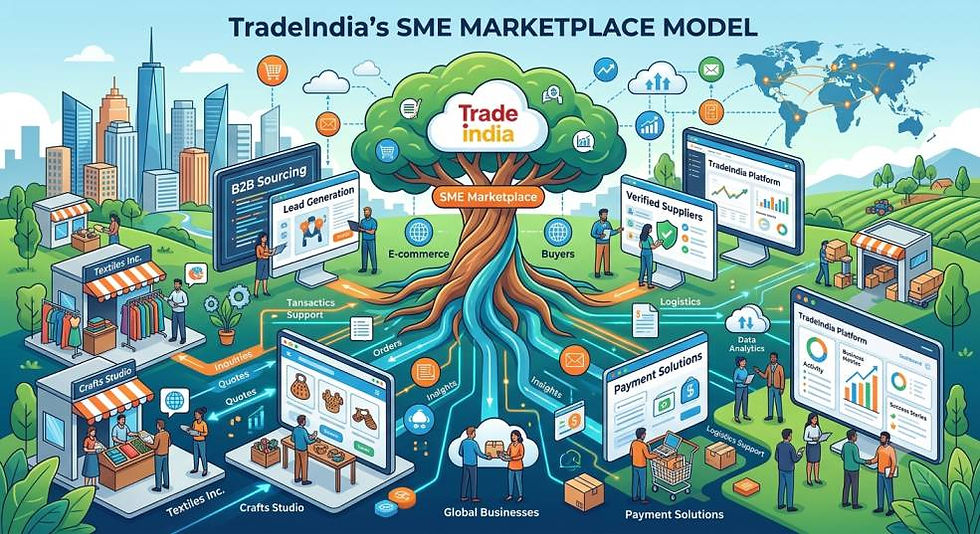
The strategic objective that emerges from TradeIndia's sequence of publicly documented moves is legible even in the absence of an explicitly stated corporate strategy document: to evolve from a B2B discovery marketplace — where value is transactional and easily replicated — into an integrated MSME operating platform, where value is embedded across the SME's commercial lifecycle and switching costs compound over time. This objective unfolds across three distinct but interconnected dimensions. The first is product stack extension: moving from pure catalogue and lead-generation services toward invoicing, payments, and credit — the operational plumbing of an SME business. The second is positioning differentiation: explicitly claiming the identity of a "360-degree digital marketing solutions" provider for MSMEs, as stated in the company's official About Us page, rather than positioning as a search or discovery utility. The third objective was geographic and segment expansion — reaching MSMEs in Tier 2 and Tier 3 cities, where the majority of India's manufacturing and trading base resides but where digital adoption remained lower.
Together, these objectives reflect a platform strategy shift from "marketplace as listing service" to "marketplace as growth infrastructure" — a move with significant implications for pricing architecture, partnership strategy, and brand positioning.
Campaign Architecture & Strategic Execution
TradeIndia's strategy unfolded through a series of publicly announced capability additions across multiple layers, each addressing a distinct pain point in the MSME commercial lifecycle.
Layer 1 — Payments and Invoicing Infrastructure (TradeKhata, 2020). The most operationally significant early step was the development of TradeKhata, a business accounting and invoicing tool for SMEs. In November 2020, TradeIndia announced a partnership with Cashfree — a payments and banking technology company — to integrate digital payment collection via UPI, credit cards, and internet banking into the TradeKhata platform. The official press release, distributed through IBEF and covered by The Week and other media, documented that this integration was designed to enable 5.5 million SMEs on the platform with digital payments. The same release noted that even during COVID-19 pandemic restrictions, the TradeIndia platform had accumulated a transactional invoice value of Rs. 1,800 crore (approximately $242 million), demonstrating the scale of commerce flowing through the network even before formal payment integration.
Layer 2 — Embedded Credit (TI Lending, 2022). In July 2022, TradeIndia announced the launch of TI Lending, described in the official press release distributed through CXOToday and covered by PYMNTS, Financial Express, and YourStory as India's first digital lending solution purpose-built for SMEs in a B2B marketplace context. The product offered collateral-free business loans up to Rs. 50 lakh (approximately $67,000) with a stated disbursal turnaround of 24 hours and zero paperwork. TradeIndia partnered with RBI-licensed lenders including ICICI Bank, Mintifi, Indifi, Flexiloans, IIFL Finance, Electronica Finance Limited (EFL), and MoneyWide to provide the credit. In January 2023, TradeIndia announced that TI Lending had disbursed loans totalling more than Rs. 500 million (approximately $6.7 million) in its first six months of operation, having received over 50,000 loan applications during that period. Aditya Shankar, Vertical Head of Lending at TradeIndia, was quoted in YourStory projecting a target of Rs. 2.5 billion in disbursements in the following financial year — a 5x stated growth ambition.
Layer 3 — Dedicated Lending Subsidiary (TradeUdhaar, 2023). In May 2023, TradeIndia announced the launch of TradeUdhaar, a 100%-owned subsidiary focused on unsecured working capital loans for MSMEs. As documented in the official press release distributed through Global Fintech Series and covered by YourStory, TradeUdhaar offered loan amounts ranging from Rs. 50,000 to Rs. 50,00,000 with a stated disbursement turnaround of 48 hours and a simplified paperless application. The transition from a bank-partnership model (TI Lending) to a subsidiary model (TradeUdhaar) reflects a deliberate deepening of the credit capability stack, moving from facilitated access to owned delivery.
Layer 4 — Institutional and Government Partnerships. TradeIndia built a documented portfolio of institutional partnerships that extended its credibility and reach. Per Wikipedia's entry on TradeIndia, the company signed a Memorandum of Understanding with the Korea International Trade Association (KITA) to promote SMEs, and in April 2013 signed a further MoU with Thailand's Department of International Trade Promotion (DITP) under the Ministry of Commerce of Thailand, to boost Indo-Thai bilateral trade. Additionally, per an official press release documented in SME Times and Morningstar India, TradeIndia announced its designation as a Google Premier SME Partner — granting co-marketing access and enabling SME advertisers on its platform to run campaigns across Google's advertising products with support from Google-certified account management teams.
Layer 5 — Lending Technology (Biz2X Integration, 2022). In September 2022, TradeIndia integrated Biz2X's Maadhyam digital lending platform to provide an omni-channel, multi-lender loan processing capability, as covered by IBS Intelligence and BFSI News. This technology integration automated the underwriting and credit processing workflows underlying TI Lending, providing infrastructure scalability for the credit business.
Positioning & Consumer Insight
TradeIndia's positioning is built around a consumer insight that has strategic depth. The Indian MSME does not merely need a buyer-supplier connection — it needs an integrated operating partner that understands the cash flow, compliance, and credibility challenges unique to small business ownership in India's informal and semi-formal trade economy. The platform's brand narrative, as stated on its official About Us page, positions it as "the only marketplace offering 360° digital marketing solutions to MSMEs to help them be tech-enabled." This framing is a deliberate departure from a pure-discovery or pure-transaction model. The "360-degree" positioning signals intent to own the full commercial lifecycle of an SME — from digital presence and product listing through to payment collection, invoicing, credit access, and trade intelligence. CEO Sandip Chhettri's public comment at the launch of TI Lending, quoted in PYMNTS and the Financial Express, captures this insight with precision: "This made us introspect if we could be a one-stop solution for the SMEs, where we go beyond providing access to a marketplace by also supporting them in raising funds to meet their next big order." The insight is that the marketplace's incumbent relationship with SMEs — forged through years of listing and lead generation — creates a privileged channel for delivering adjacent services that SMEs would otherwise source from disconnected, less-informed providers. Bikky Khosla's parallel role as editor of SME Times adds a dimension that is unusual in platform strategy: the founder is simultaneously a media voice for the trade community he serves. This positions TradeIndia not just as a commercial infrastructure provider but as a sector advocate — a posture that builds earned trust among a constituency that is historically sceptical of digital platforms and underserved by formal institutional channels.
Media & Channel Strategy
What is publicly documented is a channel architecture with three primary components. The first is a field sales network: TradeIndia operates branch offices across 35-plus cities in India, as documented on Wikipedia and the company's own official communications. This field presence functions as both a sales engine and a trust-building mechanism in markets where digital-first businesses have historically struggled to win SME confidence without human intermediation. The second is institutional and platform partnerships: the Google Premier SME Partner designation enables TradeIndia to offer its advertising SME clients a formal pathway to Google AdWords, while also providing TradeIndia with co-marketing credibility from a globally trusted technology brand. The lending partnerships with ICICI Bank and other RBI-licensed entities serve a dual function — they provide financial product infrastructure while also lending regulatory legitimacy to the credit offering. The third is event participation: per documented corporate practice on tradeindia.com and Wikipedia, the company regularly participates in domestic and global trade shows and organises its own trade events (such as the documented Consumer Goods Expo in 2021). This channel reaches high-intent manufacturers, exporters, and importers who are active in trade but may be less digitally reachable.
Business & Brand Outcomes
The following outcomes are drawn exclusively from publicly disclosed or officially reported data.
On platform scale, TradeIndia's official App Store listing and LinkedIn company profile document a registered user base exceeding 10 million, with the company's own communications during the July 2022 TI Lending announcement citing 7.5 million registered users at that moment — indicating continued growth through the period. The Cashfree partnership announcement in November 2020 cited 5.5 million registered SMEs on the platform at that time. The company's official About Us page references presence in more than 10 countries and a pan-India branch network.
On the lending business, the most precise documented outcome is the Rs. 500 million (approximately $6.7 million) in loans disbursed within the first six months of TI Lending's launch, having received over 50,000 loan applications in that period, as announced in an official press release in January 2023 and covered by YourStory, Financial IT, and TICE News. This constitutes the only verified, publicly disclosed outcome metric for the lending initiative.
On operational indicators, the Cashfree partnership release documented a transactional invoice value of Rs. 1,800 crore (approximately $242 million) processed through TradeIndia during the COVID-19 lockdown period — a figure cited by the then-COO of TradeIndia, Sandip Chhettri, in official communications distributed through IBEF.
Strategic Implications
The platform vertical integration thesis. TradeIndia's documented trajectory — from print directory (1990) to web directory (1996) to invoicing tool (TradeKhata) to digital payments (Cashfree, 2020) to credit (TI Lending, 2022) to owned lending subsidiary (TradeUdhaar, 2023) — mirrors what platform economics scholars describe as vertical integration of the commercial stack. Each added service layer deepens switching costs for the SME. A business that sources buyers, generates invoices, collects payments, and accesses credit through a single platform faces substantially higher friction in migrating to a competitor than one that merely receives trade leads. The strategic logic is that low-margin discovery services become defensible when layered beneath higher-margin financial services that rely on the same trust relationship.
The MSME credit gap as competitive moat. The $530 billion MSME credit gap, as cited by Avendus Capital and referenced in TradeIndia's own official communications, is not merely a fintech opportunity — it is a marketplace loyalty mechanism. A lender that is simultaneously a marketplace has an asymmetric information advantage over standalone banks or NBFCs: it can underwrite against transaction history, buyer-seller relationships, and platform behaviour rather than solely on collateral or formal financial statements. This is precisely the rationale articulated by Aditya Shankar, Vertical Head of Lending at TradeIndia, in the January 2023 YourStory interview: "being one of the oldest B2B e-commerce platforms with over 3 decades of experience, we understand SMEs' business, transactions and behavior more than any other lender." Whether this underwriting advantage is realised in practice is a question that awaits publicly available data.
Private ownership as a strategic variable. TradeIndia's continued status as a privately held company is a double-edged strategic condition. On one hand, it insulates the platform from the quarterly earnings pressure that shapes IndiaMART's publicly disclosed strategic choices. On the other, it limits the company's access to public capital markets for scaling its lending book — a structurally capital-intensive expansion — and reduces its comparative visibility and employer-brand credibility in a technology talent market where public-company optionality matters.
Geopolitical trade positioning. TradeIndia's documented MoUs with Thailand's DITP and the Korea International Trade Association (KITA), alongside its stated presence in 10-plus countries, indicate a deliberate push toward cross-border trade facilitation. As India's export economy grows and the "Make in India" manufacturing policy matures, B2B platforms that can credibly connect Indian SME suppliers to global buyers will capture disproportionate value. This is the original strategic rationale behind TradeIndia's founding in 1996 — and it remains the most structurally differentiated opportunity the platform can pursue if executed with modern digital trade capabilities.
The partnership-versus-integration trade-off. TradeIndia has consistently chosen a partnership-led model — Cashfree, ICICI Bank, Mintifi, Biz2X — rather than building owned financial infrastructure. This approach limits upfront capital intensity and accelerates time-to-market, but it also creates dependencies and constrains margin capture in the financial services layer. The evolution from partnership-led TI Lending (2022) to owned subsidiary TradeUdhaar (2023) suggests the company is gradually internalising capabilities where commercial scale justifies vertical integration — a classic platform maturation pattern.
MBA Discussion Questions
Platform strategy and switching costs: TradeIndia has progressively layered invoicing, payments, and credit onto its discovery marketplace. Using the framework of multi-sided platforms and switching cost theory, evaluate whether this stack-building strategy is more likely to deepen SME lock-in or to dilute the platform's core value proposition. What conditions would determine which outcome prevails?
Competitive positioning against IndiaMART: IndiaMART commands a substantially larger registered user base and operates as a public company with access to capital markets, while TradeIndia remains privately held. Evaluate TradeIndia's "360-degree MSME operating partner" positioning as a differentiation strategy. Is this a credible competitive moat, or is it a repositioning narrative that is vulnerable to replication by a better-capitalised competitor?
Embedded finance and information asymmetry: TradeIndia's leadership has publicly claimed that the platform's three decades of MSME transaction data gives it an underwriting advantage over standalone banks and NBFCs in assessing SME credit risk. Critically assess this claim. What data would you need to validate or refute it, and what regulatory, technological, or competitive factors could erode this advantage?
The private-versus-public capital dilemma: TradeIndia's credit business (TradeUdhaar) is structurally capital-intensive and will require significant scale to generate competitive lending margins. Evaluate the strategic trade-offs between remaining privately held versus pursuing an IPO or strategic funding round to capitalise the lending book. What precedents from the IndiaMART IPO trajectory are instructive?
Cross-border trade as a growth vector: TradeIndia's documented MoUs with Thailand and Korea, and its stated presence in 10-plus countries, suggest international trade facilitation as a strategic priority consistent with the platform's founding mandate. Design a market entry or platform expansion strategy that would allow TradeIndia to deepen its cross-border trade value proposition in a specific geographic corridor, articulating the capabilities, partnerships, and regulatory considerations required.


Comments