Kent RO's Premium Brand Positioning in India's Water Purification Market
Industry & Competitive Context
India's branded water purifier market has historically been served by a small set of national players competing on technology claims, price, and after-sales service. Eureka Forbes, through its Aquaguard brand, was the dominant player through the 1990s and 2000s, built primarily on ultraviolet (UV) purification technology sold via a large direct-sales force. According to Business Standard's reporting on the category, Eureka Forbes held over 70% market share with UV purifiers at the time Kent introduced RO technology in India in 1999, with UV purifiers priced around ₹3,500 against Kent's initial RO price point of roughly ₹20,000. In the first five years, Gupta had found it difficult to convince customers against a giant like Aquaguard (Eureka Forbes), which ruled the market with over 70 per cent market share with its UV purifiers, while Gupta's purifier was priced at Rs 20,000, against UV purifiers available for Rs 3,500, five times less.
Kent's founder, Dr. Mahesh Gupta, an IIT Kanpur-trained engineer, differentiated the company's early RO offering on a specific technical claim: that RO technology could remove dissolved impurities such as arsenic, fluoride, and pesticides that UV-only purifiers could not. The purifiers available in the market did not remove dissolved impurities like arsenic, fluoride or pesticides, which Kent did, and the company made this its unique selling proposition.
By the mid-2010s, the competitive set had broadened considerably. Business Standard's 2014 profile of the company noted that Kent's success had led many other players to enter the RO segment, including Pureit from Hindustan Unilever, Livpure from Luminous, Ion Exchange, and Eureka Forbes' own RO purifiers under Aquaguard and Aquasure, which had entered the market in 2005. TechSci Research's category analysis further documented that in 2013, Eureka Forbes overtook Kent to become the market leader in the RO water purifiers segment, with the two brands together accounting for about 50% market share in 2013. The report attributed Eureka Forbes' overtake to a combination of relatively lower product pricing, a direct-sales channel contributing more than 60% of RO sales, and continuous product innovation.
The category has since further fragmented and formalized. Industry research from Custom Market Insights lists the current major branded participants as Eureka Forbes, Kent RO Systems, Hindustan Unilever (Pureit), Livpure, Panasonic, LG, Blue Star, Ion Exchange, AO Smith, and Havells, among others, in a market projected to grow at an 18.4% CAGR between 2023 and 2032. Separately, MarkNtel Advisors' 2025 market analysis states that Kent RO Systems, Eureka Forbes, AO Smith, Livpure, and Havells India together account for roughly 65% of the branded segment, indicating a moderately consolidated organized market alongside a large unorganized manufacturer base.
Market-share estimates for Kent specifically vary by source and year, which is itself instructive of how contested this data is: a Business Standard report from 2014 placed Kent's RO segment share at 35–40%, with the company then leading the roughly Rs 3,000-crore RO water purifier market and growing at 30% annually; the India Brand Equity Foundation (IBEF), citing Dr. Gupta directly, stated in 2016 that Kent commanded a market share of about 40% in the RO water purifier segment; and Kent's own Draft Red Herring Prospectus (DRHP), filed with SEBI in January 2025, is reported to describe the company as commanding approximately 40% of India's RO water purifier segment as of the filing.
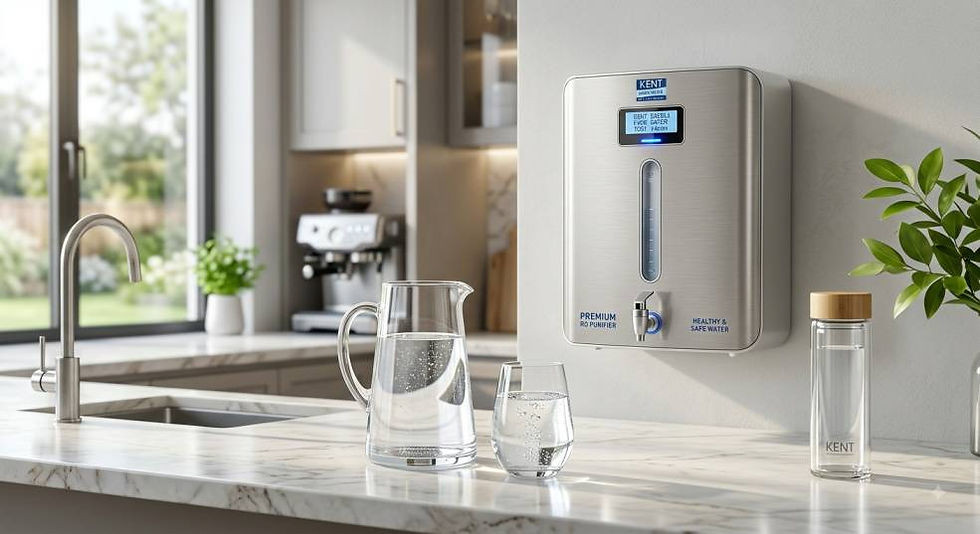
Brand Situation Prior to the RO-Led Repositioning
Before Kent's entry, the Indian purification category was defined by UV technology and low price points, with limited consumer understanding of contamination beyond microbiological concerns (which UV addresses) versus dissolved solids and chemical contaminants (which RO addresses). Dr. Gupta's own account, as reported by Business Standard, describes the difficulty of this early period: in the first five years, convincing customers to pay a five-times price premium against the market leader was a central challenge, and the company had no marketing budget for television advertising when its turnover was only Rs 30–40 crore around 2005.
The turning point in brand-building came through celebrity endorsement. Business Standard reports that in 2005, Kent signed veteran actor Hema Malini as brand ambassador, a choice Dr. Gupta explained by her appeal as "a housewife, popular, and appealing to the ladies" and that the endorsement helped the brand gain consumer attention despite the company's limited advertising budget at the time. This relationship endured for well over a decade and became a structural element of Kent's brand identity in Indian households, well before the company's revenue scaled meaningfully.
Strategic Objective
Based on the documented pattern of Kent's market actions its technology patenting, its trademarked product naming, and its advertising claims the company's strategic objective can be read as category leadership through a proprietary purity claim, rather than price competition. Two verifiable actions support this reading:
First, technology-based product naming and patenting. Kent developed and patented a "Mineral RO" purification technology, which it positioned as an advance beyond standard RO systems. Court records from Delhi High Court proceedings (Eureka Forbes Limited vs Kent RO Systems, 2010) confirm that Kent had acquired a patent in respect of its most advanced machine, the Mineral RO water purifier, which combined UV, UF, RO, and TDS control technology, distinct from its earlier machines based solely on UV or RO technology. Kent additionally holds a registered U.S. trademark for "KENT MINERAL RO WATER PURIFIERS," filed on February 5, 2019 and registered on September 24, 2019, with a claimed first use in commerce dating to September 18, 2014.
Second, a sustained purity-claim tagline defended through litigation. Kent has used the Hindi tagline "Kent deta hai sabse shudh paani" ("Kent gives the purest water") as a core brand claim. This tagline became the subject of a 2023–2024 dispute before the Advertising Standards Council of India (ASCI) and subsequently the Delhi High Court, after a complaint from competitor TTK Prestige. Court documents record that ASCI's Consumer Complaints Council concluded the claim was not substantiated with verifiable comparative data, was misleading by exaggeration, and was likely to lead to widespread disappointment among consumers, in contravention of Chapter I, Clauses 1.1, 1.4 and 1.5 of the ASCI Code. Kent contested the ruling, arguing among other things that the tagline had been in use for almost 15 years and that the complaint was driven by a competitor with an alleged institutional bias within ASCI membership. This litigation demonstrates that the "purest water" claim was not incidental messaging but a core, defended pillar of brand equity that the company was prepared to protect through legal channels.
Positioning & Consumer Insight
Kent's positioning rests on a consumer insight that is explicit in its own product and technology narrative: that Indian households conflate "purity" with "health," and that a mother/family-health frame rather than a purely functional-appliance frame would justify a premium price. This is visible in three consistent, documented brand behaviors:
Family-oriented celebrity casting. The choice of Hema Malini described by Dr. Gupta as resonant with housewives and her continued presence in Kent advertising alongside her daughter Esha Deol as late as 2020, per Tribune and HuffPost India reporting, shows the brand consistently anchoring its appeals in family and domestic-life imagery over a period spanning at least fifteen years.
A "purity" master-claim applied across the portfolio. The "sabse shudh paani" tagline and the "Mineral RO" technology story extended a single core claim purity across water purifiers and, per Kent's own product listings, into adjacent categories including air purifiers, water softeners, and kitchen appliances.
Reputational risk from over-extension of the purity/hygiene frame. The clearest evidence of how central and how commercially risky the purity-and-hygiene positioning was to Kent's brand came in May 2020, when the company ran a social media campaign for its Atta & Bread Maker appliance featuring Hema Malini and Esha Deol. The advertisement, as reported contemporaneously by The Tribune, HuffPost India, The Quint, and Gulf News, cautioned consumers against kneading dough by hand via a domestic worker, stating "her hands might be infected," and positioned the appliance as a hygiene-safe alternative. The advertisement drew immediate and widespread public backlash, characterized by commentators and a domestic workers' rights organization (Sree Jagruti Samiti) as classist and discriminatory toward domestic workers, particularly given its implication that they could be carriers of COVID-19. Kent withdrew the advertisement and its Chairman issued a public apology, stating that the advertisement was "unintentional, badly communicated and was wrong," that it had been immediately withdrawn, and that the company would investigate how its advertising standards had been compromised. Brand ambassador Hema Malini also publicly distanced herself, stating that the views expressed in the advertisement did not resonate with her values and were inappropriate. Separately, in late 2020, Kent withdrew a water-purifier advertising claim after a consumer complaint led ASCI to ask the company to substantiate a suggestion that its product could address COVID-19; Kent chose to withdraw the claim from its advertising rather than defend it before ASCI.
Taken together, these episodes indicate that Kent's "purity/hygiene" positioning was a genuine driver of brand equity and pricing power strong enough to extend across a diversified appliance portfolio but also a source of reputational exposure when the underlying insight (fear of contamination) was applied in ways that stereotyped specific social groups or overstated verifiable product benefits.
Media & Channel Strategy
Verified information on Kent's channel strategy is limited to what has been disclosed in company statements, industry reports, and its DRHP. Three elements are corroborated by public sources:
Sustained celebrity television and print advertising, anchored by Hema Malini since 2005, as detailed above.
A large distributor and franchise network. According to Research and Ranking's profile of the company, Kent RO's distribution network had expanded to over 600 distributors and 150 franchise outlets as the company scaled.
A recent shift toward subscription-based and affordability-led distribution. Custom Market Insights reports that in January 2024, Kent RO Systems launched a "HealtHzero" subscription model targeting budget-conscious consumers, allowing access to Kent purifiers at a lower upfront cost through monthly or annual subscription payments, aimed at expanding the brand's reach into rural and semi-urban markets.
Business & Brand Outcomes
Kent's financial and market-position outcomes are documented primarily through its DRHP filed with SEBI in January 2025 and subsequent IPO-related reporting, which constitute the most authoritative public disclosures available:
Revenue. Kent RO Systems reported FY24 revenue of ₹1,178 crore, an increase of 8.7% over the prior year, according to IPO Watch's reporting on the DRHP. For the April–September 2024 quarter, the company recorded revenue of ₹637 crore, and mStock's IPO guide separately reports FY24 net profit of ₹166.6 crore, with margins improving due to a better product mix and operational efficiencies.
Revenue composition. According to mStock and IndiaIPO.in's reporting on the DRHP, water purifiers account for approximately 85% of Kent's revenue, with the remainder coming from air purifiers, kitchen appliances, vacuum cleaners, and most recently BLDC ceiling fans under the "Kuhl" brand.
Ownership and governance structure ahead of listing. IPO Watch reports that as of the DRHP filing, founder Mahesh Gupta held 99.77% ownership of the company, with Mahesh Gupta, Sunita Gupta, and Varun Gupta as promoters. The IPO itself is structured as a 100% offer-for-sale of up to 10,094,568 equity shares, with IndiaIPO.in confirming that the DRHP was filed with SEBI on January 21, 2025, and received SEBI approval on June 6, 2026, and that no fresh capital will be raised by the company all proceeds go to the selling shareholders.
Market position. As referenced above, Kent's own disclosures and independent industry commentary converge on an approximate 40% share of India's branded RO water purifier segment, positioning it as a co-leader alongside Eureka Forbes in this specific sub-category, though third-party estimates of Kent's overall purifier-market share have varied between roughly 30% and 40% depending on the year and methodology of the source.
Strategic Implications
Three strategic lessons emerge directly from the documented record, without requiring inference beyond what sources report:
1. A premium entrant can unseat an incumbent's core technology claim, but the transition takes years, not quarters. Kent's five-times price premium against Aquaguard's UV purifiers in 1999 was commercially unviable at launch and required a specific chemical-contaminant differentiation (arsenic, fluoride, pesticide removal) combined with a slow-built celebrity association before revenue scaled meaningfully. The competitive contest for category leadership between Kent and Eureka Forbes has continued for over two decades, with leadership changing hands at different points by different measures indicating that RO-versus-UV category leadership in India has never been a settled, permanent outcome.
2. A single-word positioning claim ("purity") is a powerful but legally and reputationally exposed asset when extended across a diversified portfolio. Kent's "Mineral RO" patent and its "sabse shudh paani" tagline built durable brand equity, evidenced by the tagline's near 15-year continuous use cited in Kent's own court submissions. However, the same purity/hygiene logic, when extended into an unrelated kitchen appliance and framed around the alleged uncleanliness of domestic workers, produced a serious public-relations crisis demonstrating that master-brand claims built on a single consumer fear (contamination) carry contextual risk outside their original product category.
3. Regulatory and legal scrutiny of comparative and superlative claims is intensifying for large branded players, coinciding with capital-market visibility. The ASCI ruling against Kent's core tagline arrived in the same period the company was preparing its IPO filings, and it followed a separate ASCI-driven withdrawal of a COVID-related product claim in 2020. As Kent transitions to a publicly listed company, this pattern suggests governance and marketing-claims substantiation will face greater scrutiny from regulators, competitors, and now public shareholders than during its earlier decades as a privately held business.
Discussion Questions
Kent built its early differentiation on a specific technical claim (removal of dissolved contaminants via RO versus UV-only purification). To what extent can a technology-based point of difference sustain premium pricing once competitors adopt the same underlying technology, as Eureka Forbes and others did by the mid-2000s?
Evaluate Kent's use of a single master-brand claim ("purity") extended across water purifiers, air purifiers, and kitchen appliances. What are the brand-architecture trade-offs of using one consumer fear (contamination/hygiene) as the organizing insight across an unrelated product portfolio?
The 2020 "Atta & Bread Maker" controversy and the 2023–2024 ASCI ruling on Kent's core tagline both centred on claims substantiation and social sensitivity. What internal marketing-governance mechanisms (e.g., pre-clearance processes, legal review of comparative claims) might mitigate this recurring pattern of regulatory and reputational exposure?
Kent's DRHP shows water purifiers contributing approximately 85% of FY24 revenue, with founder Mahesh Gupta holding 99.77% ownership pre-IPO. As Kent transitions to a listed company with public shareholders, how might its brand-claims strategy, celebrity-endorsement model, and category diversification (fans, kitchen appliances) need to evolve to satisfy public-market scrutiny?
Market-share estimates for Kent's RO segment position range from roughly 30% to 40% depending on source and year, while Eureka Forbes and Kent have alternated category leadership since 2013. What does this persistent contestability suggest about the durability of "purity"-based brand positioning in a category where multiple players can credibly claim comparable filtration technology?


Comments