Mamaearth's Omnichannel D2C Growth Model
- Jul 9
- 8 min read
Industry & Competitive Context
India's beauty and personal care (BPC) market has historically been dominated by large, diversified FMCG incumbents — Hindustan Unilever, Procter & Gamble, and L'Oréal — which built their competitive advantage on decades-deep retail distribution and mass-media brand equity. Honasa Consumer Limited, the parent company of Mamaearth, entered this market in November 2016 as a digitally native challenger with no legacy retail infrastructure. According to the company's IPO disclosures, Honasa positioned itself as a "digital-first" BPC company, using online channels to bypass the high fixed costs and long lead times that traditional retail distribution demands of new entrants. By the time of its public listing, Honasa operated in a market also being reshaped by horizontal beauty platforms such as Nykaa, which function simultaneously as retail partners and competing destinations, and by a wave of venture-funded D2C entrants competing on ingredient claims and social-media-driven customer acquisition. Honasa's IPO prospectus described the company among the largest such digital-first BPC companies in India by revenue for the period reported, positioning its scale as a differentiator relative to smaller D2C peers.
Brand Situation Prior to the Growth Phase
Mamaearth was founded in November 2016 by Varun Alagh and Ghazal Alagh, both first-time entrepreneurs, following their personal search for toxin-free baby care products. Per Forbes India's reporting, the company generated operating revenue of approximately ₹22.19 lakh in FY17, ₹5 crore in FY18, and ₹17 crore in FY19 — a trajectory built, by the founders' own public account, on financial frugality rather than heavy marketing spend. The company avoided television advertising in its early years and instead relied on digital and influencer channels, per the same Forbes India account. An early and publicly documented brand-building decision was the 2018 equity-based endorsement deal with actor Shilpa Shetty Kundra, structured so that the celebrity invested in the company rather than being paid a cash fee — a detail confirmed directly by co-founder Varun Alagh in Forbes India's reporting. Mamaearth's first television advertising appeared only in December 2020, when it sponsored the reality show Bigg Boss, according to the same source. Ghazal Alagh separately gained public visibility as an investor ("shark") on the first season of Shark Tank India in 2021, per Wikipedia and multiple biographical profiles, which added a media-driven credibility layer to the brand's founder-led narrative. A distinct element of the brand's positioning was its MADE SAFE certification, publicly referenced across the company's own communications and third-party profiles as making Mamaearth Asia's first MADE SAFE-certified brand — a claim used to substantiate its "toxin-free" positioning.
Strategic Objective
Honasa's IPO Red Herring Prospectus (RHP), as summarized in publicly available IPO analysis documents filed with market intermediaries, articulated the company's core strategic pillars as: brand-building capability and repeatable playbooks across multiple brands, customer-centric product innovation, digital-first omnichannel distribution, data-driven contextualized marketing, and the ability to drive growth and profitability in a capital-efficient manner. These pillars indicate that the company's stated strategic objective was not simply to scale a single digital brand, but to convert digital-first origins into a multi-brand, omnichannel FMCG platform while preserving capital discipline — a notable departure from the "growth-at-all-costs" model associated with many venture-backed Indian consumer startups of the same period.
Campaign Architecture & Execution
Portfolio construction. Rather than executing a single sustained brand campaign, Honasa executed a multi-brand portfolio strategy. Beyond Mamaearth, it built The Derma Co. as a dermatologist-oriented skincare brand, and launched or acquired Aqualogica, Ayuga, Dr. Sheth's, BBlunt (acquired from Godrish Consumer Products, per Inc42), and the colour cosmetics brand Staze, according to afaqs! reporting citing Honasa's chief business officer, Zairus Master. The company also acquired the content platform Momspresso, which Inc42 reported was subsequently shut down due to scaling inefficiencies.
Distribution transition. According to Inc42's reporting, in FY24 Honasa began eliminating super-stockists from its supply chain in favour of direct distributors — a structural change intended to improve cost control and execution speed in offline retail, rather than a marketing campaign per se.
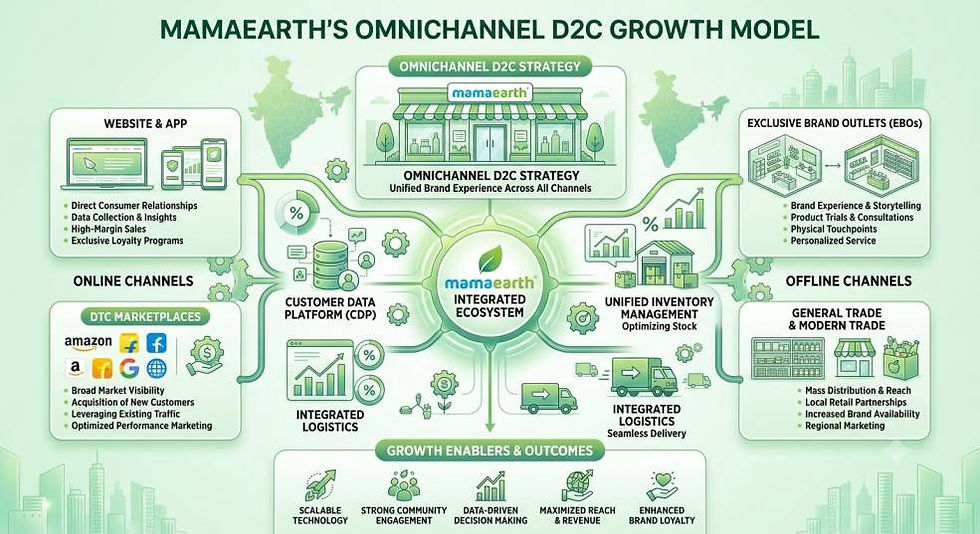
Retail expansion. Honasa's own press release, cited in third-party financial summaries, confirmed that by March 2024 Mamaearth's distribution had reached 188,377 FMCG retail outlets in India, a 34% year-on-year increase. Separate reporting cited in company profile summaries put offline reach at approximately 200,000 outlets by June 2024 (a 30% year-on-year increase per that account), and Wikipedia's current entry states that Mamaearth's offline reach extended to over 2.7 lakh (270,000) retail outlets, along with over 100 exclusive brand outlets (EBOs) in Indian malls, as of 2026. Because these figures come from different reporting periods and sources, they should be read as sequential milestones in an expanding distribution footprint rather than as directly comparable, single-source data points.
Quick commerce. In on-record comments to afaqs!, Honasa's chief business officer Zairus Master stated that the company was an early adopter of quick commerce partnerships as those platforms expanded from grocery into beauty categories, and noted that quick commerce represented "a small portion" of overall sales relative to traditional and online channels at the time of that interview (July 2024).
Positioning & Consumer Insight
Mamaearth's original consumer insight — as recounted consistently across the founders' own public statements — was that Indian parents lacked confidence in the safety of baby-care products available in the market, creating demand for a certified, "toxin-free" alternative. This insight was translated into a brand promise built on ingredient transparency and third-party certification (MADE SAFE) rather than on price or mass-market convenience, positioning Mamaearth initially as a trust-first rather than a price-first challenger to incumbent FMCG players.
Media & Channel Strategy
The verifiable channel strategy has three documented phases:
Digital-only origin (2016–2020): Sales exclusively through the company's own website and third-party online marketplaces, per the company's own IPO disclosures and consistent secondary reporting. No verified public information is available on the exact revenue split between owned website and third-party marketplace sales during this period.
Celebrity and influencer-driven brand building (2018–2021): The Shilpa Shetty equity endorsement (2018), Ghazal Alagh's Shark Tank India appearance (2021), and reported use of YouTube and social media influencer promotion (referenced across biographical secondary sources, though without company-disclosed spend figures).
Omnichannel scale-up (FY24 onward): Direct-distributor transition, EBO rollout (over 110 exclusive brand outlets, per afaqs! reporting from Honasa's chief business officer), general trade and modern trade expansion, and early quick commerce partnerships.
Honasa's IPO prospectus disclosed that its flagship brand Mamaearth was ranked among the top three brands by awareness in the grooming category on Flipkart between May 2021 and July 2023, according to IPO analysis documentation filed with market intermediaries and based on the company's RHP — one of the few third-party-adjacent, quantified brand-awareness data points publicly available.
Business & Brand Outcomes
Funding and valuation: Honasa Consumer became a unicorn in 2022 following a funding round valuing the company at over $1 billion, per Wikipedia and consistent secondary reporting.
IPO: Honasa Consumer's initial public offering opened for subscription on October 31, 2023, and closed on November 2, 2023, with a price band of ₹308–₹324 per share and a total issue size of approximately ₹1,701 crore, comprising a fresh issue of approximately ₹365 crore and an offer for sale of roughly 4.12 crore shares by existing shareholders, per IPO documentation from market intermediaries (Chittorgarh, m.Stock, Bajaj Broking) citing the company's RHP. The issue was subscribed 7.61 times overall as of the close of bidding on November 2, 2023 (1.35x retail, 11.5x QIB, 4.02x NII), per the same sources. Shares listed on the BSE and NSE on November 7, 2023.
Financial performance: Per Inc42's reporting citing company disclosures, Honasa's revenue grew approximately 57% between FY22 and FY23. The company reported a net loss of ₹150.96 crore in FY23, followed by a net profit of ₹110.52 crore in FY24 — described by Inc42 as the company's first full year of profitability after listing.
Offline distribution: Distribution reached 188,377 FMCG outlets by March 2024 (34% year-on-year growth), per Honasa's own press release as cited in secondary financial reporting, expanding to over 2.7 lakh outlets by 2026 per Wikipedia's current entry.
Multi-brand scaling: The Derma Co. reached an annual recurring revenue run rate of ₹500 crore in FY24, becoming, per Inc42, the second brand in Honasa's portfolio (after Mamaearth) to reach that milestone. New product development contributed 18% of FY24 sales, per company disclosures to analysts as reported by Inc42.
Post-IPO stock performance: One secondary source (StartupTalky) reported that Honasa's share price fell from listing levels to approximately ₹227 within roughly two months of listing, a decline reported as having reduced the company's market capitalisation below $1 billion. This is a single-source claim within the material reviewed and is presented here with that caveat; it has not been independently cross-verified against a second named source in this research.
Strategic Implications
Three analytically distinct strategic lessons emerge from the documented record, independent of any single campaign or metric.
First, Honasa's growth model illustrates a sequencing logic rather than a channel-substitution logic: the company did not pivot away from digital in favour of offline distribution, but used its D2C-originated customer and geographic data to inform where and how it expanded into physical retail — a pattern consistent with the company's own stated RHP objective of "digital-first omnichannel distribution." This suggests that for asset-light D2C entrants, the sequencing of channel investment (digital-data-informed offline expansion, rather than simultaneous or offline-first expansion) may be a more capital-efficient path to national scale than either a pure-digital or a pure-offline strategy alone.
Second, the shift from super-stockists to direct distributors in FY24, alongside the swing from a ₹150.96 crore loss in FY23 to a ₹110.52 crore profit in FY24, indicates that supply chain and distribution architecture — not only marketing or brand positioning — were material levers in the company's path to profitability. This is a reminder that D2C brand strategy conversations often overweight demand-side factors (content, influencers, positioning) relative to supply-side and distribution-architecture factors that are less visible externally but are documented here as materially significant to the company's own reported financial turnaround.
Third, the house-of-brands architecture (Mamaearth, The Derma Co., Aqualogica, BBlunt, Dr. Sheth's, Ayuga, Staze) represents a deliberate hedge against single-brand dependency and category saturation, allowing the company to address different price points, use cases, and offline-readiness levels brand by brand — as reflected in Zairus Master's on-record description, in afaqs!, of each brand's distribution strategy being tailored to its stage of development (Mamaearth offline-heavy; The Derma Co. offline-expanding but selectively so; newer brands still primarily online).
At the same time, the limits of the publicly available record should be stated plainly: without disclosed CAC, retention, or channel-level conversion data, it is not possible to draw a fully evidence-based conclusion about the unit economics underlying Honasa's omnichannel model, only about its top-line, distribution-footprint, and reported profitability trends as disclosed.
Discussion Questions
Honasa's RHP describes its strategy as "digital-first omnichannel distribution." Based on the documented sequencing of digital origin followed by offline expansion, what specific organizational capabilities would a company need to build during its digital-only phase to execute a comparably data-informed offline expansion later?
The shift from super-stockists to direct distributors in FY24 coincided with the company's first full year of profitability. What are the likely trade-offs (in cost structure, working capital, and execution complexity) between a super-stockist model and a direct-distributor model for a scaling FMCG entrant, and how might these trade-offs differ by company size?
Honasa operates seven brands across different price points and channel strategies (Mamaearth, The Derma Co., Aqualogica, Ayuga, Dr. Sheth's, BBlunt, Staze). What criteria should a house-of-brands company use to decide which brand should lead in offline retail expansion versus which should remain primarily digital?
The 2018 equity-based celebrity endorsement (in lieu of a cash fee) is documented as a deliberate capital-conservation tactic. Under what conditions might an equity-for-endorsement structure create long-term strategic risk for a founder team, even if it conserves cash in the short term?
Given the absence of publicly disclosed CAC, LTV, and retention metrics, what alternative, publicly observable indicators (e.g., retail outlet growth, ARR milestones, distribution mix shifts) can analysts reasonably use to assess the health of a D2C company's omnichannel transition, and what are the limitations of relying on these proxies?


Comments