Safari Industries: Brand Positioning in India's Travel Goods Market
Industry & Competitive Context
India's organised luggage market operates within a much larger, largely informal category. Industry estimates place the overall Indian luggage market at roughly ₹9,000 crore in the mid-2010s, growing to an estimated ₹15,500 crore by CY23, with unbranded and unorganised players still accounting for the majority of volume. Within the branded segment, three companies — VIP Industries, Samsonite India, and Safari Industries — have historically accounted for a large share of organised sales; a 2018 sell-side estimate placed their combined share at roughly 28% of the total market (organised plus unorganised), while a 2025 industry thematic report estimated branded players' share of the category at approximately 52% in CY23, with VIP, Samsonite, and Safari together controlling around 33% of the overall market. Category growth has been underpinned by rising disposable incomes, expanding air connectivity, a post-pandemic surge in leisure and business travel, and a gradual shift in consumer preference from unbranded to branded products. India's Ministry of Tourism data cited in a September 2025 industry report shows domestic tourist visits rising to 3.06 billion in CY24 from 2.51 billion in CY23, surpassing pre-pandemic levels — a demand tailwind that has benefited all organised players. Within this competitive set, VIP Industries has traditionally been the largest company by revenue, built on a multi-brand portfolio (VIP, Skybags, Aristocrat, Alfa, Carlton) and an in-house manufacturing base established since the company's founding in 1971. Samsonite India operates as the Indian arm of the global Samsonite Corporation, competing largely in the premium and mid-premium segments. Safari Industries, by contrast, has pursued a single-brand-led strategy, concentrating investment and consumer recall on the "Safari" name before later extending into adjacent brands.
Brand Situation Prior to Repositioning
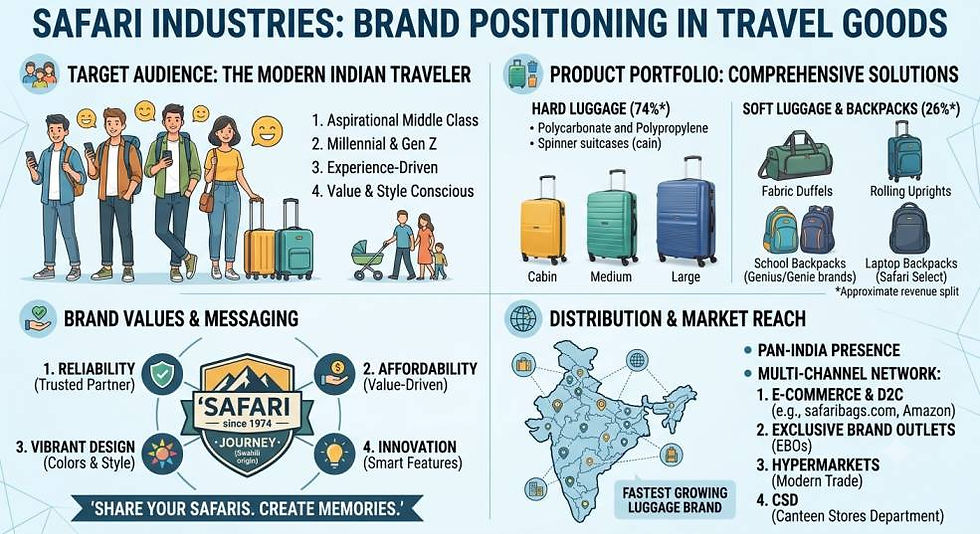
Safari Industries traces its origins to 1974 and was incorporated as a company in 1980. For much of its early history, the business catered to a narrow, largely functional customer base — primarily adult and family travellers — with a limited stock-keeping-unit (SKU) range. Public research reports covering the company note that revenue growth was nearly stagnant in the years leading up to 2011, expanding at a compound annual growth rate of only around 6.2% between FY05 and FY11. At this stage, Safari lacked the marketing reach, retail distribution depth, and brand salience of the market leader, VIP Industries. A change in ownership altered this trajectory. In May 2012, Sudhir M. Jatia — who brought roughly two decades of prior experience in the Indian luggage industry, including a senior role at VIP Industries — acquired a majority (77%) stake in Safari Industries and was appointed Managing Director effective April 18, 2012. Public research reports describe the subsequent period as one of product rationalisation: non-performing SKUs were discontinued, and the company reoriented its portfolio toward faster-growing categories such as polycarbonate hard luggage, laptop bags, and backpacks.
Strategic Objective
Based on publicly available research reports and company disclosures, Safari's strategic objective following the 2012 ownership change was to convert a stagnant, undifferentiated legacy brand into a mass-market, growth-oriented luggage company by (a) rationalising its product portfolio around higher-growth categories, (b) building a distribution footprint that matched the shopping habits of India's expanding middle class, and (c) establishing a distinct market position relative to VIP's multi-brand architecture and Samsonite's premium positioning. Equity research covering the stock frames this explicitly as a shift "from a value-oriented brand to a mass-premium contender," achieved through aggressive expansion of the hard-luggage SKU portfolio and a widening of price points to capture share from both unorganised players and established competitors.
Positioning & Consumer Insight
The most distinctive and well-documented element of Safari's brand strategy is its approach to marketing itself. A July 2024 equity research report on the company states that Safari's marketing strategy centres on "the product as the brand," and notes that the company has historically built its consumer proposition without reliance on a celebrity brand ambassador — a marked contrast to the endorsement-led marketing traditionally used by several competitors in Indian consumer categories. The same report attributes Safari's marketing efficiency to this approach, stating that for every rupee of marketing spend, Safari generated ₹5.6 of incremental sales over FY17–24, compared with ₹1.4 for VIP Industries and ₹1.8 for Samsonite India over the same period. This product-led positioning has been paired with a portfolio architecture aimed at distinct price and demographic tiers. Through acquisitions of the Genius, Magnum, Activa, and Genie brands between FY14 and FY17, Safari extended into the school-bag and campus-gear segment, targeting teenagers and young adults as a demographic distinct from its historical adult and family-travel base. To address the premium end of the market, the company subsequently introduced the "Urban Jungle" brand — initially focused on zippered hard luggage before extending into backpacks and duffle bags — alongside a "Safari Select" range, both aimed at capturing the premiumisation trend within India's luggage category. Equity research also characterises Safari's core brand identity as skewing toward a "vibrant, youth-centric" positioning within the "athleisure" and affordable-premium segments of the travel-gear market, differentiating it from the more traditional imagery historically associated with VIP. A recent, publicly documented example of Safari extending its brand into an adjacent cultural occasion is its 2026 collaboration with menswear brand Manyavar to launch "Shaadi Ka Safar," a wedding-themed luggage collection. According to a trade-press announcement, the collection was built around positioning luggage as part of Indian wedding journeys — spanning bridal trousseau packing, family gifting, and travel for newly married couples — combining Safari's travel-goods expertise with Manyavar's standing in wedding and celebration wear. Sudhir Jatia, in comments carried by the same announcement, framed the tie-up around the idea that luggage plays a role across life's significant journeys, extending the brand's relevance beyond functional travel into a culturally specific, high-emotion occasion (Indian weddings) that neither company's core category typically addresses in isolation.
Campaign Architecture & Execution (Shaadi Ka Safar, 2026)
The "Shaadi Ka Safar" launch, as documented in trade press, was supported by a marketing campaign spanning national editorial outreach, wedding- and fashion-led storytelling, influencer content, and experiential activations. The campaign featured dancer and actress Mukti Mohan and actor Kunal Thakur in promotional content. Distribution for the collection was structured across Safari's own retail stores, select Manyavar outlets, both companies' brand websites, and major e-commerce marketplaces — reflecting Safari's broader, well-documented emphasis on omni-channel availability rather than exclusive-channel distribution.
Media & Channel Strategy
Public disclosures and equity research consistently describe Safari's brand-building as weighted toward advertising and content on digital platforms, alongside a broad physical retail footprint. A 2018 research report noted that Safari's products were, at that time, available across 25 or more major Indian cities through more than 3,500 outlets, spanning exclusive brand showrooms, multi-brand outlets, modern retail chains, and e-commerce platforms. More recent equity research reaffirms that the company has built a strong position on e-commerce marketplaces and continues to invest in scaling its own brand websites and digital content strategy to engage consumers. Regarding the precise split of Safari's revenue contributed by e-commerce, one market-analysis publication has cited a figure of over 40% of revenue coming from online channels; however, this figure has not been independently verified against a company annual report or investor presentation, and readers should treat it as an industry estimate rather than a confirmed company disclosure. On manufacturing — a factor that indirectly shapes brand execution by determining speed-to-market and cost structure — public filings and research reports indicate that Safari manufactures polypropylene and polycarbonate hard luggage in-house at a facility in Halol, Gujarat, while soft luggage is predominantly imported. The company announced a new manufacturing facility in Jaipur, Rajasthan, with an estimated capital expenditure of approximately ₹215 crore as disclosed in research coverage referencing a January 2024 company announcement; subsequent reporting for the December 2025 quarter (Q3 FY2025-26) attributed part of the company's revenue growth to this new facility. This is a differentiated model relative to VIP Industries' historically in-house manufacturing base in Nashik and Nagpur, and relative to a broader industry trend (also seen at VIP) of sourcing soft luggage from Bangladesh.
Business & Brand Outcomes
Market share: Equity research indicates that Safari's market share rose from approximately 8% in FY14 to approximately 23% in FY23, a period coinciding with the brand and portfolio changes described above. A separate 2025 industry thematic report estimated Safari's share of the mass luggage segment (priced below ₹4,000) at approximately 16%, and described Safari as having gained roughly 30% share among top branded players in a subsequent period, alongside a reported revenue CAGR of approximately 36% over FY22–25. Revenue and profitability: Equity research covering FY19–24 cites revenue and EBITDA CAGRs of approximately 22% and 39% respectively for the period. At the quarterly level, one published equity research note recorded Q4 FY23 consolidated revenue of ₹303 crore, up 56.99% year-on-year from ₹193 crore, with consolidated net profit rising to ₹38 crore from ₹2 crore in the same quarter of the prior year. For the twelve months ended March 2025, business-data platform disclosures place consolidated revenue at approximately ₹1,800 crore, with a reported one-year revenue CAGR of around 15%. Analyst forward estimates published in mid-2024 projected a revenue CAGR of approximately 23% for FY24–26, with EBITDA and PAT CAGR estimated at approximately 28% and 30% respectively over the same period; these are analyst projections, not confirmed outcomes, and should be read as such.
Strategic Implications
Several elements of Safari Industries' approach to brand positioning are instructive from a strategy standpoint, based strictly on the documented facts above.
First, the company's stated reliance on "the product as the brand" rather than a celebrity endorsement represents a departure from the conventional Indian consumer-marketing playbook, particularly in a category (luggage) where competitors have historically used ambassador-led advertising. The marketing-efficiency figures cited in equity research — incremental sales per rupee of marketing spend well above two domestic competitors — suggest this approach has, at least over the FY17–24 period referenced, been associated with more efficient conversion of marketing investment into sales, although the causal mechanism (product visibility, distribution intensity, pricing, or advertising content itself) is not disentangled in the available public sources.
Second, Safari's brand architecture — a dominant single "Safari" master brand supplemented selectively by "Urban Jungle" for premiumisation and category-specific acquisitions (Genius, Genie, Magnum, Activa) for school and campus segments — illustrates a more concentrated brand-portfolio strategy than the multi-brand approach pursued by VIP Industries. Publicly available commentary suggests this concentration has allowed for more targeted marketing and SKU rationalisation, though again, no independently audited study quantifying the marginal efficiency of this architecture versus a multi-brand model was identified.
Third, the 2026 Manyavar collaboration signals a strategic move to extend brand relevance beyond the functional "travel" occasion into culturally specific, high-emotion consumption moments (Indian weddings), a positioning direction consistent with the broader industry shift — noted in analyst commentary — from luggage as utility to luggage as a lifestyle and status signal. Whether this represents a durable repositioning or a single campaign-level activation cannot be assessed from the sources reviewed, since no post-campaign performance data has yet been publicly disclosed.
Finally, the asset-light, largely outsourced manufacturing model (contrasted with VIP's historically in-house base) appears — per publicly available industry commentary — to support faster SKU turnover and go-to-market speed, which in turn may reinforce a brand promise built around frequent newness and trend responsiveness rather than manufacturing heritage. This is a strategic trade-off rather than an unambiguous advantage, since the same commentary notes that geopolitical and supply-chain factors affecting outsourced manufacturing (e.g., dependence on China, Bangladesh, and Vietnam) represent a documented risk factor for the company.
Discussion Questions
Safari Industries has reportedly achieved higher incremental sales per rupee of marketing spend than VIP Industries and Samsonite India without using a celebrity brand ambassador. What alternative levers (distribution, pricing, digital content, portfolio architecture) could plausibly explain this efficiency, and how would you design a study to isolate their individual contributions?
Compare Safari's single-master-brand strategy (Safari, with Urban Jungle for premiumisation) against VIP Industries' multi-brand portfolio (VIP, Skybags, Aristocrat, Alfa, Carlton). Under what market conditions does portfolio concentration outperform portfolio diversification, and vice versa?
The Safari–Manyavar "Shaadi Ka Safar" collaboration repositions luggage from a travel-utility purchase to a wedding-occasion purchase. Using STP (Segmentation, Targeting, Positioning) logic, evaluate whether this represents a genuine new market segment or a seasonal demand-capture tactic, and what evidence would distinguish the two.
Safari's shift toward outsourced, multi-country manufacturing (China, Bangladesh, Vietnam) supports faster SKU rationalisation but introduces supply-chain and geopolitical risk. How should a growth-stage consumer brand weigh manufacturing agility against supply-chain resilience when these trade-offs directly affect brand promises such as "newness" or "affordability"?
Given the stated absence of independent brand-tracking data (recall, equity, NPS) in the public domain for Safari Industries, what internal or third-party brand-health metrics would you recommend the company disclose or commission to validate whether its market-share gains reflect durable brand equity versus price- and distribution-led volume growth?


Comments