Marketing in 2030: Skills Every Future Marketer Will Need
INDUSTRY AND COMPETITIVE CONTEXT
Marketing is entering the second half of the decade under two pressures at once: static budgets and rapid technological change. Gartner’s annual CMO Spend Survey, which polls several hundred senior marketing leaders in North America, the United Kingdom and Europe (mostly at companies with more than $1 billion in revenue), shows budgets plateauing. In the 2025 edition (402 respondents, fielded February to March 2025), average marketing budgets held at 7.7% of company revenue, the same as the prior year. In the 2026 edition (401 respondents, fielded January to March 2026), the figure edged up to 7.8%. Gartner’s own analysis notes that in the five years before the pandemic, average budgets were 11.2% of revenue, against 8.1% in the five years after. The mean also conceals a wide spread: in 2025, half of surveyed CMOs reported budgets of 6% of revenue or less.
Against this backdrop, the competitive question for the profession is no longer simply how much to spend but who can convert constrained resources into growth. In 2025, 59% of CMOs said they lacked the budget to execute their strategy. In 2026, 56% said so, and 54% also reported insufficient resources more broadly. Gartner reported that 61% of CMOs in 2025 said marketing was seen as a profit center inside their company, up from 54% a year earlier. Marketing leaders are therefore being judged on commercial contribution while working with flat funding. Skills, rather than spend, become the lever they control.
The wider labour-market frame comes from the World Economic Forum’s Future of Jobs Report 2025, based on a survey of more than 1,000 employers representing over 14 million workers across 55 economies. The report finds that job disruption will equate to 22% of jobs by 2030, with 170 million new roles created and 92 million displaced, and that nearly 60% of the global workforce will require upskilling or reskilling by 2030. Upskilling is identified as the top workforce strategy employers plan to pursue. Marketing sits inside this transition and is not insulated from it.
BRAND SITUATION PRIOR TO THE SKILLS SHIFT
First, the technology is already in use. LinkedIn’s UK marketing skills data, reported in March 2025, found that 59% of marketers were already using AI in their jobs. McKinsey’s 2023 analysis of generative AI estimated that technology could add $2.6 trillion to $4.4 trillion annually across 63 use cases in 16 business functions, with about 75% of that value falling in four areas, one of which is marketing and sales. For marketing specifically, McKinsey estimated that generative AI could raise productivity by 5% to 15% of total marketing spend, which it put at about $463 billion annually. McKinsey also described current uses as mostly off-the-shelf pilots integrated into existing workflows.
Second, agency and creative work is being reconsidered. In Gartner’s 2025 survey, 22% of CMOs said generative AI had enabled them to reduce reliance on external agencies for creativity and strategy building, and 39% planned to cut agency budgets further. Gartner also reported that the average share of marketing budgets going to agencies, martech and labour had each declined versus 2024, while paid media rose to about 30.6% of budgets.
Third, individual self-assessment lags the organisational shift. Gartner data released in February 2026 found that nearly two-thirds of marketers believe AI will change their jobs, yet only 32% believe they personally need to update their skills. The profession therefore enters the transition with high exposure to the technology and a documented gap between expecting change and preparing for it.
STRATEGIC OBJECTIVE
The shared objective across the published evidence is productivity growth under constraint. Gartner’s 2025 release framed CMOs as using data analytics and technology, particularly AI, to extract more from static budgets, and 41% of CMOs cited leveraging data and analytics to optimise performance as a productivity action. In 2026, 70% of CMOs said becoming an AI leader was a critical goal for the year.
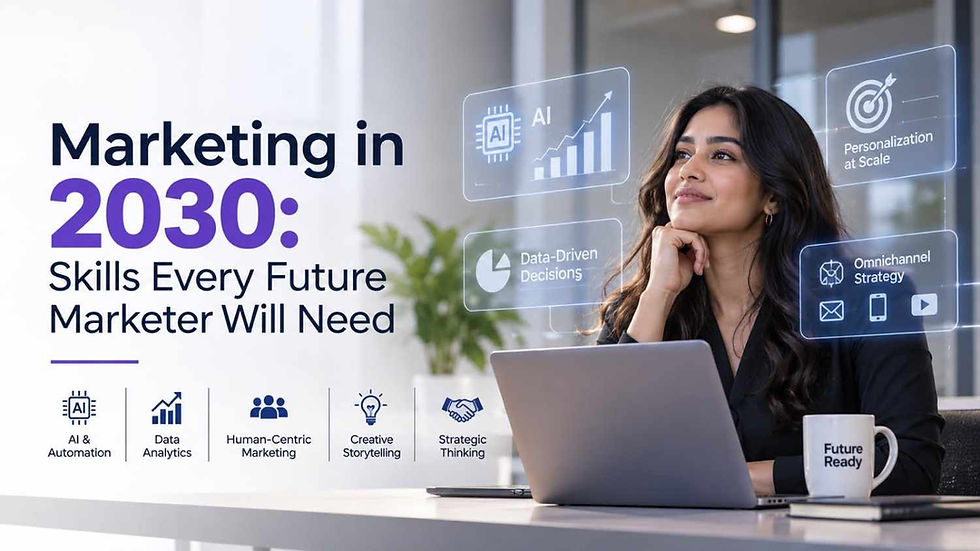
For individual marketers and the organisations that hire them, the objective follows directly: build the capabilities that employers say they will need by 2030. The Forum’s survey identifies these in two groups. The fastest-growing skills are technological: AI and big data, networks and cybersecurity, and technological literacy. Alongside them, the report says creative thinking, resilience, flexibility and agility, and curiosity and lifelong learning are rising in importance, and that analytical thinking remains a core skill. The Forum’s own summary stresses that many growing jobs will require a combination of technological and human skills.
CAMPAIGN ARCHITECTURE AND EXECUTION
What can be documented is the architecture of the published evidence base itself. Four independent institutions, covering employers (World Economic Forum), CMOs (Gartner), economists and consultants (McKinsey) and professionals’ own skill data (LinkedIn), converge on the same pattern: technical fluency with AI is rising fastest, while communication, adaptability and creativity retain or increase their value.
LinkedIn’s 2025 Skills on the Rise list ranks AI literacy first across all professions. LinkedIn defines it as the ability to understand and use AI-enabled tools, and treats it as distinct from the technical skill of developing large language models. LinkedIn also reported that AI literacy appeared in job descriptions six times more frequently than a year earlier. Its next entries were people-oriented skills, conflict mitigation and adaptability. LinkedIn’s marketing-specific list for Australia ranked campaign execution first, AI literacy second, communication training third, creativity and innovation fourth and relationship building fifth. Those Australian rankings should not be generalised to other markets without comparable data.
POSITIONING AND CONSUMER INSIGHT
The relevant “consumer” in this case is the employer, and the central insight in the published data is that technology investment and human capability are not substitutes. Gartner’s 2026 survey provides the clearest illustration. CMOs allocated an average of 15.3% of marketing budgets to AI initiatives, yet only 30% reported mature or fully developed readiness to scale AI capabilities, and 70% acknowledged that their internal marketing processes were not mature enough to implement and scale AI effectively. Marketing organisations with higher readiness allocated 21.3% of budgets to AI and reported average marketing budgets of 8.9% of revenue, compared with the 7.8% survey average. These figures show an association. The published material does not establish that readiness causes larger budgets.
Gartner also reported that labour’s share of marketing budgets rose from 21.9% in 2025 to 24.5% in 2026, reversing the 2025 decline. Trade coverage of the survey interpreted this as evidence that the value of AI depends on people, skills and execution. That is a reading of the data, offered by commentators, and not a measured finding about cause.
For positioning, the implication is that the scarce resource is not access to AI tools but the capability to deploy them within sound processes. McKinsey’s guidance on consumer marketing points in the same direction. It recommends guardrails such as human review of anything going directly to a customer and notes that marketing campaigns that once took months to design and target could be rolled out in weeks or days. It cites L’Oréal as analysing millions of online comments, images and videos to identify potential product innovation opportunities. Both examples describe judgement-intensive work built on top of the technology.
MEDIA AND CHANNEL STRATEGY
The verified channel evidence concerns where budgets sit and what that demands of marketers. Gartner’s 2025 survey found paid media at 30.6% of marketing budgets, with media price inflation meaning CMOs get less for every dollar spent. Offline channels accounted for 38.9% of budgets, led by events at 19.3%, sponsorships at 17.4% and linear TV at 16.2%. Gartner’s 2026 data indicates that awareness and conversion together account for 62.6% of media spend, a rise of about 10% from 2024. Gartner also reported that 62% of surveyed CMOs planned to invest more in marketing technology in 2026, and that 19.4% of the marketing budget was allocated to technology.
No verified public information is available on the specific channel mix that marketers in 2030 will manage, or on how the skills listed above map to individual channels.
BUSINESS AND BRAND OUTCOMES
The documented results are limited to current-state indicators: budgets flat at 7.7% to 7.8% of revenue; 15.3% of budgets going to AI in 2026; 30% of CMOs reporting mature AI readiness; labour share of budgets up from 21.9% to 24.5%; and AI literacy topping LinkedIn’s 2025 fastest-growing skills list. No verified public information is available on conversion, retention, acquisition cost or lifetime value outcomes linked to marketer upskilling.
STRATEGIC IMPLICATIONS
Four implications follow from the documented evidence, each stated as an interpretation of the data and not as a prediction.
First, capability is the binding constraint. The gap between the 70% of CMOs who want AI leadership and the 30% who report readiness suggests that purchasing tools does not by itself produce capability. For a marketing leader, hiring and training plans warrant the same scrutiny as technology budgets.
Second, the skills profile is hybrid. The Forum’s findings and LinkedIn’s lists both place technological literacy next to adaptability, communication, creativity and analytical thinking. A marketer strong in only one group does not match the profile employers describe.
Third, the self-assessment gap is a risk in its own right. If nearly two-thirds of marketers expect AI to change their jobs but only 32% believe they need to update their skills, individuals and organisations may be underinvesting in learning relative to what employers report they will need.
Fourth, the agency relationship is being renegotiated. With 22% of CMOs reporting reduced reliance on external agencies for creativity and strategy through generative AI, in-house strategic and creative judgement becomes a more valuable internal skill, while agencies face pressure to demonstrate value that tools cannot replicate.
Limits of the evidence should be stated plainly. Gartner’s surveys cover North America, the UK and Europe and skew toward large companies, so they may not describe small firms or other regions. The Forum’s 2030 figures are employer expectations from a survey, not measured outcomes. LinkedIn’s marketing rankings cited here are country-specific. A marketer in India, for example, should seek local data before applying them.


Comments