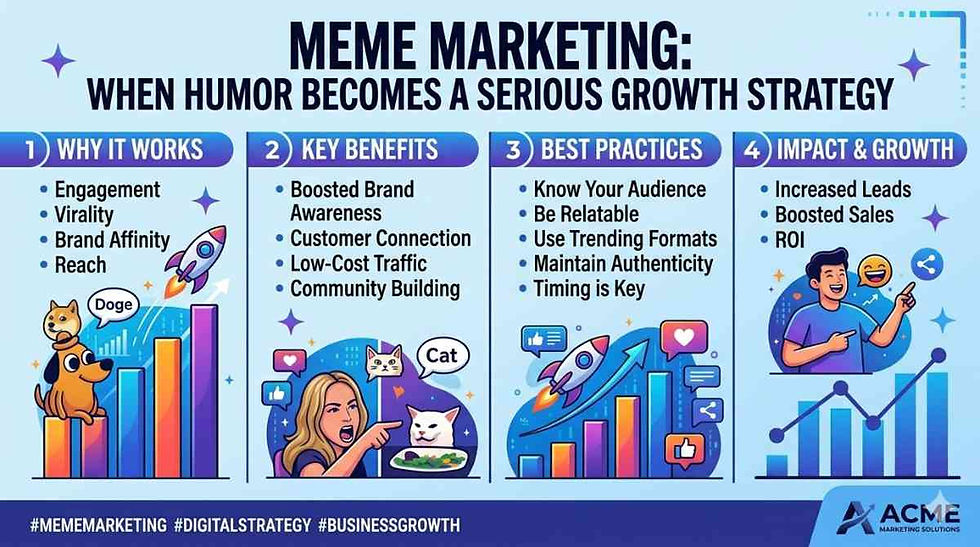
Meme Marketing: When Humor Becomes a Serious Growth Strategy
- Jun 8
- 12 min read
Industry and Competitive Context
The Indian Online Food Delivery Market
India's online food delivery market evolved rapidly through the mid-2010s, consolidating around two dominant aggregator platforms — Zomato and Swiggy — after Uber Eats exited the Indian market in January 2020 through an all-stock acquisition by Zomato valued at approximately USD 350 million. The exit of Uber Eats, despite the parent company's global scale and significant capital deployment, underscored a defining feature of the Indian food-tech market: success was contingent on deep local understanding and the ability to sustain consumer mindshare over extended periods, not just distribution capability.
In this duopolistic structure, product-level differentiation between Zomato and Swiggy was functionally limited. Both platforms offered comparable restaurant listings, delivery times, and promotional structures. Competing purely on price or logistics efficiency was strategically unsustainable given the high cost of delivery partner incentives. For Zomato, this structural reality elevated brand communication to a strategic priority. The brand that could occupy more mental space — that consumers instinctively recalled when hungry — had a structural commercial advantage in a category where purchase intent and platform selection are often simultaneous and instantaneous decisions.
The US Quick Service Restaurant (QSR) Market
The American QSR market is one of the most aggressively marketed categories in the world, characterized by high advertising spend, heavy promotional cadences, and brand recall wars fought primarily through traditional and digital media. Within this environment, Wendy's — the third-largest hamburger fast-food chain by system-wide sales in the United States — occupied a challenger position relative to McDonald's and Burger King. Competing on product parity in such a category demands that a brand either outspend rivals or out-communicate them. Wendy's chose the latter.
Brand Situation Prior to the Meme-Led Strategy
Zomato: The Attention Economy Problem
By 2018–2019, Zomato had established operational scale — the company's IPO prospectus, filed with SEBI in 2021, disclosed that as of March 31, 2021, Zomato was present in 525 cities in India with 389,932 active restaurant listings and 32.1 million average monthly active users during Fiscal Year 2021. However, scale alone did not guarantee top-of-mind brand recall in a market where Swiggy was making aggressive inroads. The challenge was one familiar to platform businesses: high utility, low emotional differentiation. Both platforms were functionally interchangeable to significant segments of their user base, making brand preference — rather than just app availability — a genuine competitive variable.
This is the market context in which Zomato's social media team adopted a content philosophy rooted in cultural fluency and comedic brevity. The strategic insight was straightforward: in the attention economy, a brand that entertains earns organic reach that advertising must otherwise purchase.
Wendy's: From Corporate to Conversational
Wendy's entered the social media space as a relatively conventional corporate account before a deliberate transformation of its brand voice in the mid-2010s. The company's then-CMO Kurt Kane, in a 2019 interview with Fast Company, described the brand voice as "sassy" — a deliberate strategic positioning that positioned Wendy's as the witty, confident challenger brand within the QSR category. Kane noted that Wendy's had recognized Twitter as the ideal platform for expressing this brand voice, though the extent of the attention it would attract exceeded internal expectations.
The underlying brand logic drew from Wendy's founding proposition: Dave Thomas had built the chain on the premise that it did things differently from competitors. The meme-led, combative social media strategy was, in this reading, not a departure from brand heritage but an expression of it in a new medium.
Strategic Objective
For both brands, the core strategic objective of their humor-led social media strategy was the same, even if articulated differently: build and sustain mental availability — the probability that a brand comes to mind when a consumer enters a relevant buying situation.
Byron Sharp's framework of mental availability, widely applied in brand planning, holds that consistent, emotionally salient brand impressions — created across a broad range of consumer touchpoints — are the primary driver of market share in mature categories. For Zomato in the food delivery market and Wendy's in the QSR market, the frequency of consumption decisions meant that staying top-of-mind was more commercially valuable than any single campaign's promotional conversion.
The secondary objective, particularly important given the cost structure of both businesses, was organic reach amplification. Meme content, by its nature, is built to be shared. A brand post that is entertaining rather than purely promotional carries a far higher likelihood of distribution through peer-to-peer sharing — effectively transforming the brand's own followers into a distribution network. This materially reduces the cost of reaching incremental audiences.
Campaign Architecture and Execution
Zomato: Relatable Brevity at Scale
Zomato's social media content strategy, particularly on Twitter (now X) and Instagram, was built on a foundation of culturally embedded humor. The content architecture had several consistent features. First, posts were anchored in universally relatable food and hunger scenarios — a strategic choice that kept all content functionally tied to the brand's category without making it overtly promotional. Second, the brand actively engaged with trending pop culture moments, national events, and seasonal conversations, inserting itself into ongoing public discourse rather than attempting to create isolated brand moments. Third, Zomato deployed a minimalist creative aesthetic — brief text, simple visuals, or reactive meme formats — reducing production friction and enabling high-frequency publishing.
Critically, Zomato extended its meme-informed voice beyond social media posts into its push notification strategy. The brand's app notifications became widely noted for their witty, personalized copy — often food-cravings-based humor triggered by time-of-day or weather conditions. This extended the brand's humorous voice into a direct, permission-based channel, reinforcing consistent brand character at every consumer touchpoint.
Zomato's IPO prospectus noted that its mobile application was the most downloaded food and drinks application in India on both the iOS App Store and Google Play combined for each of the three fiscal years from FY2019 to FY2021, per App Annie estimates — a metric that, while not directly attributable to content strategy alone, reflects the sustained brand preference the company had built.
Wendy's: The Roast as Brand Architecture
Wendy's social media execution was more confrontational in character. The brand's Twitter strategy was built on three content pillars that were deliberately interwoven: humorous roasts of competitors (most frequently McDonald's, which Wendy's targeted over its use of frozen beef as a point of product differentiation), real-time engagement with consumer tweets through witty clapbacks, and participation in internet meme culture.
The most strategically instructive execution was the #NuggsForCarter campaign of 2017. In April of that year, a 16-year-old user named Carter Wilkerson tweeted at Wendy's asking how many retweets it would take to receive free chicken nuggets for a year. Wendy's replied with a single word: "18 million." Wilkerson's screenshot of the exchange, captioned with a plea for help, went viral. Confirmed by Twitter and reported by the Associated Press, NPR, Fortune, and Fast Company, the tweet accumulated 3.42 million retweets — surpassing Ellen DeGeneres' 2014 Oscars selfie to become the most retweeted tweet of all time at that point. Wendy's awarded Wilkerson the free nuggets, and also donated USD 100,000 to the Dave Thomas Foundation for Adoption. Twitter confirmed the record independently on its official blog.
What makes #NuggsForCarter strategically significant is not that Wendy's planned a viral campaign — the initial exchange was organic and reactive — but that the brand's existing voice, content posture, and platform credibility made it the kind of account a consumer would spontaneously engage with in that way. The campaign was less a media plan and more a consequence of brand architecture.
Positioning and Consumer Insight
The foundational consumer insight driving both strategies is the same: consumers, particularly millennials and Gen Z, do not want to be spoken at by brands. They engage with brands that demonstrate cultural fluency, that participate in the same conversations they have with peers, and that exhibit a recognizable personality rather than a corporate communications register.
This insight connects directly to the concept of brand as social currency. When a consumer shares a Zomato meme or retweets a Wendy's roast, they are not primarily engaging with brand content — they are using brand content to express something about themselves to their own networks. The implication for marketing strategy is significant: content that has social currency value generates organic distribution that paid content must replicate at substantial cost.
For Zomato specifically, the consumer insight had a cultural dimension particular to India's internet landscape. The rapid growth of affordable mobile data — driven in large part by Reliance Jio's market entry in 2016 — dramatically expanded India's internet-active consumer base, and this new cohort was young, smartphone-first, and highly engaged with vernacular internet culture. A brand that communicated in the idiom of that culture — memes, witty brevity, food-as-emotion — was speaking a language that functionally resonated.
For Wendy's, the insight was competitive as much as consumer-driven. In a category where competitors like McDonald's maintained formal, broad-reach, family-oriented communications, Wendy's carved out a distinct positioning as the brand that had a personality — one willing to be direct, funny, and occasionally provocative. This positioning was not merely entertaining; it served a clear strategic purpose by making Wendy's the default brand association for younger consumers who found conventional QSR advertising either forgettable or off-putting.
Media and Channel Strategy
Platform Selection as Strategic Signal
Both brands made deliberate, documented choices about primary platforms. Wendy's identified Twitter — as confirmed by CMO Kane in his Fast Company interview — as the platform whose format (public, conversational, character-limited) was most congruent with its brand voice. The platform's real-time nature enabled reactive content that had a significantly higher probability of engagement than pre-scheduled brand posts.
Zomato distributed its meme-led content across Twitter, Instagram, and through its own app notifications — a multi-touchpoint approach that maintained brand voice consistency across different consumer contexts. The brand's IPO prospectus disclosed that its mobile application led in downloads within its category for three consecutive fiscal years, validating the breadth and depth of its consumer touchpoint strategy.
The Organic Amplification Model
A defining structural feature of meme marketing as a channel strategy is that it is primarily built to earn earned media, not to deploy paid media. The commercial logic is straightforward: humor-led content is shared by consumers at no cost to the brand. When a Wendy's tweet goes viral or a Zomato post is screenshotted and recirculated across WhatsApp groups, the brand receives impressions and brand recall at no marginal paid media cost. This is particularly valuable for businesses operating in capital-intensive, unit-economics-challenged categories — precisely the situation faced by both Zomato (pre-profitability at IPO) and Wendy's (competing against larger-spending rivals in QSR).
No verified public data has been disclosed by either brand on the ratio of organic to paid impressions generated by their social media strategies. However, the Wendy's CMO's reference to "six consecutive years of same-store sales growth" — a confirmed public statement to Fast Company — and Wendy's recognition as No. 1 on Fast Company's 2019 Most Innovative Companies list in the Social Media category both provide publicly documented signals of strategic effectiveness.
Business and Brand Outcomes
Zomato
Based on publicly available and verified information from Zomato's IPO prospectus and third-party documented sources:
Zomato's mobile application was the most downloaded food and drinks application in India on both iOS and Google Play combined for each fiscal year from FY2019 to FY2021, per App Annie estimates as cited in the company's IPO Red Herring Prospectus. As of March 31, 2021, the platform had 32.1 million average monthly active users in India and was present in 525 cities with 389,932 active restaurant listings. Zomato's IPO in July 2021, which raised approximately INR 9,375 crore (approximately USD 1.3 billion per multiple verified media reports including Reuters and Bloomberg), was oversubscribed 38 times — a function of accumulated brand equity and investor confidence in the platform's consumer mindshare, among other business fundamentals.
The company's FY2021 revenue was INR 1,994 crore, having declined 23% year-on-year — a reflection of the COVID-19 pandemic's impact on food delivery volumes rather than brand weakness. By FY2024, per Benzinga's documented comparative analysis, Zomato reported a 71% year-on-year revenue increase to INR 12,114 crore and achieved its first annual profit. The sustained growth trajectory from a brand that competed almost entirely on organic social capital during its formative scaling years is significant context.
No verified public information is available on the specific contribution of Zomato's social media strategy to any particular revenue, MAU, or download metric. The prospectus does not isolate marketing channel attribution.
Wendy's
Per publicly documented sources including Fast Company's direct reporting and the official Twitter (now X) blog:
The #NuggsForCarter tweet achieved 3.42 million retweets in May 2017, confirmed by both Guinness World Records and Twitter's official blog as the most retweeted tweet of all time at that date. Wendy's CMO Kurt Kane confirmed in a 2019 Fast Company interview that the brand had achieved six consecutive years of same-store sales growth — a commercially significant metric in the QSR industry where same-store sales growth is the primary indicator of brand-driven consumer preference. Wendy's was ranked No. 1 on Fast Company's 2019 Most Innovative Companies list in the Social Media category.
No verified public information is available on the specific revenue impact, traffic uplift, or paid media savings attributable to Wendy's Twitter strategy.
Strategic Implications
Meme Marketing as Mental Availability Infrastructure
The most significant strategic takeaway from both cases is that humor-led social media communication, when executed with consistency and cultural intelligence, functions as a sustained investment in mental availability rather than a campaign-level tactic. The brands that derive the most value from meme marketing are not those that occasionally produce viral content, but those that maintain a consistent and recognizable voice across time — one that consumers come to associate with a particular emotional register. Zomato's push notification strategy and Wendy's year-round Twitter engagement are both expressions of this principle: humor as an always-on brand signal, not a burst-campaign instrument.
The Brand Voice as Strategic Asset
Both cases demonstrate that brand voice — the tonal and stylistic register in which a brand communicates — can function as a durable competitive moat in categories where product differentiation is limited. When Wendy's CMO described the brand voice as "sassy" and rooted it in the company's founding brand ethos, he was articulating a positioning decision, not a creative one. Zomato's decision to communicate as "a friend sending a meme" rather than a corporate entity was a strategic orientation that shaped every downstream content and communications decision. For brand strategists, the implication is that voice development is a brand architecture exercise deserving the same rigor as positioning, segmentation, or visual identity work.
The Earned Media Structural Advantage
In capital-intensive consumer categories with uncertain unit economics — particularly relevant for platform businesses like Zomato during its pre-profitability phase — a content strategy that generates organic distribution at scale has a quantifiable structural advantage over pure paid media models. The #NuggsForCarter moment generated media coverage across major outlets including NPR, Fortune, Fast Company, and the Associated Press at zero incremental media spend. For a challenger brand in a well-funded competitive environment, the ability to generate disproportionate share of voice through earned media is both a financial and a strategic advantage.
Risk Architecture of Humor-Led Brand Communication
Meme marketing is not without documented risk. The format demands speed, cultural fluency, and judgment — a combination that creates conditions for error. Wendy's own history includes documented instances of content misjudgment, including a post in 2017 that inadvertently incorporated imagery associated with extremist internet communities, requiring a public correction. The strategic implication is that the same organizational agility that enables rapid, reactive, humor-led content also requires robust editorial judgment frameworks. The scale of harm from a misread meme in a culturally polarized environment can significantly outweigh the brand equity accumulated through months of effective content.
The Follower-to-Buyer Conversion Question
A critical limitation of meme marketing as a documented strategy is the absence of publicly verified attribution data connecting social engagement to commercial outcomes. Both Zomato and Wendy's have built demonstrably large and engaged social followings. Neither has publicly disclosed conversion metrics that connect social engagement to incremental orders, foot traffic, or sales with statistical precision. Brand and marketing practitioners should approach social engagement metrics — follower counts, shares, and impressions — as signals of brand salience rather than as direct proxies for commercial performance. The strategic value of meme marketing is best understood through the lens of brand equity accumulation and mental availability, not direct response.
Discussion Questions for MBA Students
Mental Availability and Brand Architecture Zomato and Wendy's both operate in categories with low functional differentiation between competitors. Drawing on Byron Sharp's concept of mental availability, how does a humor-led brand voice strategy create sustainable competitive advantage in such categories? What are the limits of this approach as a brand scales?
Voice Consistency and Organizational Design Wendy's brand voice has been described as requiring speed, cultural fluency, and editorial judgment simultaneously. What organizational structures, approval processes, and talent profiles would be necessary for a large consumer brand to execute real-time meme marketing at scale without significant reputational risk? What trade-offs does this organizational model create?
Earned Media and Capital Efficiency For a platform business like Zomato operating in a pre-profitability phase with high customer acquisition and delivery infrastructure costs, what is the strategic value of a content model that generates organic reach? How would you evaluate the ROI of this approach relative to paid digital advertising in the absence of publicly disclosed attribution data?
The Attribution Problem in Brand Marketing Neither Zomato nor Wendy's has publicly disclosed data that directly connects social media engagement to revenue outcomes. Does this absence of attribution data undermine the case for meme marketing as a business strategy — or does the concept of mental availability provide sufficient strategic justification even without direct conversion metrics? How should a CMO present this trade-off to a CFO focused on measurable ROI?
5. Category and Cultural Transferability The documented cases of humor-led brand communication are concentrated in consumer-facing, high-frequency-purchase categories such as food delivery and QSR. What conditions — category type, target audience, purchase frequency, brand maturity — must be present for meme marketing to function as a viable growth strategy? Identify a B2B or low-frequency-purchase category and evaluate whether a similar strategy could be adapted, and how.


Comments