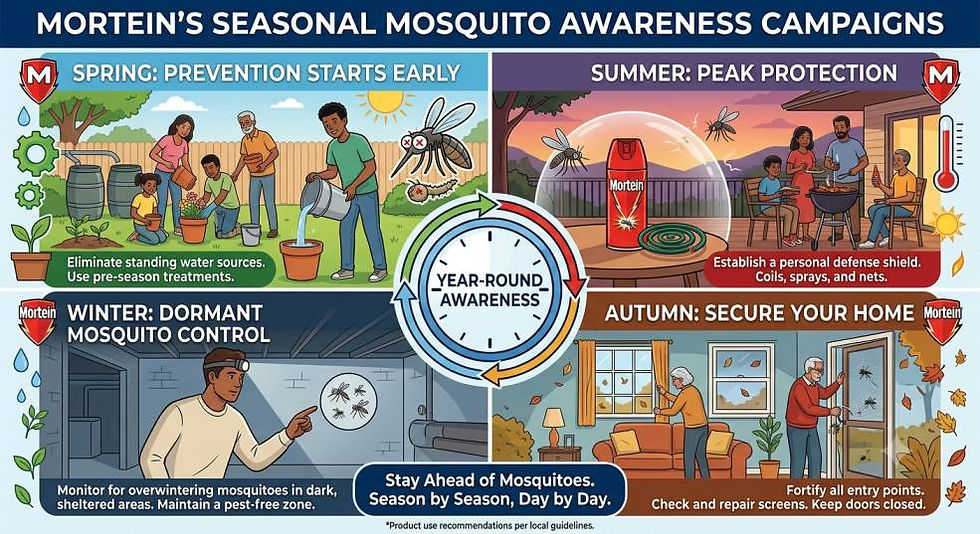
Mortein's Seasonal Mosquito Awareness Campaigns
- 10 hours ago
- 10 min read
Industry & Competitive Context
India's household insecticides category is concentrated among a small number of established players. Godrej Consumer Products Limited (GCPL), through its GoodKnight and HIT brands, has been cited in industry analyses as holding roughly 60% of India's home insecticide market, making it the category leader. Reckitt Benckiser's Mortein and Dabur's Odomos (positioned specifically in the personal repellent/cream segment) are identified as the principal competing brands, alongside S.C. Johnson's All Out and Jyothy Laboratories' Maxo. Estimates of overall category size vary by source and market definition: one industry deck places the Indian "flying insect" repellent market above ₹10,000 crore, while a separate figure tied to GCPL's own disclosures describes a ₹5,057 crore insecticides segment in which GoodKnight and HIT together account for nearly half of sales. At a global level, market-research firms tracking the household insecticides category (Mordor Intelligence, Persistence Market Research, Research and Markets, Euromonitor) describe a market shaped by rising dengue and malaria incidence, regulatory scrutiny of active ingredients, and premiumisation through proprietary molecules. The World Health Organization reported approximately 14.4 million dengue cases globally in 2024, roughly double the prior year, a figure cited by at least one market-research report as a driver of category investment. Competing manufacturers have responded with differentiated actives: GCPL's Renofluthrin (launched July 2024) and Reckitt's own "2-in-1" dual-action mosquito-and-cockroach spray (launched September 2024) are both documented in recent industry reporting as recent innovation moves. Reckitt's own investor disclosures confirm that Mortein sits within a broader corporate category called "Essential Home," which spans air care, surface, pest control and laundry brands. In July 2024, Reckitt publicly announced a strategy to reshape itself around 11 "Powerbrands" in consumer health and hygiene, a category set that does not include Mortein globally. Mortein's inclusion in the subsequent divestment process (detailed in Section 3) is therefore a documented, not inferred, feature of the brand's current corporate context.
Brand Situation Prior to Campaign
Mortein originated as an insecticidal powder manufactured in the 1870s by J. Hagemann, a German immigrant to Australia, and is described by Reckitt's own corporate materials (as reflected on its Wikipedia brand listing, sourced from Reckitt's public brand portfolio pages) as "the Australian insecticide brand Mortein." Publicly available case-study material — including student and industry analyses hosted on platforms such as SlideShare and Scribd — variously places Mortein's India launch in the late 1980s to early 1990s; these sources are not officially corroborated corporate publications, so no precise, verifiable launch date for the Indian market can be confirmed here. Historically, Mortein's brand persona in India has been built around potency and ruggedness rather than the softer, family-protector positioning used by its principal rival. Advertising built around a "7 times more powerful" claim (marketed under the PowerGard sub-brand) and efficacy against both mosquitoes and houseflies has been a recurring feature of the brand's positioning, as documented in academic brand-positioning case studies of the category. This differs from GoodKnight's consumer-research-driven "protection" framing and from All Out's "Mosquito Mortality Rate" (MMR) efficacy metric — both used by competitors, not by Mortein, and referenced here only to establish competitive contrast. More recently, Mortein's communications in India have shifted toward purpose-linked, public-health-oriented storytelling. Officially released campaign material from 2023–2024 — distributed through BusinessWire India and carried by outlets such as ANI, The Print, and Medianews4u — documents a brand actively investing in category-awareness and disease-prevention messaging rather than pure product-efficacy claims, run under Reckitt's "South Asia – Hygiene" regional marketing function led by Saurabh Jain, Regional Marketing Director.
Strategic Objective
Based on the statements accompanying each officially released campaign, Mortein's marketing objectives in this period can be read across three layers, all directly evidenced in company and partner press material:
First, sustained category and disease awareness: campaigns tied to World Malaria Day and the "Mission Zero Malaria" initiative explicitly state an objective of supporting India's national target — publicly referenced in these materials as aligned with Prime Minister Narendra Modi's stated goal — of eliminating malaria by 2030, with a specific geographic focus on Bareilly and Budaun districts in Uttar Pradesh, cited by Reckitt's partnership announcement as accounting for 70% of the state's officially reported malaria cases in 2019.
Second, product-technology credibility: the "Ab Raho Befikar" campaign centres on Mortein's "Mosquito Fight Technology" (MFT), explicitly positioned by Reckitt as delivering "unmatched effectiveness and convenience" for liquid vaporisers, indicating an objective of building trust in a specific technological claim tied to a named product (Mortein Liquid Vaporiser with MFT, 45ml pack, priced at ₹85, per the official release).
Third, brand affinity through social recognition: the #MorteinKiRakshaJyoti campaign states its objective as recognising community workers — security guards and similar caregivers — who are exposed to mosquito-borne disease risk while protecting others, an explicitly stated brand-purpose objective rather than a direct-response or trial-generation goal.
Campaign Architecture & Execution
Several discrete, separately documented campaign properties make up Mortein's recent seasonal and awareness-linked activity in India:
Ab Raho Befikar (2024). Conceptualised by Havas Worldwide India and featuring actress Preity G. Zinta, this campaign centres on the "journey of motherhood" and a new mother's heightened responsibility to protect her child. The creative insight, as stated by Havas Worldwide India's Chief Creative Officer Anupama Ramaswamy, was "the behavior shift that a house undergoes when a family anticipates or welcomes a new baby," leading to the selection of "a new mother" as the campaign's spokesperson archetype. The campaign promotes the Mortein Liquid Vaporiser with Mosquito Fight Technology and included a cash-back offer for consumers who were not satisfied with the product.
#MorteinKiRakshaJyoti (February 2024). Also created by Havas Worldwide India, this ad film — released on YouTube and distributed via BusinessWire India — carries the message "Unki raksha kare jo roz hamari raksha karein" ("protect those who protect us daily"), depicting a mother and her children giving a Mortein liquid vaporiser to their housing society's security guard. Reckitt's release frames this within its "Mortein Ki Raksha Jyoti" initiative and states an intention "to contribute to a Malaria and Dengue-free India."
Mission Zero Malaria (launched April 2023, Bareilly, Uttar Pradesh). Announced via BusinessWire India and reported by The Print, this initiative was launched with Malaria No More as implementation partner and with the support of the Uttar Pradesh state government. The announcement explicitly references World Health Organization data that India accounts for 82.5% of malaria cases in the WHO South-East Asia region, and cites 2019 state data attributing 70% of Uttar Pradesh's reported malaria cases to the Bareilly and Budaun districts. Reckitt's Ravi Bhatnagar (Director – External Affairs and Partnerships, Reckitt South Asia) and Saurabh Jain are quoted as company spokespeople.
World Malaria Day 2024, Bareilly. A continuation of Mission Zero Malaria, this activity involved a public art installation created by artist Dr. Bibhuti Adhikary — a sculpture with three lights that change colour (green, orange, red) according to the pattern of local mosquito infestation, intended as a public early-warning and awareness device. Partners named in the official release include Prayatna and Sesame Workshop India, alongside Reckitt.
Mortein Smart+ launch (March 2023). According to a household-insecticides market report (Research and Markets), Mortein launched "Smart+," a liquid vaporiser claimed to provide extended mosquito protection for up to two hours after being switched off. To demonstrate efficacy, the brand staged a simulated mosquito-attack experiment at a PVR Cinemas theatre, with the screen "protected" using the Smart+ formulation as a demonstration device.
2-in-1 dual-action spray (September 2024). A market-research report (Persistence Market Research) documents this as a Mortein product launch targeting both mosquitoes and cockroaches, part of what the report frames as an industry-wide shift toward multi-pest formulations.
Positioning & Consumer Insight
Two distinct positioning threads are documented in Mortein's public-facing material. The first is legacy and product-centred: potency- and technology-based claims (7x power historically; Mosquito Fight Technology and Smart+ more recently) aimed at differentiating on efficacy. The second, more recent thread is purpose- and empathy-centred: motherhood-driven vigilance (Ab Raho Befikar) and social recognition of vulnerable caregivers (Raksha Jyoti), both explicitly reframing the brand's role from "killing mosquitoes" toward "protecting people who protect others." The stated consumer insight behind Ab Raho Befikar — the behavioural shift a household undergoes when anticipating or welcoming a new baby — is explicitly attributed to Havas Worldwide India's creative leadership in the campaign's own press material, and represents a household-life-stage insight rather than a seasonal-usage insight. It is worth noting, for competitive contextual accuracy, that a comparable and more rigorously disclosed consumer-insight study exists in the category, but it belongs to a competitor, not to Mortein: GCPL's 2015 GoodKnight campaign was explicitly built on a joint GCPL–AC Nielsen study across 16 Indian states, which identified a gap between actual dengue-vector mosquito behaviour (daytime biting) and consumer perception (protection associated mainly with evenings). A related, more recent GCPL-commissioned survey around World Mosquito Day 2025 reportedly found that 81% of Indians believe mosquito-borne illness risk is present year-round, despite usage patterns remaining seasonal. These findings are attributed here specifically to GoodKnight/GCPL and are included only to illustrate the category-level insight environment in which Mortein competes; no equivalent, independently disclosed research study underpinning Mortein's own campaigns was found in the sources reviewed for this case.
Media & Channel Strategy
Based on officially released material, Mortein's channel mix for these campaigns includes: television and OTT-distributed ad films (with YouTube used as a direct distribution and reference channel, as in the Raksha Jyoti film); celebrity-led brand-film content (Preity Zinta for Ab Raho Befikar); on-ground public installations and experiential activations (the Bareilly sculpture; the PVR Cinemas demonstration for Smart+); and public-health partnership channels, in which Reckitt co-brands with NGO and institutional partners (Malaria No More, Prayatna, Sesame Workshop India, and the Uttar Pradesh state government) to extend reach through community and government-linked distribution rather than paid media alone.
Havas Worldwide India is named as the consistent creative agency partner across the Ab Raho Befikar and Raksha Jyoti campaigns, with named personnel including Chief Creative Officer Anupama Ramaswamy, CEO Tarun Jha, and Chief Strategy Officer Anirban Mozumdar; the Raksha Jyoti film's production house is credited as The Film Folks, directed by Pooja Khemani.
Business & Brand Outcomes
This is the area where publicly disclosed, campaign-specific information is most limited. No verified public information is available on sales uplift, market-share change, brand-awareness scores, reach, engagement metrics, or return on investment attributable specifically to Ab Raho Befikar, #MorteinKiRakshaJyoti, Mission Zero Malaria, the Bareilly sculpture activation, Mortein Smart+, or the 2-in-1 spray launch. None of the press releases, market-research reports, or news coverage reviewed for this case disclose such figures. What is verifiably documented, at a corporate rather than campaign level, is Reckitt's broader portfolio context for Mortein. In July 2024, Reckitt announced a strategic reshaping around 11 "Powerbrands," a set that does not include Mortein. In July 2025, Reckitt announced an agreement to divest its "Essential Home" division — which includes Mortein, Air Wick, Calgon, Woolite, Cillit Bang, Resolve, Sole and Easy-Off, along with roughly 75 other brands across more than 70 markets — to private equity firm Advent International, for an enterprise value of up to US$4.8 billion, while retaining a 30% equity stake. Reckitt's own release specifies that under this transaction, "Essential Home will also own the Mortein brand in North America, Europe and LATAM." Reckitt's disclosures further state that Essential Home generated approximately £2.0 billion of net revenue in 2024 (about 14% of Reckitt's total group net revenue) and £490 million of adjusted operating profit for the twelve months ended 31 December 2024, with a 7.0% like-for-like net revenue decline recorded for the division in the first quarter of 2025. As of the transaction announcement, completion was expected by 31 December 2025, though earlier reporting (April 2025, via Dow Jones/ainvest.com) noted Reckitt had flagged that "challenging market conditions" could delay the exit beyond its original 2025 target. These figures describe the entire multi-brand Essential Home division globally and are not attributable to Mortein alone, nor to its India business specifically, nor to the campaigns described in Section 4. Reckitt's divestment announcements are silent on Mortein's ownership or strategic status in South Asia/India; they specify only that the Mortein brand in North America, Europe and LATAM transfers with Essential Home.
Strategic Implications
Several patterns emerge from a strict reading of the documented evidence, useful for classroom discussion of brand strategy under corporate portfolio pressure.
First, there is a visible divergence between corporate portfolio treatment and market-level marketing investment. At the same time that Reckitt's global disclosures place Mortein outside its core "Powerbrand" set and inside a division being sold to private equity, Reckitt's South Asia marketing organisation continued to launch multiple, resource-intensive campaigns in India — including celebrity endorsement, agency-led creative production, NGO partnerships, and public art installations — through 2023 and 2024. This is consistent with (though not proof of) a strategy in which a mature, high-endemic-burden market such as India is treated differently from mature Western markets where the brand is being divested, but the sources reviewed do not confirm or deny this interpretation directly; it is offered here as an observation for discussion, not a documented fact.
Second, the shift in creative territory — from potency-based claims ("7x more powerful") to purpose-led storytelling (motherhood, protecting caregivers, public-health partnership) — mirrors a broader industry pattern in which household-insecticide brands increasingly link commercial messaging to public-health credibility (regulatory approval, NGO partnership, government alignment) rather than efficacy claims alone. Mortein's Mission Zero Malaria and World Malaria Day activity in Bareilly exemplify this: a hyper-local geographic focus tied to specific, cited epidemiological data (WHO regional statistics; UP state case data) lends the campaign a level of evidentiary grounding not present in more generic disease-awareness messaging.
Third, the near-total absence of publicly disclosed outcome metrics for any of these individual campaigns is itself a notable feature of the case. Unlike some competitors' campaigns (e.g., GCPL's GoodKnight campaigns, which are documented as being built on named third-party research such as the AC Nielsen study), Mortein's recent campaigns are documented primarily through press releases describing intent and creative rationale, not through independently verified performance data. This absence should be treated by students as a genuine evidentiary gap rather than as evidence of either success or failure.
Discussion Questions
Reckitt's July 2025 divestment announcement places Mortein's brand rights in North America, Europe, and LATAM within the divested "Essential Home" business, while remaining silent on India. What strategic and operational risks does this ownership ambiguity create for a brand that continues to run large, multi-year public-health campaigns in an emerging market?
Compare Mortein's purpose-led campaigns (Ab Raho Befikar, Raksha Jyoti, Mission Zero Malaria) with the documented, research-driven positioning of a competing brand such as GoodKnight. What are the relative strategic merits of building a campaign on a named third-party study (as GoodKnight did with its GCPL–AC Nielsen research) versus building on an internally stated creative insight (as Mortein's agency did for Ab Raho Befikar)?
Given the complete absence of disclosed sales, market-share, or awareness metrics for any of Mortein's individual India campaigns reviewed in this case, how should a marketing leader justify continued multi-campaign investment to corporate stakeholders, particularly when the parent company is simultaneously divesting the brand in other regions?
Mortein's Mission Zero Malaria initiative targets two specific Uttar Pradesh districts (Bareilly and Budaun) rather than a national campaign. What are the strategic trade-offs of hyper-local, government- and NGO-partnered activation versus a broader national media campaign, from both a public-health-impact and a brand-equity-building perspective?
Reckitt's corporate disclosures categorise Mortein outside its 11 global "Powerbrands," yet the brand continues heavy campaign investment in South Asia. What does this suggest about how multinational FMCG companies may selectively apply global portfolio strategy differently across regional markets with differing category economics (e.g., a high-endemic-disease-burden market like India versus mature Western markets)?

Comments