MTR Foods’ Adaptation of Traditional Indian Meals for Modern Households
Industry & Competitive Context
India’s packaged food industry has been one of the structural growth stories of Indian consumption, driven by rising female workforce participation, urbanization, smaller nuclear households, and a widening gap between the time Indian consumers wish to spend cooking and the time they actually have. According to a Technopak industry report cited in Orkla India’s IPO prospectus, the Indian packaged food industry was estimated at roughly ₹10.18 lakh crore in FY24, having grown at a compound annual rate of about 10.8% since FY19. Within this broader category, the ready-to-cook (RTC) and ready-to-eat (RTE) convenience foods segment has emerged as one of the fastest-expanding sub-segments, as processed substitutes for home-cooked staples idli and dosa batters, breakfast mixes, curry pastes, and instant meals have moved from niche urban shelves into mainstream retail.
The competitive set spans large diversified conglomerates and focused regional specialists. ITC competes through Aashirvaad and ITC Master Chef; Nestlé India and Haldiram’s (through its Minute Khana range) compete in adjacent convenience categories; Gits Food Products and ID Fresh Foods compete directly in ready-to-cook South Indian staples; and Tata Consumer Products has expanded its presence in the broader convenience-food space through acquisitions of Capital Foods and Organic India in FY24. The sector has also seen active consolidation more broadly, including Patanjali’s acquisition of Ruchi Soya in FY20 and ITC’s acquisition of Sunrise Foods in FY21. Within this landscape, MTR Foods now operating as Orkla India Limited has positioned itself as a heritage-anchored specialist in authentic South Indian and broader Indian vegetarian convenience foods, competing less on scale advertising spend and more on claimed culinary authenticity rooted in a century-old restaurant brand.
Brand Situation Prior to the Shift
MTR traces its origins to 1924, when Yagnanarayana Maiya established the Mavalli Tiffin Room restaurant in Bangalore, which became renowned for South Indian vegetarian dishes such as idli, dosa, and rava idli. The brand’s transition from a restaurant to a packaged food manufacturer was not originally a strategic consumer-insight-led decision but a response to regulatory disruption: in 1975, during the national Emergency, the Indian government introduced a Food Control Act mandating that food be sold at very low prices. This made it commercially unviable for the Maiya family to sustain the restaurant’s quality standards, and by 1976 the family pivoted into packaged convenience foods, beginning with ready-to-eat chutneys, rasams, and instant breakfast mixes sold under the MTR name. The company subsequently expanded geographically, entering Tamil Nadu and Andhra Pradesh by 1984, and was incorporated as a public limited company in 1996.
By the mid-2000s, MTR had built a recognisable regional packaged foods business but remained concentrated in South India with limited retail footprint; at the time of its 2007 acquisition it reportedly operated only a single exclusive retail outlet in Bangalore despite decades in the packaged foods business. Private equity investors JPMorgan Partners and Aquarius India Fund held stakes in the company prior to 2007, and in February of that year, Norwegian consumer goods conglomerate Orkla ASA acquired MTR Foods in a deal reported at approximately ₹353–354 crore (around $80–100 million across different contemporaneous reports), with MTR’s annual turnover for fiscal 2006–07 expected at roughly ₹165 crore. This acquisition gave MTR access to a global parent with professional supply-chain capability, category innovation expertise, and international distribution resources the founding family’s standalone business had not been able to deploy at scale.
Strategic Objective
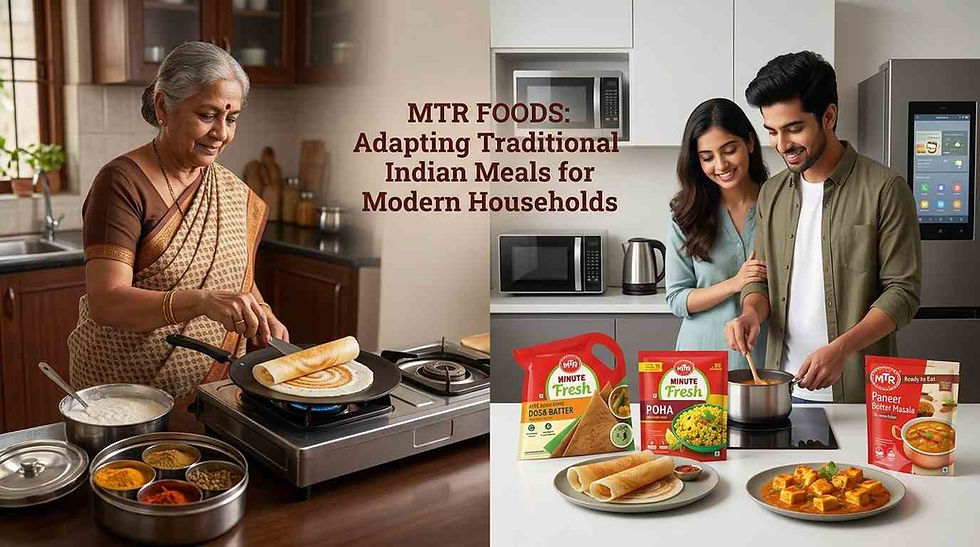
Following the Orkla acquisition, MTR’s broad strategic objective was to convert a regionally trusted, heritage-rooted brand into a nationally and internationally scalable convenience-food business, without diluting the authenticity that differentiated it from larger, more diversified competitors. This required addressing a specific and well-documented consumer tension in Indian households: a persistent preference for traditional, home-style Indian meals particularly breakfast dishes such as poha, upma, idli, and dosa set against the time pressure of modern urban routines that pushed many consumers, especially young working professionals, toward skipping breakfast altogether or substituting it with Western convenience formats such as cereal. MTR’s publicly stated strategy was to position its convenience range not as a compromise on tradition but as the mechanism that made tradition practical again inside a modern schedule.
This objective played out across two mutually reinforcing tracks: continuous product-line extension within the ready-to-cook and ready-to-eat categories (instant mixes, batters, spice blends, ready meals, and sweets), and periodic high-visibility marketing campaigns designed to reframe specific product categories, of which the clearest public example is the 2017 “3 Minute Breakfast” launch.
Campaign Architecture & Execution
In April 2017, MTR Foods launched its “3 Minute Breakfast” range, described in the company’s own press communications as a first-of-its-kind instant Indian breakfast format. The range combined, for the first time, the company’s existing ready-to-cook breakfast mixes with a ready-to-eat format, producing six variants Poha, Khatta Meetha Poha, Vegetable Upma, Magic Masala Upma, Oats Homestyle Masala, and Kesari Halwa each prepared by simply adding hot water and waiting three minutes. Then-CMO Sunay Bhasin publicly described the range as a response to a documented gap: Indian consumers, particularly in time-constrained weekday mornings, wanted a hot, familiar Indian breakfast but frequently skipped the meal or substituted it with less preferred Western alternatives purely because of time pressure. Trade press coverage noted that the product concept had been under development for roughly eight years, reflecting an extended internal process of business planning and consumer research before the April 2017 launch, rather than a rapid reactive rollout.
The launch was supported by a 360-degree marketing campaign built around three television commercials and a digital film created with Ogilvy & Mather, with digital promotions handled by the agency The Social Street, alongside out-of-home advertising and in-store sampling activity. The creative execution depicted a panel of exaggerated “experts” scientists, astrologers, and other specialists investigating a comic premise (framed around why today’s youth are perceived as short-tempered) before arriving at the answer that skipping breakfast due to time pressure was the actual cause, and that MTR’s three-minute range removed that excuse. Reported media spend on the campaign varied across trade publications, with contemporaneous estimates ranging from approximately ₹20 crore to ₹40 crore allocated to promoting the range, with Bhasin noting that a large majority of the category’s annual media budget was concentrated into the first two months following launch to maximise reach.
Distribution execution was equally structured. MTR sharpened its route-to-market approach by identifying leading retail outlets in metro and Tier 1 cities most likely to carry the target consumer profile, and deployed imagery-led point-of-purchase materials, including floor stacking units and end-cap displays, across both modern trade and general trade formats to reinforce the “three minutes” proposition at the shelf. The 2017 breakfast launch sat within a longer pattern of portfolio extension: MTR had introduced the MTR SnackUp range of traditional snacks (such as Khara Boondi and Benne Murukku) in 2011, acquired Rasoi Magic (a ready-to-cook meal-mix specialist) the same year, broadened its ready-to-cook breakfast portfolio in 2013, and launched the Laban brand in 2017 as well, indicating that the “3 Minute Breakfast” launch was one visible moment within a continuous strategy of category extension rather than an isolated campaign.
Positioning & Consumer Insight
The underlying consumer insight MTR articulated publicly was narrow and specific rather than a broad claim about “modernising tradition”: Indian consumers, when given a free choice for instance at a breakfast buffet tend to select Indian dishes over Western alternatives, but on an ordinary weekday morning convenience, not preference, determines what actually gets eaten. The strategic implication MTR drew from this was that the addressable barrier was not taste preference but preparation friction, and that removing friction, rather than reinventing the product, was the correct lever for growth. This is a materially different positioning choice than the one typically used by global cereal or ready-to-eat brands entering India, which generally had to build an unfamiliar taste proposition from the ground up. MTR instead relied on inherited brand permission: its credibility in dosa and idli mixes had been built since the mid-1970s, giving the “3 Minute Breakfast” range an implicit authenticity claim that a new entrant brand could not easily replicate, and allowing MTR to extend into a new, more convenience-intensive occasion without having to construct a new brand narrative from scratch.
This insight also explains why the campaign’s creative execution leaned on humour and social relatability (the “irritable youth” investigation) rather than an appeal to nutrition or health, which was the positioning route competitors such as Gits chose around the same period with its Wholesome Breakfast range of brown rice, oats, and ragi-based idli, dosa, and dhokla variants. MTR’s choice to compete on convenience and tradition rather than health signalling reflects a deliberate segmentation decision: targeting consumers who already valued Indian breakfast but needed permission to choose it under time pressure, rather than consumers seeking a dietary upgrade.
Media & Channel Strategy
Publicly available detail on MTR’s channel strategy is strongest for the 2017 breakfast launch and for the company’s broader retail footprint rather than for digital performance metrics, which the company has not disclosed. The 2017 campaign combined television (three commercials), a digital film, out-of-home advertising, and in-store sampling, executed with Ogilvy & Mather on broadcast creative and The Social Street on digital content — indicating a conventional integrated campaign structure rather than a digital-first or influencer-led strategy, consistent with FMCG category norms of that period. MTR separately disclosed that online sales accounted for only 2–3% of its breakfast business at the time of the 2017 launch, with a stated ambition to grow this to approximately 10% within five years, reflecting that e-commerce was a secondary, developing channel rather than the primary vehicle for the campaign.
At the retail execution level, MTR’s route-to-market approach for the breakfast range involved selectively mapping modern trade and general trade outlets in metro and Tier 1 markets to the profile of the likely three-minute breakfast buyer, rather than pursuing blanket national distribution a targeted approach consistent with a premium convenience positioning rather than a mass-market price play.
Business & Brand Outcomes
Verifiable, company-disclosed outcomes are available primarily at the consolidated financial level rather than as campaign-specific sales or market-share metrics for the 3 Minute Breakfast range in isolation; no verified public information is available on unit sales, revenue contribution, or market share specifically attributable to the 2017 campaign. What is documented is the trajectory of the broader business MTR anchors. Group revenue from operations, reported under the Orkla India entity that now houses MTR, Eastern Condiments, and Rasoi Magic, grew from ₹2,172.48 crore in FY23 to ₹2,356.01 crore in FY24 and ₹2,394.71 crore in FY25, with FY25 net profit reported at approximately ₹255.69 crore. As of March 31, 2025, the company’s portfolio spanned over 400 products across spices, ready-to-cook, and ready-to-eat convenience foods, with average daily sales of approximately 2.3 million units, manufactured across nine facilities with a combined installed capacity of 182,270 tonnes per annum. Per the Technopak industry report cited in the company’s draft IPO prospectus, Orkla India ranked among the top four companies by revenue from operations among comparable leading spices and convenience-food peers in fiscal 2024.
The business’s continued acquisitive expansion is also documented: in 2020, MTR (through Orkla) acquired a 67.8% stake in Kerala-based Eastern Condiments, a spice and condiments company founded in 1983, through the purchase of a 41.8% stake from the Meeran family and the entirety of McCormick’s 26% holding, in a transaction reported at approximately ₹2,000 crore. A subsequent merger of Eastern into MTR left Orkla with a 90.01% stake in the combined entity and the Meeran family with the remaining 9.99%. In 2023, the combined business was renamed Orkla India and restructured into three units — MTR (convenience foods), Eastern (spices and condiments), and an International Business division. This corporate evolution culminated in an initial public offering: Orkla India filed its draft prospectus in June 2025, priced its IPO in a band of ₹695–730 per share in October 2025, raised an issue size of approximately ₹1,667.54 crore (structured as an offer-for-sale benefiting the promoter selling shareholder rather than the company itself), and listed on the NSE and BSE on November 6, 2025, at an implied valuation of roughly ₹10,000 crore. This represents a substantial increase from the company’s scale at the time of Orkla’s original 2007 entry, when MTR was a single-region business with annual revenue in the range of ₹135–165 crore.
Strategic Implications
MTR’s trajectory illustrates a recurring pattern in the adaptation of heritage food brands for modern, convenience-seeking households: incremental, insight-specific product extensions sustained over more than a decade generally outperform any single campaign as the actual engine of brand transformation. The “3 Minute Breakfast” launch is the most visibly documented marketing moment in MTR’s post-Orkla history, but the company’s own disclosures frame it as one extension within a continuous innovation pipeline that also included MTR SnackUp, Rasoi Magic, Laban, and subsequent “Minute Fresh” batter and ready-to-eat sweets ranges, rather than a single turning point. This suggests that for heritage food brands, the more durable strategic asset is not any one campaign’s creative execution but the credibility bank built through decades of category presence, which can be selectively drawn down to authorise entry into new, more convenience-intensive consumption occasions without requiring a new brand story.
The case also illustrates the commercial logic of foreign strategic ownership in culturally rooted consumer categories. Orkla’s acquisition did not involve repositioning MTR as a global or Western brand; instead, Orkla supplied professional supply-chain infrastructure, acquisition capital (used for Rasoi Magic and Eastern Condiments), and governance discipline, while MTR supplied the cultural authenticity and distribution relationships that a foreign entrant could not easily build organically. The eventual public listing of the combined entity, at a valuation many multiples of the business Orkla acquired in 2007, suggests that this division of capabilities local brand equity paired with external capital and operational rigor can be a durable model for scaling regionally rooted food brands nationally, provided the acquirer resists the temptation to dilute the specific cultural credibility that made the brand valuable in the first place.
Finally, the case underlines a limitation relevant to marketing analysis generally: while campaign mechanics (creative strategy, media mix, retail execution) are often well documented in trade press, the causal link between a specific campaign and subsequent financial performance is rarely disclosed by companies at a granular level. Analysts and students examining heritage brand transformations should therefore distinguish carefully between documented strategic intent and execution on one hand, and verified business outcomes on the other, rather than assuming a direct causal chain where public disclosure does not support one.
Discussion Questions
To what extent did MTR’s “3 Minute Breakfast” positioning strategy competing on convenience and inherited authenticity rather than health or nutrition represent a defensible differentiation choice relative to competitors such as Gits, which pursued a health-led positioning in the same period?
How should a heritage brand’s historical credibility (“brand permission”) be weighed as a strategic asset when deciding whether to extend into adjacent consumption occasions, versus building a new sub-brand from scratch?
Given that Orkla supplied capital, governance, and supply-chain infrastructure while MTR supplied cultural authenticity and regional distribution, what general principles can be drawn about the division of capabilities in cross-border acquisitions of culturally rooted consumer brands?
In the absence of publicly disclosed campaign-specific sales data, how should a marketing analyst responsibly assess the effectiveness of a single campaign (such as the 2017 breakfast launch) within a longer multi-decade brand strategy?
What risks does Orkla India’s documented geographic concentration in South Indian markets pose to its growth strategy as a newly listed public company, and how might the company’s historical playbook of incremental category extension translate — or fail to translate into other regional food cultures across India?


Comments