Nazara Technologies’ Mobile Gaming Portfolio Strategy: From Telco Subscriptions to an IP-Led Global Gaming Platform
Industry & Competitive Context
Nazara Technologies describes itself, in its FY25 Directors’ Report, as India’s only publicly listed gaming company, with a portfolio spanning online and offline gaming, eSports, sports media and ad tech. Its position as a listed pure-play in the category was visible at its March 2021 IPO: Business Standard reported that the offer was subscribed roughly 175 times, making it among the most heavily subscribed issues of that year, while analysts quoted by AGBrief noted that the listing had no direct peer comparison in India.
The most consequential industry event in the case window was regulatory. Outlook Business reports that India’s Promotion and Regulation of Online Gaming Act, 2025 was enacted on 22 August 2025 and effectively outlawed real-money online gaming. MediaNama and Storyboard18 report that Nazara responded by recording an impairment against its investment in Moonshine Technologies (operator of PokerBaazi) and by writing down its HalaPlay subsidiary, because those businesses’ revenue-generating activity ceased. The regulatory line the Act draws between real-money gaming and other digital games is the competitive backdrop against which Nazara’s mobile portfolio must now be read.
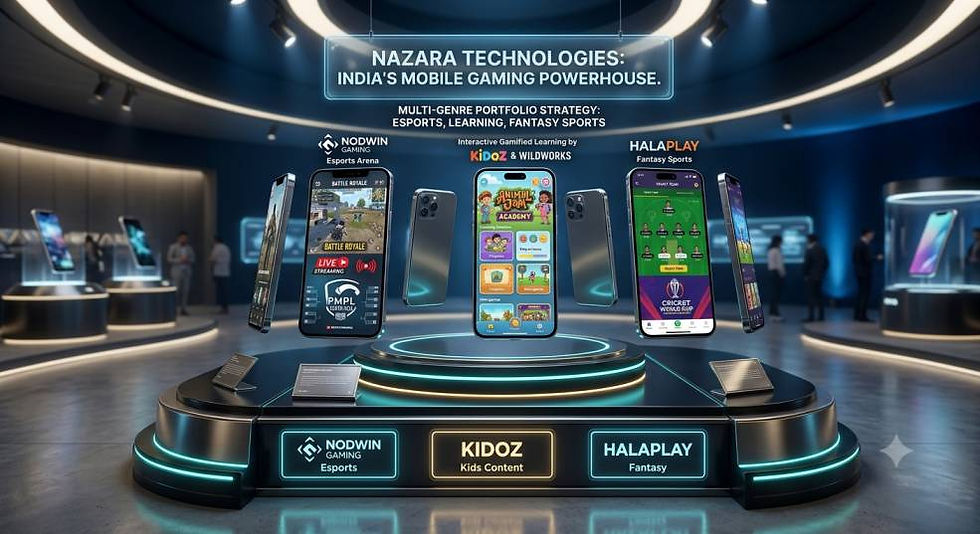
Brand Situation Prior to the Strategic Shift (Portfolio at IPO)
At the time of its IPO, Nazara’s mobile business was oriented toward mass-market users in emerging markets. BloombergQuint, summarising the offer documents, reported that its telco subscription offering comprised over 1,021 Android games aimed at first-time mobile gamers, monetised through daily, weekly or monthly carrier-billing subscriptions arranged with telecom operators. The same report stated that India contributed nearly 41% of FY21 revenue, with North America contributing an equal share, up from 12% a year earlier. Brokerage summaries of the prospectus (Swastika Investmart) list dependence on third parties for distribution and billing among the disclosed risk factors, and describe five business lines: subscription, freemium, eSports, gamified early learning and real-money gaming.
The portfolio already contained assets that would later become central: the company acquired 54.99% of Nodwin Gaming in 2018 to launch its eSports business, and it had invested in Kiddopia’s developer, Paper Boat Apps, in 2019, according to company-linked profiles and press coverage. Titles named in IPO coverage included World Cricket Championship and CarromClash in mobile games, alongside Sportskeeda, Halaplay and Qunami in other segments.
Strategic Objective
Nazara’s stated objective, as expressed by management in acquisition announcements and results releases, is to build a global, IP-led gaming platform with the operating capabilities to scale acquired IP. When Nazara acquired Fusebox Games, CEO Nitish Mittersain described the opportunity as building an IP-based global gaming business anchored in India, where the company could support global studios with user acquisition, data analytics, live operations and an in-house AI playbook. On the Curve Games acquisition, he said the deal would extend Nazara beyond mobile into cross-platform gaming and that Curve could serve as a gateway for Indian game developers.
The FY25 results release referred to a “Nazara 3.0” strategy, which the CEO said had been executed successfully that year. For FY26, the company said it had refocused on its higher-margin core gaming business and was converging toward a globally diversified platform across mobile, PC and console, and offline gaming, with exposure across India, North America and Europe.
Campaign Architecture & Execution: The Portfolio Build
The documented execution is a sequence of acquisitions and ownership changes rather than a conventional advertising campaign. Reading them in order shows three distinct moves.
Move one: ownership of family and children’s IP. In August 2022 Nazara announced the acquisition of 100% of US-based WildWorks, maker of Animal Jam, in an all-cash transaction. Exchange4Media reported that WildWorks’ apps had attracted over 150 million players over the preceding decade, and Mr Mittersain framed the deal as consolidating Nazara’s leadership in gamified learning for children. In mid-2024 Nazara moved to 100% ownership of Paper Boat Apps, developer of Kiddopia. The company’s investor presentation filed with the BSE set out plans to license and integrate globally popular children’s IPs into Kiddopia, to grow the app beyond the United States, and to develop a differentiated India approach.
Move two: licensed-IP mobile publishing in developed markets. In 2024 Nazara acquired 100% of UK-based Fusebox Games for ₹228 crore (US$27.2 million) in an all-cash deal. BW Marketing World reported that Fusebox publishes the interactive story game Love Island, targets developed markets including the US, UK, Australia and Canada, and reported ₹87.5 crore revenue in 2023, with in-app purchases accounting for 92% of revenue in July 2024.
Move three: expansion beyond mobile. Nazara acquired 100% of UK publisher Curve Digital Entertainment (Curve Games) for ₹247 crore (GBP 21.7 million), as announced in a company release carried by CXO Today. Entrepreneur India reported that Curve’s portfolio had more than 100 million downloads. Storyboard18 reported that the company also received NCLT approval to acquire Smaaash, extending the portfolio into offline gaming.
Alongside these moves, Nazara disclosed a minority real-money position: a 46.07% non-controlling stake in Moonshine Technologies, which, per the company’s 20 August 2025 disclosure as summarised by Ticker (Finology), was an associate whose revenue was not consolidated. After the 2025 Act, Nazara terminated a planned ₹15.9 crore top-up purchase in Moonshine, citing a material adverse effect (Outlook Business; Outlook Respawn). In Q2 FY26 the company also reported that its stake in Nodwin Gaming had fallen below 50%, resulting in its deconsolidation (PTI via The Week).
On operating mechanics, the company has publicly said that every gaming IP it owns plugs into a common operating system (Equity Bulls, summarising the FY26 results release), and MediaNama reported plans for a unified identity and data platform linking users across its games.
Positioning & Consumer Insight
Nazara’s public positioning has shifted with its portfolio. At IPO, the proposition was access to mass-market, first-time mobile gamers in emerging markets through telecom billing. The post-2022 portfolio is positioned around owned or licensed intellectual property in segments with identifiable audiences: safe social play and learning for children (the WildWorks CEO described Animal Jam’s approach to safe social gameplay in the acquisition coverage), gamified early learning for parents and young children (Kiddopia), and licensed television-property story games for adult players in developed markets (Fusebox). At the corporate level, the CEO’s own descriptor in FY26 is an “IP-led, global gaming platform.”
The strategic reading is that Nazara moved from a distribution-dependent model, where the telecom operator controlled access to the customer, toward a model in which it owns the content and the player relationship, with IP as the common asset. That reading is an interpretation of the documented sequence; Nazara has not published it as such.
Media & Channel Strategy
Public disclosure here is limited to one line item. Storyboard18, analysing company filings, reported that Nazara’s consolidated advertising and business promotion spending was ₹39.56 crore in Q2 FY25 and ₹145.36 crore in Q3 FY25, a 253.5% year-on-year increase, and reported a figure of ₹151 crore for Q4 FY25. In the Q4 coverage, the company attributed growth to momentum in Fusebox and Animal Jam and improved unit economics in Kiddopia. These are consolidated totals for the period, when Nazara still consolidated Nodwin, so they cannot be read as mobile-only marketing spend.
Business & Brand Outcomes
Financial outcomes are the best-documented element. For FY25, Storyboard18 reported record annual EBITDA of ₹153.5 crore, a 19.9% EBITDA margin in the core gaming business and 9.4% overall. For FY26, Nazara reported audited consolidated revenue of ₹1,829 crore (up 13% from ₹1,623.9 crore), EBITDA of ₹255 crore (up 66%), and pre-tax operating cash flow of ₹213 crore, up 81%. Gaming’s share of EBITDA rose from 56% to 90%, according to the company’s results release and investor presentation.
Within gaming, the company’s earnings call and Inc42’s reporting give the following FY26 detail: total gaming revenue of ₹1,072 crore, up 107%, with a 24.7% EBITDA margin; mobile gaming revenue of ₹713 crore (up 38%) and EBITDA of ₹137 crore (up 33%); PC and console publishing revenue of ₹261 crore and EBITDA of ₹101 crore; and offline gaming revenue of ₹99 crore and EBITDA of ₹27 crore. Animal Jam reported FY26 revenue of ₹108 crore, up 3%, with EBITDA up 23% to ₹27 crore, and Kiddopia’s revenue rose 8% year on year in Q4 FY26, which Inc42 described as a return to growth.
The outcomes were not uniformly positive. Q4 FY26 revenue of ₹397.8 crore was about 24% lower year on year, which the company attributed to the deconsolidation of Nodwin from August 2025; adjusted for that, Inc42 reported 8% growth. The company recognised an impairment of ₹914.7 crore on its Moonshine investment, reducing its carrying value to ₹96.53 crore as of 30 September 2025, and Nazara reported a consolidated loss for Q2 FY26 (PTI reported ₹33.9 crore; other outlets cite a slightly different figure). Storyboard18 also reported pending GST show-cause notices relating to Halaplay and Moonshine-linked entities, with aggregate demands reported above ₹1.19 lakh crore.
Strategic Implications
The following are analytical readings of the documented record, not company statements.
Acquisition as the primary route to owned IP. The documented sequence (WildWorks, Paper Boat Apps, Fusebox, Curve) shows Nazara acquiring established IP and audiences rather than building titles from scratch. The company’s stated value-add is operational: user acquisition, analytics, live operations and AI tooling. Whether that operating layer lifts the acquired assets is only partly visible in public data; Animal Jam’s modest FY26 revenue growth alongside faster EBITDA growth is one disclosed data point.
Geographic migration of the portfolio. The telco-subscription core was oriented to emerging markets, while Fusebox and Curve are UK-based and oriented to developed-market audiences. The company itself describes its exposure as spanning India, North America and Europe. India functions in the company’s stated model as an operating base more than as the principal revenue market, although a market-by-market revenue split is not verified here.
Associate exposure and regulatory concentration. Because Moonshine was a non-consolidated associate, Nazara’s reported revenue and EBITDA were insulated from the 2025 Act, as the company noted in its 20 August 2025 disclosure, but its balance sheet was not: the ₹914.7 crore impairment shows that minority stakes in a single-regulation business carry capital risk even when operating results look unaffected. The case also illustrates a portfolio-governance question: how much capital should a diversified portfolio place in a segment whose legal status is outside management’s control?
Portfolio mix shift. The rise of gaming from 56% to 90% of EBITDA between FY25 and FY26 reflects both the growth of gaming and the changed composition of the group, including Nodwin’s deconsolidation and the end of real-money activity. Readers should treat the improvement as the product of both effects rather than of operating performance alone.
Discussion Questions
Nazara’s mobile business began with carrier-billed subscriptions and moved toward owned and licensed IP. What strategic risks does reliance on a distribution partner create, and which of the documented acquisitions best addresses them?
Management states that it can improve acquired studios through user acquisition, analytics, live operations and AI tooling. What evidence from the disclosed segment results would you want to see to test that claim, and what is missing from the public record?
Nazara’s revenue and EBITDA were insulated from the 2025 online gaming law because Moonshine was a non-consolidated associate, yet the balance sheet absorbed a ₹914.7 crore impairment. How should a diversified portfolio account for regulatory concentration in minority holdings?
Gaming’s share of EBITDA rose from 56% to 90% in one year, partly due to portfolio changes. How should an analyst separate operating improvement from composition effects when evaluating this strategy?
Fusebox and Curve are UK-based businesses serving developed-market audiences, while Nazara operates from India. What does this suggest about how Nazara defines its competitive advantage, and what additional information would you need to evaluate it?


Comments